
A shorter lease term isn’t automatically the simpler choice. A 12-month commitment can fit a defined equipment need, but it won’t suit every business or operating plan. With 12-month equipment lease plans, you’re choosing a one-year lease term, not deciding by term alone what happens to the equipment at the end.
Lease duration and buyout structure are separate parts of the agreement. Executech Lease Group (ELG) offers 12, 24, 36, 48, and 60-month terms for payment-processing equipment, including POS systems, card terminals, and ATMs. Its options include FMV leases, with a buyout of about 10% of original equipment cost, and lease-to-own, which ends with a $1 buyout. ELG requires no money down, but ongoing lease obligations still apply.
This guide explains how a 12-month term compares with longer choices, how to weigh the expected use of your equipment, and what to review in the contract before moving forward. You’ll also see why the end-of-lease option deserves separate attention, so you can compare structures without assuming one is right for every business.
Key Takeaways
- Evaluate 12-month equipment lease plans against how long you expect to use the equipment, not just a preference for a shorter commitment.
- Compare the lease term and end-of-lease structure as separate contract decisions.
- Review the equipment, recurring obligations, and contract details before choosing a plan.
- Any equipment warranty comes from the manufacturer, not the equipment lease brokerage.
What 12-Month Equipment Lease Plans Cover for Payment Technology
A 12-month equipment lease plan sets a one-year term for leasing payment-processing equipment. The equipment identifies what’s being leased, the term sets how long the lease runs, and the lease structure defines the financial arrangement, including the end-of-lease buyout. Keeping those elements separate helps you assess the agreement without treating “12 months” as a complete description.
For merchants, the equipment supports payment operations at the point of sale or provides cash access. The right category depends on what your business needs, not simply on the length of the lease. Equipment lease programs can differ in structure as well as term, so compare those elements independently.
Which payment-processing equipment can a lease cover?
ELG’s equipment focus includes POS systems, credit-card terminals, and ATMs. A POS system supports point-of-sale activity, a payment terminal is used to accept card transactions, and an ATM provides cash access. These are distinct equipment needs within merchant-services and payment-processing operations. The lease description should identify the equipment covered rather than relying on a general label such as “payment technology.”
For example, if you’re reviewing a POS system lease, identify the POS equipment in the agreement. If you’re considering a terminal or ATM, make sure the agreement describes that equipment clearly too. Don’t assume the lease term alone establishes compatibility with a particular brand, model, processor, or integration. Equipment compatibility and lease terms are separate details to understand.
What does “12-month term” tell you, and what doesn’t it tell you?
The term tells you the lease duration: 12 months. It doesn’t, by itself, explain recurring obligations, other contract conditions, or what happens at the end. Those details depend on the lease structure and the written agreement. A 12-month term is one decision within the arrangement, not a shortcut for understanding the full commitment.
In brief: A 12-month equipment lease plan covers specified payment-processing equipment for a one-year lease term, while the lease structure sets out the financial arrangement and end-of-lease buyout.
Separate the questions as you review the arrangement:
- Equipment: Is the agreement for a POS system, card terminal, or ATM?
- Duration: Does a 12-month term align with the period you expect to use the equipment?
- Obligations: What recurring payments and other responsibilities does the contract set out?
- Structure: What does the agreement specify for the end of the term?
A shorter term doesn’t automatically mean a lower cost or a better fit. Match the duration to your expected equipment use, then review the lease structure and contract details separately. That gives you a clearer basis for comparing 12-month equipment lease plans with other available terms.
How ELG’s Equipment Lease Terms and Structures Differ
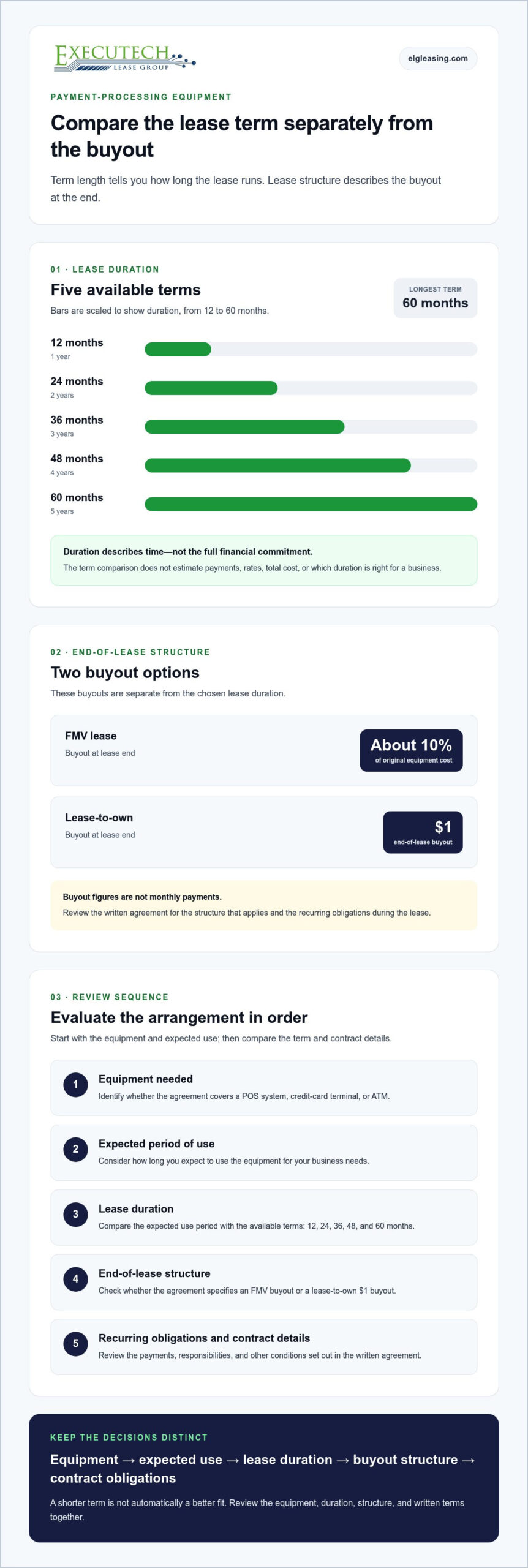
ELG offers equipment lease terms of 12, 24, 36, 48, and 60 months for payment-processing equipment. Each term represents a different lease duration. The term is only one part of the arrangement; the lease structure sets out the buyout at the end.
Term length tells you how long the lease runs; the lease structure tells you the end-of-lease buyout option. Keep those decisions distinct as you compare 12-month equipment lease plans with longer terms. For broader industry context, the Equipment Leasing & Finance Association provides information about the equipment finance industry.
How does the 12-month option compare with longer terms?
The table compares duration only. It doesn’t estimate payments, rates, total cost, or which term is right for your business. Consider how long you expect to use the equipment and whether that period aligns with the lease duration. A shorter term isn’t automatically a better fit, just as a longer term isn’t right for every operation.
| Lease term | What the duration indicates |
|---|---|
| 12 months | A one-year lease duration |
| 24 months | A two-year lease duration |
| 36 months | A three-year lease duration |
| 48 months | A four-year lease duration |
| 60 months | A five-year lease duration |
Use the list as a starting point, not a ranking. For example, if you’re considering a POS system for a defined business need, compare the expected period of use with each available duration. Don’t infer a cost advantage from the number of months alone. You’ll need to review the agreement’s payment terms and other details to assess the financial commitment.
How do FMV and lease-to-own buyouts differ?
ELG offers two lease structures with different end-of-lease buyouts. An FMV lease ends with a buyout of about 10% of the original equipment cost. A lease-to-own option ends with a $1 buyout. These figures describe the respective buyout options at lease end, not monthly payments.
Neither structure should be confused with the term itself. A 12-month lease is distinguished from a longer term by duration, while FMV and lease-to-own describe different buyout arrangements. Review the contract to understand which structure applies and what recurring obligations continue during the term. Don’t assume a particular structure includes end-of-term rights or conditions that aren’t stated in the agreement.
Once you’ve considered the equipment, expected use, term, and buyout structure, you can begin an equipment lease inquiry with those choices in mind.
How to Evaluate a 12-Month Equipment Lease Plan
Make the decision in sequence. Start with the equipment your operation needs, then assess how long you expect to use it. After that, compare the lease term, structure, and contract details. This helps separate a genuine operational need from a simple preference for a shorter commitment.
- Define the equipment need. Identify whether you’re considering a POS system, card terminal, or ATM. Note the role it serves in your payment operations and why the business needs it.
- Estimate the expected use period. Consider how long the equipment is expected to serve that role. Base this on your operating plans, not an assumption that you can change or exit the arrangement early.
- Compare the term with that period. Assess whether a 12-month term aligns with your expected use, then weigh it against the other available durations. A shorter commitment isn’t automatically the right fit.
- Identify the lease structure. Distinguish the selected structure from the term. The structure determines the end-of-lease buyout option, so make sure you understand which arrangement the agreement describes.
- Review the contract details. Read the recurring payment obligations and end-of-term language. Make sure the written terms match your understanding of the selected equipment, duration, and structure.
Match the term to the equipment’s expected use
Think about the job the equipment must do and how long your business expects to rely on it. A POS system supporting an ongoing operation may have a different expected use period from a terminal required for a defined business need. The key question is whether the term fits your operational plan, not whether a shorter commitment simply feels more appealing.
For a wider view of the ownership decision, compare this term-focused review with the related discussion, “Leasing vs. Buying POS Systems.” The questions are connected but distinct: whether to lease or buy, and which lease duration and structure to consider.
Review the lease obligations and end-of-term language
Read the payment schedule and other recurring obligations alongside the selected lease structure. At the end of the term, an FMV option has a buyout of about 10% of original equipment cost; a lease-to-own option has a $1 buyout. These are end-of-lease buyout figures, not monthly payments. Focus on the terms stated in your agreement rather than assuming additional end-of-term options.
Keep your review practical. Can you identify the equipment, lease duration, ongoing obligations, and applicable buyout structure from the contract? If those details are clear and align with your operating need, you’ll have a more grounded basis for evaluating 12-month equipment lease plans.
What to Clarify Before Choosing a 12-Month Equipment Lease
Before you commit, make the key terms easy to identify. A practical review covers the equipment, lease duration, selected structure, recurring obligations, and responsibility for warranty coverage. This keeps the discussion focused on what the agreement actually says, rather than assumptions about what a short term or a no-money-down arrangement includes.
- Equipment: Identify the POS system, card terminal, or ATM covered by the agreement.
- Term: Confirm that the lease duration is 12 months.
- Structure: Identify whether the agreement uses an FMV or lease-to-own structure.
- Ongoing obligations: Review recurring payments and the other commitments stated in the contract.
- Warranty source: Confirm that any equipment warranty comes from the manufacturer.
What does no-money-down mean in practice?
ELG offers no-money-down equipment leasing. That means there’s no down-payment requirement; it doesn’t mean the equipment is free or that there are no ongoing lease obligations. Review the agreement’s payment terms and other stated financial responsibilities so you understand what you’re committing to throughout the lease.
Which responsibilities sit outside ELG’s equipment lease role?
ELG leases payment-processing equipment; it doesn’t process payments or provide merchant accounts. Any equipment warranty comes only from the manufacturer. Keep those roles distinct as you assess the overall arrangement, including who provides services beyond the equipment lease itself.
For broader context on the equipment category and leasing considerations, the POS equipment leasing information can help frame your review. Keep your questions specific to the contract in front of you:
- Does the equipment description match the payment technology you intend to lease?
- Does the stated duration match the term you’re considering?
- Which lease structure and end-of-lease buyout apply?
- What recurring obligations does the agreement state?
- Where does any equipment warranty coverage come from?
Our goal is to deliver credit decisions in under 2 business hours. That goal applies to the credit-decision stage only, not to funding, delivery, or deployment. Keep that distinction clear when planning next steps, and rely on the contract for the details of the lease obligations and equipment arrangement.
A careful review helps you assess 12-month equipment lease plans on their actual terms. Read each item in context, and make sure the equipment, duration, structure, and ongoing commitments align with your business’s needs.
How to Explore a 12-Month Equipment Lease Plan with ELG
ELG is an equipment lease brokerage serving the merchant-services and payments-technology ecosystem. Its equipment leasing focuses on POS systems, credit-card terminals, and ATMs. ELG offers terms of 12, 24, 36, 48, and 60 months, with FMV and lease-to-own structures. These are choices to compare, not a recommendation that one term or structure suits every business.
As you consider 12-month equipment lease plans, start with the equipment’s role and expected use period. Then compare the term with the end-of-lease structure. ELG’s leasing program comparison can help you review available lease structures alongside duration. Keep the questions separate: how long is the term, and what buyout structure does the lease specify?
What ELG does, and what it does not do
ELG’s role is equipment leasing for payment technology. It doesn’t process transactions or provide merchant accounts. Those remain separate from an equipment lease. ELG also doesn’t provide warranties, maintenance, repairs, replacements, installation, or equipment deployment. Any warranty coverage comes only from the equipment manufacturer.
This distinction helps set clear expectations. An equipment lease concerns the equipment arrangement and its contractual obligations. It doesn’t determine payment processing, merchant-account terms, or services another business may provide. Review the lease and the separate arrangements relevant to your operations on their own terms.
What happens after an inquiry?
The form is a vendor or ISO inquiry, not a financing application and not a route to an immediate credit decision. It’s a starting point for vendor or ISO readers exploring ELG’s equipment leasing role. Keep the inquiry focused on the payment technology and lease options under consideration.
If a credit decision is part of the process, our goal is to deliver credit decisions in under 2 business hours. That goal applies only to the credit decision. It doesn’t establish when funding, equipment delivery, or deployment will occur, and it doesn’t promise a particular outcome.
Before submitting an inquiry, have a clear picture of the equipment, the term you’re considering, and whether you want to explore FMV or lease-to-own. You can then discuss the relevant leasing arrangement with those priorities in mind, without treating an inquiry as an approval or funding commitment.
Move Forward with a Clear Equipment Plan
Before taking the next step, put the business reason for the equipment decision into a few clear points. Note the operational need, the role the equipment will serve, and the priorities your team wants the arrangement to support. This gives everyone involved a shared reference when discussing 12-month equipment lease plans and keeps the conversation grounded in your business needs.
A considered decision doesn’t need to be complicated. Focus on what your operation requires, then use that as the basis for moving forward. Clear priorities make it easier to have a useful leasing conversation.
With a clear plan in hand, you can take the next step with confidence.
Frequently Asked Questions
Are 12-month equipment lease plans available through ELG?
Yes. ELG offers a 12-month equipment lease option for payment-processing equipment. If you’re comparing 12-month equipment lease plans, consider the equipment’s expected role and how long you anticipate needing it, then review the agreement’s structure and obligations. The 12-month choice is one available term, not a recommendation for every business. POS systems, card terminals, and ATMs are relevant equipment categories.
Does no-money-down mean the equipment is free?
No. No-money-down means there’s no down-payment requirement; it doesn’t mean the equipment is free or that the lease has no ongoing obligations. For example, a business considering a card terminal should still review the recurring payment terms and other financial responsibilities stated in the agreement. Don’t treat the absence of a down payment as an indication that no payments or other obligations apply.
How fast does ELG make a credit decision?
Our goal is to deliver credit decisions in under 2 business hours. That goal applies to the credit-decision stage only. It doesn’t set a timeline for funding, delivery, or equipment deployment. Keep those steps separate when planning your operations; a credit decision by itself doesn’t establish when equipment will be available for use or guarantee a particular outcome.
How do ELG’s FMV and lease-to-own buyouts differ?
An ELG FMV equipment lease ends with a buyout of about 10% of original equipment cost. The lease-to-own option ends with a $1 buyout. These are different end-of-lease structures, not monthly payment amounts. When reviewing an agreement, identify which structure applies to your equipment and read the relevant end-of-term language rather than assuming the options are interchangeable.
Does ELG process payments when it leases a payment terminal?
No. ELG leases payment-processing equipment, but it doesn’t process transactions. A merchant’s payment processing is a separate relationship from the equipment lease. For instance, leasing a card terminal through ELG doesn’t mean ELG supplies a merchant account or determines transaction pricing. Keep the equipment agreement and payment-processing arrangements distinct as you plan how the terminal will be used.
Does ELG provide a warranty or repairs for leased equipment?
No. ELG doesn’t provide equipment warranties, maintenance, repairs, or replacements. Any warranty coverage comes only from the equipment manufacturer. If you’re assessing a POS system, terminal, or ATM, review the manufacturer’s warranty information separately from the lease agreement. The equipment lease itself shouldn’t be treated as warranty coverage or a promise of repair or replacement service.

Article by
Robert Ensminger
Robert Ensminger is the founder and CEO of Executech Lease Group (ELG Leasing), which specializes in equipment leasing and financing solutions for the merchant-services, payments, POS, and FinTech industries. Robert helps ISOs, payment processors, POS providers, and software companies build practical equipment leasing programs. He founded ELG in 2010. His work focuses on responsive service, transparent program structures, SaaS-monetization programs, and helping ELG’s partners close more business while creating sustainable revenue.