
The number of months doesn’t tell you what happens when a lease ends. With 48-month equipment leasing terms, the key distinction is the lease structure and its end-of-term buyout, not just the length of the agreement.
It’s understandable to focus first on the monthly payment or whether money is due upfront. But a fair market value (FMV) lease and a lease-to-own agreement can have different end-of-term buyouts. No money down doesn’t mean the equipment is free or that you have no payment obligation.
This guide explains what a 48-month term means, how FMV and lease-to-own options compare, and which details to review in a proposal. Executech Lease Group (ELG) offers both structures, with an FMV option ending with about a 10% buyout and a lease-to-own option ending with a $1 buyout. Those options aren’t interchangeable. Compare the stated term, payment details, and buyout language to understand the full arrangement, not just its duration.
Key Takeaways
- A 48-month term describes the lease duration, not the total cost. Compare the exact term and equipment description in the proposal.
- ELG’s FMV and lease-to-own programs offer several term choices, including 48 months, with different lease-end buyouts.
- Assess whether the lease duration aligns with how long you plan to use the POS or payment equipment.
- Review the lease type and payment obligations alongside the equipment details before comparing proposals.
- No money down describes the upfront payment requirement. It doesn’t mean the equipment is free or remove the agreement’s financial obligations.
What 48-Month Equipment Leasing Terms Mean for POS and Payment Equipment
A 48-month lease term is four years. It tells you how long the agreement runs, not the equipment’s total cost or what you’ll pay across the full term. ELG offers 12, 24, 36, 48, and 60-month choices for both its FMV and lease-to-own options.
The term tells you how long the agreement runs; the lease-end structure tells you what buyout applies when it ends. Keep those details separate when reviewing an offer. The applicable agreement sets out payment obligations and other financial terms. The duration alone doesn’t tell you the payment amount, interest rate, or total cost.
Which payment equipment can a 48-month lease cover?
POS means point-of-sale. POS equipment can include systems used to support sales transactions, as well as credit-card or bank-card terminals. ELG’s equipment categories also include ATMs and Clover equipment. Check the equipment description in the agreement: it identifies what the lease covers, while the 48-month term identifies its duration.
What does the 48-month duration tell you?
It describes a four-year period under the agreement. It doesn’t, by itself, establish whether you own the equipment during that time or at the end. Ownership and lease-end options depend on the lease structure and agreement terms. Read them together to understand how the agreement applies to the equipment.
To compare options, read the duration alongside the lease type, payment terms, and stated lease-end buyout. A 48-month term can appear in different structures, so two proposals with the same duration may have different financial obligations and endings. For broader context on equipment categories and leasing, explore ELG’s POS equipment leasing programs.
48-Month FMV vs. Lease-to-Own Terms: Understand the Lease-End Difference
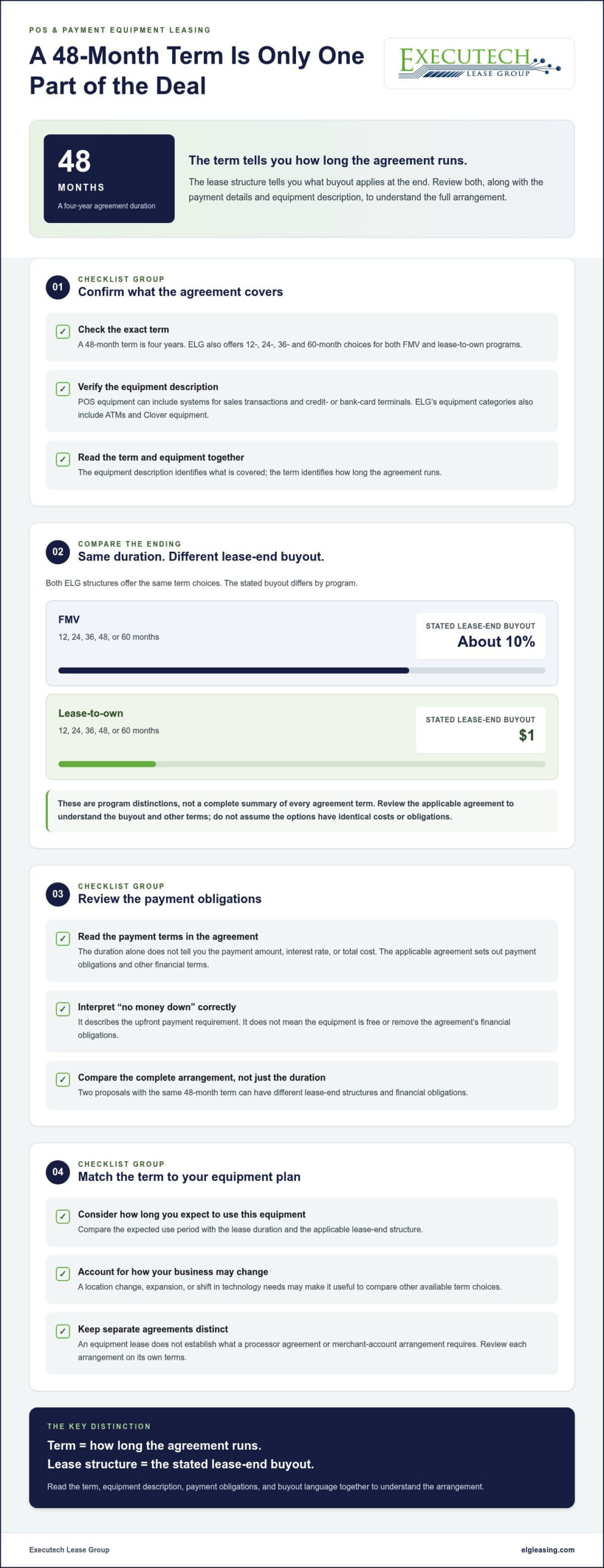
A 48-month term doesn’t determine what happens when a lease ends. The lease structure does. ELG offers FMV and lease-to-own programs in 12, 24, 36, 48, and 60-month terms, but the stated buyout differs by program.
| Lease structure | Term choices and stated buyout |
|---|---|
| FMV | 12, 24, 36, 48, or 60 months; ends with about a 10% buyout. |
| Lease-to-own | 12, 24, 36, 48, or 60 months; ends with a $1 buyout. |
These are program distinctions, not a complete summary of every agreement term. The Small Business Administration guidance offers broader context on buying and leasing business equipment. For your comparison, focus on the lease type and the ending stated in the applicable agreement, not just the number of months.
How does the 48-month FMV option end?
ELG’s FMV option ends with about a 10% buyout. That figure distinguishes the FMV structure, but it doesn’t explain how the percentage is calculated. Review the buyout and other applicable terms stated in the agreement to understand the specific arrangement.
How does the 48-month lease-to-own option end?
ELG’s lease-to-own program ends with a $1 buyout. This applies to lease-to-own, not to every ELG lease. Compared with the FMV option’s approximate 10% buyout, it’s a different stated lease-end structure. Read the applicable agreement to understand its terms; don’t assume the two options have identical costs or obligations.
That distinction matters even when both proposals specify 48-month equipment leasing terms. The duration can match while the lease-end buyout differs. For a deeper look at the structure, read about POS leasing programs. Vendors and partners can also use ELG’s vendor inquiry page to start an inquiry.
Is a 48-Month Equipment Lease the Right Fit for Your Business?
A four-year term may fit one equipment plan and conflict with another. There’s no universal answer. Compare the proposed lease duration with how long you expect to use the equipment, how your business may change, and what the agreement requires over the full term. The right fit depends on your operational plans, not simply on whether a 48-month option is available.
Think beyond today’s setup. If you expect to use your current point-of-sale equipment through a defined multi-year period, consider whether a four-year arrangement aligns with that plan. If you anticipate a location change, expansion, or a shift in technology needs, compare the other term choices before committing.
When might a 48-month term align with your equipment plan?
Start with the expected use period. If you plan to rely on the equipment for several years, compare that timeline with the lease duration and the applicable lease-end structure. This helps you judge whether the agreement’s length matches your operational horizon, without assuming it will produce savings or a particular outcome.
Keep equipment leasing separate from processor agreements or merchant-account obligations. A lease covers the equipment arrangement; it doesn’t establish what another agreement requires or how those obligations may change. Review each arrangement on its own terms.
ELG offers no-money-down equipment leasing. No money down changes the upfront payment requirement; it doesn’t mean the equipment is free or remove the financial obligations set out in the agreement.
When should you compare a different term choice?
ELG’s FMV and lease-to-own programs offer 12, 24, 36, 48, and 60-month choices. Compare them with your expected equipment use and business plans. A shorter term may align more closely with a shorter planned use period; a longer one may better match a longer equipment plan. Neither is automatically the right choice.
- Equipment horizon: How long do you expect this specific equipment to serve your operation?
- Business plans: Could growth or changing payment technology needs affect the setup before the term ends?
- Agreement details: Does the stated duration work with the payment obligations and lease-end structure in the proposal?
Use these questions to compare 48-month equipment leasing terms with other durations, rather than treating four years as a default. ELG’s leasing programs overview provides context on its equipment lease options.
How to Evaluate a 48-Month Equipment Lease Proposal
A clear proposal lets you compare what the lease covers, how long it runs, and what financial obligations it includes. Review each element separately. The equipment description, selected term, lease type, recurring payments, and buyout all matter, but they answer different questions.
What should the proposal make clear?
Use these five steps to organize your review:
- Equipment: Compare the proposal’s equipment description with the POS system, terminal, or other payment equipment you expect the lease to cover.
- Duration: Check that the selected term is stated as 48 months. Don’t rely on a general discussion of term options.
- Lease type: Identify whether the proposal names an FMV or lease-to-own program. Then compare the stated buyout: ELG’s FMV option ends with about a 10% buyout, while its lease-to-own option ends with a $1 buyout.
- Payment obligations: Review recurring payment terms separately from the buyout. The buyout describes a lease-end distinction; it doesn’t replace the payment obligations in the agreement.
- Process: Understand what each process stage represents. ELG’s leasing process overview provides context for how the process moves forward.
Keep the proposal in view as you compare 48-month equipment leasing terms. A matching duration doesn’t mean two lease structures have the same buyout or financial obligations. The agreement’s stated terms make the comparison specific.
What does ELG’s decision timing mean?
ELG provides credit decisions in 1-2 business hours. That timing refers to the decision only. It doesn’t state when funding or equipment delivery will occur.
A credit decision is a decision-stage update, not a promise of funding or equipment delivery timing. Keep those milestones distinct as you review the process and plan for the equipment. The Apply Now page is a vendor inquiry route, not a financing application or credit-decision route.
How ELG Offers 48-Month Equipment Leasing Terms
ELG is a U.S. equipment lease brokerage serving the merchant-services and payment-technology ecosystem. Its equipment leasing options include point-of-sale (POS) systems and credit-card terminals. ELG focuses on the equipment lease arrangement. It does not process payments or provide merchant accounts, and a lease does not replace separate agreements with payment providers.
ELG offers no-money-down equipment leasing. That describes the upfront payment requirement, not the total financial obligation. The equipment isn’t free, and the agreement’s payment terms still apply.
Which ELG equipment lease structures include a 48-month option?
Both FMV and lease-to-own programs offer the following term choices:
- FMV: 12, 24, 36, 48, and 60 months, with about a 10% buyout at the end of the term.
- Lease-to-own: 12, 24, 36, 48, and 60 months, with a $1 buyout at the end of the term.
The buyout descriptions are distinct. The approximately 10% buyout applies to the FMV option, while the $1 buyout applies to lease-to-own. Review the agreement for the selected program and term. ELG’s leasing programs page provides an overview of its equipment lease options.
How can merchants and payment partners proceed?
Merchants typically evaluate equipment proposals through their independent sales organization (ISO), agent, or vendor relationship. Compare the equipment description, selected term, lease structure, payment obligations, and stated buyout in the proposal. This keeps the equipment lease clear and separate from any payment-processing or merchant-account arrangements.
For vendors and payment partners, ELG’s Apply Now page is a vendor inquiry, not a financing application or a route to a credit decision. Use it to Discuss becoming an ELG vendor.
Compare the Full Lease Before You Decide
The right equipment lease depends on how long you plan to use the equipment and which lease structure fits your business plans. A 48-month term describes the duration, while the FMV or lease-to-own option determines the stated buyout at the end. Compare the equipment, exact term, payment obligations, and lease-end terms in the proposal.
ELG offers both FMV and lease-to-own options with 48-month terms. The FMV option ends with about a 10% buyout; lease-to-own ends with a $1 buyout. ELG provides credit decisions in 1-2 business hours. That timing applies to the decision only, not to funding or equipment delivery.
Reviewing 48-month equipment leasing terms with these distinctions in mind can help you make a more informed comparison. Vendors and payment partners can use the vendor inquiry page to discuss becoming an ELG vendor.
With the term, structure, and agreement details clearly compared, you can move forward with greater confidence.
Frequently Asked Questions
What are 48-month equipment leasing terms?
48-month equipment leasing terms describe a lease lasting four years. The duration tells you how long the agreement runs, not the total cost or payment amount. For point-of-sale (POS) equipment, review the stated term alongside the equipment description, lease type, payment obligations, and lease-end buyout. Those details come from the applicable agreement and help you understand the full arrangement.
Does a 48-month equipment lease mean I own the equipment?
No. A 48-month term describes the agreement’s duration; it doesn’t by itself establish ownership during or after the term. The lease structure and applicable agreement determine the stated lease-end buyout. For example, ELG’s FMV option ends with about a 10% buyout, while its lease-to-own option ends with a $1 buyout. Review the selected structure and agreement rather than assuming the term means ownership.
How do the FMV and lease-to-own buyouts differ?
ELG’s FMV option ends with about a 10% buyout. Its lease-to-own option ends with a $1 buyout. The $1 buyout applies only to lease-to-own, not to every ELG lease. These are distinct program descriptions, not a complete summary of every agreement term. Compare the named lease type and buyout stated in your agreement, and don’t assume the two structures have identical costs or obligations.
Does ELG require money down for equipment leasing?
ELG offers no-money-down equipment leasing. This means the arrangement doesn’t require money down, but it doesn’t mean the equipment is free or remove the financial obligation. The applicable agreement sets out the payment terms. Review those terms, the lease structure, and the stated buyout together to understand what the proposed arrangement requires, rather than treating the initial payment requirement as the total cost.
How fast does ELG make a credit decision?
This refers to the decision only, not funding or equipment delivery. Keep those stages separate as you plan for the equipment and review the lease proposal.
Does ELG process payments or provide a merchant account?
No. ELG does not process payments or provide merchant accounts. ELG’s role is equipment leasing within the merchant-services and payment-technology ecosystem. A lease proposal concerns the equipment arrangement; it doesn’t set or replace the terms of a separate payment-processing or merchant-account relationship. Review those arrangements independently, and focus the lease comparison on the equipment, duration, lease type, payment obligations, and buyout.
Can I choose a 48-month term for an ELG FMV or lease-to-own lease?
Yes. ELG offers 48-month terms for both FMV and lease-to-own equipment leases. Each program also offers 12, 24, 36, and 60-month choices. The term options are the same, but the stated buyouts differ: the FMV option ends with about a 10% buyout, and lease-to-own ends with a $1 buyout. Compare the selected program and exact term in the proposal.

Article by
Robert Ensminger
Robert Ensminger is the founder and CEO of Executech Lease Group (ELG Leasing), which specializes in equipment leasing and financing solutions for the merchant-services, payments, POS, and FinTech industries. With more than 20 years of industry experience, Robert helps independent sales organizations, payment processors, POS providers, and software companies develop practical leasing, subscription, and SaaS-monetization programs. He founded ELG in 2010 and guided the company to recognition on the Inc. 5000. His work focuses on responsive service, transparent program structures, and helping ELG’s partners close more business while creating sustainable revenue.