
What if the monthly payment is the clearest part of an equipment lease proposal? The written agreement may spell out different terms, and the difference can matter most when the lease ends. That’s why equipment lease agreement red flags deserve a careful, side-by-side review before you sign.
Comparing a proposal with a contract can feel difficult when payment schedules, lease terms, and end-of-term options don’t line up neatly. FMV and lease-to-own arrangements can also sound similar while ending differently. You need a focused way to spot gaps and get clear answers before those details become obligations.
This practical checklist shows you how to compare the proposal with the agreement, review payment and term language, and identify which lease-end option the contract describes. It also highlights unclear charges, renewal or return wording, and other provisions to clarify. As you review, you’ll see where ELG’s FMV and lease-to-own program information can help you understand the structure being described. Start with the written terms, not assumptions about what the proposal meant.
Key Takeaways
- Compare the written agreement with the proposal, equipment description, and stated business purpose. A mismatch is a point to clarify, not automatic proof of misconduct.
- Review the payment schedule, term, and responsibilities as they appear in the agreement instead of relying on assumptions or proposal shorthand.
- Identify the lease-end structure before comparing buyouts: ELG’s FMV option ends with about a 10% buyout, while its lease-to-own program ends with a $1 buyout.
- Use this equipment lease agreement red flags checklist to record differences, request written clarification, and review the revised terms.
- Match the next step to the program named in the agreement. ELG offers no-money-down equipment leasing, which does not mean the equipment is free.
Equipment Lease Agreement Red Flags: Start by Comparing the Proposal and Contract
A mismatch between a proposal and an agreement is a reason to pause and clarify, not automatic proof of misconduct. Proposals often summarize a deal, while the agreement sets out detailed terms. Your first review should establish whether both documents describe the same lessee, equipment, business purpose, term, and payment arrangement.
Keep the proposal and agreement side by side. If you have an equipment quote or order description, include that too. Check each document for missing details, conflicting descriptions, blank fields, or wording that could reasonably mean more than one thing. The goal is a clear written record of the arrangement you intend to accept.
Do the parties and equipment match the deal you discussed?
Check that the business name and lessee details identify the entity intended to enter the agreement. Compare the equipment description and quantities with the proposal and related equipment documents. For example, a proposal may describe two payment terminals while the agreement lists only one, or the agreement may identify a different model. Flag blanks and inconsistent identifiers for clarification.
Also compare the equipment with its stated business purpose. If the proposal describes a POS setup but the agreement uses a broad or unfamiliar equipment label, ask for a clearer description. That makes it easier to understand what the agreement covers and compare it with the items your business expects to receive. Keep a note of the page or section where each description appears, so you can point to the exact wording that needs attention.
Do the written terms match the proposal?
Compare the term and payment schedule line by line. Check that the agreement’s stated duration and payment timing align with the proposal, and read the actual schedule rather than relying on a verbal summary. If someone described a different term, payment, or responsibility, note the exact difference. Request an explanation in writing before signing so the documents can be reconciled.
Use a discrepancy log as you review. Record the document name, page or section, wording, and question it raises. This keeps small differences from getting lost in email threads or conversations. It also gives the person responding a precise point to address instead of a general concern about the agreement.
- Lessee: Does the agreement name the intended business entity?
- Equipment: Do the descriptions and quantities match the proposal?
- Term: Does the agreement clearly state the duration and relevant start or end points?
- Payments: Does the written schedule match the proposal, including timing and any stated amounts?
- Open questions: Are any fields blank or terms ambiguous?
Verbal assurances can help explain a proposal, but they don’t resolve conflicting written details on their own. Ask for material differences to be addressed in the agreement or another written document that clearly identifies the revised terms. Then review the updated version, not just the explanation, before deciding whether it reflects the deal you intend to accept.
Once the documents align, keep the final proposal, agreement, equipment description, written clarifications, and signed version together. A complete file gives you a practical reference for the arrangement later. Treat equipment lease agreement red flags as specific questions to resolve, one by one, before you commit.
Check Payment, Term, and Responsibility Language Before Committing
Once the proposal and agreement appear to describe the same deal, read the operating terms closely. Payment schedules, start and end points, and responsibility clauses explain what the agreement expects from each party. Look for wording you can’t trace to a clear figure, date, item, or named party. An unclear term is a question to resolve, not a detail to fill in from memory.
Can you follow the payment schedule from the document?
Find the stated payment amount, frequency, and payment period. Then check whether the agreement explains what each payment covers. If the schedule refers to an amount elsewhere in the document, follow that reference and make sure it leads to a clear figure and period.
Don’t calculate missing charges from the proposal or assume a verbal estimate fills a gap. If a figure differs, a charge is undefined, or the schedule doesn’t explain what’s included, request written clarification before signing.
Are the term and responsibilities described clearly?
Locate the stated term and identify the events the document uses to mark its beginning and end. Don’t assume the term starts on delivery, installation, or another milestone unless the agreement says so. Check which equipment or services the document names and which party it assigns responsibilities to. Unclear references to “the customer” or “the equipment” may need more precise wording.
Responsibility language matters because a proposal may summarize the equipment while the agreement spells out who handles particular obligations. Identify the lessee, lessor, and any other named party, then note what the document assigns to each. If the agreement references a separate document for a responsibility or service, locate that document and compare the descriptions.
Pay special attention to bundles. A POS proposal may mention hardware, software, and payment services together, while the agreement may cover only some of them or refer to another arrangement. Check whether software or subscription language identifies the relevant service and party. Don’t treat payment-processing obligations as part of an equipment lease unless the documents say so. ELG leases equipment; it does not process payments.
Use this quick review to isolate payment and responsibility questions:
- Payment: Can you identify the amount, frequency, payment period, and what the schedule says it covers?
- Term: Does the agreement state when the term begins and ends, without relying on an unstated trigger?
- Scope: Are the equipment and any referenced software or services identifiable?
- Responsibilities: Does the document assign each stated obligation to a specific party?
Mark each unclear clause and request a written explanation or revised wording. Keep the answer with the agreement, then review the updated document to see whether it resolves the question. These equipment lease agreement red flags are easier to manage when you tie each one to a specific clause rather than relying on a general verbal assurance.
If you’re exploring equipment leasing for POS or payment-terminal needs, you can also review ELG’s vendor page as a separate next step. It isn’t a financing application or a credit-decision tool.
Compare FMV and Lease-to-Own Endings Without Confusing the Buyouts
The lease-end option depends on the program named in the agreement. FMV and lease-to-own are distinct structures, so don’t assume a buyout described in one applies to the other. Read the program description and end-of-term wording together. If they point to different options, pause and get the discrepancy resolved in writing before signing.
ELG’s FMV option ends with about a 10% buyout. Its lease-to-own option ends with a $1 buyout. Those details can help you identify which program the agreement describes, but they aren’t interchangeable. In particular, don’t assume the FMV buyout is calculated from a specific base unless the written terms say so.
What should the agreement say about an FMV option?
Look for wording that identifies the agreement as an FMV option, then compare that designation with the stated lease-end option. ELG’s FMV option ends with about a 10% buyout. If the agreement doesn’t explain how its end-of-term wording relates to that option, or leaves the buyout unclear, request a written explanation. Don’t fill in a calculation base, renewal term, notice deadline, or cancellation right from assumption.
How is the lease-to-own ending different?
Check whether the agreement specifically identifies a lease-to-own program before applying its buyout language. ELG’s lease-to-own option ends with a $1 buyout. That amount applies to this program, not automatically to an FMV option or another lease. If the program name and the end-of-term language appear inconsistent, ask for the written terms to be clarified before you commit.
For a quick comparison, keep the program and its stated ending together in your notes:
- FMV: The program is identified as FMV, and the stated ending aligns with an about 10% buyout.
- Lease-to-own: The agreement identifies lease-to-own, and its stated ending aligns with a $1 buyout.
- Unclear or conflicting wording: The program name, buyout, or lease-end language doesn’t align, so request written clarification.
Use ELG’s equipment leasing program information as a reference when comparing the program named in the agreement. It can help you keep the two structures distinct while you review the written terms. The agreement itself should make clear which option applies to your proposal.
These equipment lease agreement red flags are about clarity, not assumptions. Before signing, make sure you can point to the program description and the matching lease-end option in the documents. If either detail is missing or contradictory, get the wording resolved and retain the revised agreement with your records.
Use a Step-by-Step Checklist to Resolve Unclear Agreement Terms
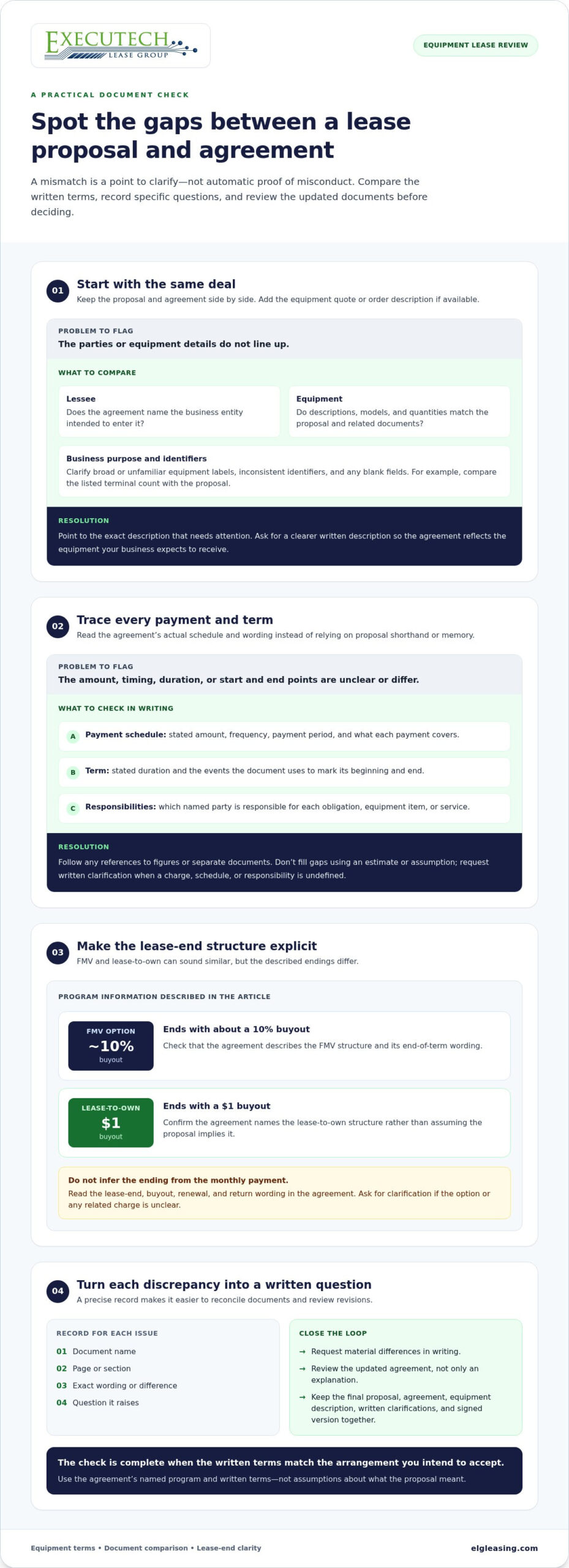
A repeatable review keeps small discrepancies from turning into overlooked questions. Treat each equipment lease agreement red flag as an item to document and resolve, not as a legal conclusion. Keep the proposal and agreement together, then work through the same sequence: identify the term, compare both documents, mark the question, request written clarification, and review the revision.
What belongs on a practical agreement review checklist?
Capture the contracting parties, equipment and quantities, stated term, payment schedule, and named lease program. For each item, note where it appears in both documents. Mark missing information, conflicting wording, and references to schedules or other documents that you still need to locate. This gives you a focused record of what matches and what needs attention.
Use a comparison table to keep each question tied to its source. For example, if the proposal and agreement describe equipment differently, record the wording from each rather than relying on memory. Add the question that needs an answer and, once resolved, note who provided the clarification and where the updated wording appears.
| Agreement wording | Proposal wording | Question | Resolution |
|---|---|---|---|
| Equipment description in agreement | Equipment description in proposal | Do both describe the intended items and quantities? | Record the revised document and section |
| Term or payment language | Stated term or payment schedule | What wording should govern the difference? | Record who clarified it and where |
| Named lease program | Program discussed in proposal | Do the program descriptions align? | Note the written correction or explanation |
Then follow the review in order:
- Identify the specific clause, field, or document reference.
- Compare its wording with the related proposal language.
- Write down the exact question, without filling gaps with assumptions.
- Request a written explanation or revised wording from the relevant party.
- Review the revision and record where it resolves the question.
What should you do when wording remains unclear?
Pause that part of the comparison until the wording makes sense. Ask for an explanation in writing and keep the response with the proposal and agreement. If a revision arrives, check that it addresses the question and that the final version reflects the clarified terms. Retain copies of the proposal, responses, and final agreement together.
A document review can help you spot inconsistencies, but it doesn’t determine the legal effect of a clause. If your question concerns legal rights or obligations, seek guidance from qualified legal counsel. That keeps practical clarification separate from legal interpretation.
Choose the Right Next Step After Reviewing an Equipment Lease Agreement
Your next step depends on what your review uncovered and which program the agreement names. If the terms match the proposal, save the final documents together. If a clause remains unclear or conflicts with the stated program, get the wording clarified in writing and review the revision before signing. A checklist is useful only if it leads to a clear, documented resolution.
Where can readers compare ELG equipment leasing programs?
Use the program name in the agreement as your starting point. ELG’s equipment leasing programs overview can help you compare the available structures with the wording you’re reviewing. Keep the focus on the details that affect your agreement: the named program, payment terms, responsibilities, and lease-end option. The overview provides context, but the written agreement should specify the terms that apply to your transaction.
ELG offers no-money-down equipment leasing. That means no initial money down, not free equipment or the absence of a financial obligation. Read the agreement for its stated payment schedule and other terms rather than drawing conclusions from the phrase “no-money-down.”
ELG provides credit decisions in 1-2 business hours. That describes decision timing only. It doesn’t mean approval is guaranteed, or that funding, delivery, or installation will occur within that time. Keep those steps distinct as you assess the agreement and any next steps.
When is the Apply Now page relevant?
The Apply Now page is an inquiry route for prospective ELG vendors, including ISO and MSP partners. It isn’t a merchant financing application and doesn’t produce a credit decision. If you’re a merchant reviewing an equipment proposal, use the agreement and the relevant program information to resolve contract questions. If you’re an ISO, MSP, or vendor exploring an ELG partnership, the inquiry page is the relevant route.
Before you move forward, make sure you can answer these questions from the documents:
- Which lease program does the agreement identify?
- Have unresolved differences been clarified in writing?
- Does the final version reflect the terms you reviewed?
- Have you retained the proposal and final agreement together?
These equipment lease agreement red flags are prompts for careful comparison, not a substitute for understanding the final terms. If a question concerns legal rights or obligations, qualified legal counsel can provide legal interpretation. For other open points, keep the question specific, tie it to the relevant agreement language, and retain the written response with your records.
Make Your Next Equipment Decision With Clarity
A clear review process can become part of how your business evaluates future equipment needs. Keep the final agreement and supporting documents organized, and make sure everyone involved knows which written version reflects the agreed terms. That gives your team a reliable starting point when equipment plans change or a new proposal arrives.
For merchants, the next step is to proceed only when the written terms are clear to you. For ISO, MSP, and vendor partners, building a productive working relationship starts with a direct conversation about the opportunity. The equipment lease agreement red flags you identify can guide better questions and more precise documentation, without turning every discrepancy into a reason for alarm.
Take the next step with a clear record, a focused conversation, and confidence in what comes next.
Frequently Asked Questions
Does ELG process payments?
No. Executech Lease Group (ELG Leasing) leases equipment and does not process payments. Payment processing and equipment leasing are separate parts of a merchant’s setup. If an agreement or sales discussion refers to both, identify which company provides each service and which document governs it. For example, a terminal lease doesn’t by itself establish who handles transaction processing or what terms apply to a processor relationship.
Does a credit decision in 1-2 business hours mean funding is immediate?
No. ELG provides credit decisions in 1-2 business hours, and that timing refers to the decision only. It doesn’t establish when funding, equipment delivery, or installation will occur. If you’re coordinating a planned opening or equipment change, treat those as separate milestones and rely on the applicable written information for each rather than building a schedule around the credit-decision timeframe.
Does no-money-down equipment leasing mean the equipment is free?
No. ELG offers no-money-down equipment leasing, which means no money down, not free equipment. A lease still carries the payment obligations stated in its agreement. For budgeting, use the actual written schedule and the program terms instead of treating the absence of a down payment as the total cost. No-money-down also shouldn’t be read as a promise that there are no fees, taxes, or other obligations.
Is the $1 buyout available on every ELG equipment lease?
No. The $1 buyout applies to ELG’s lease-to-own option, not every equipment lease. ELG’s FMV option ends with about a 10% buyout. If a proposal mentions one program and the agreement appears to describe another, don’t transfer the buyout from one structure to the other. Check the program name and end-of-term language together, and ask for the documents to be aligned if they conflict.
Can I use ELG’s Apply Now page to request a merchant financing decision?
No. ELG’s Apply Now page is an inquiry route for prospective vendors, not a merchant financing application or a form that produces a credit decision. Merchants reviewing a proposal should use the transaction’s relevant written documents to clarify terms. The distinction matters if you’re trying to move a specific equipment request forward: a vendor inquiry and a merchant credit decision serve different purposes.
What should I do if a sales explanation differs from the written lease agreement?
Ask for the difference to be explained in writing before signing, and identify the clause or proposal wording that prompted your question. For example, if a discussion describes a particular payment schedule but the agreement states something different, request clarification tied to that schedule. The phrase equipment lease agreement red flags is a prompt to investigate discrepancies, not a conclusion about intent. For questions about legal rights or obligations, consult qualified legal counsel.
Can ELG discuss SaaS funding with an independent software vendor now?
Yes. ELG is actively staging independent software vendors (ISVs) for its SaaS funding program, and ISVs may engage now. This is an opportunity to discuss the business, not a statement that funding has been completed or that specific terms or timing are available. Keep SaaS program discussions separate from equipment lease details, such as hardware buyouts or equipment credit-decision timing. Discuss your SaaS business with ELG.

Article by
Robert Ensminger
Robert Ensminger is the founder and CEO of Executech Lease Group (ELG Leasing), which specializes in equipment leasing and financing solutions for the merchant-services, payments, POS, and FinTech industries. With more than 20 years of industry experience, Robert helps independent sales organizations, payment processors, POS providers, and software companies develop practical leasing, subscription, and SaaS-monetization programs. He founded ELG in 2010 and guided the company to recognition on the Inc. 5000. His work focuses on responsive service, transparent program structures, and helping ELG’s partners close more business while creating sustainable revenue.