
Could the monthly POS lease payment be the smallest part of your total commitment? It is a useful starting point, but it may not show every lease obligation, equipment-related expense, or separate payment-processing charge. Understanding POS leasing hidden fees and how to avoid them starts with separating those costs and reading beyond the headline figure.
It’s reasonable to expect a clear picture before you sign. Lease terms, processing conditions, and end-of-term responsibilities can appear in different documents, making an offer difficult to compare at a glance. A low monthly payment alone doesn’t tell you what you’ll owe over the full term or what happens when it ends.
This guide shows you how to review written terms, compare offers over the same period, and identify unanswered questions before committing. You’ll learn to distinguish lease payments and buyout obligations from processing charges, find costs or responsibilities described elsewhere in the documents, and identify who handles equipment-related services. A clear cost breakdown makes potential surprises easier to spot before signing.
Key Takeaways
- Look beyond the headline payment: the written agreement sets out the lease term, equipment, stated charges, and end-of-term obligations.
- Compare offers using the same equipment, lease length, payment frequency, and time horizon to assess the documented commitment.
- Use a five-step review to organize documents, track amounts, identify responsibility, resolve gaps, and save the final terms.
- Understand POS leasing hidden fees and how to avoid them by separating charges stated in the agreement from costs that still need clarification.
- Keep equipment leasing and payment processing distinct, including which obligations belong to the lease and which belong to the processor.
POS Leasing Hidden Fees: Why the Monthly Payment Is Only One Line to Review
A headline payment makes a POS lease easy to scan, but it may not show every contractual obligation. Amounts due at the beginning or end of the term, or charges described in another document, may be presented separately. That difference deserves a closer look, but it doesn’t by itself indicate misconduct. A summary and an agreement may simply provide different levels of detail.
A hidden POS lease cost is a charge or obligation that isn’t clear from the offer summary but may be specified elsewhere in the agreement. The practical questions are what the written terms require, when a charge could arise, and which party is responsible.
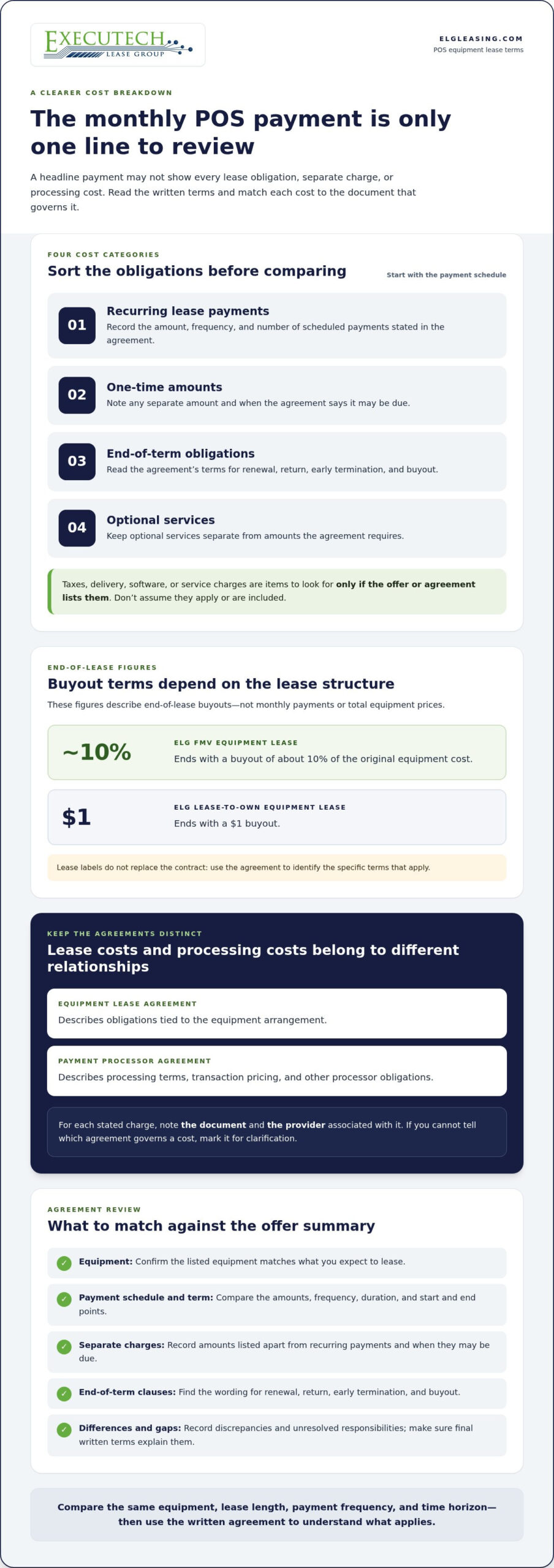
Organize the terms into four categories: recurring lease payments, one-time amounts, end-of-term obligations, and optional services. A charge in one agreement may not apply to another. Fees, responsibilities, and lease structures vary by contract, so treat examples as items to look for, not standard POS lease charges.
What counts as a cost beyond the quoted payment?
Start with the payment schedule, then look for obligations outside the regular installments. A one-time amount may be due at a point specified in the agreement. An end-of-term obligation may apply when the lease concludes. Keep optional services in a separate category so you can distinguish them from amounts the agreement requires.
Look for taxes, delivery, software, or service charges only if the offer or agreement lists them. Don’t assume they’re included or that they apply. A sales summary may show the main payment and equipment at a glance, while the written agreement provides details about timing, conditions, and responsibility. Compare the documents and record any differences that need clarification.
Why equipment and payment-processing costs need separate labels
Equipment leasing and payment processing are separate commercial relationships. A lease agreement describes obligations tied to the equipment arrangement. Processing terms belong to the agreement with the payment processor. For each stated charge, note the document and provider associated with it. This keeps equipment payments distinct from processing charges, transaction pricing, and other processor obligations.
If a cost appears in a sales summary but you can’t tell which agreement governs it, mark it for clarification before signing. Don’t assume the equipment lessor sets processing prices or controls the processor’s terms. Match each cost to the document that describes it, then compare the summary with the full written agreement. The agreement’s wording, rather than a general label, is the useful reference for understanding what applies to your arrangement.
How to Read a POS Lease Agreement for Charges and End-of-Term Obligations
Read the offer summary beside the proposed written agreement before signing. The summary outlines the proposed arrangement; the agreement records the terms you’re being asked to accept. Compare them line by line, paying close attention to the equipment, payment schedule, term, and stated charges. Don’t rely on a verbal explanation to fill a gap that affects your obligations.
The signed agreement, not the headline payment, defines the documented lease obligations. Identify what each clause says, when it applies, and which document governs it. Labels such as FMV or lease-to-own describe a lease structure, but they don’t replace reading the full terms.
- Payment schedule: Check the amount, frequency, and number of scheduled payments stated in the agreement.
- Term length: Confirm the start and end points, and compare the duration with the offer summary.
- Equipment: Match the listed equipment to what you expect to lease, including the descriptions in the agreement.
- Separate charges: Note amounts listed apart from recurring payments, including when the agreement says they may be due.
- End-of-term terms: Locate the clauses for renewal, return, early termination, and buyout. Their wording and effect depend on the specific agreement.
Which payment and equipment details should the agreement identify?
Check that the equipment description and payment schedule match the offer you’re considering. If the documents use different descriptions or show different amounts, record the discrepancy and make sure the final written terms resolve it before signing. Keep the lease agreement distinct from any separate processor or software agreement, and note which document assigns each charge. This creates a clearer record of which terms relate to the equipment lease.
How to interpret buyout language without guessing
Read the buyout clause alongside the payment schedule and other end-of-term terms. ELG’s FMV equipment lease ends with a buyout of about 10% of the original equipment cost. ELG’s lease-to-own equipment lease ends with a $1 buyout. These are end-of-lease figures, not monthly payments or total equipment prices. Use the agreement to identify the specific terms that apply to your lease.
Don’t infer renewal, return, or early-termination rights from a lease label. Find the relevant clauses and note any stated notice requirements, deadlines, or conditions. If the language leaves an amount or responsibility unclear, keep that point marked as unresolved until the final written terms explain it. Save any written clarification with the signed documents so you can refer to the same terms later.
Vendors, ISOs, and MSPs can start an inquiry through ELG’s Become a Vendor form. The form is a conversation starter, not a financing application.
How to Compare POS Lease Offers Without Misreading the Total Cost
A lower monthly payment doesn’t automatically mean a lower total commitment. The term may be longer, the equipment may differ, or the end-of-term terms may change the comparison. You can’t compare POS lease offers using the monthly payment alone; match the equipment, term, payment frequency, and time horizon first.
Use the same review period for each offer, then total only the payments and amounts documented in writing for that period. Keep quoted amounts separate from possible charges that need clarification. Don’t add estimated fees to make an offer look more complete. Mark missing details as unanswered and resolve them before comparing totals. This gives you a consistent basis for assessing each proposal without assuming a charge applies.
A like-for-like comparison table for written offers
Build one table for all offers, using the same equipment and comparison period in each column. Separate the equipment lease from software and payment processing so distinct agreements and charges remain visible.
| Category | Offer A | Offer B |
|---|---|---|
| Equipment description | As written, or unanswered | As written, or unanswered |
| Lease term and payment frequency | As stated, or unanswered | As stated, or unanswered |
| Recurring lease payment | Quoted amount, or unanswered | Quoted amount, or unanswered |
| Separately listed lease charges | Documented amounts, or unanswered | Documented amounts, or unanswered |
| Software terms or charges | Separate agreement, amount, or unanswered | Separate agreement, amount, or unanswered |
| Processor terms or charges | Separate agreement, amount, or unanswered | Separate agreement, amount, or unanswered |
| End-of-term terms | As stated, or unanswered | As stated, or unanswered |
For each offer, total the scheduled lease payments over the same time horizon and record any written end-of-term amount separately. Keep optional services and unconfirmed charges outside the documented total until written terms specify them. This preserves the distinction between stated obligations and open questions.
How lease structure affects the comparison
Compare scheduled installments separately from any specified end-of-term obligation. Lease structures can treat the end of the term differently, so record the exact language in each offer rather than assuming the labels mean identical terms. ELG offers FMV and lease-to-own structures. Compare the specific written terms and their effect on your planned time horizon. The POS lease program structures page provides context for reviewing those options.
Include buying the equipment as another scenario if you have a written purchase price and can compare the same equipment over the same period. Leasing and ownership can involve different cash-flow patterns and obligations; neither is automatically cheaper. Make your assumptions visible, keep software and processor charges distinct, and mark unanswered details instead of guessing. Then you can compare what each option documents on consistent terms.
Pre-Signing Checklist for POS Leasing Charges
A clear review is easier when you turn every promise, amount, and open question into a written record. This five-step process helps you reconcile the offer with the agreement without assuming an unclear clause is a fee or a violation. The goal is to know what the documents say, who is responsible, and which points still need an answer before you sign. It’s a practical way to approach POS leasing hidden fees and how to avoid them.
- Gather the matching documents. Collect the offer and proposed agreement for the same equipment and lease term. Include any separate software or payment-processing documents that relate to charges in the offer.
- List every stated amount. Record recurring payments, separately listed charges, and end-of-term amounts in one review sheet. Note where each appears and when the document says it is due.
- Identify responsibility. For each amount, record which contracting party charges it and which agreement governs it. Keep equipment lease costs separate from processor and software terms.
- Resolve unanswered items. Mark any amount, timing, or responsibility that the documents don’t explain. Keep it as an open item rather than estimating or assuming.
- Save and reconcile final terms. Before signing, check that written clarifications appear in the final documents where needed. Save the offer, agreement, and clarifications together for future reference.
Five steps to reconcile an offer with its agreement
Use the review sheet as a comparison tool, not as a substitute for the agreement. If the quote lists equipment differently, a payment doesn’t match, or a charge appears without an explanation, record the exact difference. Compare the final paperwork with the written explanation and make sure the obligation is clear before signing. A verbal answer may help explain a point, but the documents should make the terms clear.
Questions that expose unclear cost responsibility
Use specific, neutral questions as prompts while reviewing the documents: who charges each separately listed amount, which agreement governs it, and whether software or processing costs sit outside the equipment lease. For early termination, renewal, support, or equipment damage, look for the relevant written clause. Don’t infer cancellation rights, automatic renewal, or service coverage from a summary or general label.
Broader context can help you interpret equipment lease structures, while the written offer and agreement remain the basis for reviewing your specific terms. The POS equipment leasing guide provides background as you work through the documents. Keep each written clarification with the agreement, and make sure the final terms match what you intend to accept.
How ELG Leasing Keeps POS Equipment Terms Distinct from Processing
Executech Lease Group (ELG) is a U.S. equipment lease brokerage serving the payment-technology ecosystem. ELG’s role is equipment leasing. It doesn’t process payments, provide merchant accounts, set transaction pricing, or control obligations established by a payment processor. Keeping these relationships distinct helps you identify which written agreement governs each part of your business costs.
That distinction matters during a POS lease review. An equipment payment belongs to the lease terms; transaction pricing and processor obligations belong to the processing relationship. If a summary combines details from multiple arrangements, use the documents to separate them. Look at the party named in each agreement and the charges assigned there, rather than assuming one provider controls every cost connected to your POS setup.
What ELG’s equipment lease options mean for cost review
ELG offers no-money-down equipment leasing. “No money down” means there’s no down-payment requirement; it doesn’t mean the equipment is free or that recurring lease obligations disappear. Read the payment schedule and other written terms to understand the commitment.
Buyout terms depend on the lease structure. ELG’s FMV equipment lease ends with a buyout of about 10% of the original equipment cost. Its lease-to-own equipment lease ends with a $1 buyout. These are distinct end-of-lease figures, not monthly payments or total equipment prices. To compare structures, review the written details alongside ELG’s leasing program options.
Our goal is to deliver credit decisions in under 2 business hours. That goal applies only to the credit-decision stage. It isn’t a timing estimate for funding, delivery, or installation. Keep each process and obligation distinct as you review the proposed arrangement.
Where equipment leasing ends and other services begin
Payment processing remains separate from ELG’s equipment leasing. Processor pricing and obligations are set through the processing relationship, not controlled by ELG. Any equipment warranty comes only from the equipment manufacturer. ELG doesn’t provide equipment warranties, maintenance, repairs, or replacements. If a document mentions a service or charge, identify the agreement and party responsible before treating it as part of the lease.
Clear boundaries make it easier to review POS leasing hidden fees and how to avoid them: match each amount to its written terms and responsible party, then resolve unclear items in the relevant documents. This isn’t a claim that every fee applies. It’s a disciplined way to distinguish a documented lease obligation from processor or equipment-service terms.
Vendors, ISOs, and MSPs can use the Become a Vendor inquiry form to start a conversation about working with ELG. It’s an inquiry, not a financing application.
Make Your Next Lease Decision With Clear Terms
Before moving forward, consider how long you expect the equipment to fit your business needs and compare that with the lease term. ELG offers equipment lease terms of 12, 24, 36, 48, or 60 months. Review the proposed term alongside your operating needs, and make sure the written obligations are clear before you commit. This gives your review a practical focus beyond the monthly figure.
Use the same disciplined approach to POS leasing hidden fees and how to avoid them: base decisions on documented terms, not assumptions. Clear records help you understand the commitment and keep equipment leasing distinct from processing arrangements.
For an equipment-leasing inquiry, use ELG’s Become a Vendor form.
Frequently Asked Questions
Does no-money-down POS leasing mean the equipment is free?
ELG offers no-money-down equipment leasing. That does not mean the equipment is free or that there are no ongoing lease obligations. Review the payment schedule and other written terms to understand the commitment. When reviewing POS leasing hidden fees and how to avoid them, keep the down-payment requirement separate from recurring payments and any other amounts stated in the agreement.
Can a POS lease and payment-processing agreement have separate charges?
Yes. An equipment lease and a payment-processing arrangement are separate commercial relationships, and each may have charges documented in its own agreement. For example, a lease statement may show equipment payments while a processor statement lists charges tied to processing. Match each amount to the document and party that assigns it. ELG leases equipment; it doesn’t process payments or control processor obligations.
What does an FMV buyout mean at the end of an ELG equipment lease?
ELG’s FMV option ends with about a 10% buyout. Its lease-to-own option ends with a $1 buyout. Those are end-of-lease figures. The FMV figure is not a monthly payment or the total equipment price. Review the specific lease documents to understand the terms that apply to your arrangement.
Is ELG’s $1 buyout available on every equipment lease?
No. ELG’s $1 buyout applies to its lease-to-own equipment lease, not every equipment lease. Its FMV equipment lease has a different end-of-lease buyout. Check the lease structure named in your documents and confirm that the buyout language matches that option. The $1 figure describes the lease-to-own buyout only; it isn’t a monthly payment or the total equipment price.
How quickly does ELG make a credit decision?
Our goal is to deliver credit decisions in under 2 business hours. Keep that separate from the funding and equipment-deployment stages. The decision timeframe doesn’t guarantee approval or a particular outcome.
Can I deduct POS lease payments on my business taxes?
Tax treatment depends on your circumstances and the lease details, so consult a tax professional about how your POS lease payments should be handled. Bring the signed agreement and payment records to that discussion. Don’t assume a lease label alone determines tax treatment or that another business’s approach applies to yours. A tax professional can consider the relevant details and advise you on your situation.
This article reflects the author’s opinion for general information only and isn’t tax, legal, or accounting advice. Consult your CPA or attorney about your specific situation.

Article by
Robert Ensminger
Robert Ensminger is the founder and CEO of Executech Lease Group (ELG Leasing), which specializes in equipment leasing and financing solutions for the merchant-services, payments, POS, and FinTech industries. Robert helps ISOs, payment processors, POS providers, and software companies build practical equipment leasing programs. He founded ELG in 2010. His work focuses on responsive service, transparent program structures, SaaS-monetization programs, and helping ELG’s partners close more business while creating sustainable revenue.