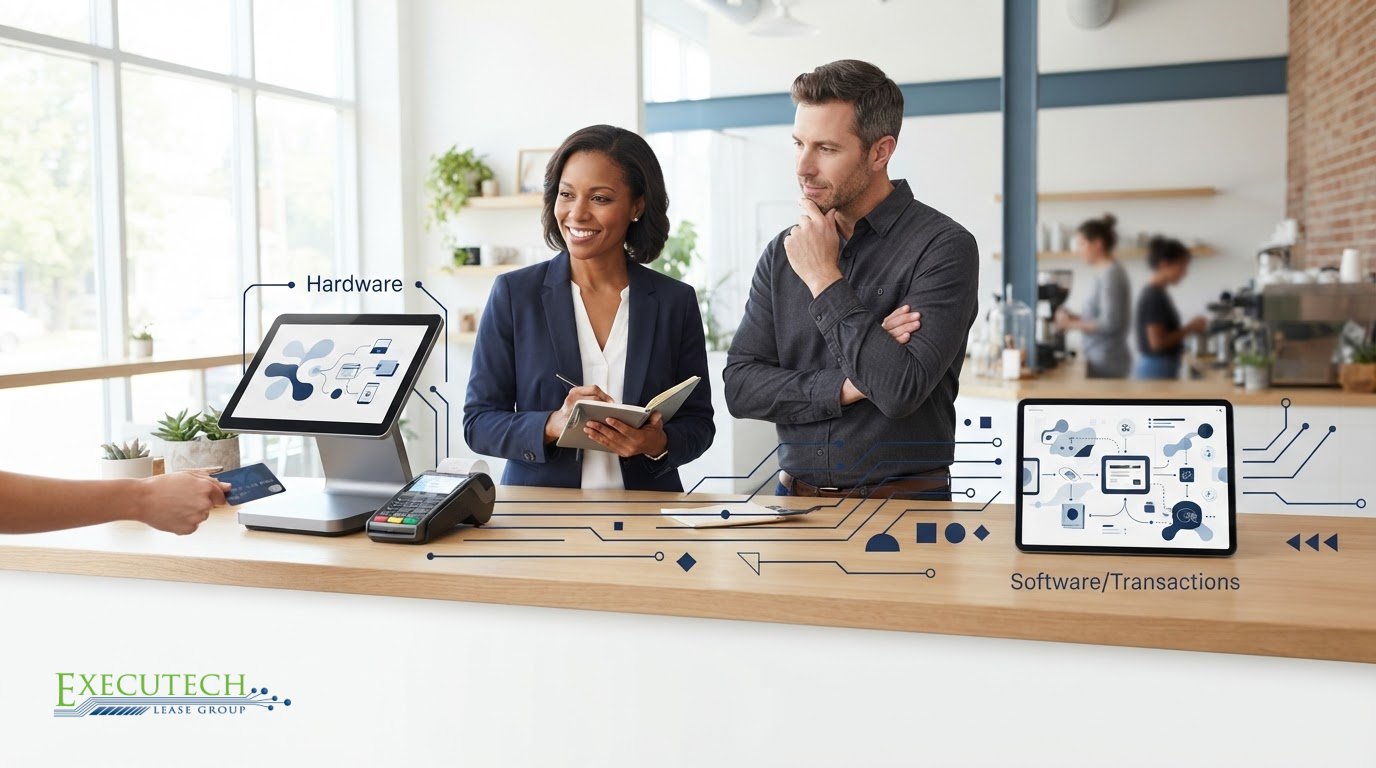
Can you lease the equipment behind an integrated payment setup without tying your hardware agreement to payment processing? Yes. Integrated payment system leasing addresses equipment acquisition, while the POS software, processor relationship, and lease remain distinct parts of the arrangement.
It’s easy to blur those boundaries when a sale, payment, and business record move through one workflow. But integration describes how systems work together, not who finances the equipment or processes transactions. Executech Lease Group (ELG) leases payment-technology equipment, including POS systems and credit card terminals. ELG doesn’t process payments or provide merchant accounts.
This guide explains what an integrated payment workflow connects, which equipment leasing can cover, and what stays separate. You’ll also learn how equipment lease terms of 12, 24, 36, 48, or 60 months differ, including the distinct end-of-term buyouts for FMV and lease-to-own options. The goal is clarity: understand the workflow, assess leasing as an equipment-acquisition option, and identify the processing and lease details that matter before you commit.
Key Takeaways
- Map how a customer payment moves through acceptance, processing, software records, and reconciliation to see where your workflow connects.
- Integrated payment system leasing is an equipment-acquisition decision, not a measure of how closely your software and payment workflow are connected.
- List the terminals, POS equipment, locations, and operational needs your business relies on before evaluating an equipment arrangement.
- Compare lease structures by their end-of-term terms, and keep those obligations distinct from your processor relationship.
- ELG focuses on payment-technology equipment leasing. Payment processing remains a separate relationship.
What Is an Integrated Payment System, and Where Does Leasing Fit?
An integrated payment system connects payment acceptance with business software or workflows so transaction information can move between related parts of an operation. For example, a completed sale may be recorded in a connected business application rather than entered separately. This can reduce duplicate data entry and make transaction information useful beyond the checkout itself. The exact setup varies by business and system.
The payment workflow and the hardware are different things. Software and connected processes determine how transaction information is handled. A terminal, POS system, or other payment device is the equipment used to accept or support transactions. Leasing addresses the equipment acquisition, but a lease does not configure software, connect applications, or establish payment processing. Integrated payment system leasing is about the equipment arrangement, not the integration itself.
What does integrated payment functionality connect?
Integration can link payment acceptance with a business application so relevant transaction details flow into connected operations. For example, a customer pays at a terminal, and the transaction information is reflected in the business software used to record the sale. That describes a possible workflow, not a promise that every terminal, processor, or application connects in the same way.
A payment terminal sitting beside a POS system doesn’t, by itself, show that the systems share information. The practical question is whether transaction data moves between the payment activity and the business workflow, rather than staff having to enter it again manually.
What can an equipment lease cover?
An equipment lease concerns the acquisition of payment technology, such as POS systems, credit card terminals, and ATMs. It does not determine how software exchanges data or which processor handles transactions. Keep those decisions separate: evaluate the workflow for its operational role, then evaluate the lease for the equipment your business needs to acquire.
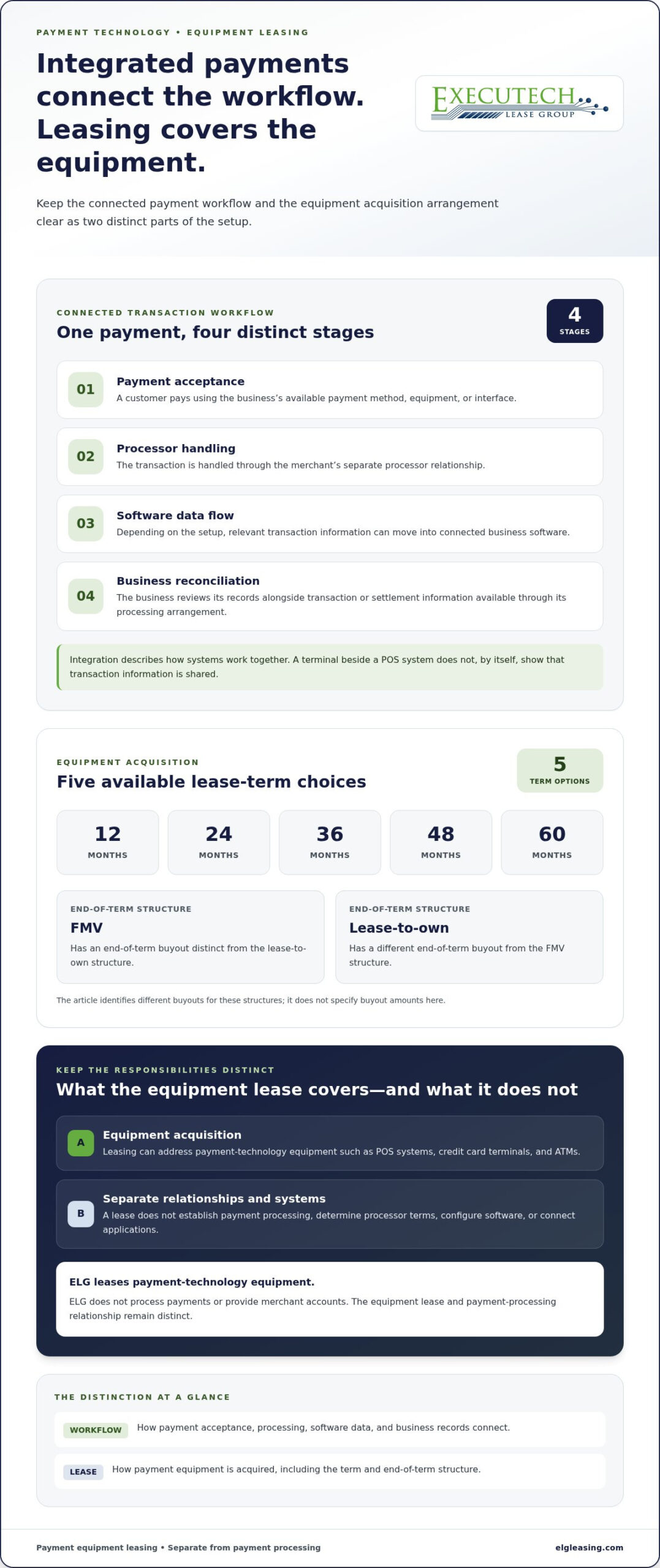
ELG offers equipment lease terms of 12, 24, 36, 48, or 60 months. Its FMV and lease-to-own structures have different end-of-term buyouts. The equipment lease and your payment-processing relationship remain distinct.
For more detail on the equipment-acquisition side, the sibling guide, “The Comprehensive Guide to POS Equipment Leasing in 2026,” explores POS leasing. ELG’s payment equipment leasing programs provide additional context on lease structures. Financing hardware doesn’t create an integrated workflow. It addresses how the equipment is acquired.
How Integrated Payments Work Across Software, Processing, and Hardware
A connected payment workflow can involve several distinct parts. The customer initiates a payment, a processor handles it through the merchant’s processing relationship, software receives relevant transaction information, and the business uses its records to reconcile activity. This sequence helps explain the different roles, but it isn’t a claim that every system follows the same technical design.
Trace one transaction through the connected workflow
- Payment acceptance: A customer pays through the business’s chosen payment method using the available payment equipment or interface.
- Processor handling: The transaction is handled through the merchant’s separate processor relationship. The processor’s terms and responsibilities come from that relationship, not from an equipment lease.
- Software data flow: Depending on the setup, relevant transaction information can move into connected business software. That information may support the business’s transaction records, reducing the need for staff to enter the same details again.
- Business reconciliation: The business reviews its records alongside the transaction or settlement information available through its processing arrangement. This helps it account for activity across its operations.
The U.S. Department of the Treasury’s Invoice Processing Platform (IPP) offers a government example of an invoice and payment workflow handled through a connected platform. For a merchant, the practical step is to identify which information moves between the payment process and the business application, and where staff still need to record or review it manually. Connected data may reduce re-entry, but the workflow depends on the systems involved.
Separate the processor, software, equipment, and lessor
Clear boundaries help prevent confusion. A processor handles payment processing through its relationship with the merchant. POS software provides an interface or business application used in the workflow. Hardware, such as a terminal or POS system, is the equipment used to accept or support transactions. A lessor’s role concerns the equipment acquisition arrangement.
Payment processing handles transactions; equipment leasing addresses how payment hardware is acquired. One agreement doesn’t define the other. A processor’s terms, transaction pricing, and obligations remain separate from the equipment lease. Leasing equipment also doesn’t create a software connection or determine how transaction data flows.
ELG focuses on leasing payment-technology equipment. It doesn’t process payments or control a merchant’s processor terms. Integrated payment system leasing therefore requires you to consider the workflow and equipment arrangement as separate decisions. If equipment acquisition is part of your planning, the equipment leasing inquiry form provides a way to submit an inquiry to ELG.
Integrated Payment System Leasing: Compare the Arrangement, Not Just the Device
A payment setup can look like one package at checkout while involving separate decisions behind the scenes. Software integration describes how business applications and payment activity connect. Equipment acquisition describes how you obtain the hardware. The processor relationship governs payment processing. Compare each part on its own terms rather than treating them as a single arrangement.
Buying or leasing equipment is a financing choice, not a measure of software integration. Either acquisition route can apply to hardware used in a connected workflow. Neither determines how transaction information moves or which processor handles payments. Integrated payment system leasing focuses on acquiring payment equipment through a lease. It doesn’t create the software connection or replace the merchant’s processing agreement.
| Part of the arrangement | What it describes | What to distinguish |
|---|---|---|
| Workflow integration | How payment activity connects with business software or processes | Data flow and the role of each application |
| Equipment acquisition | How you obtain payment hardware, such as a POS system or card terminal | Buying the equipment versus leasing it |
| Processor relationship | The separate relationship used to handle payment processing | Processor terms and obligations, apart from the equipment lease |
| End-of-term structure | The lease’s specified outcome at the end of its term | The applicable buyout terms in the lease agreement |
FMV and lease-to-own equipment leases are distinct
ELG’s FMV equipment lease ends with a buyout of about 10% of the original equipment cost. Its lease-to-own equipment lease ends with a $1 buyout. These are end-of-lease buyouts, not monthly payments or total equipment prices. Keep the structures distinct when comparing options, and use the agreement for the terms that apply to your lease.
The buyout figures don’t describe software access, transaction processing, or equipment compatibility. They address the end-of-term purchase amount for the respective equipment lease only. Consider them alongside the equipment being acquired and the full obligations stated in the lease.
Questions that clarify the whole arrangement
Before comparing options, separate the paperwork and map each decision to the right part of the setup. A focused review can help you understand what you’re agreeing to without assuming a connected workflow means a single contract.
- Equipment: What equipment is described in the lease?
- Lease structure: What term length and recurring obligations does the agreement state?
- End of term: What buyout terms apply, and how are they described in the agreement?
- Software and processing: Which separate agreements govern the applications and processor relationship?
Read each agreement according to its purpose. The equipment lease covers the acquisition arrangement; software and processor agreements address different parts of the operation. That separation makes the comparison clearer, without assuming one option is universally cheaper or improves cash flow.
A Practical Checklist for Evaluating an Integrated Payment System Lease
Start with the work your business needs the payment setup to do. Then assess equipment acquisition separately. This helps avoid treating a lease as a software configuration or assuming a connected workflow depends on one particular financing choice. Integrated payment system leasing addresses the hardware acquisition; the rest of the checklist clarifies the workflow and agreements around it.
Map workflow and equipment needs first
Write down where customers pay, which business applications need relevant transaction information, and who uses the equipment at each location. Describe the task rather than assuming a technical solution. This gives you a practical equipment list and workflow map without assuming that a particular brand, processor, or application will connect to every device.
- Transaction points: Note where payments occur, such as a counter, service area, or other business location.
- Information needs: Identify which business applications use transaction details and what staff need to record or review.
- Equipment categories: List the POS hardware, credit card terminals, or ATMs required for your operation.
- Operational requirements: Record who uses each device, where it is used, and what role it serves in the workflow.
Keep software and processing questions separate. Describe the data flow you need, but don’t treat that description as proof of compatibility or a specific integration.
Review lease terms and responsibilities
Once the equipment need is clear, compare the lease structure with the equipment and obligations stated in the agreement. No-money-down means no down payment is required; it doesn’t mean the equipment is free or that the lease has no ongoing financial obligations. Review the agreement’s term and payment schedule as part of your equipment-acquisition decision.
- Equipment description: Check that the lease describes the payment equipment being acquired.
- Term and recurring obligations: Review the selected term and the recurring obligations stated in the agreement.
- End-of-lease structure: Identify the buyout terms that apply to the specific lease option.
- Separate responsibilities: Keep the equipment lease, software agreement, and processor relationship in distinct decision notes.
- Warranty coverage: Any equipment warranty comes from the manufacturer. ELG doesn’t provide warranties, repairs, or replacements.
Use the agreement for the exact terms rather than assuming details such as renewal rules, cancellation rights, or additional fees. The decision is clearer when you can explain what each agreement covers and which party is responsible for it.
Bottom line: Evaluate payment workflow integration and equipment financing as related but separate decisions.
How Executech Lease Group (ELG) Fits Into Payment Equipment Leasing
ELG is an equipment lease brokerage focused on payment technology. Its role is to help arrange equipment leasing for businesses and industry partners. It is separate from the software that connects business workflows and from the processor relationship that handles transactions. ELG doesn’t process payments, provide merchant accounts, set transaction pricing, or control processor obligations.
That boundary matters in an integrated payment setup. Integrated payment system leasing addresses equipment acquisition, not the payment workflow itself. A lease doesn’t configure software or create a connection between applications. Those functions belong to the systems and relationships used in your payment operations.
ELG’s equipment leasing role
ELG focuses on POS systems, credit card terminals, and ATMs. Equipment lease terms are 12, 24, 36, 48, or 60 months. No-money-down means no down payment is required, not that the equipment is free or that recurring lease obligations disappear.
ELG offers FMV and lease-to-own equipment lease options. The end-of-lease buyout differs by structure: the FMV lease ends with a buyout of about 10% of the original equipment cost, while the lease-to-own lease ends with a $1 buyout. These figures apply to their respective equipment leases, not to software or payment processing.
For vendors and independent sales organizations (ISOs), the related guide “POS Leasing for Independent Sales Agents: The 2026 ISO Growth Resource” explores the industry context. Keep the key roles distinct: ELG handles equipment leasing, while payment processing remains a separate relationship.
Take the next step with clear expectations
Before making an inquiry, note the equipment categories your business needs and the lease structure you want to understand. Keep processor and software questions separate from equipment details. This helps make the inquiry focused without treating it as a decision about processing terms or system integration.
Our goal is to deliver credit decisions in under 2 business hours. That goal applies only to the credit decision stage. It doesn’t promise approval, funding, delivery, or any other outcome.
The “Become a Vendor” form is a contact mechanism for vendor or ISO inquiries. It isn’t a financing application or a credit decision. Use it to make an inquiry about equipment leasing, with your equipment needs and intended lease structure in mind.
Move Forward With a Clear Equipment Brief
Turn your workflow notes into a clear equipment brief. Identify what the business needs to acquire, where each item will be used, and which lease structure you want to evaluate. Keep software requirements and processor terms separate. This gives you a focused basis for discussing equipment without expecting a lease to configure or operate the payment workflow.
Integrated payment system leasing is easier to assess when the equipment scope and agreement are explicit. Before moving forward, make sure your vendor or ISO inquiry reflects the equipment need and intended lease structure. Keep your workflow map nearby so the equipment discussion stays anchored to operating needs, not assumptions about integration. An inquiry is a contact step, not a processing agreement or credit outcome.
Prepare your equipment brief, then submit a vendor or ISO inquiry to ELG to discuss the equipment leasing arrangement.
Frequently Asked Questions
Does ELG require money down?
ELG offers no-money-down equipment leasing. That does not mean the equipment is free or that there are no ongoing lease obligations. When planning a new checkout setup, budget separately for lease payments and payment-processing charges. They belong to different arrangements, and the lease’s obligations are set out in its agreement.
How fast does ELG make a decision?
Our goal is to deliver credit decisions in under 2 business hours. Keep that separate from the funding and equipment-deployment stages. The decision timing doesn’t guarantee approval or set a timeline for funding, vendor payout, equipment delivery, or installation. If you’re coordinating an equipment change, treat the credit decision as one step in the process, not confirmation that later stages will happen within that window.
Does ELG process payments?
No. ELG does not process payments. Its equipment-leasing role is separate from payment processing. A merchant’s processor relationship handles payment processing and its associated terms. For example, a business reviewing transaction charges or processor obligations should look to that separate relationship, not the equipment lease. ELG doesn’t provide a merchant account, set transaction pricing, or determine how a business’s software and payment systems connect.
How do the two buyouts differ?
ELG’s FMV option ends with about a 10% buyout. Its lease-to-own option ends with a $1 buyout. Those are end-of-lease figures. They are not monthly payments or total equipment prices. If you’re comparing agreements, identify which structure applies and review its written end-of-term terms rather than assuming another lease follows the same arrangement.
Does an integrated payment system mean the equipment lease includes payment processing?
No. Integration describes connections between payment acceptance, software, and business workflows. A lease addresses equipment acquisition, not payment processing. Integrated payment system leasing doesn’t, on its own, provide a merchant account or establish how specific hardware and software connect. If you’re evaluating a setup, keep the equipment agreement separate from the processor relationship and assess each according to the role it serves in your business.
Does ELG provide equipment warranties or repairs?
No. ELG doesn’t provide equipment warranties, maintenance, repairs, or replacements. Any warranty comes from the equipment manufacturer. If you’re acquiring a terminal or POS device, review the manufacturer’s warranty terms to understand what they cover and for how long. Don’t treat the equipment lease or your payment-processing arrangement as repair or replacement coverage, or as a promise of uninterrupted equipment service.

Article by
Robert Ensminger
Robert Ensminger is the founder and CEO of Executech Lease Group (ELG Leasing), which specializes in equipment leasing and financing solutions for the merchant-services, payments, POS, and FinTech industries. Robert helps ISOs, payment processors, POS providers, and software companies build practical equipment leasing programs. He founded ELG in 2010. His work focuses on responsive service, transparent program structures, SaaS-monetization programs, and helping ELG’s partners close more business while creating sustainable revenue.