A salon’s POS setup may look like one purchase, but the equipment, software, and payment processing can involve separate costs and agreements. Salon POS system leasing can spread equipment costs over recurring payments, but it doesn’t automatically cover the software or determine how card processing works.
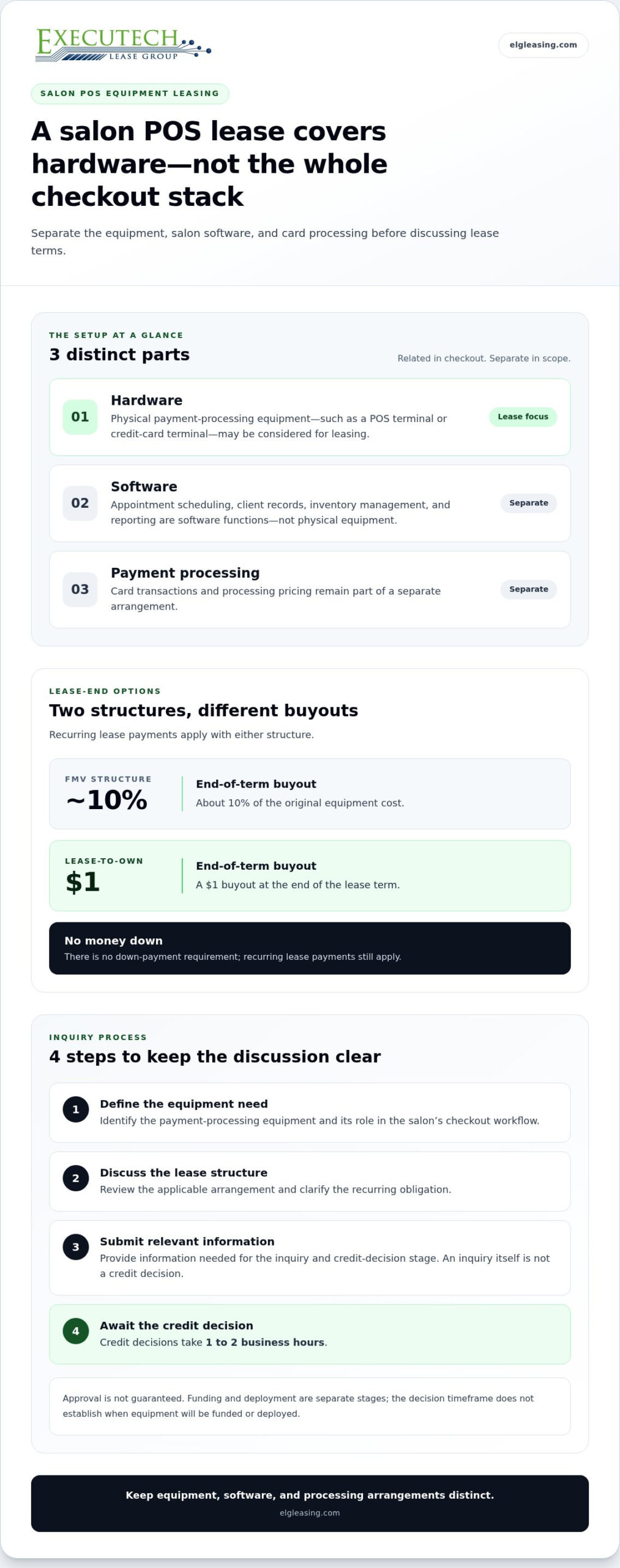
It’s understandable to want a clear answer before planning a technology upgrade. The key is to identify what the lease covers and what happens when the term ends. Executech Lease Group (ELG Leasing) arranges equipment leases for payment-processing technology. Its lease structures include fair market value (FMV), with an end-of-term buyout of about 10% of the original equipment cost, and lease-to-own, with a $1 buyout. Recurring lease payments still apply.
This guide explains which parts of a salon POS setup may involve equipment leasing, how FMV and lease-to-own options differ, and how to describe the terms clearly to salon merchants. You’ll also see how to keep hardware financing separate from software subscriptions and payment-processing arrangements, so the next step is clear without promising approval or delivery.
Key Takeaways
- Salon POS system leasing focuses on eligible payment-processing equipment, so separate hardware needs from salon software and processing arrangements.
- Map the equipment discussion to checkout volume, salon workflow, and who will use the system before comparing lease terms.
- Understand how FMV and lease-to-own structures differ so you can explain end-of-term options clearly.
- Follow a straightforward process: define equipment needs, discuss the lease structure, submit relevant information, then await a credit decision.
- Salon providers can introduce equipment leasing through their merchant-services relationships, with Executech Lease Group serving as an equipment lease brokerage.
What Does Salon POS System Leasing Cover?
Salon POS system leasing is an equipment lease arrangement for eligible payment-processing hardware. It doesn’t mean every part of a salon’s technology setup comes under one agreement. A salon may use a physical terminal to accept payments, software to manage appointments and clients, and a payment processor to handle card transactions. Those are related parts of the checkout workflow, but they serve different roles and can involve separate business relationships.
Leasing can be worth considering when a salon wants to access needed equipment without paying the full equipment cost upfront. Instead, the equipment is covered by recurring lease obligations over an agreed term. ELG offers no-money-down equipment leasing, meaning there’s no down payment requirement; recurring lease payments still apply. For general context on how equipment leases work, see What is Equipment Leasing?
Which parts of a salon POS setup are equipment?
Equipment means the physical devices used in payment acceptance, such as a POS terminal or credit-card terminal. The precise equipment involved depends on the salon’s setup. By contrast, appointment scheduling, client records, inventory management, and reporting are software functions. They may appear within a salon-management platform, but they aren’t physical payment-processing equipment simply because staff access them through a screen.
This distinction helps define what an equipment lease covers. A tablet or terminal is hardware; the digital tools accessed through it are software. A leasing discussion should focus on the equipment itself, rather than treating the whole salon technology stack as one item.
How equipment leasing differs from software and processing
Software access and payment processing are separate from equipment leasing. A salon may have a software relationship for managing appointments or client information, and a processing relationship for accepting card payments. Leasing equipment doesn’t automatically include either one, or provide operational services connected to them.
ELG is an equipment lease brokerage serving the merchant-services and payments-technology ecosystem. ELG leases equipment; it doesn’t process transactions or supply merchant accounts. It also doesn’t set transaction pricing. The salon’s processing arrangements and pricing remain separate from the equipment lease.
Keep the boundaries clear when discussing a POS setup:
- Hardware: Physical payment-processing equipment that may be considered for leasing.
- Software: Digital services for salon operations, which aren’t automatically part of an equipment lease.
- Processing: The separate arrangement through which card transactions are handled.
Compatibility also matters. Brands, models, and integrations aren’t universally supported across every setup. The equipment conversation should identify the intended devices and avoid assuming that a particular terminal will work with every salon platform or processing arrangement. Keeping these categories distinct gives merchants and providers a clearer basis for discussing equipment leasing, without presenting it as a bundled software or payment-processing solution.
How Salon POS Equipment Leasing Works Through ELG
A clear equipment discussion starts with the salon’s checkout needs, not a broad request to fund its entire technology setup. Salon POS system leasing through ELG focuses on payment-processing equipment. The process gives merchants and providers a way to discuss the equipment, lease structure, and relevant information in distinct steps, without treating the inquiry as an approval or delivery promise.
What to clarify before discussing a lease
Identify the equipment being considered and its role in the checkout workflow. A salon merchant may be planning for payment acceptance at the front desk, while a POS dealer or ISO may be discussing equipment in connection with a merchant relationship. Keep the parties and purpose clear. Also separate equipment from salon software, payment processing, and any other vendor arrangements. That makes it easier to describe the equipment request accurately and avoid implying that a lease includes services or products outside its scope.
Equipment leasing has defined structures and terms, as outlined by the Equipment Leasing & Finance Association. For ELG’s inquiry process, the practical sequence is:
- Define the equipment need. Identify the payment-processing equipment under discussion and how it fits the salon’s checkout workflow.
- Discuss the lease structure. Review the applicable lease arrangement and clarify the recurring obligation. No money down means no down-payment requirement; it doesn’t remove lease payments or other obligations.
- Submit relevant information. Provide the information needed for the inquiry and credit-decision stage. The inquiry itself isn’t a credit decision.
- Await the credit decision. Our goal is to deliver credit decisions in under 2 business hours. Funding and deployment are separate stages, so that goal doesn’t establish when equipment will be funded or deployed.
What happens after an equipment lease inquiry?
After the relevant information is submitted, ELG reviews the request for a credit decision. A decision may be made, but approval isn’t guaranteed. If a lease proceeds, funding and deployment follow their own stages. Keep those milestones separate when setting expectations with a salon merchant. An inquiry, a credit decision, funding, and equipment deployment are not interchangeable terms.
Providers can use the equipment leasing process flow to understand the sequence and explain each stage clearly. For a provider interested in discussing the process with ELG, the vendor inquiry form is a starting point. It’s an inquiry, not a financing application or a credit decision.
FMV vs. Lease-to-Own: Compare Salon POS Lease End Options
FMV and lease-to-own use different end-of-lease buyout structures. The introduction gives the specific amounts; this comparison focuses on what distinguishes the options. A buyout is an end-of-lease amount, not a monthly payment or the total equipment price. Keep it separate from the recurring obligations when explaining either structure.
| Lease structure | How the end-of-lease buyout is framed |
|---|---|
| FMV lease | An approximate percentage of original equipment cost |
| Lease-to-own | A nominal fixed buyout |
What does the FMV equipment lease buyout mean?
The FMV option’s end-of-lease buyout is tied to original equipment cost, as stated earlier. Treat it as a distinct amount due at the end of the lease, not a recurring charge or a statement of the equipment’s current market value. Don’t infer a calculation method, renewal rule, notice deadline, or additional end-of-term option from the FMV label alone.
How does the lease-to-own buyout differ?
Lease-to-own uses a nominal fixed end-of-lease buyout rather than the FMV structure. That distinction describes the structure, not which option will cost less overall. The buyout alone doesn’t account for recurring lease payments or other terms, so compare the complete lease arrangement instead of judging by the end amount in isolation.
Use precise language in merchant discussions: identify the lease type, explain that its buyout applies at the end of the lease, and keep that amount separate from monthly obligations and equipment price. ELG’s equipment lease program structures provide broader context for comparing the available arrangements.
How to Assess a Salon POS Lease Before Moving Forward
A useful lease review starts with how the salon actually handles checkout. Match the equipment discussion to the volume and flow of transactions, where payments happen, and which staff members will use the devices. Then review the lease term and obligations as equipment terms, separate from salon software and payment processing.
Does the equipment match the salon’s operating needs?
Map the checkout workflow before discussing equipment. Consider whether transactions happen at a front desk or another checkout point, and who needs to use the POS equipment during a shift. Keep the physical devices distinct from appointment, client-record, inventory, and reporting software. Software capabilities don’t establish which hardware is being leased, and compatibility shouldn’t be assumed across every device, platform, or processor.
- Checkout volume: Describe the salon’s transaction flow so the equipment discussion reflects how checkout works.
- Work locations: Identify where payment acceptance takes place.
- Intended users: Clarify which staff members will use the equipment.
- Separate systems: Note the software and processing relationships without treating them as part of the equipment lease.
These details give merchants and providers a practical frame for discussing the equipment itself, rather than making assumptions based on the salon’s broader POS setup.
Which lease details deserve a clear explanation?
State the selected term clearly. ELG’s equipment lease term choices are 12, 24, 36, 48, or 60 months. Explain the applicable end-of-lease buyout structure alongside that term, and keep it distinct from recurring payments. Don’t invent rates or fees. The purpose is to make the equipment obligation understandable, not to imply that software or processing costs are included.
Review the manufacturer’s warranty terms separately. Any equipment warranty comes from the equipment manufacturer, not ELG. A lease doesn’t add warranty, maintenance, repair, or replacement coverage from ELG. Payment processing is also a separate relationship: processor agreements and transaction pricing aren’t set by ELG. Keeping these boundaries clear helps prevent a merchant from mistaking an equipment lease for an all-in-one service arrangement.
For tax questions related to a lease, consult a tax professional. Tax treatment depends on circumstances beyond the equipment discussion, so avoid promising a particular tax outcome.
A structured review of the equipment, operating needs, term, and separate agreements makes Salon POS system leasing easier to explain. ELG’s equipment leasing program details provide broader context for the available lease structures.
How Salon POS Providers Can Discuss Leasing With ELG
Salon POS providers can bring an equipment leasing option into conversations with merchants who are planning payment-processing equipment purchases. Executech Lease Group (ELG Leasing) is an equipment lease brokerage serving the merchant-services ecosystem. Its role is specific: leasing payment-processing equipment, not processing salon transactions or supplying a merchant account. That distinction lets providers discuss equipment separately from a salon’s software and payment arrangements.
A provider can introduce leasing as one possible way to address equipment needs, then explain the lease structure and its obligations in plain terms. Keep expectations measured. An inquiry starts a discussion; it doesn’t establish approval, funding, equipment delivery, or processor compatibility.
What ELG’s role includes, and what it does not
ELG leases payment-processing equipment. It doesn’t process transactions or control a salon’s processor agreement, transaction pricing, or software services. Equipment warranties come from the manufacturer. ELG doesn’t provide warranties, maintenance, repairs, or replacements. Keeping these responsibilities separate helps providers explain who handles each part of the merchant’s setup without suggesting that an equipment lease includes operational services.
For example, a salon may be discussing a terminal for checkout alongside its appointment software and a separate payment-processing relationship. The provider can present the equipment lease as a distinct conversation, not as a bundle that automatically includes the software, merchant account, or manufacturer warranty. Clear boundaries make Salon POS system leasing easier to describe accurately.
What should a provider include in an initial inquiry?
Useful context helps frame the equipment discussion. Identify the organization making the inquiry and its role in the merchant-services relationship. Then describe the salon merchant context and the payment-processing equipment being considered. A concise description of where the equipment fits in the checkout workflow can make the request easier to understand.
- Organization type: Note whether the inquiry comes from a POS dealer, ISO, merchant-services provider, or another provider.
- Merchant context: Identify that the equipment discussion concerns a salon merchant.
- Equipment need: Describe the hardware under discussion and its intended checkout use.
- Separate arrangements: Keep salon software, processor agreements, and manufacturer warranty terms distinct from the lease inquiry.
Describe equipment needs without assuming every brand, model, or configuration works with every salon platform or processor. Specificity is more useful than a broad compatibility claim. Providers who work with independent sales agents can also apply the same role clarity to those conversations, distinguishing the lease discussion from processing and software relationships.
The Become a Vendor form is an inquiry, not a financing application or a credit decision. Providers ready to open an equipment leasing conversation can begin a vendor inquiry.
Make the Next Equipment Conversation Count
A productive next step is to give the salon owner and provider a shared brief for the equipment discussion. Capture the business need in practical terms: what part of checkout needs attention, who will be involved in the decision, and what the merchant wants the equipment to support. A concise brief helps keep the conversation focused and gives everyone a clear starting point.
Use Salon POS system leasing as one part of a deliberate technology-planning conversation, not a shortcut around understanding the merchant’s needs. Providers can frame the inquiry clearly, while salon merchants can use it to consider how equipment decisions fit their broader operating plans. The goal is a well-defined discussion, with expectations set before the next step.
Start the provider inquiry when you’re ready to move the equipment conversation forward. A clear request is a practical first step toward exploring the arrangement.
With a focused brief and clear roles, you can approach the next conversation with confidence.
Frequently Asked Questions
Does ELG require money down for salon POS equipment leasing?
No. The no-money-down option removes the down-payment requirement. When planning a salon’s equipment budget, account for the recurring lease commitment separately and make sure the people reviewing the arrangement understand both parts. That distinction helps prevent “no money down” from being mistaken for equipment at no cost or a lease without ongoing obligations.
How fast does ELG make a credit decision?
That timing is a goal, not a guarantee. Treat that as one defined milestone, not as a timeline for the entire equipment process. In merchant conversations, describe the decision stage separately and avoid setting expectations for later steps based on its timing.
How do ELG’s FMV and lease-to-own buyouts differ?
FMV uses an approximate percentage-based buyout, while lease-to-own uses a fixed $1 buyout. Both figures apply at the end of their respective lease structures. For a useful comparison, put the applicable buyout beside the term and recurring obligations in the proposal, so the salon can review the structure as a whole rather than focus on one figure.
Does ELG process salon payments or provide merchant accounts?
No. ELG doesn’t handle those services. A salon should keep its equipment discussion and its payment-processing relationship in separate records, with the relevant provider and terms identified for each. This helps avoid confusion about who manages transaction processing or merchant-account arrangements when the salon is reviewing its technology setup.
Does ELG provide a warranty or repair service for leased POS equipment?
No. ELG doesn’t provide warranties or repair services. For warranty questions, the relevant terms come from the equipment manufacturer. Keep the manufacturer’s warranty information with the equipment records, separately from the lease documents, so salon staff know where warranty coverage is addressed without treating the lease as service coverage.
Can salon POS software be included in an equipment lease?
Software isn’t automatically included in an equipment lease. ELG also offers cloud-based SaaS POS software, but that is a separate offering from payment-processing equipment leasing. For a salon evaluating both, list the software arrangement and the equipment lease separately, and make clear which agreement covers each part of the setup.
Does a salon POS equipment lease guarantee approval or equipment delivery?
No. An inquiry doesn’t guarantee either outcome. Providers should describe it as the start of a discussion, not as approval or a confirmed order. Before a salon makes operational plans around new equipment, distinguish the inquiry from any later decision and deployment arrangements, and avoid communicating a delivery date that hasn’t been established.

Article by
Robert Ensminger
Robert Ensminger is the founder and CEO of Executech Lease Group (ELG Leasing), which specializes in equipment leasing and financing solutions for the merchant-services, payments, POS, and FinTech industries. Robert helps ISOs, payment processors, POS providers, and software companies build practical equipment leasing programs. He founded ELG in 2010. His work focuses on responsive service, transparent program structures, SaaS-monetization programs, and helping ELG’s partners close more business while creating sustainable revenue.