The POS quote with the lowest price can cost more over the period you actually use the system. Calculating total cost of ownership for POS systems 2026 means looking beyond the hardware price or monthly payment to the full cost of operating the setup.
Comparing proposals takes care because quotes bundle hardware, software, and services differently, and lease payments can make a longer commitment look smaller month to month. Processing charges also change with transaction volume and sales activity. Comparing headline figures alone leaves important costs out.
This guide gives you a practical framework for building a transparent TCO calculation from documented costs. You’ll compare purchase and lease scenarios over the same period, account for software, processing, and operating expenses, and flag assumptions that could change the result. For leased equipment, include the payment schedule and any end-of-term amount stated in the agreement. Payment processing is a separate cost, not part of an equipment lease. The goal is a fair, like-for-like comparison that makes open questions visible before you decide.
Key Takeaways
- Use one defined system scope and comparison period so each cost belongs to the same like-for-like calculation.
- Organize calculating total cost of ownership for POS systems 2026 around one-time costs, costs during the period, and end-of-term obligations.
- For every cost, record its source, amount, frequency, period total, and any assumption that affects the calculation.
- Keep initial cash requirements distinct from total scheduled payments when comparing a purchase with a lease.
- ELG’s no-money-down equipment leasing means no down-payment requirement; scheduled lease obligations still apply.
What Does Total Cost of Ownership for a POS System Mean?
Total cost of ownership (TCO) is the sum of costs tied to a defined POS system over a defined period, using a consistent system scope. It includes more than the amount due at purchase. A quote may show hardware, software, or a monthly payment, but each figure covers only part of the ownership picture. Include costs that arise throughout the period, not just the initial purchase price.
For a POS comparison, separate costs into four groups: the purchase price or equipment payments, recurring commitments such as software subscriptions, usage-based charges that vary with transactions or activity, and end-of-term obligations stated in an agreement. Base the calculation on documented terms and stated assumptions. If transaction volume, renewal pricing, or future system needs are uncertain, label the estimate rather than presenting it as a fixed cost.
This is the basis for calculating total cost of ownership for POS systems 2026: define what you’re evaluating, set the time boundary, and include costs consistently. Totals are meaningful only when they cover comparable systems and periods.
Set the system scope before comparing proposals
Write down exactly what the comparison includes. That could mean terminals, registers, peripherals, software, and the locations served. A proposal for one checkout lane isn’t directly comparable to one covering multiple locations unless you adjust the scope or clearly explain the difference.
Separate essential components from optional features or services. Record exclusions and assumptions too, such as whether a listed device is included or priced separately. Apply the same boundary to every proposal. Otherwise, a lower total may simply reflect fewer components, not a lower cost for an equivalent setup.
- Included: the equipment, software, and locations counted in the comparison.
- Optional: features or services that can be added but aren’t required for the baseline.
- Excluded: items outside the comparison, recorded so their absence is visible.
Choose a fair comparison period
Set a time horizon that fits your planning needs and the contract terms available for review. Compare purchase and lease scenarios over the same number of months. If one scenario ends before the other, state how you handle the remaining equipment or any end-of-term obligation. Don’t silently treat the unmatched period as cost-free.
Keep the time frame consistent even when payment schedules differ. A purchase may involve an upfront payment, while an equipment lease uses scheduled payments over its term. Record each according to the actual proposal and include applicable end obligations within the chosen period. Mark estimates clearly when future usage, subscription renewals, or other terms may change. Transparent assumptions make the result useful even when some inputs remain uncertain.
Which POS System Costs Belong in a 2026 TCO Calculation?
Use a structure that captures costs across the full comparison period, and tie every entry to a quote, agreement, invoice, or clearly labeled estimate:
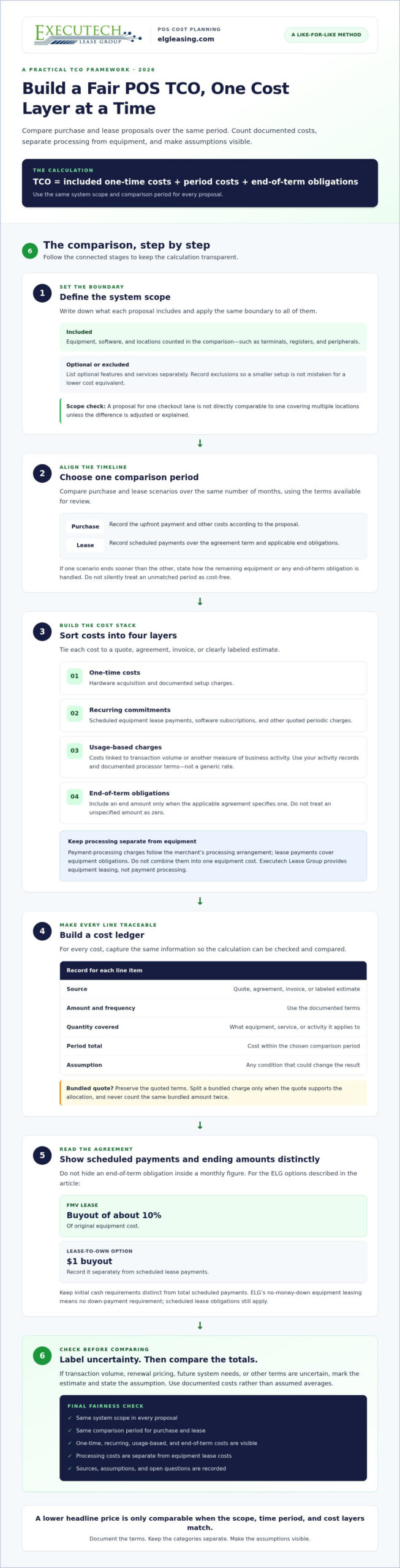
TCO = included one-time costs + period costs + end-of-term obligations.
For each line item, note its source, amount, frequency, and the quantity it covers. A proposal might bundle hardware and setup, while another lists them separately. Preserve the quoted terms, and split bundled charges into separate rows only when the quote supports that allocation. Avoid counting a bundled amount again as a separate line item. Forbes’ POS system cost guide also discusses hardware, software, and transaction charges as distinct parts of POS pricing.
Separate fixed, recurring, and usage-based costs
Create distinct ledger rows for setup, recurring commitments, and expenses that vary with use. Record actual quoted software and service charges, not assumed industry averages. Include connectivity, support, or replacement costs only when they apply to your setup and are documented in the relevant terms. This prevents an estimate from quietly turning into an assumed charge.
- One-time: hardware acquisition and documented setup charges.
- Recurring: scheduled equipment lease payments, software subscriptions, and other quoted periodic charges.
- Usage-based: charges linked to transaction volume or another measure of business activity.
Variable transaction costs depend on your merchant activity and the terms set by your payment processor. Keep these charges in their own ledger category. A processor relationship is separate from equipment leasing: lease payments cover equipment obligations, while processing charges follow the merchant’s processing arrangement. Executech Lease Group (ELG) provides equipment leasing, not payment processing, so don’t combine the two into a single quoted equipment cost. For an accurate projection, use your own activity records and documented processor terms instead of applying a generic rate.
Account for obligations at the end of the comparison period
Review the equipment agreement for an end-of-term amount, and include it only when the applicable agreement specifies one. Don’t assume every lease has the same ending obligation or treat an unspecified amount as zero. Label the amount separately from scheduled payments so both the recurring commitment and any amount due at the end are clear.
For ELG equipment options, an FMV lease ends with a buyout of about 10% of original equipment cost. Its lease-to-own option ends with a $1 buyout; that amount applies only to lease-to-own, not other lease options. Use the terms that match the actual proposal. A disciplined ledger makes calculating total cost of ownership for POS systems 2026 more transparent by showing where each figure came from and which assumptions still affect the result.
How Should You Compare Buying and Leasing a POS System?
Put both options on the same footing before comparing totals. Use identical equipment, software, location coverage, and time horizon in each scenario. A purchase quote for a complete setup shouldn’t be compared with a lease covering only selected equipment. If the proposals differ, identify the difference and adjust the scope or show it as a separate line item.
Separate cash timing from total cost. A purchase may require more cash at the start, while a lease spreads equipment payments across its schedule. That difference matters for budgeting, but lower upfront spending doesn’t prove a lower total cost. Compare all payments and any end-of-term obligation specified in the applicable agreement. IBM’s discussion of Understanding Total Cost of Ownership also frames technology costs as broader than the initial outlay.
Build a like-for-like purchase and lease comparison
Use documented terms, not estimates that make one option look better. For the ownership scenario, enter the actual purchase quote and applicable ongoing costs for the chosen period. For the lease scenario, record the proposed scheduled payments, lease term, and any specified end amount. Keep software, processor charges, and operating assumptions constant in both columns.
A useful comparison separates three views:
- Initial cash requirement: the amount due at the start under each documented scenario.
- Scheduled cost: the purchase amount or lease payments included in the comparison period, plus common operating costs.
- End obligations: any amount specified by the applicable equipment agreement at the end of the period.
Don’t treat the lease’s periodic payment as its total cost, or assume a purchased system has no ongoing expenses. If a quote bundles equipment with another charge, use only the itemization the proposal supports. If you can’t reliably separate a bundle, preserve it as one amount and note the assumption rather than inventing an allocation.
Read lease structures without confusing their end amounts
Lease structures can have different end-of-term obligations, so compare the actual agreement rather than treating all leases alike. Enter the applicable end amount only in the scenario it belongs to, and keep it separate from scheduled payments. This prevents an end obligation from being mistaken for a recurring charge or omitted because it falls outside the monthly payment schedule.
For more context on evaluating lease structures, the article “Lease-to-Own and FMV: Choosing the Right Program” can provide additional background. In your comparison, state the period, equipment scope, and assumptions beside each total. That makes it easier to see what the numbers represent and why they may change if your needs or documented terms differ. A consistent method keeps the decision focused on comparable obligations, not a single attractive payment figure.
How Can You Calculate POS TCO Step by Step?
Turn quotes and agreements into one cost ledger before comparing totals. This makes calculating total cost of ownership for POS systems 2026 repeatable: each figure has a source, frequency, period total, and clear status as confirmed or estimated.
- Define the scope. List the equipment, software, and locations included. Keep the scope consistent across scenarios.
- Select the comparison period. Use the same number of months for every option and note where a contract ends before or after that period.
- Collect documented terms. Gather equipment quotes, software terms, processor agreements, and documented service charges. Mark missing details instead of filling gaps with assumed averages.
- Calculate period totals. Convert recurring charges to the selected period, include applicable one-time costs and end obligations, and tie variable charges to stated activity assumptions.
- Compare and test assumptions. Review totals side by side, then adjust uncertain inputs to see which ones materially change the result.
Turn vendor documents into a comparable cost ledger
Use this blank worksheet to capture the source terms. Add rows as needed. Enter separate charges when the documents support a breakdown. If a bundle isn’t itemized, keep it as one amount and identify the limitation in the assumption column. For recurring charges, calculate the total across your selected period only when the amount and billing frequency are documented.
| Cost category | Amount from quote | Frequency | Period total | Assumption |
|---|---|---|---|---|
| ________________ | ________________ | ________________ | ________________ | ________________ |
| ________________ | ________________ | ________________ | ________________ | ________________ |
| ________________ | ________________ | ________________ | ________________ | ________________ |
| ________________ | ________________ | ________________ | ________________ | ________________ |
Keep equipment charges separate from processor charges, even when both appear in materials from the same business relationship. The processor agreement supports transaction-cost estimates; the equipment proposal supports equipment costs. For tax treatment, consult a tax professional rather than adding assumed deductions or tax savings.
For broader context on equipment lease structures, review ELG’s POS equipment leasing programs alongside the proposed terms.
Test assumptions and explain the result
Calculate each scenario from documented amounts, and label estimates clearly. For variable processing charges, run a sensitivity check using different transaction activity assumptions based on your own records. This shows how the total changes as activity changes without predicting a particular outcome.
Before relying on the comparison, identify gaps that could shift the result: an unclear renewal term, an unitemized bundle, an unspecified end obligation, or incomplete processor pricing. State how each gap affects confidence in the total. A transparent estimate is more useful than a precise-looking number built on invented inputs.
How Can ELG Help Put POS Equipment Leasing Into Your TCO?
ELG is an equipment lease brokerage focused on POS systems and card terminals. Its role is to help place equipment lease terms into the equipment portion of your comparison, giving you a documented lease scenario to compare with a purchase quote. It doesn’t replace the rest of your TCO worksheet or determine costs in separate business relationships.
Keep payment processing separate. ELG doesn’t process payments, and a POS equipment lease doesn’t set your processor’s terms. Enter equipment payments in the lease column, then use your processing agreement and activity assumptions to estimate transaction charges. A single monthly payment can’t represent both equipment obligations and processing costs unless the documents explicitly combine them and show how they’re allocated.
Enter confirmed equipment lease terms into your comparison
Use the term stated in the proposal. ELG equipment lease terms are 12, 24, 36, 48, or 60 months. Record the scheduled payments and the end amount that applies to the selected option, using the agreement rather than assuming every structure ends the same way. The POS equipment leasing programs provide context for including equipment leasing in a TCO comparison.
No-money-down refers to the down-payment requirement. It doesn’t mean the equipment is free or remove the recurring lease obligations. Count the payments over your chosen comparison period, and include any applicable end-of-term amount stated in the agreement. Keep those figures limited to the equipment arrangement. ELG doesn’t provide equipment warranties, maintenance, repairs, replacements, installation, or support. Any equipment warranty comes from the manufacturer.
Use the process context to keep assumptions clear
As you evaluate an option, distinguish the equipment proposal from other parts of your POS setup. ELG’s process information can help frame the leasing steps; your worksheet should still identify which amounts come from the equipment proposal and which come from software, processor, or operating documents. This makes calculating total cost of ownership for POS systems 2026 more transparent, especially when several agreements contribute to the system’s total cost.
Our goal is to deliver credit decisions in under 2 business hours. That is not a promise of approval, funding, equipment delivery, or installation timing. Vendors, ISOs, and MSPs can use the inquiry form to raise a vendor inquiry. The form is an inquiry, not a financing application. Keep any follow-up figures tied to documented terms before adding them to your comparison.
Make Your Next POS Decision With a Clear Cost Picture
A TCO estimate is a decision tool, not a fixed forecast. Keep the source documents beside your calculation, and revisit assumptions when your transaction patterns, system scope, or contract terms change. This gives you a practical basis for weighing options without treating an uncertain estimate as a guaranteed future cost.
As you finalize your comparison, keep equipment leasing and payment processing separate. If your next step involves POS equipment leasing, ELG’s vendor inquiry form is available to vendors, ISOs, and MSPs. It’s an inquiry, not a financing application. A clear record of your scope and requirements can help frame a discussion around the equipment terms you’re evaluating.
With documented assumptions and a consistent comparison period, calculating total cost of ownership for POS systems 2026 becomes a more useful foundation for a confident decision. Keep the numbers transparent, and move forward with clarity.
Frequently Asked Questions
How much does a POS system cost in 2026?
There’s no single price that applies to every POS setup. The total depends on the equipment included, software and service terms, transaction activity, and the period you’re evaluating. For calculating total cost of ownership for POS systems 2026, use figures from your own proposals rather than a general estimate. For example, a quote for one checkout station may not cover the peripherals or software listed in a multi-station proposal.
Can I calculate POS system TCO if future transaction volume is uncertain?
Yes. Use recent transaction records as a baseline, then calculate additional scenarios with lower or higher activity assumptions. Label each scenario clearly as an estimate, and apply the processing terms that govern your account. This shows how transaction-related costs respond to activity changes without pretending you know future sales. Revisit the estimate when you have updated transaction data or a material change in your business model.
Should taxes and depreciation be included in a POS TCO comparison?
Keep tax treatment separate from your operating-cost calculation unless your accounting method calls for a specific treatment. Don’t estimate deductions, depreciation, or tax savings from a general POS comparison. Those details depend on your circumstances and applicable tax guidance. Ask a qualified tax professional how to handle equipment costs in your analysis, and document any tax-related assumptions separately so they aren’t mistaken for quoted system costs.
Does ELG require money down?
ELG offers no-money-down equipment leasing. That means no down payment is required; it doesn’t mean the equipment is free or that ongoing lease obligations disappear. For a practical budget, distinguish the amount required at the start from scheduled payments and any applicable end-of-term obligation. The proposal and agreement provide the figures for your specific equipment scenario.
How fast does ELG make a credit decision?
Our goal is to deliver credit decisions in under 2 business hours. This goal applies only to the credit-decision stage. It isn’t a promise of approval, funding, equipment delivery, or installation within that period. Keep those stages distinct in your planning, especially if you’re coordinating a POS changeover with other business timelines. The vendor inquiry form is a contact mechanism, not a financing application.
Can a POS lease payment include payment processing?
ELG’s role is equipment leasing, not payment processing. A POS equipment lease payment doesn’t set or include your processor’s terms. If documents show both equipment and processing charges, treat them as separate cost lines and use the applicable agreement for each. This helps you see whether an equipment obligation changes with transaction volume or remains distinct from processing charges tied to merchant activity.
What information should I gather before comparing POS system proposals?
Gather each proposal’s itemized equipment list, quantities, software terms, payment schedule, and any stated end-of-term obligation. Also collect processor pricing documents and transaction records, plus billing dates and renewal terms for recurring services. Note which figures are confirmed and which are estimates. For example, if a quote groups several devices under one line, preserve the bundle and flag the missing breakdown instead of assigning unsupported amounts to each device.
This article reflects the author’s opinion for general information only and isn’t tax, legal, or accounting advice. Consult your CPA or attorney about your specific situation.

Article by
Robert Ensminger
Robert Ensminger is the founder and CEO of Executech Lease Group (ELG Leasing), which specializes in equipment leasing and financing solutions for the merchant-services, payments, POS, and FinTech industries. Robert helps ISOs, payment processors, POS providers, and software companies build practical equipment leasing programs. He founded ELG in 2010. His work focuses on responsive service, transparent program structures, SaaS-monetization programs, and helping ELG’s partners close more business while creating sustainable revenue.