
Each conversation counts. Sales scripts for ISOs offering equipment leasing should do more than present a payment; they should connect the equipment a merchant needs with a payment approach that fits the business.
It’s easy to focus on call volume and treat every conversation like a pitch. But merchants also need a clear reason to consider leasing, an honest explanation of the payment structure, and a practical view of timing. A focused script helps you uncover those priorities without overpromising approval or outcomes.
Here, you’ll find ways to discuss leasing as a cash-management option, explain the monthly payment, explain approval speed responsibly, and bring up equipment replacement at the end of a lease. You’ll also see how to qualify a merchant and shape the conversation around their business needs, so the next step feels straightforward and relevant.
Key Takeaways
- Frame leasing around the merchant’s cash-management priorities, and discuss payment options without reducing the conversation to total equipment cost.
- Ask about the merchant’s cash-management priorities before walking through the monthly payment.
- Explain the approval process accurately, set clear expectations, and avoid presenting a target decision time as a guarantee.
- Ask when the merchant expects to replace equipment, then discuss end-of-lease choices without implying mid-contract upgrades.
- Qualify with focused questions about the equipment, business needs, and financing plans before moving to an application.
Leasing as a cash-management option
A cash-management script frames equipment leasing as a way to spread payments, not erase costs. Ask whether the merchant would rather preserve cash for payroll, inventory, or another business need. Then compare the proposed monthly payment with the cash purchase, using the same equipment and clearly stated terms. Financing may also help keep existing credit lines available for other needs. Keep the explanation balanced: the merchant still takes on a payment obligation.
For example, an ISO discussing a payment terminal can ask, “Would keeping more cash available matter more than owning the equipment outright?” If the merchant says yes, explain how a lease structures payments over time. Payment-processing equipment lease terms can span 12 to 60 months. The right comparison focuses on the equipment, payment schedule, contract term, and end-of-term conditions, not just the first monthly figure.
How do equipment leasing scripts differ by industry or equipment type? Start with the equipment’s role in the business: a countertop terminal supports checkout, while a POS system may handle broader sales operations. Name the equipment and the task it supports, then connect the payment discussion to the merchant’s priorities.
Owners may object that leasing costs more than paying cash, or that they don’t want another monthly obligation. Acknowledge the concern, then compare the written payment schedule with the cash purchase and ask which better fits their priorities. Don’t claim leasing is cheaper or promise savings.
What disclosures and regulations apply to equipment leasing sales in the United States? Explain the agreement’s actual payment schedule, term, fees, and end-of-term conditions, and distinguish a lease from a purchase. Use accurate contract language; a sales script is not a substitute for required disclosures.
What follow-up scripts and steps help close an equipment leasing sale? Summarize the merchant’s equipment need and stated cash priority, send the relevant terms, and agree on a specific next conversation. If the merchant isn’t shopping now, ask permission to follow up in 60 days, rather than sending repeated, untargeted pitches.
Sales scripts for ISOs offering equipment leasing should keep the conversation practical. Try: “You mentioned keeping cash available for payroll. Would comparing a monthly lease payment with the purchase option help you decide?” Then pause. The merchant’s answer guides whether to explain payment structure, clarify contract terms, or arrange follow-up. This keeps financing relevant to the business decision.
Explaining monthly payment terms
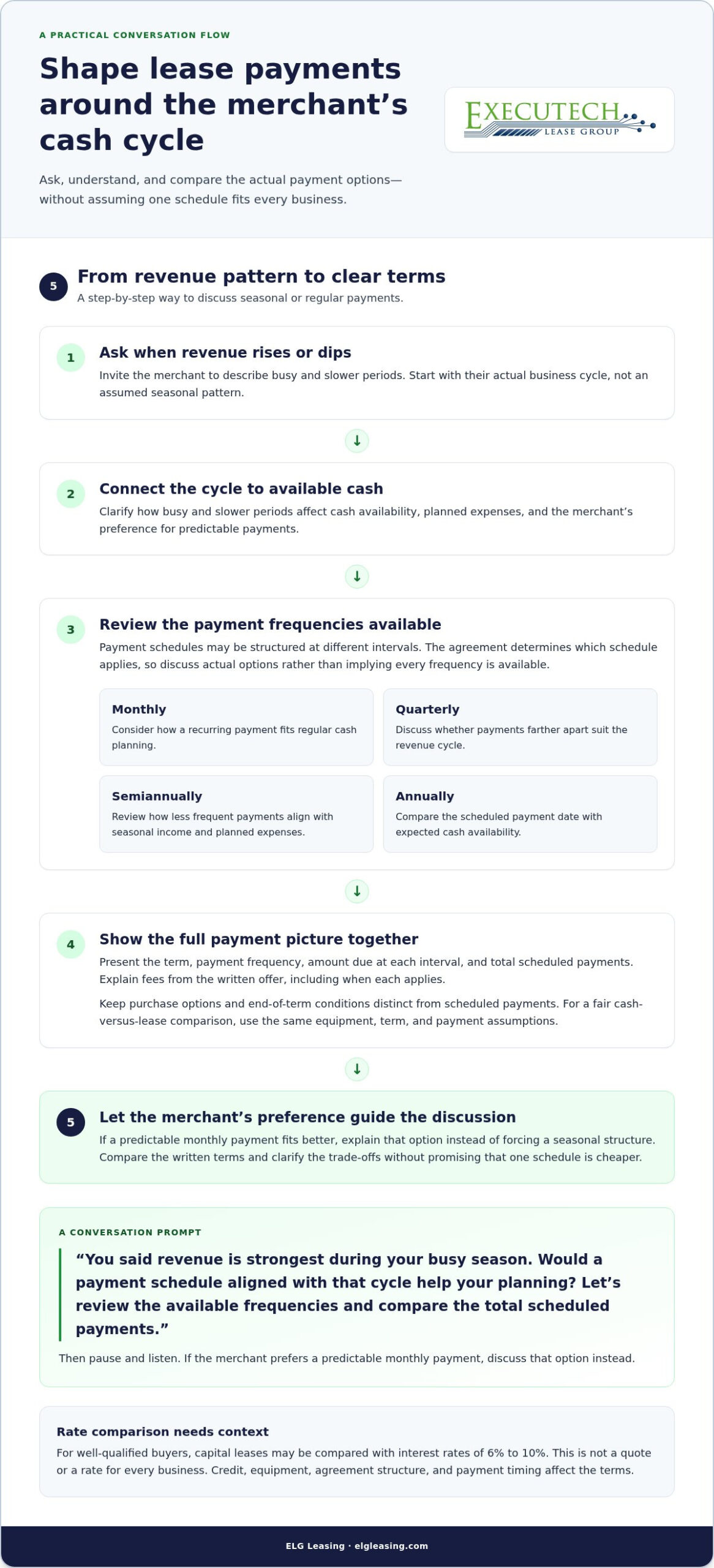
A payment schedule should reflect the merchant’s cash cycle, not an assumed pattern. Ask when revenue rises or dips, then explain the payment schedule available under the agreement.
Rates, Fees, and Lease Terms
For well-qualified buyers, capital leases may be compared with other financing options. That comparison isn’t a quote or a rate for every business. Credit, equipment, agreement structure, and payment timing affect the terms. Discuss fees only from the written offer, and identify how each fee affects the total amount due. A competitive comparison uses matching equipment and terms.
ELG payments are monthly. Start by asking the merchant to describe busy and slower periods, then clarify how those cycles affect available cash. The agreement determines the payment amount and term, so present only the actual options.
- Monthly: Explain the recurring payment and how it fits the merchant’s regular cash planning.
Clear Cost Explanations
Show the term, payment frequency, amount due at each interval, and total scheduled payments together. Separate these details from any purchase option or end-of-term condition. That way, the merchant can compare the full commitment, not just a monthly figure. If the agreement includes fees, name each one and explain when it applies using the written terms.
Try this script: “Would a predictable monthly payment help your planning? Let’s review the monthly payment and compare the total scheduled payments.” Then pause.
Keep the comparison consistent. Use the same equipment, term, and payment assumptions when discussing a cash purchase and lease. Ask the merchant to identify which schedule fits expected revenue and upcoming expenses. Record the preference, then walk through the relevant written terms together. A clear explanation makes the trade-offs visible without promising that one structure is cheaper.
For a practical next step, prepare the proposed equipment and payment details for an application review. Submit an equipment lease application when the merchant is ready to move forward.
Approval speed
Merchants often ask when equipment can be funded, but an approval estimate isn’t a funding date. Explain the sequence: application submission, credit review, decision, signed agreement, and funding. Each step has a separate status. A clear update identifies what has happened and what remains, instead of treating an application as an approval.
Use a script that separates speed from certainty: “I can help submit the application promptly. The credit team reviews it before making a decision, and funding follows the required steps.” Avoid words like “guaranteed” or “approved” before receiving a decision. If the merchant needs equipment by a specific date, record that date and explain which steps could affect timing.
Keep the application moving with a simple sequence:
- Confirm the request. Match the application to the selected equipment and the business purchasing it.
- Review the submission. Check that required fields are complete and readable before sending it for review.
- Set a status update. Tell the merchant when you’ll share the next known update, not an invented decision time.
- Explain the decision. Distinguish approval, any conditions, agreement signing, and funding as separate steps.
This process makes progress clear without manufacturing a promise. If an application needs clarification, tell the merchant what information is outstanding and how it affects the next step. Don’t suggest that a quick submission guarantees a quick decision. A responsive conversation is useful, but it isn’t the same as credit approval or funding.
How can ISO sales reps avoid misleading claims about lease approval, tax benefits, and ownership? State that approval follows credit review, describe only the agreement’s actual ownership terms, and never promise a tax result. Tax treatment depends on lease structure; FMV lease payments may be deductible as an operating expense, so the merchant should consult a CPA.
Ownership language needs equal precision. A lease and a purchase are different arrangements, and the signed agreement controls the merchant’s rights and obligations. Explain whether the agreement describes a purchase option or other end-of-term choices, using the contract’s exact wording. Don’t say the merchant will own the equipment unless the agreement supports that statement.
Before ending the call, recap the application status, the next action, and who is responsible. A useful closing line is: “Your application is submitted. I’ll update you when I have a decision or need additional information.” This sets a clear expectation without promising approval, funding, or a specific timeline.
Asking about equipment replacement plans
Replacement planning starts with the merchant’s equipment lifecycle, not an assumed upgrade date. Ask what devices they use, which tasks depend on them, and when they expect to reassess their needs. A manager may know that a terminal still works but can’t support a planned change at checkout. That detail helps an ISO discuss future equipment financing without suggesting a mid-contract swap.
Use a direct question: “When do you expect to review this equipment again, and what would prompt a replacement?” Follow with: “Would you prefer to own the next system or consider leasing?” The answers reveal whether the merchant is planning around an existing lease term, a business change, or a future purchase. Record the expected timing and reason, rather than treating interest as a commitment.
For a merchant already leasing, distinguish an active agreement from its end-of-term choices. Equipment lease agreements may provide options such as returning the equipment, extending month-to-month, renewing for a specified term, upgrading at the end, or purchasing at a predetermined price. The signed agreement defines which choices apply. Don’t imply that a merchant can upgrade, trade in, or replace equipment during an active lease.
A useful script for an end-of-term conversation is: “As your current term approaches its end, would you like to review the equipment’s condition and your business needs before deciding what comes next?” This keeps the discussion focused on the merchant’s plans. It doesn’t promise a replacement, a trade-in, or a particular lease outcome.
- Return: Review the agreement’s return terms and the merchant’s plan for continued operations.
- Extend or renew: Compare the written extension or renewal terms with the expected equipment timeline.
- Purchase: Explain the stated purchase option and its contract terms.
- Upgrade at term end: Discuss new equipment as a separate future decision, based on current business needs.
If a merchant expects to replace outdated equipment, clarify whether the new system is a separate purchase or a new lease. Don’t describe that as an automatic upgrade. A payment-processing partner can coordinate the sales conversation with the merchant’s equipment provider, while keeping the existing contract’s obligations clear.
Close with a specific next step: note the expected review point, identify who will join the discussion, and arrange follow-up around the merchant’s stated timeline. For example, if the owner wants the store manager involved, include that manager in the next equipment review. This makes replacement planning useful without promising coverage, repair, or a particular outcome.
How should an ISO qualify a business for equipment leasing?
Qualify the equipment need before discussing a lease. Ask what payment-processing equipment the business plans to acquire, what it must support, and when the merchant wants to proceed. Then ask, “Are you considering a purchase, or would you like to compare leasing?” Raising financing early helps identify whether a lease discussion fits the merchant’s plans.
Use focused questions to distinguish interest from readiness. Ask who will approve the agreement, whether the equipment selection is settled, and what the merchant wants to understand before applying. For example, a store manager may identify the operational need, while the owner makes the financing decision. Include both people in the next conversation when appropriate.
A practical qualification sequence keeps the conversation organized:
- Confirm the equipment. Record the type of terminal or POS system and its intended business use.
- Understand the timing. Ask when the merchant wants the equipment and what drives that target.
- Identify decision-makers. Learn who reviews the application and who signs the agreement.
- Discuss payment priorities. Ask whether the merchant wants to compare a cash purchase with lease payments.
- Agree on the next step. Explain the credit application process and invite the merchant to proceed.
A credit application gives the credit team information to review the business’s request. Introduce it plainly: “The application gives the credit team information to review your request. Would you like to complete it?” Don’t frame an application as approval, and don’t pressure a merchant who hasn’t chosen equipment or isn’t ready to apply.
Business maturity and credit profile can affect lease terms. Lease rates depend on credit and the application. Present this as a possible difference, not an automatic result for every applicant. Keep the discussion centered on the actual decision and terms provided after review.
Term also belongs in qualification. Equipment lease terms can span 12 to 60 months, so ask how long the merchant expects to use the equipment and what contract duration they want to consider. Clarify that the agreement’s payment schedule and end-of-term terms matter alongside duration. Don’t infer affordability from revenue alone; ask how the proposed obligation fits the business’s own planning.
Close with a precise recap: equipment requested, decision-makers, timing, and whether the merchant wants an application. That summary gives the next conversation a clear purpose.
[Start an equipment lease application](https://www.elgleasing.com/apply-now/)
Executech Lease Group (ELG Leasing): 12-60 Month Credit Card and POS Equipment Leases
Executech Lease Group (ELG Leasing) helps ISOs offer merchants leasing options for payment-processing equipment. Its 12-60 month credit card and POS equipment leases give ISOs a way to discuss scheduled payments alongside an outright purchase. The best time to bring this option forward is when a merchant is evaluating equipment and wants to understand how leasing fits their cash-management priorities.
Available choices include Lease-to-Own Programs, FMV Lease Options, and leases for popular terminals and POS systems, including Clover devices. Explain the agreement type, monthly payments, and end-of-term terms clearly, so merchants can compare options against their equipment needs. An ISO can also discuss the merchant’s timeline and plans before moving to an application.
Contact Executech Lease Group to discuss equipment leasing for your ISO and merchant customers.
Turn Each Merchant Conversation Into a Clear Next Step
Make your script a framework, not a fixed pitch. Use sales scripts for ISOs offering equipment leasing to guide discovery, then adapt the language to the merchant’s priorities and questions. After each conversation, note what the merchant needs to decide, what information they still need, and who should join the next discussion. That turns follow-up into a useful continuation, not another generic sales call.
For your next opportunity, review the script with your sales team. Practice explaining contract terms plainly, responding to questions without overpromising, and closing with one specific next action. Consistent, transparent conversations help merchants make informed equipment decisions and give your team a repeatable process.
[Explore an equipment lease application](https://www.elgleasing.com/apply-now/)
Keep the conversation direct, useful, and focused on the merchant’s business. With a clear process, your team can move forward with confidence.
This article reflects the author’s opinion for general information only and isn’t tax, legal, or accounting advice. Consult your CPA or attorney about your specific situation.
Frequently Asked Questions
How many calls does it take to close an equipment finance deal?
There’s no fixed call count that predicts a funded deal. The result depends on whether the merchant needs equipment, has authority to make the decision, and is ready to consider financing. Track qualified conversations separately from unanswered calls, applications, and funded deals. That breakdown helps you spot where prospects pause and improve the relevant step instead of simply increasing call volume.
What makes an equipment leasing sales script work?
A useful script gives the rep a clear path without making the conversation sound mechanical. It identifies the equipment need, prompts the rep to listen, and explains relevant terms in plain language. Include a concise response to common concerns and a specific next step, such as reviewing written terms. For example, ask what the merchant needs the equipment to do before discussing payment options.
What sales scripts work for ISOs offering equipment leasing to small businesses?
Small-business scripts work best when they connect the equipment to a specific operating need. Try: “What part of checkout do you want this system to improve, and how are you thinking about paying for it?” If the owner wants to compare financing, explain the payment structure and agreement terms clearly. Keep the discussion grounded in the merchant’s stated priorities, not assumptions about their cash position.
What questions should sales reps ask to identify equipment leasing needs?
Ask what equipment the business needs, what problem it should solve, and who will decide on the purchase. Then clarify the desired timeline, whether the merchant is comparing payment methods, and which contract details matter most. A useful follow-up is, “What would you need to understand before choosing a lease?” The answer can reveal concerns about payment frequency, ownership, or end-of-term choices.
How do equipment leasing offers compare with equipment loans and cash purchases?
A lease generally provides use of equipment through scheduled payments, with ownership and end-of-term options set by the agreement. An equipment loan finances a purchase, while a cash purchase pays for the equipment directly. Compare the full payment obligation, agreement length, ownership terms, and any end-of-term choices. Use the same equipment in each comparison so the merchant can assess the alternatives clearly.
This article reflects the author’s opinion for general information only and isn’t tax, legal, or accounting advice. Consult your CPA or attorney about your specific situation.

Article by
Robert Ensminger
Robert Ensminger is the founder and CEO of Executech Lease Group (ELG Leasing), which specializes in equipment leasing and financing solutions for the merchant-services, payments, POS, and FinTech industries. With more than 20 years of industry experience, Robert helps ISOs, payment processors, POS providers, and software companies build practical equipment leasing programs. He founded ELG in 2010. His work focuses on responsive service, transparent program structures, subscription and SaaS-monetization programs, and helping ELG’s partners close more business while creating sustainable revenue.