
Quota-based pay can distinguish a plan that rewards each closed deal from one that ties earnings to target attainment. POS leasing commission structures for sales agents commonly include commission-only pay, draws against commission, gross-margin commissions, and quota-based commissions. Each calculates earnings differently and changes how sales performance affects pay.
It’s reasonable to focus on the commission rate, but the rate alone doesn’t show how predictable or attainable a compensation plan may be. The calculation base, payout timing, quota rules, and treatment of deals below target matter too.
This comparison explains how the four core structures work, where base-plus-commission, tiered, residual, and territory plans fit, and what trade-offs to weigh. It also offers a guide to matching a structure to the sales cycle, margin model, and level of income variability you can accept.
Key Takeaways
- Compare pay plans by what they reward: closed sales, gross margin, quota attainment, or a combination.
- Commission-only pay ties earnings directly to sales, while a draw can provide an advance that later commissions offset.
- Gross-margin commissions make deal profitability part of the calculation, so expenses affect the commission base.
- Quota plans can change payouts as you approach or exceed targets; the threshold and accelerator rules shape the result.
- Use the sales cycle, payout timing, and income variability to decide which structure best fits your role.
Commission-only compensation
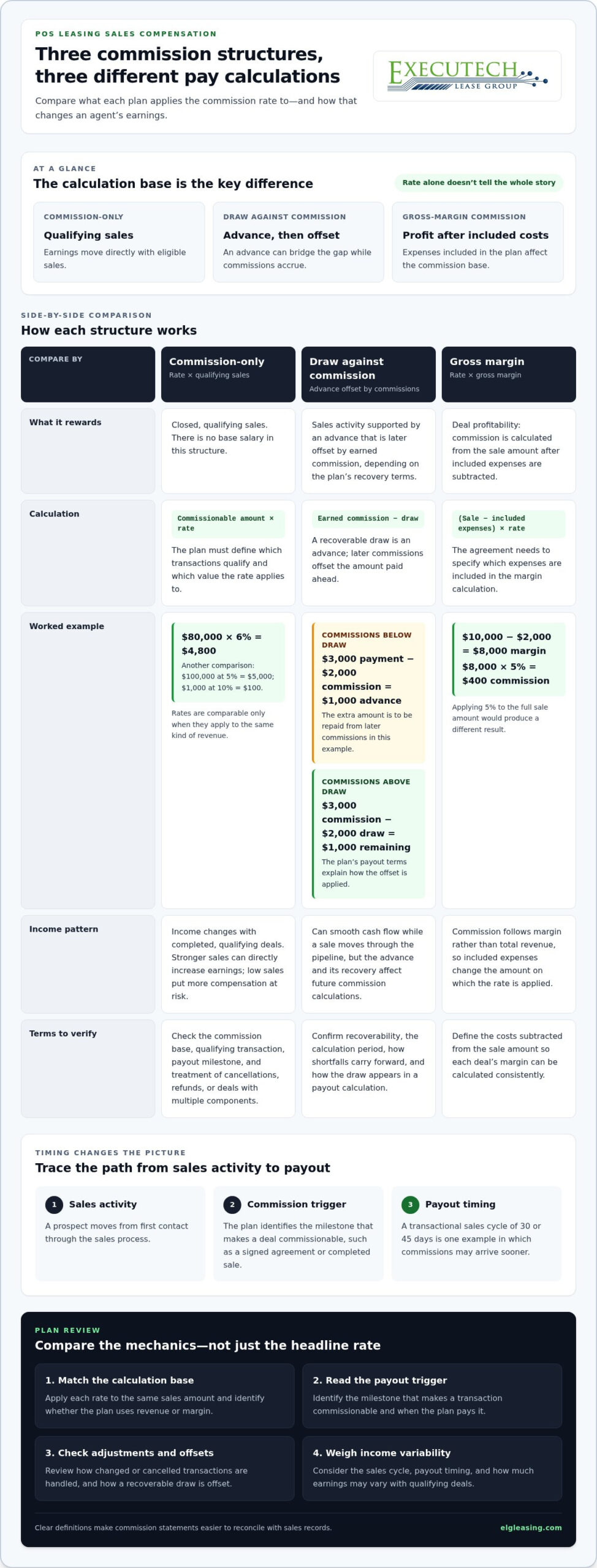
Commission-only pay links an agent’s earnings directly to qualifying sales. There’s no base salary in this structure. For example, a salesperson who closes $80,000 in revenue at a 6% commission rate earns $4,800. The formula is straightforward: multiply the commissionable amount by the rate. Your actual earnings still depend on which sales count and when the plan pays them.
The commission rate alone doesn’t tell you how a plan works. The agreement should define its calculation base, qualifying transaction, and payout point. A 5% rate on $100,000 in sales produces $5,000 in commission. A 10% rate on a $1,000 product sale produces $100. The percentages are only comparable when both plans apply them to the same kind of revenue.
For POS leasing sales, read the plan’s deal definitions closely. Check whether commission applies to a signed agreement, a completed sale, or another specified milestone. Then establish how the plan treats cancellations, refunds, and deals with multiple components. Those terms determine which transactions enter the calculation, not the headline rate. Clear definitions also make it easier to reconcile your sales records with each commission statement.
Payout timing affects how commission-only income flows. A transactional sale cycle of 30 or 45 days is one example in which commissions may arrive sooner. Longer sales cycles can separate the work of developing a prospect from the payout. Map the steps from first contact through the plan’s commission-triggering milestone. That timeline helps you assess how much time can pass between sales activity and earnings.
Before comparing two commission-only offers, use this short review:
- Calculate sample earnings. Apply each rate to the same sales amount and check the arithmetic.
- Read the commission base. Determine which revenue or transaction value the rate uses.
- Trace the payout trigger. Note the milestone that makes a deal commissionable.
- Review adjustments. Find how the plan handles changed or cancelled transactions.
This structure puts more of your compensation at risk when sales are low, while stronger sales can directly increase earnings. That makes the plan’s sales expectations and payout mechanics central to evaluating it. Consider whether you can manage income that changes with completed, qualifying deals. For POS leasing commission structures for sales agents, compare the rate, calculation base, and payment trigger together, not just the rate.
Draws against commission
A draw against commission advances pay before earned commissions cover that amount. It can smooth cash flow while a sale moves through the pipeline. The key distinction is whether the draw is recoverable. With a recoverable draw, later commissions offset the advance. The draw’s label alone doesn’t explain what happens when commissions fall short of or exceed the advance.
Consider the monthly example: a salesperson earns $2,000 in commissions but receives a $3,000 guaranteed payment. The extra $1,000 is an advance that must be repaid from later commissions. The draw raises that month’s payment, but it doesn’t create an additional $1,000 in commission. Instead, the plan carries that advance into the future commission calculation.
A separate example shows how a draw can work when commissions exceed the advance. With a $2,000 draw against commission and $3,000 earned in commission, subtracting the draw leaves $1,000 after the draw is deducted. This is the amount remaining beyond the draw under that calculation. Read the plan’s payout terms to see how it applies the offset and reports the remaining commission.
For a POS leasing sales role, timing matters. A prospect may take time to move from initial discussion to a completed transaction. A draw can bridge part of that gap, while earned commissions vary with qualifying sales. To understand the arrangement, map a deal’s milestones against the draw period and commission payout rules. This makes the cash-flow effect easier to assess than the draw amount alone.
- Identify recoverability. Find out whether an unpaid draw balance carries forward against later commissions.
- Check the calculation period. Establish when the draw is paid and when commissions offset it.
- Follow a sample transaction. Trace how the draw and commission appear in the payout calculation.
- Review low-commission periods. Understand how the plan handles a shortfall before stronger sales arrive.
Compare draw plans by the balance they create, not only by the payment received upfront. For example, a $3,000 monthly payment paired with $2,000 in commissions leaves an advance to recover. A $2,000 draw paired with $3,000 in commissions leaves $1,000 after deduction. Those examples show why the plan’s recovery terms and timing affect the practical value of a draw.
For a separate merchant-side step, a business seeking POS equipment can begin a POS equipment application. That process concerns equipment acquisition, not a sales agent’s draw or commission calculation.
Gross margin commission
A gross-margin commission applies a rate to profit from a sale rather than to total revenue. First, subtract the expenses included in the plan from the sale amount. Then multiply the remaining gross margin by the commission rate. This structure ties an agent’s commission to deal profitability. The plan must define which costs count, or the same sale could produce different commission calculations.
For example, a $10,000 sale with $2,000 in expenses produces an $8,000 gross margin. At a 5% commission rate, the agent earns $400. The calculation is $8,000 multiplied by 5%. Applying that same rate to the full $10,000 sale would produce a different result, so identify whether the plan uses revenue or margin as its base.
A second example shows how unit economics affect total earnings. Selling 10 units with a $200 gross margin per unit produces $2,000 in gross margin. At a 15% commission rate, the commission is $300. The unit count alone doesn’t determine pay. The margin per unit and the rate both shape the final amount.
Commission rates commonly fall within 20% to 30% of gross margins, with the range varying from 5% to 100%, depending on the setup. Those figures describe different plan designs, not one universal rate. Compare rates only after confirming the margin calculation. A higher percentage applied to a smaller margin base may pay less than a lower percentage applied to a larger base.
Before evaluating a gross-margin plan, pin down these calculation details:
- Included expenses. Identify which deal costs reduce gross margin.
- Commission timing. Determine when the margin is calculated for payout.
- Adjustments. Understand how revised expenses affect a previously calculated commission.
- Deal reporting. Compare the recorded sale, expenses, margin, and rate on each commission statement.
For POS leasing sales, margin-based pay can make profitability part of the sales incentive. It also means that two deals with equal revenue may generate different commissions if their included expenses differ. For instance, a $10,000 deal with $2,000 in counted expenses has an $8,000 margin; a deal with different counted expenses has another commission base. Review the plan’s definitions and test them against a sample deal before comparing its rate with a revenue-based structure.
Quota-based commissions
Quota-based plans tie commission rates or payouts to sales target attainment. The plan may set a minimum threshold, increase rates above quota, or reduce rates below a performance level. Bonuses can reward milestones, while chargebacks or clawbacks may recover commission after a deal is cancelled, refunded, or churns within a defined window, typically 90 days to a year.
That structure makes the quota rules as important as the headline rate. One example sets a 50% quota-attainment threshold before commissions are paid. Another uses a 7% decelerator on deals closed while the salesperson is below 60% of quota. These rules affect how progress translates into earnings, especially before a rep reaches the target.
Accelerators reward production above quota. In one example, the rate rises from 10% up to 100% of quota to 15% beyond quota. A separate plan uses a $3,000 monthly base, a $10,000 quota, and 15% commission on sales above quota. Under this structure, sales above quota can add commission to the base, depending on the plan’s terms.
Milestone payouts can also change the timing or amount of commission. One suggested approach pays 40% of a commission when a salesperson reaches 50% of the goal. Another pays 65% at 70% attainment. A proposed plan pays 100% at 95%, but its suggested approach is untested and may not suit every industry. A separate example pays 110% when the salesperson reaches 105% of goal.
Rate modifiers need precise definitions. One example pairs a 10% standard rate with a 0.8% rate below quota or a 1.5% rate when the rep doubles quota. Because these figures materially change the payout, identify the applicable threshold, calculation base, and period before estimating earnings.
Use this checklist to compare plans:
- Quota basis: Confirm whether attainment measures sales volume, revenue, or another defined result.
- Threshold: Find the point where commissions begin or rates change.
- Accelerator or decelerator: Map the rate at target and above or below it.
- Recovery terms: Check when paid commissions can be reversed and how the clawback window applies.
For POS leasing commissions, quota-based pay can reward steady progress toward a target and exceptional performance, but the thresholds determine how much each deal contributes. Model a below-quota month, a month at target, and a month above target using the plan’s actual rules. This shows whether the structure rewards steady production, high attainment, or both.
A payout tied to attainment can make timing important as well as total sales. One suggested payout approach gives a salesperson 65% of their commission after they reach 70% of their goal. When comparing this kind of arrangement with a standard quota commission, clarify what portion is paid at the milestone and how the remaining commission is handled. The plan should also define which sales count toward the goal and how attainment is measured, so that the milestone can be evaluated consistently.
For forecasting, consider how earnings change as a salesperson approaches the payout point and then moves beyond it. Keep milestone payments distinct from commissions earned on individual deals, and check whether the written plan explains the calculation clearly. This helps prevent a headline payout from obscuring the conditions that determine when compensation is received.
How are sales agents typically paid for leasing POS systems?
Sales agents may earn a base salary, commission, or a combination tied to sales. A base-plus-commission example uses a $40,000 annual salary and a 10% commission rate on $100,000 in sales, producing $50,000 in total annual pay. The base provides fixed compensation in that example; commission adds earnings based on qualifying sales.
Tiered plans change the commission rate as sales volume reaches defined bands. One example pays 3% on sales from $0 to $10,000, 5% from $10,000 to $20,000, and 8% from $20,000 to $40,000. Another pays 5% up to $5,000, 8% between $5,000 and $10,000, and 12% above $10,000. The plan’s wording determines whether each rate applies only within its tier or across all sales after crossing a threshold.
Recurring commissions can add an ongoing component. One example pays 5% of a client’s monthly subscription payments. If an account pays $1,000 in monthly premiums at that rate, the agent receives $50 monthly. That differs from a single-sale commission: the calculation follows recurring payments rather than one completed transaction. The plan needs to clarify how long qualifying payments generate commission.
Territory plans connect earnings to a group’s sales instead of one agent’s individual deals. In one example, a territory with $50,000 in sales receives $5,000 when total team sales are $500,000 and the commission rate is 10%. That model emphasizes shared production. Agents evaluating it should distinguish their territory’s contribution from total team volume.
Payment timing also matters. An 18-month sales cycle can mean waiting up to a year for commission. Clawbacks may recover commission already paid when a deal is cancelled, refunded, or churns within a defined window, typically 90 days to a year. Compare the commission trigger with the sales cycle, then understand how later changes affect payout.
Use this comparison to assess a POS leasing sales plan:
- Base plus commission: Calculate fixed salary and variable earnings separately.
- Tiered commission: Apply each band’s rate to the correct sales volume.
- Residual commission: Trace recurring payments and the plan’s qualifying period.
- Territory commission: Separate individual sales from team or territory totals.
Choose the structure that best matches how you sell, how long deals take, and which results the plan rewards. A clear example calculation can reveal differences that a headline rate hides.
Executech Lease Group (ELG Leasing): 12-60 Month Credit Card and POS Equipment Leases
Executech Lease Group (ELG) helps merchants access payment-processing equipment through credit card and POS equipment leases. If you’re evaluating equipment financing for a merchant, ELG’s lease options offer a practical next step to explore.
Options include lease-to-own programs and Fair Market Value (FMV) leases. ELG leases POS and card terminal equipment, including Clover devices. The right structure depends on the merchant’s equipment needs and preferred lease arrangement.
For agents, understanding these options can help frame an equipment conversation clearly while keeping commission calculations separate from a merchant’s lease terms. Explore POS equipment leasing with ELG.
Put the right plan into practice
Choosing among POS leasing commission structures for sales agents starts with how you want your work and earnings measured. Before deciding, test the written plan against a realistic deal from prospecting through payout. Trace how the plan defines a qualifying sale, calculates commission, and handles changes to the transaction. This practical walkthrough can reveal whether the rules support the sales process you’ll actually follow.
For merchants, equipment access is a separate decision from an agent’s compensation plan. ELG can help businesses explore POS equipment leasing when they’re considering how to acquire payment-processing technology. Keep the decisions distinct: one concerns how you’re paid, the other concerns the merchant’s equipment arrangement.
A clear plan gives you a stronger foundation for each sales conversation. Take the next step with confidence.
Frequently Asked Questions
What commission rates do POS leasing agents earn per deal?
There’s no single standard per-deal rate for POS leasing agents; each plan defines its rate and calculation base. One plan may calculate commission from eligible sales revenue, while another may use gross margin or adjust payouts according to quota attainment. To estimate a deal’s commission, identify its qualifying value, apply the plan’s rate and thresholds, then account for any stated adjustments. Compare plans using the same deal assumptions.
How can a sales agent negotiate a POS leasing commission agreement?
Clarify the commission base, qualifying deal milestone, payout timing, and how cancellations, refunds, or deal expenses affect pay. For a draw, establish whether it is recoverable and how later commissions offset it. For a quota plan, confirm thresholds, accelerators, and any chargebacks.

Article by
Robert Ensminger
Robert Ensminger is the founder and CEO of Executech Lease Group (ELG Leasing), which specializes in equipment leasing and financing solutions for the merchant-services, payments, POS, and FinTech industries. With more than 20 years of industry experience, Robert helps ISOs, payment processors, POS providers, and software companies build practical equipment leasing programs. He founded ELG in 2010. His work focuses on responsive service, transparent program structures, subscription and SaaS-monetization programs, and helping ELG’s partners close more business while creating sustainable revenue.