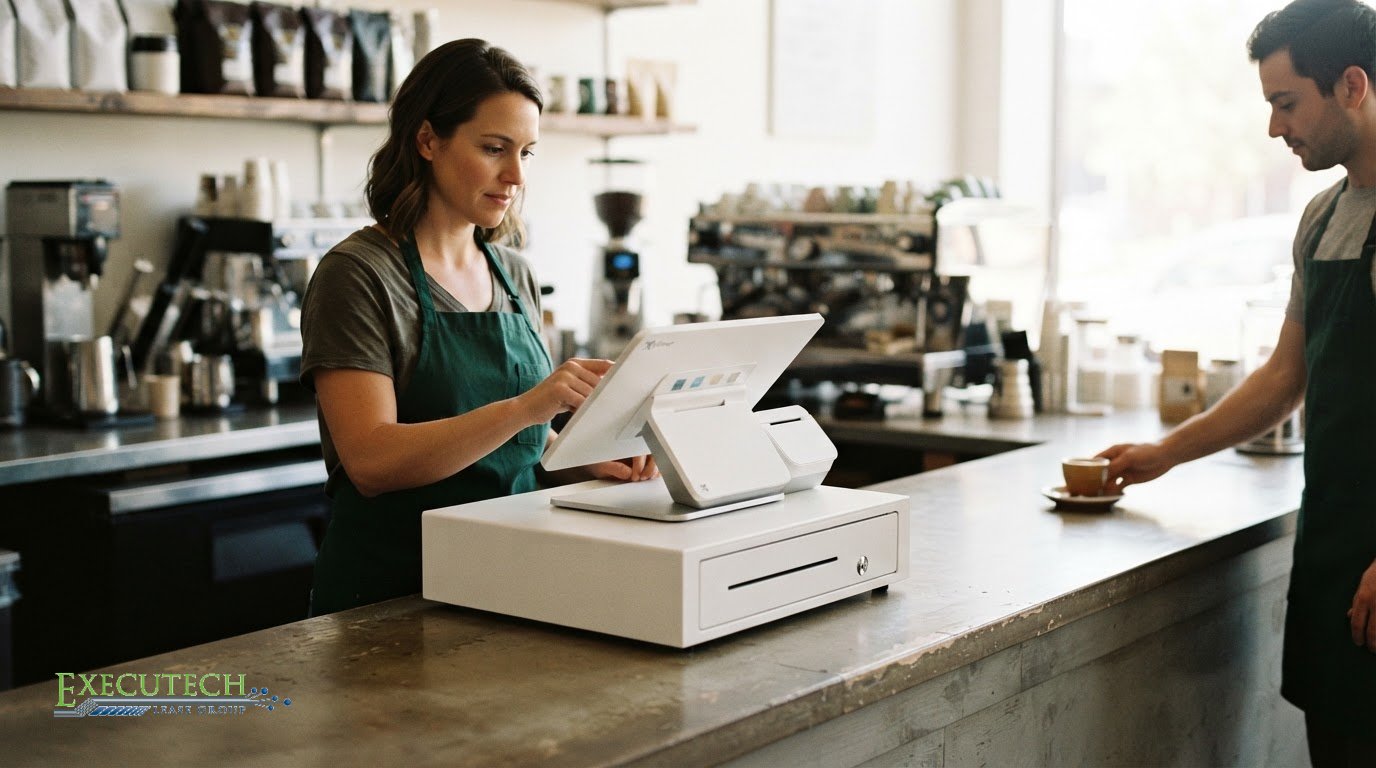
A new café can apply for equipment financing before it has a trading history, but approval depends on the application. Leasing POS equipment for coffee shops and cafes can spread the equipment cost across scheduled payments instead of requiring full payment upfront. A clear startup plan and realistic cash-flow forecast can help explain how the business expects to meet those obligations.
It’s reasonable to wonder whether a lender will consider a business that hasn’t opened yet. Focus on what the application needs to show, then compare the lease structure, payment schedule, and ownership options.
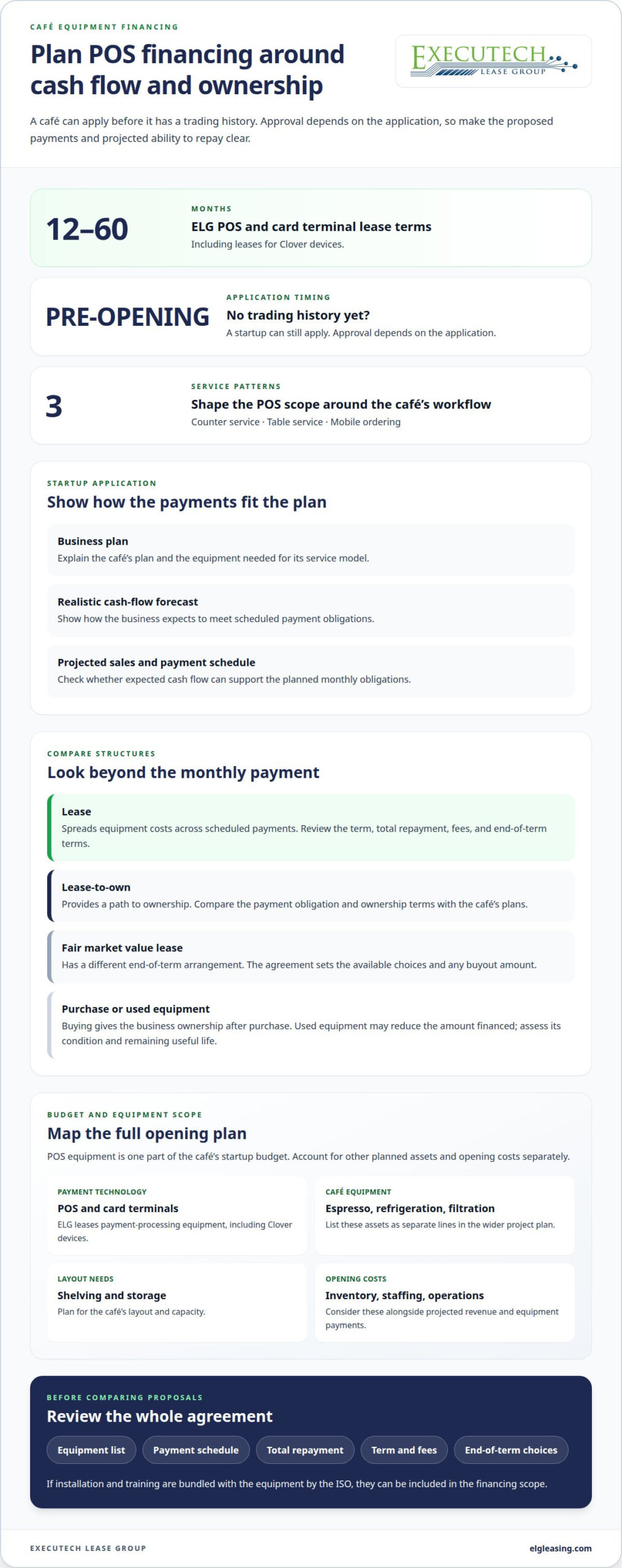
This guide explains how POS and equipment leasing works, what to compare beyond the monthly payment, and how startup eligibility is assessed. Executech Lease Group offers POS and card terminal equipment leases, including Clover devices, with terms from 12 to 60 months and options such as lease-to-own and fair market value leases.
Key Takeaways
- Explore equipment funding options, including SBA 7(a) loans, leasing, and purchasing used equipment, to match financing with your café’s needs.
- Compare lease and ownership structures by considering payment obligations, end-of-term options, and how each fits your operating plans.
- Build a startup budget that accounts for POS technology, installation, and ongoing equipment upkeep, while preserving working capital.
- Review the flat rate, APR, monthly payments, and total repayment together to understand the full cost of financing.
- A new café can explore equipment financing; applications may be assessed using the business plan and projected ability to repay.
Coffee shop equipment financing
A counter-service café may need a fixed checkout station, while table service depends on how staff take orders and payments around the dining area. For mobile ordering, consider how incoming orders will fit alongside in-person transactions. Define the equipment scope around the café’s service model.
Coffee shops and roasteries can consider business loans, equipment financing, leasing, or used assets. According to the U.S. Small Business Administration, SBA 7(a) loans are one source of business loans for roasteries and coffee shops in the United States. Credit review and repayment structures differ by financing route. Projected cash flow helps show whether monthly obligations fit planned sales.
Budget for more than the espresso machine. Storage needs depend on the café’s layout and capacity, so include shelving and other storage equipment in the project plan. These purchases compete for the same startup funds as POS equipment and opening expenses.
Used equipment can reduce the amount financed, but assess its condition and remaining useful life. A three-year-old commercial espresso machine from a reputable refurbisher is one possible second-hand option. A financing package may combine POS equipment with refrigeration or filtration, while separate purchases keep each asset’s costs distinct. Compare how each approach fits the café’s cash flow and operating needs.
Leasing and Hire Purchase Structures
Leasing spreads equipment costs across scheduled payments, while hire purchase generally combines payments with a path to ownership. Compare the monthly obligation, total repayment, and end-of-term terms before choosing. A roastery financing a roaster and a café financing POS equipment may have different priorities. Let the equipment’s role, cash flow, and ownership plans guide the decision.
Finance Leases, Operating Leases, and Rental
A finance lease, operating lease, and rental can differ in payment structure and end-of-term options. The contract sets the lessee’s obligations and what happens when the term ends. Rental may suit a temporary equipment need, while a lease may fit longer-term use. Compare the full agreement, including the term, total payments, and any return or purchase provisions.
Tie the financing decision to the café’s complete equipment plan. A POS system supports transactions, while refrigeration, storage, and water filtration support daily operations. List each asset, its intended use, and whether the business wants ownership at the end. This makes it easier to compare financing options with projected cash flow and planned service.
What Is Coffee Shop Equipment Financing?
Financing lets owners pay for POS equipment over time rather than paying the full cost upfront. Review the agreement’s fees and obligations, and make sure the proposed setup fits the café’s service and order flow.
Leasing or Owning Equipment
Leasing spreads payments over time, while buying gives the business ownership after purchase. Compare the equipment list, projected revenue, payment schedule, and ownership plans. A café planning to keep the same POS setup for years may weigh ownership differently from one focused on limiting upfront costs. Consider total payments, not just the first month’s obligation.
Tax Treatment of Lease Payments
Lease payments may receive different tax treatment depending on the contract structure. FMV lease payments may be deductible as an operating expense, but the business’s circumstances and agreement terms matter. Owners should have a CPA review the proposed lease before relying on a tax treatment in their cash-flow plan. Treat the tax effect as a separate consideration, not as a substitute for comparing total payments and end-of-term obligations.
Lease Terms and Upgrade Options
The term determines how long payments continue and helps shape the monthly obligation. Compare the payment schedule with the POS equipment’s planned useful life and the café’s revenue forecast. If the café wants updated equipment, consider that when the current term ends, then assess whether a new lease fits its plans.
Lease Types and Buyout Options
A lease-to-own structure provides an ownership path, while a fair market value lease has a different end-of-term arrangement. Under an FMV option, the end-of-term buyout amount depends on the lease agreement. Review the agreement for the end-of-term choices, payment obligations, and any fees. The right structure depends on whether the café values eventual ownership or prefers an option that does not make ownership the central goal.
For POS setup, the provider can align the financed equipment with counter, table-service, or online ordering needs. The merchant services provider or ISO can handle installation and training when those services are bundled with the equipment. This keeps the financing scope clear while connecting the selected system to the café’s actual workflow.
Coffee shop technology and POS startup costs
A provider can map your café’s service model to a practical POS equipment scope. For owners considering leasing POS equipment for coffee shops and cafes, the proposal should clearly identify the equipment and any bundled installation or training.
Preserving Working Capital for Opening Costs
Financing POS equipment spreads its cost across scheduled payments rather than using the full amount of capital upfront. This can leave working capital available for opening priorities such as initial inventory, staffing, and operating expenses. Review the equipment included and consider the payment obligations alongside projected revenue to see how the structure fits the café’s plans.
Opening and Installation Costs
The opening budget should separate equipment from site preparation and other launch expenses. Installation and training may be included in lease financing when an ISO bundles them with the equipment. Keep the itemized scope clear so bundled services aren’t confused with rent, inventory, or other startup costs.
Servicing, maintenance, and breakdowns need separate budget attention. Equipment financing covers the financed items and eligible bundled installation or training, not future maintenance or repairs. Owners can account for those operating needs separately rather than treating the lease payment as a service plan. This distinction keeps the equipment commitment and the café’s ongoing upkeep expenses visible in the opening budget.
Essential POS Equipment for Cafes
Shape the POS equipment list around how orders move through the café. Counter service, table service, and mobile ordering create different workflows, so identify where staff enter orders, send them for preparation, and take payment. A proposal for leasing POS equipment for coffee shops and cafes should reflect those needs, not simply name a general POS system.
Equipment Included in a Cafe POS Lease
The agreement’s itemized equipment list shows what the lease covers. It may name components such as terminals, printers, and card readers, depending on the selected equipment scope. Match each listed item to a task in the café’s workflow, such as entering an order or completing payment. When installation or training is bundled by the ISO, the financing scope can include those items too. The contract sets the included equipment and obligations.
Comparing flat rates, APR, and total repayment
A flat rate, annual percentage rate (APR), and total repayment describe different parts of a financing offer. The monthly payment alone doesn’t show the full cost of a POS lease or espresso machine financing. Compare offers using the same equipment amount and term, then review the rate, payment schedule, fees, and any end-of-term amount together.
A flat rate applies a stated percentage to the original amount financed. For example, a quote of 5% a year is a flat-rate example, but it doesn’t tell you the APR. The APR reflects the cost of financing differently, and may be close to double the flat rate. Don’t treat those two percentages as interchangeable.
Use the application and written agreement to identify the amount financed, payment frequency, term, fees, and buyout terms. Multiply the number of monthly payments by each payment amount, then add applicable fees and any end-of-term purchase amount. This gives a clearer total repayment figure than comparing monthly payments alone. Use the same method for each offer.
Consider an espresso machine financed over a stated term. A lower monthly payment may reflect a longer repayment period, not a lower overall expense. Compare total repayment with the cost of paying outright, while considering the cash the café would retain for opening expenses. Keep the equipment scope consistent so an offer doesn’t appear cheaper simply because it includes fewer items.
For a POS application, separate recurring equipment payments from other business expenses. Check whether the quoted repayment includes installation or training bundled with the equipment. Then examine fees, payment dates, and the agreement’s end-of-term choices. A fair market value lease, for example, can include a buyout about 10% of original equipment cost. Include that amount when comparing total costs if ownership is your plan.
- Flat rate: Read the stated percentage and its calculation basis. A 5% annual flat-rate example is not the APR.
- APR: Compare the APR across financing offers rather than assuming it matches the flat rate.
- Total repayment: Add monthly payments, applicable fees, and any planned buyout.
- Cash impact: Compare financing with paying outright, including the cash needed for other café expenses.
Finally, compare what each agreement finances and what happens at the end. A consistent equipment list and repayment calculation help owners assess the full commitment, not just the advertised monthly amount.
Eligibility for cafes and coffee shops
A new café can apply for equipment financing without a trading history. Eligibility for leasing POS equipment for coffee shops and cafes depends on the application, not simply the opening date. A lender may assess the owner’s credit profile, business plan, equipment request, and projected cash flow. Without a sales record, the plan and forecasts can explain how the café expects to meet its payment obligations.
Make projected revenue and expenses specific to the café’s operating plan. Show how anticipated cash flow relates to annual repayments. One useful planning benchmark is projected cash flow covering annual repayments by at least 1.25 times. This helps demonstrate the relationship between forecast income and financing costs. It is a planning measure, not a universal approval rule.
For example, connect expected customer volume to the equipment request. A café selling 200 cups a day is an example of a business clearing the projected debt service coverage requirement comfortably. That example doesn’t establish a standard lenders must follow. Each application is considered on its overall details, including credit, projected revenue, and planned expenses.
Define the equipment scope clearly. An application for an espresso machine, POS equipment, and grinders should explain how each asset supports the planned operation. Leasing POS equipment for coffee shops and cafes is easier to assess when the application identifies payment equipment separately from other startup purchases. This gives the request a clear context alongside the proposed business and repayment plan.
A practical application can include a business plan, startup budget, sales forecast, and itemized equipment list. Tie forecast assumptions to the café’s operating model and expected customer volume. If the plan includes multiple revenue scenarios, show how the proposed payment obligations fit each one. Concrete details help the lender assess repayment capacity rather than rely on a broad estimate of future sales.
A small business or a lack of trading history alone doesn’t show whether an application is suitable. The lender considers the credit profile, cash-flow projections, equipment request, and expected repayments together. For leasing POS equipment for coffee shops and cafes, connect the terminal or system to planned transactions and show how payments fit the startup budget.
Executech Lease Group (ELG Leasing): 12-60 Month Credit Card and POS Equipment Leases
Executech Lease Group (ELG Leasing) is a next step when a café needs payment-processing equipment and wants to spread its cost over scheduled payments. It leases POS and card terminal equipment, including Clover devices. Its equipment leases run from 12 to 60 months, giving merchants term options to consider alongside projected cash flow and equipment plans.
The lease structure matters as much as the equipment list. Lease-to-own programs provide a path to ownership, while fair market value (FMV) leases have a different end-of-term arrangement. Compare the payment schedule, total repayment, term, and end-of-term terms together to understand the commitment and decide which structure fits the café’s plans.
A new coffee shop can focus its financing request on payment-processing equipment rather than every item in a full café buildout. An itemized equipment scope gives the application a clear purpose. The POS and card terminal equipment should match how the café accepts orders and payments, whether service is at a counter or through another ordering workflow.
Executech Lease Group (ELG) offers no-money-down equipment leasing, which means no down payment is required, not that the equipment is free or that lease obligations disappear. Credit decisions are subject to review, so the application and repayment capacity matter. Keep the requested equipment, planned term, and projected cash flow aligned. ELG leases equipment; payment processing and equipment maintenance are separate.
When comparing options, look at the lease terms and program details together. Lease structures and program options can help frame the choice between lease-to-own and FMV arrangements. An FMV option should be considered in light of its end-of-term provisions, while a lease-to-own program suits owners who prioritize an ownership path. The agreement governs the actual obligations.
This financing is relevant when your café needs POS or card terminal equipment and wants a structured lease rather than an outright purchase. It is not a substitute for payment processing or a complete opening budget. Define the equipment scope, then compare the agreement’s term, payments, and end-of-term provisions with your operating plan.
To discuss equipment leasing for your café, contact Executech Lease Group.
Frequently Asked Questions
Can I get equipment finance for a brand-new café with no trading history?
Yes, a café can apply before it has a trading history. A startup application can set out the business plan, owner’s credit profile, forecast, and requested equipment. For example, explain how the POS system will support planned counter or table service. This gives the lender context for assessing the request without past sales. The application is reviewed on its details, not simply the café’s age.
Can startup coffee shops qualify?
Yes, startup coffee shops can apply for POS equipment leasing. A focused request identifies the payment equipment needed and how it fits the opening plan. A café opening with counter service, for instance, can explain the role of its checkout setup. Keep equipment financing distinct from inventory, rent, and other startup needs so the request and repayment plan are clear.
Who qualifies for POS system financing?
Businesses seeking POS equipment for their operations, including coffee shops and cafés, can apply. A financing review may consider the applicant’s credit profile, business information, requested equipment, and repayment capacity. A café with a defined operating plan can explain how the system supports transactions. Business size alone doesn’t determine the outcome.
Why lease a POS system instead of buying?
Leasing involves scheduled payments rather than paying the full equipment cost upfront. This may suit an owner who wants to keep available cash for other business needs. Buying may suit an owner who prefers ownership without an ongoing lease agreement. Compare the total commitment and end-of-term terms with the café’s cash priorities. The right choice depends on the business’s plans, not a general rule that leasing is always better.
Which companies offer POS hardware leasing for cafes?
Executech Lease Group (ELG) leases POS and card terminal equipment, including Clover devices. Its role is equipment leasing, not payment processing or supplying merchant accounts. A café should distinguish the equipment agreement from its separate payment-processing relationship. The lease covers the listed equipment; payment processing remains a separate arrangement.
What are typical POS equipment lease terms, fees, and contract lengths?
Executech Lease Group offers POS equipment lease terms from 12 to 60 months, with lease-to-own and fair market value options. Fees and obligations depend on the specific agreement, so review the full payment schedule and end-of-term provisions. Compare the total commitment rather than relying on the monthly amount alone. The lease document defines the applicable terms for the equipment and agreement.
Is leasing POS equipment better than buying or financing it?
No single method suits every café. Leasing involves scheduled equipment payments, while buying requires payment upfront and provides ownership. Other financing structures may have different payment and ownership terms. Consider whether the café prioritizes keeping cash available for other expenses or owning its equipment outright. Compare the full agreement and business priorities rather than assuming one approach always costs less.
Can small coffee shops qualify for POS equipment leasing, and what credit requirements apply?
Small coffee shops can apply, but no single credit requirement determines every decision. A review may consider the owner’s credit profile, business details, equipment request, and repayment capacity together. A concise application should explain the café’s operating plan and how the POS equipment will be used. Approval depends on the individual application, so business size or credit information alone doesn’t tell the whole story.
This article reflects the author’s opinion for general information only and isn’t tax, legal, or accounting advice. Consult your CPA or attorney about your specific situation.
Article by
Robert Ensminger
Robert Ensminger is the founder and CEO of Executech Lease Group (ELG Leasing), which specializes in equipment leasing and financing solutions for the merchant-services, payments, POS, and FinTech industries. With more than 20 years of industry experience, Robert helps ISOs, payment processors, POS providers, and software companies build practical equipment leasing programs. He founded ELG in 2010. His work focuses on responsive service, transparent program structures, subscription and SaaS-monetization programs, and helping ELG’s partners close more business while creating sustainable revenue.