The cheapest POS choice today can cost more over time. For a new business, leasing vs buying a POS comes down to more than the upfront cost: leasing typically requires less cash at the start, while buying may cost less over the equipment’s useful life if you keep it for years.
It makes sense to focus on cash flow when opening a business. But the right choice also depends on how long you expect to use the system, how your operations may change, and the total cost of each option.
This guide compares upfront costs, cash flow, business needs, growth plans, and net present value (NPV), a way to assess costs that occur at different times. You’ll see when leasing can preserve cash for other startup needs, when buying may suit stable operations, and how to weigh the trade-offs without relying on the monthly payment alone.
Key Takeaways
- Compare the full cost of ownership with lease payments, including who handles maintenance and what happens if equipment fails.
- Weigh upfront cash needs against long-term costs, ownership, and any usage-based or payment-processing expenses.
- Match the choice to your expected equipment needs, inventory, and growth plans rather than buying for a future you may not need.
- Use net present value to compare costs over time and account for when payments and other expenses occur.
- Explore POS and card terminal lease structures, including lease-to-own and fair market value options, when preserving startup cash matters.
Is leasing equipment cheaper than buying?
Buying may cost less over time when equipment serves your business for years. Leasing spreads payments across an agreed term and can preserve cash for other startup needs. Compare the full cost and contract terms, not just the initial outlay.
Buying Versus Leasing Equipment
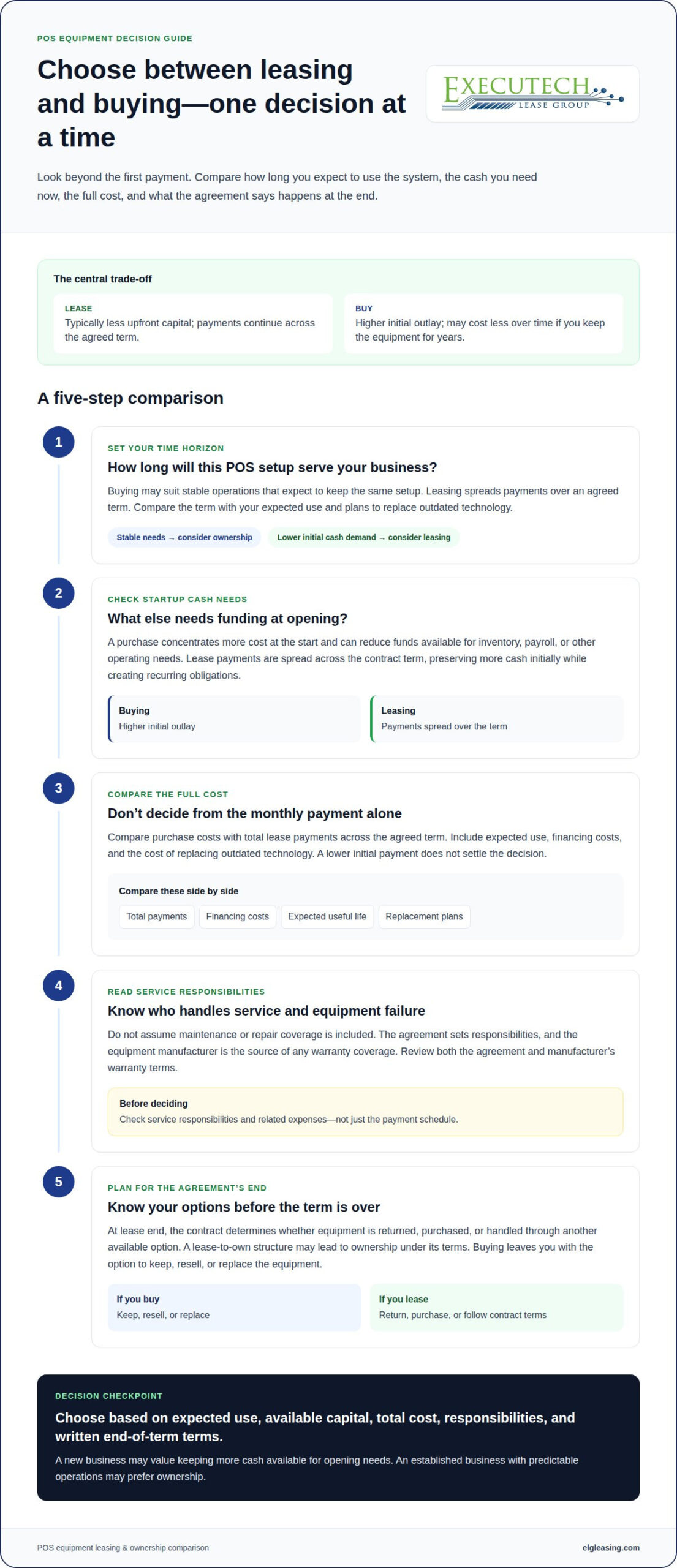
Buying gives owners control of the equipment and any resale value it retains. That can suit stable operations expecting to keep the same POS setup. Leasing typically requires less upfront capital but creates ongoing payments for the agreed term. Before deciding, compare total lease payments with purchase costs, expected use, and the cost of replacing outdated technology.
Rental Terms, Maintenance, and Equipment Failure
Lease agreements set the payment schedule, term, and responsibilities. Don’t assume maintenance or repair coverage is included. Warranty coverage comes from the equipment manufacturer, and lease payments do not include repair, maintenance, or exchange services. Review the agreement and manufacturer’s warranty terms to understand who handles service and related expenses.
POS Equipment at Lease End
At lease end, the agreement determines whether you return the POS equipment, purchase it, or choose another available option. A lease-to-own structure may lead to ownership under its terms; other agreements may require you to return the equipment. Use the end date to plan for continued use, replacement, or an available end-of-term option. The contract’s terms control these choices.
| Option | Upfront cost | Maintenance and failure | End of term |
|---|---|---|---|
| Buy | Higher initial outlay | Owner arranges service; manufacturer warranty may apply | Keep, resell, or replace |
| Lease | Payments spread over term | Agreement sets responsibility; manufacturer warranty may apply | Return, purchase, or follow other contract terms |
Tax treatment can affect the comparison. Section 179 expensing may offer a tax benefit when you own business assets; ask your CPA how it applies. A CPA can explain how tax treatment applies to your equipment and business circumstances.
Match the equipment to current demand and realistic growth plans. A new shop opening with one checkout station may value keeping more cash available. An established store with predictable sales may prefer ownership. Decide based on expected use, replacement plans, equipment responsibilities, and the written agreement.
Compare the full term, service responsibilities, and end-of-term choices to find the option that fits your business.
Should your business lease or buy equipment?
For a new business, compare the equipment’s expected use with available capital and payment capacity. Buying may build ownership and resale value; leasing can spread payments and preserve funds for operating needs. The advantages depend on the agreement, financing costs, and how long the equipment will serve your business.
Tax treatment can affect the comparison. The Internal Revenue Service identifies Section 179 expensing as a possible tax benefit of owning business assets. A CPA can assess how tax rules apply to your equipment and business structure. An attorney can review contract terms, including your payment obligations and options if circumstances change.
For example, compare a 36-month lease on a two-station POS setup with buying the same equipment outright. Look at total payments, ownership at the end, and how long you expect to use the system.
Start your review before a lease renewal. That gives you time to compare a new term with buying, financing, or continuing with equipment you own. Rates and terms vary by provider and credit profile, so compare the actual financing terms side by side. Compare the actual financing terms alongside total payments and any end-of-term obligations. A lower initial payment doesn’t settle the decision.
- Before renewal: List the equipment you still need and its expected use.
- For each option: Compare total payments, interest, ownership, and end-of-term terms.
- Before signing: Have a CPA review tax treatment and an attorney review contract obligations.
A lease may require payments for the full term, even if your business stops using the equipment. Early termination may also trigger penalties. Before committing, read the agreement for its term, payment obligations, and end-of-term options. If there’s no early exit, factor that limitation into your operating plan rather than assuming you can change course.
Upfront costs and cash flow
For owners considering leasing vs buying a POS for a new business, upfront cash needs are only part of the decision. Compare equipment payments with other operating costs and the obligations attached to each agreement.
A business can use its own POS hardware with a different payment processor when the equipment and software are compatible and the agreements allow it. Compatibility matters: confirm that the hardware supports the intended setup before moving transactions or changing processors.
Upfront and Monthly Costs
Buying POS equipment concentrates more cost at the start. That outlay can reduce cash available for opening inventory, payroll, or other operating needs. Leasing spreads equipment payments across the contract term, easing the initial cash demand while creating recurring obligations. Compare the full payment schedule with how long you expect to use the system, not just the first bill.
Build a cash-flow comparison using the same equipment and business assumptions. List the purchase payment, any financing payments, and the lease schedule. Then compare those amounts with expected sales and startup expenses. A retailer opening before a busy season, for example, may prioritize keeping cash for inventory, while a business with funds set aside may prefer to purchase equipment.
Payment Processing Costs and Contract Terms
Equipment and payment processing are separate cost categories. Processing agreements may include transaction-based or recurring charges, according to their terms. Estimate those costs using expected transaction volume and payment mix, then include them in both POS scenarios. A low equipment payment alone doesn’t show the full cost of accepting payments.
Read the processing and equipment agreements together. Review the term, recurring obligations, cancellation conditions, and costs tied to changing systems or processors. If you plan to use your own hardware, assess whether its POS software and terminal fit the intended processor setup. Include any required configuration or compatible equipment in your comparison before signing.
Ownership and Long-Term Costs
Buying can leave the business with equipment it may keep using or resell. Its value depends on its condition and usefulness when it’s no longer needed. Leasing avoids a large purchase outlay, but payments continue under the agreement. Add expected software, maintenance, repair, and replacement expenses to the ownership scenario instead of treating the purchase payment as the entire cost.
Usage-based costs make operating patterns important. POS costs can also depend on usage, such as transaction volume under your processing agreement. POS processing costs depend on transaction volume and contract terms. For a practical leasing vs buying a POS for a new business comparison, identify which costs vary with usage, which recur, and how each option fits projected cash flow.
Evaluating business needs and growth plans
Start with the tasks your POS must handle today. A restaurant may need ordering, payment processing, inventory management, sales reporting, and employee management. Separate essential functions from features that can wait. This helps business owners avoid paying for capacity before sales and staffing needs justify it.
Next, map equipment to expected demand. A restaurant might open with two POS stations, then add equipment as it grows. Leasing can preserve flexibility when demand or expansion plans may change. Buying may suit a business with stable operations and predictable equipment needs. Don’t base the choice on projected growth alone; consider whether expansion is planned, funded, and likely to change checkout requirements.
Inventory needs also shape the setup. A retailer with many products may rely heavily on accurate inventory tracking, while a service business may prioritize checkout speed and sales reporting. List the functions each location needs, then identify which devices support those tasks. For example, adding a station makes sense when the existing checkout setup can’t handle actual customer flow.
Consider the equipment’s useful life alongside your business plan. If you expect to use the same POS system for years, ownership may provide value over time. If technology needs may change, leasing can avoid committing all available capital to equipment you may later outgrow. A lease still carries obligations for its full term, so projected expansion doesn’t automatically let you change equipment early.
Depreciation is another ownership consideration. Purchased equipment may be depreciated, but the applicable treatment depends on the asset and your business circumstances. Discuss this with your CPA rather than assuming a particular deduction or schedule. For leased equipment, accounting treatment depends on the lease structure, so compare the agreement’s terms with your business’s accounting approach.
Use a short planning exercise before choosing:
- List current POS tasks, stations, and inventory needs.
- Separate confirmed expansion plans from possible future growth.
- Compare equipment use over the expected term with ownership, lease payments, and depreciation considerations.
A business opening with two restaurant stations and a funded expansion plan can evaluate whether to buy the full setup now or phase equipment needs. A stable operation with predictable inventory and checkout demands may favor ownership. Choose based on the equipment your business expects to use, not an unsupported growth forecast.
Comparing leasing and buying with net present value
Net present value (NPV) compares payments made at different times in today’s dollars. It helps show whether preserving immediate cash justifies higher or longer-term expenses. For a leasing vs buying a POS for a new business decision, compare both options over the same period and include every cost tied to using the system.
For each option, list the initial investment, future payments, operating expenses, and any value remaining at the end. Discount future cash flows using a rate that reflects your cost of capital or the return you could earn elsewhere. Apply the same rate and time period to the lease and purchase scenarios. Otherwise, the comparison may favor one option simply because its costs occur later.
Consider a new bakery opening one location with one checkout station. Buying requires the bakery to commit more capital immediately, while leasing spreads equipment payments across the agreement. The purchase calculation should include setup, software, maintenance, repairs, and eventual replacement costs. The lease calculation should include scheduled payments, required expenses outside the agreement, and any end-of-term purchase amount or return costs.
Then discount each future cash flow to its present value. A simplified formula is NPV = initial cash flow + the present value of future cash flows. Treat outflows as costs and any resale value as an offset. If the bakery has limited opening capital, the lease may preserve money for ingredients and payroll. If buying results in lower discounted total costs and the bakery expects long-term use, ownership may make more financial sense.
- Set one comparison period: Use the expected time the bakery will need the POS.
- List cash flows: Include upfront investment, lease payments, operating expenses, and end-of-term costs.
- Discount consistently: Apply the same discount rate to both scenarios.
- Compare NPV and liquidity: Review total present cost alongside the immediate cash each option requires.
Lease structure matters. A return-based agreement and a lease with a purchase option create different end-of-term cash flows. Include the applicable option cost and any remaining obligations rather than assuming ownership transfers automatically. Also include each expense only once; don’t count bundled costs again as separate payments.
NPV gives a clearer cost comparison, but available cash still matters. This approach makes leasing vs buying a POS for a new business easier to assess: choose an option with an acceptable present cost that also leaves enough working capital for opening operations.
Executech Lease Group (ELG Leasing)
Executech Lease Group helps businesses access POS and card terminal equipment through lease options designed around equipment financing, not payment processing. If buying equipment outright would put too much pressure on opening cash, a lease can spread equipment costs across an agreed term. If ownership matters more, a lease-to-own structure may better fit your plans.
Available terms run from 12 to 60 months for credit card and POS equipment leases. That gives you a defined period for payments and a way to plan equipment costs alongside other business expenses. The right term depends on your expected use, cash-flow priorities, and the contract’s end-of-term structure. Review those details alongside your purchase comparison, rather than judging an option by its periodic payment alone.
Lease-to-own programs are designed for businesses that want a path toward owning the equipment under the agreement’s terms. Fair market value (FMV) lease options follow a different structure. At the end of an FMV lease, the equipment may be returned or purchased according to the agreement; the FMV buyout is about 10% of original equipment cost. The distinction matters if your plan depends on keeping the POS system after the lease ends.
ELG’s options apply to POS and payment-processing equipment, including Clover devices. Leasing can help business owners consider the equipment investment separately from other startup needs while keeping the lease obligations visible in cash-flow planning. A lease doesn’t remove the need to review total payments, equipment use, or the contract’s end-of-term terms. It changes how you fund access to the equipment.
ELG works with merchant services providers, ISOs, and payment processors to help their merchants acquire payment technology through lease programs. For a new business, this can be a practical next step after comparing ownership costs, immediate cash needs, and the equipment’s expected useful life. Choose a lease structure that aligns with how long you expect to use the system and whether ownership is part of your plan.
Review the available POS equipment leasing programs as you weigh lease terms and end-of-term options. A clear comparison starts with the equipment required, the expected term, and your preference for returning or owning it later.
Contact Executech Lease Group to discuss POS equipment leasing for your business.
Frequently Asked Questions
Making Informed Decisions: Buy or Lease?
Choose the option that fits your business’s likely operating conditions, not just its opening budget. Model a slower sales period, for example, and ask whether fixed lease payments or an equipment purchase would leave enough cash for payroll and inventory. Then compare that with expected equipment use and end-of-term plans. A decision that still works under a conservative sales forecast is more resilient than one based only on optimistic projections.
POS Rental vs Buying: Which Option Makes More Sense for Your Business?
A POS rental or lease can suit a business that wants to spread equipment payments over a defined term. Buying may better fit a business that plans to keep the same setup and wants ownership. The distinction also matters at the end: rental agreements may require equipment return, while ownership leaves you responsible for what happens next. Compare the agreement’s complete obligations, not just the initial payment or recurring amount.
So when looking to lease, what should you be aware of?
Understand the full commitment before signing: the term, payment schedule, equipment covered, and end-of-term options. Check whether software or other services are separate from equipment payments. Also identify who handles warranty claims, repairs, or replacement if a device fails. ELG provides equipment leasing, not warranties, maintenance, repairs, replacements, or exchange support. Warranty coverage comes from the manufacturer. Keep the signed agreement and manufacturer warranty information accessible to the person responsible for POS operations.
What Should You Ask a POS Rental Provider?
Clarify the agreement’s term, total payment schedule, equipment included, and end-of-term choices. Identify costs outside the equipment agreement, including software, installation, or payment processing, if applicable. Review who is responsible for maintenance and how the manufacturer’s warranty applies if a device fails. For a restaurant with multiple checkout stations, confirm how the agreement treats each unit and any separately added equipment.
Which Option Is Better for Your Restaurant?
For a restaurant with steady operations and a POS setup expected to serve for years, buying may fit its long-term plans. A new restaurant uncertain about customer flow may prefer to preserve opening capital and lease its initial equipment. Map each station to a real task, such as taking orders or processing checkout, before deciding. Avoid committing to more equipment than the opening menu and service model require.
Why should you consider leasing?
Leasing can make equipment payments predictable across the agreement and reduce the immediate cash needed to put a POS system in place. That may matter when a new business needs available funds for inventory, staffing, or opening expenses. Leasing also establishes a defined period of equipment use. Balance those advantages against the ongoing payment obligation and the agreement’s end-of-term terms before choosing.
What does it cost to buy a POS system for a new business in the US?
The purchase cost depends on the hardware configuration, number of checkout stations, software, and any setup services included. Purchase prices vary by vendor and configuration. Build a complete estimate that separates equipment from software and payment-processing expenses, since those can follow different agreements. Also consider costs that may arise later, such as maintenance, repairs, or replacement equipment.
How much does it cost to lease or rent a POS system, including fees?
Lease or rental pricing depends on the equipment, term, and agreement structure. The price depends on the case and is given after a quote request. Review the scheduled payments and identify any separate costs for software, processing, installation, or other services. Don’t assume maintenance or repairs are included. For a fair comparison, total the agreement payments and other required expenses over the period you expect to use the system.
This article reflects the author’s opinion for general information only and isn’t tax, legal, or accounting advice. Consult your CPA or attorney about your specific situation.

Article by
Robert Ensminger
Robert Ensminger is the founder and CEO of Executech Lease Group (ELG Leasing), which specializes in equipment leasing and financing solutions for the merchant-services, payments, POS, and FinTech industries. Robert helps ISOs, payment processors, POS providers, and software companies build practical equipment leasing programs. He founded ELG in 2010. His work focuses on responsive service, transparent program structures, SaaS-monetization programs, and helping ELG’s partners close more business while creating sustainable revenue.