
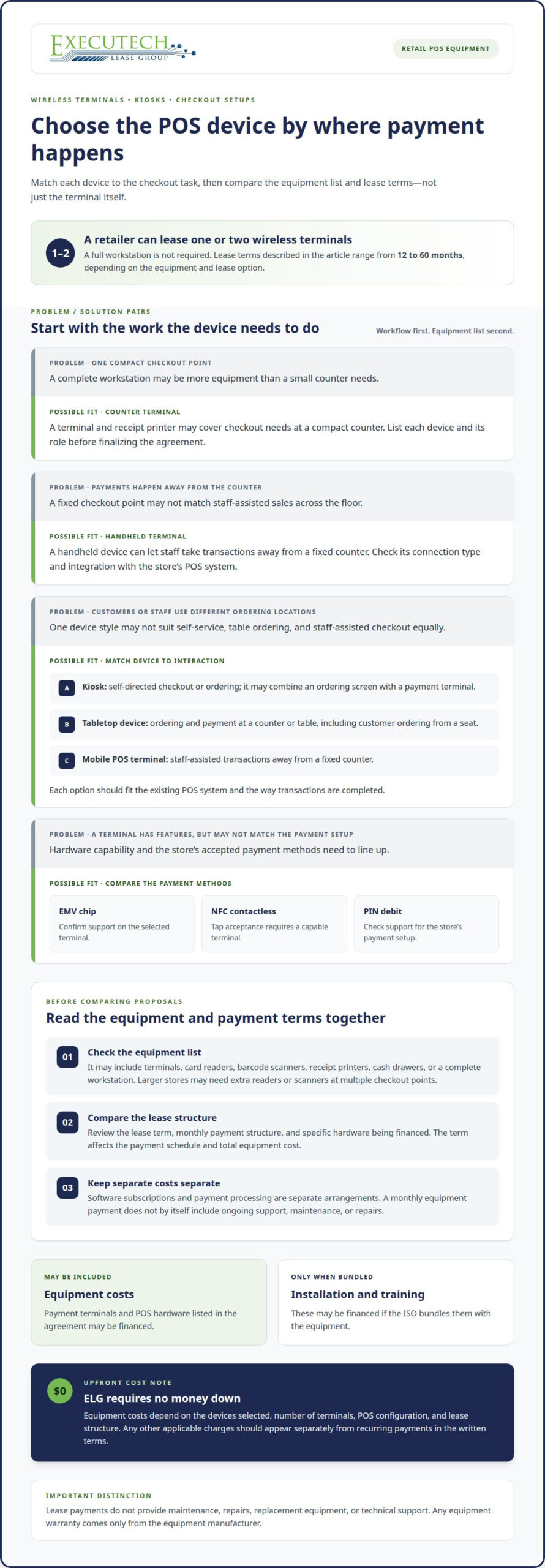
Yes, a retailer can pursue leasing for one or two wireless POS terminals rather than a full workstation setup. Wireless POS terminal leasing for retail stores can be arranged through lease terms of 12 to 60 months, depending on the equipment and lease option. The right structure starts with the number of terminals and how the store plans to use them.
Equipment costs may be included in the lease. Installation or training may be included if the ISO bundles those services with the equipment. ELG does not provide repairs or replacements. Any warranty comes only from the equipment manufacturer.
This guide explains what an equipment lease may include, how FMV and lease-to-own options differ, and what to understand about end-of-term purchase terms. It also covers how Executech Lease Group (ELG) leases POS equipment to retailers considering wireless terminals for one checkout point or several.
Key Takeaways
- See how leasing can fit a retailer that needs one or two wireless terminals, not a complete workstation.
- Understand which equipment costs may be financed and when bundled installation and training can be included.
- Learn how kiosks, tabletop ordering devices, and remote management fit into a POS setup.
- Compare FMV and lease-to-own options, including how end-of-term purchase terms affect total cost.
- Identify the equipment, lease term, and other factors that shape a POS lease, while keeping software and service costs distinct.
Integrated payment terminal options for U.S. retailers
Retailers can lease one or two wireless terminals without financing a complete workstation. The right setup depends on where staff take payments and which payment methods the store accepts.
Available Terminal and POS Equipment
A retail POS setup may combine payment terminals with card readers, barcode scanners, receipt printers, cash drawers, or a complete workstation. For a compact counter, a terminal and receipt printer may cover checkout needs. A larger store may need extra readers or scanners at multiple checkout points. Identify each device’s role before finalizing the equipment list in the agreement.
Provider and Hardware Feature Comparisons
When comparing lease proposals, review the equipment list, term, monthly payment structure, and terminal features. These details help show whether the arrangement fits one checkout counter or several. Compare support for EMV chip, NFC contactless, and PIN debit payments, then confirm that the selected hardware and payment setup accept the methods customers use.
Square Terminal is one example of a handheld payment device retailers may consider. Other handheld terminals can let staff take transactions away from a fixed counter, such as while assisting customers on the sales floor. A device’s connection type and integration with the store’s POS system affect where it can be used. The lease agreement should identify the specific equipment being financed.
In-person checkout, online sales, and contactless payments involve different transaction settings. A countertop terminal handles in-person sales, while online checkout uses a digital payment flow. Retailers operating in both channels should consider how sales records and inventory connect across systems. NFC contactless acceptance lets customers tap a compatible card or device at a capable terminal.
A fixed terminal can keep checkout organized at a busy counter. For retailers taking payments across the sales floor, a handheld device may offer more flexibility. Compare support for EMV chip, NFC contactless, and PIN debit payments. The lease covers equipment; the processing arrangement and payment setup determine how transactions are handled.
Can software and installation be financed with the hardware?
The retailer submits business and equipment details for lease review, then reviews the agreement before equipment is ordered. After delivery, the ISO or installer can connect the terminal to the POS system if installation is bundled with the equipment.
Financed Hardware, Software, and Services
Equipment financing can cover payment terminals and POS hardware listed in the agreement. Installation and training may also be financed if the ISO bundles them with that equipment. Software subscriptions, ongoing support, maintenance, and repairs are separate. A monthly equipment payment does not, by itself, include those services.
Separate the cost categories before comparing proposals. For example, a leased wireless terminal may have an equipment payment, while POS software and payment processing are covered by separate arrangements. A no-cost POS offer may still involve processing terms, paid software, or other charges. Review the full agreement and related terms to understand the obligations for each part.
Lease and Upfront Cost Factors
Equipment costs depend on the devices selected, the number of terminals, the POS configuration, and the lease structure. A single handheld terminal differs from a package with a counter terminal, scanners, and printers. The lease term also affects the payment schedule and total equipment cost. ELG requires no money down; any other applicable charges should appear separately from recurring payments in the written terms.
Wireless hardware still needs maintenance. Lease payments do not themselves provide maintenance, repairs, replacement equipment, or technical support. Those services are separate from the equipment agreement. When comparing a “free” POS system with leased hardware, consider equipment obligations, processing terms, and software fees, not just the advertised device cost.
Application, Installation, and POS Connection
During the application process, the retailer provides business and equipment details for lease review. The agreement identifies the hardware being financed and its payment terms. The ISO can coordinate installation and training if those services are bundled with the equipment. The installer then connects the terminal to the retailer’s POS setup.
Before launch, the retailer and installer can confirm that the terminal communicates with the POS system and supports the selected payment methods. For example, a handheld terminal used on the sales floor needs to suit the store’s connection and checkout workflow. Keep software subscriptions, processing arrangements, and equipment financing separate so each cost has a clear purpose.
Kiosks, tabletop ordering devices, and remote device management
A kiosk, tabletop ordering device, or mobile POS terminal serves a different point-of-sale workflow. Assess each device by its location, customer interaction, and role in transactions. A self-service kiosk may combine an ordering screen with a payment terminal. A tabletop device brings ordering and payment to a counter or table, while a handheld terminal lets staff take transactions across the sales floor.
Start with the task. A kiosk suits self-directed checkout or ordering, while a tabletop device can let customers order from their seats. A mobile POS terminal supports staff-assisted checkout away from a fixed counter. Each option should fit the store’s existing POS system and how staff or customers complete transactions. The equipment list should identify the terminal and related components.
Remote device management means handling device settings and administration through the retailer’s POS software or management platform. Capabilities vary by platform. Assess whether the system provides a centralized view of assigned devices, user permissions, or configuration tools. For example, a manager overseeing a kiosk and handheld terminals may value consistent settings across both device types. The platform’s actual functions determine what can be managed remotely.
Device choice also affects convenience and workflow. A kiosk near an entrance serves a different purpose from a handheld device used throughout a store. Map each point-of-sale location, identify who operates the device, and match the hardware to that use. A tabletop terminal, for example, needs to support the customer-facing process without replacing staff-assisted checkout where employees remain part of the transaction.
Lease documents define the equipment included and the payment obligations. If leasing kiosks alongside mobile terminals, make sure each financed device appears in the equipment schedule. Remote management is a software or system capability, not an automatic feature of the terminal lease. Separating hardware from software clarifies which agreement covers each component, especially if the store later adds a device type or changes its workflow.
End-of-term purchase options and total cost
The end-of-term choice depends on the lease structure and the equipment listed in the agreement. With an FMV lease, a retailer may have a purchase option at the end of the term. An FMV lease may include a purchase option at the end of the term, depending on the agreement. Review the contract’s end-of-term language to understand the applicable purchase amount and other available options.
Lease-to-own and FMV leases have different ownership structures. The agreement sets out how payments and any end-of-term purchase terms apply to the equipment. Do not assume every lease transfers ownership automatically. Compare the full payment schedule, final purchase terms, and what happens to each listed terminal when the term ends.
Total cost involves more than the monthly payment. Consider scheduled lease payments alongside any end-of-term buyout and separate expenses, such as POS software or payment processing. For example, a retailer leasing a wireless terminal and receipt printer should ensure both devices appear in the equipment schedule. Then compare the full equipment commitment with the separate costs of operating the POS system.
Hardware needs vary by retail workflow. A single handheld terminal can support mobile checkout, while a counter setup may include a terminal, receipt printer, and cash drawer. A retailer tracking inventory may also use barcode scanners in its POS setup. Restaurants have different service workflows, so equipment should match how staff take orders and payments. The equipment list provides a practical basis for comparing lease structures.
At the end of a lease, assess whether the listed equipment still fits the business and review the contract’s stated options. An FMV purchase option may suit a store that wants to retain a terminal, while lease-to-own terms follow a different path to ownership. Do not assume an early purchase or a change during the term is a right. The agreement determines the available terms.
For wireless POS terminal leasing for retail stores, compare the terminal configuration and end-of-term terms together. A lower monthly payment alone does not show the total commitment. A clear comparison includes scheduled payments, the FMV buyout when applicable, and costs outside the equipment lease.
How much does it cost to lease a POS system?
Lease pricing depends on the equipment configuration, term, and agreement. PCI DSS concerns payment-card data security, while EMV refers to chip-based payment technology. The processor setup determines which configurations apply.
Lease Prices and Included Software Fees
The price depends on the equipment and lease term, and is provided after a quote request. A proposal should separate terminal and card reader costs from software subscriptions and payment processing. Software is not automatically included with leased hardware. For example, a retailer may lease a handheld terminal but pay separately for POS software and transaction processing.
A free POS offer also needs a full cost comparison. The advertised device price does not describe software charges or processing terms. Review the complete agreement and related service terms to understand recurring costs and what each covers.
Lease Terms, Duration, and Renewal
Credit card terminal and POS equipment leases can run from 12 to 60 months. The agreement sets the payment schedule and term for the listed devices. Retailers should also review any renewal language, including how notice works and whether the agreement renews automatically. Those details affect the equipment commitment beyond the initial checkout setup.
Renewal and notice terms vary by agreement. Read the stated deadlines and required notice method instead of assuming a standard period applies. Keep the signed agreement and equipment schedule together for reference.
Lease-to-Own, Loans, and Credit
A lease-to-own program sets out how the agreement leads toward ownership, while a loan or credit arrangement finances a purchase. Compare the payment schedule, ownership terms, and total obligation. For example, a retailer choosing between leased card readers and a financed purchase should consider whether owning the equipment matters more than spreading its cost over time.
Credit terms and approval decisions depend on the financing arrangement. The agreement explains payment obligations and ownership treatment. Do not assume a lease transfers title unless its terms say so.
Agreement Risks and Hidden Fees
Review the equipment schedule for proprietary devices or software dependencies. A terminal designed for a specific POS environment may limit its connections to other systems. Check whether the agreement identifies each device, separates hardware payments from software and processing charges, and explains any additional fees.
PCI DSS requirements concern payment-card data security; EMV chip acceptance depends on compatible hardware and processing setup. These standards do not establish the lease’s fees or renewal terms. Compare the written agreement with the proposal, especially recurring charges, notice deadlines, and conditions tied to proprietary equipment.
Executech Lease Group (ELG Leasing): Credit Card Terminal Leasing
Executech Lease Group (ELG) provides credit card terminal leasing for retailers financing wireless checkout equipment. This can suit a store equipping one or two checkout points or a business with several. ELG focuses on payment-processing equipment, not the retailer’s processing service or software subscription.
ELG offers credit card and POS equipment leases with terms from 12 to 60 months. The equipment schedule defines what the lease covers, whether that’s a handheld terminal, a countertop device, or a larger POS setup. A clear equipment list helps align the lease with the store’s checkout workflow, rather than financing equipment the business doesn’t need.
Retailers can choose between lease-to-own programs and FMV lease options. These structures differ in ownership and end-of-term options. With lease-to-own, the agreement sets out the terms for acquiring the equipment. An FMV lease has its own end-of-term conditions. Review the payment schedule, equipment details, and ownership language together before choosing a structure.
For example, one retailer may need a handheld terminal for mobile checkout, while another may need several terminals and related POS equipment. The requested configuration and selected lease term shape the arrangement. Keep software, payment processing, and any separate services distinct from the equipment lease. This makes it easier to identify the costs associated with the devices themselves.
Wireless POS terminal leasing for retail stores is relevant when a retailer wants to spread equipment costs through a lease rather than buy the hardware outright. Start by identifying the equipment needed, preferred lease structure, and suitable term. ELG’s options cover payment terminals and POS equipment, with lease terms and ownership approaches set out in the agreement.
To discuss a terminal or POS equipment lease for your store, contact Executech Lease Group.
Executech Lease Group (ELG Leasing) offers leases for wireless terminals and other POS equipment. It provides lease-to-own and fair-market-value options, which differ in ownership and end-of-term conditions; terms range from 12 to 60 months.
Frequently Asked Questions
Can I finance just one or two POS terminals?
A retailer can request one or two terminals. The practical question is whether that number supports the store’s busiest checkout periods. One unit may suit a single active checkout point, while separate stations may need their own devices. Include each terminal’s intended location and use in the equipment request so the proposed setup reflects how the store operates.
Can I get approved with bad credit?
Bad credit does not automatically determine the result, but approval is not guaranteed. Credit review considers the application, not just a single description of credit history. Keep the requested equipment and business information accurate and consistent. If the business has limited operating history or unusual circumstances, describe them clearly in the application. A credit decision is separate from equipment delivery or installation.
Can a new restaurant finance its POS system before it opens?
A new restaurant can apply for POS equipment before opening, but approval is not guaranteed. Start with a clear equipment plan based on the service model: counter service, table service, or both. Include the planned opening timeline and intended device locations in the business’s planning materials. This helps define the equipment request without assuming financing also covers opening costs, software, or payment processing.
What is the typical monthly cost to lease a wireless POS terminal for a retail store in the US?
There is no single typical monthly amount for every retailer. The cost depends on the requested equipment and agreement; the specific amount is provided after a quote request. To assess affordability, compare the proposed payment schedule with the store’s budget across the full agreement term. Also separate equipment payments from other technology expenses, so the monthly figure is not mistaken for the entire POS operating cost.
What wireless POS terminal lease terms, payment options, and early termination rules are common?
The signed agreement controls payment timing, renewal language, notice requirements, and any early-termination provisions. Do not assume a particular cancellation right or notice deadline applies to every lease. Before signing, identify payment due dates and any dates requiring action, then keep the agreement somewhere the business can access. If the store’s needs change, the written terms determine the available options.
Is leasing a wireless POS terminal better than buying or renting one for a retail store?
The better fit depends on how long the store expects to use the equipment and whether it prioritizes ownership. Buying gives the retailer ownership of the purchased hardware; a lease follows its contractual terms. A rental suits a different time horizon. Consider the device’s expected lifespan, the store’s available capital, and its preference for ownership before choosing a structure.
What cellular, Wi-Fi, and battery requirements affect wireless POS terminal reliability in stores?
Reliability depends on the device’s documented network and power requirements, as well as conditions at checkout locations. A cellular terminal needs usable service where transactions occur; Wi-Fi equipment needs a stable connection throughout its operating area. Compare the manufacturer’s stated battery capacity with expected use between charges. Do not attempt offline processing unless both the terminal and processor explicitly support it and provide instructions.
What PCI DSS, EMV, and payment processor requirements apply to leased wireless POS terminals?
Choose a terminal that supports EMV chip, NFC contactless, and PIN debit payments. Payment processing is separate from the equipment lease, so review the processing arrangement alongside the hardware terms.

Article by
Robert Ensminger
Robert Ensminger is the founder and CEO of Executech Lease Group (ELG Leasing), which specializes in equipment leasing and financing solutions for the merchant-services, payments, POS, and FinTech industries. Robert helps ISOs, payment processors, POS providers, and software companies build practical equipment leasing programs. He founded ELG in 2010. His work focuses on responsive service, transparent program structures, SaaS-monetization programs, and helping ELG’s partners close more business while creating sustainable revenue.