Credit card terminal leasing for seasonal businesses can cost more over the full term than buying equipment outright. In return, leasing spreads equipment costs into recurring payments instead of requiring a larger upfront purchase.
That trade-off matters when sales rise and fall with the season. Lease payments may continue during slower months, so consider the term, payment schedule, ownership terms, and end-of-term options before committing.
This guide explains what shapes leasing costs, which contract terms affect your total commitment, and when leasing or buying may suit your business. Use this framework to weigh predictable payments against total cost and choose equipment financing that fits your operating cycle.
Key Takeaways
- Compare the full lease commitment with the cost and responsibilities of buying, not just the monthly payment.
- Separate equipment financing terms from payment-processing terms so a provider change doesn’t obscure what you still owe.
- Understand what happens to equipment payments if your business closes or changes processors.
- Match the lease structure and term to your seasonal cash flow, equipment needs, and plans for ownership.
- Learn how a leasing provider can help assess equipment financing options for your business.
Should I buy or lease a credit card machine?
Buying usually costs less over the equipment’s full life, while leasing spreads payments over time. For a seasonal business, key considerations are cash available during quiet months, the lease terms, and whether you want to own the equipment.
Processing Agreements and Equipment Leases
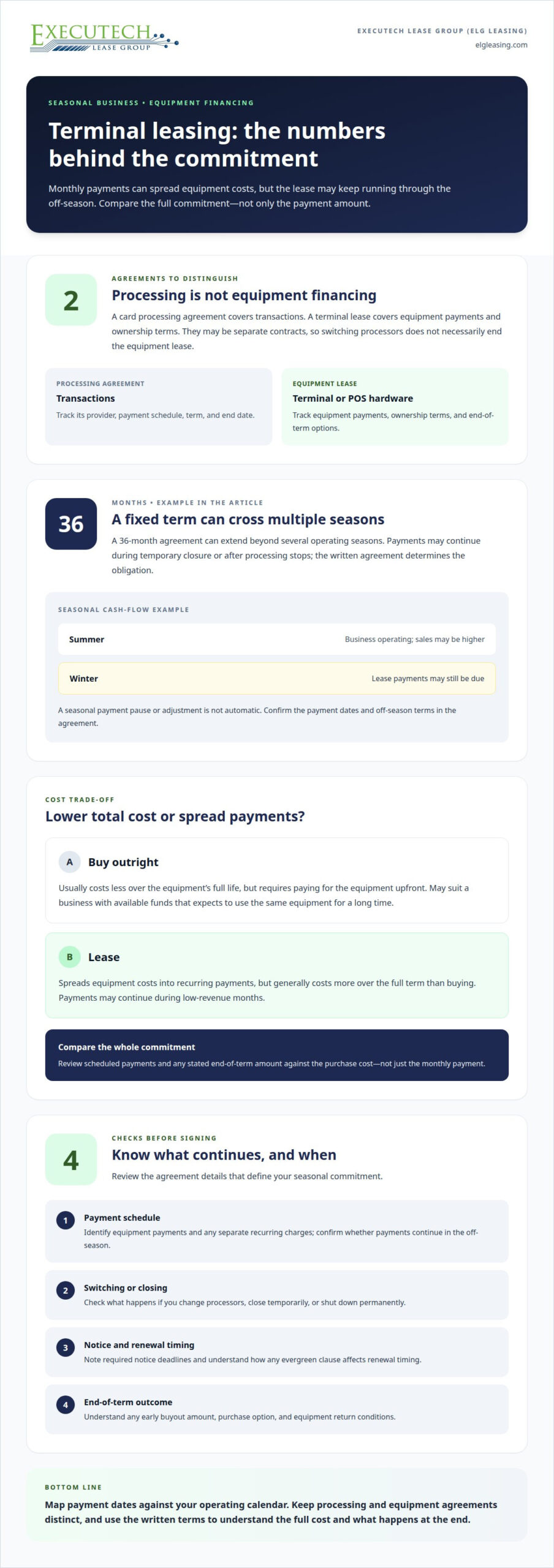
A card processing agreement covers transaction processing; a terminal lease covers equipment payments and ownership terms. They may be separate contracts, so changing card processing doesn’t necessarily end the terminal lease. Identify each agreement, its provider, its payment schedule, and its end date. That separation helps you understand which commitment continues if you switch processors.
Lease Payments, Buyouts, and Cancellation Terms
A terminal lease can require payments throughout its stated term, including during a seasonal closure. A non-cancelable agreement may keep those payments due even if sales stop or you no longer need the device. Before signing, identify any early buyout amount, end-of-term purchase option, and equipment return conditions. Don’t assume that stopping card processing cancels equipment payments.
Seasonal Flexibility and Contract Checks
Month-to-month terminal rentals may be available, but a rental isn’t necessarily a lease or a path to ownership. A fixed-term lease may continue through the off-season. Before signing, ask the leasing provider whether payments continue when your business is closed, how the agreement ends, and whether you must give notice. Also ask how an evergreen clause affects renewal timing.
Lease Costs Versus Upfront Purchase
Leasing generally costs more over the full term than buying a terminal upfront. Buying may suit you if you have the funds and expect to use the same equipment for a long time. Leasing spreads equipment costs rather than requiring the full purchase amount at once. Compare the scheduled payments and any stated end-of-term amount with the purchase cost, not just the monthly payment.
For example, a business open only during summer still needs to account for every payment due during winter. Ask the provider to explain the total commitment, ownership outcome, cancellation terms, renewal notice deadline, and buyout conditions in the agreement. Those answers show whether the payment structure fits your operating calendar and whether you’ll own or return the terminal at the end.
Ongoing payments after switching providers or closing
Changing card processing providers doesn’t automatically end a separate terminal lease. If your seasonal business closes, equipment payments may continue under the lease agreement even while sales stop.
Month-to-month terminal rentals may be available, while other equipment agreements use fixed terms. A seasonal plan or payment pause isn’t automatic. The written agreement determines whether payments continue during the off-season and whether any seasonal adjustment applies.
Before signing, ask the leasing provider what happens if you switch processors, close temporarily, or shut down permanently. Get clear answers about the remaining payment schedule, the process for ending the agreement, and any notice deadlines. A 36-month agreement, for example, can extend beyond several operating seasons.
Switching providers affects card processing, not necessarily equipment financing. A terminal lease may remain payable after you stop processing transactions through the original provider. Check whether the device is compatible with the new processing setup, since some terminals are proprietary.
Closing the business doesn’t itself determine what happens to the equipment contract. The agreement sets out payment obligations and any end-of-term options. Keep lease documents alongside processing records to distinguish equipment payments from processing charges under a separate agreement.
For a festival booth or temporary event, a mobile terminal can support transactions away from a fixed counter. Confirm that the device, processing arrangement, payment gateway, and POS integrations work together for the event. Review any gateway or software terms and recurring charges separately from the terminal payment.
Monthly payments can make equipment costs easier to plan across the year, but they may fall due during low-revenue months. Map payment dates against your operating calendar. If your business earns most of its revenue in summer, budget for winter payments before committing to a fixed-term agreement.
Use these contract checks to clarify your commitment:
- Identify the equipment payment and any separate recurring charges.
- Confirm whether payment dates continue during the off-season.
- Review the terms for switching processors or closing the business.
- Note the required notice timing and equipment return conditions.
Once your equipment needs and seasonal cash flow are clear, you can start an equipment lease application with the relevant business details.
Separate processing and equipment finance contracts
A card processing agreement and an equipment lease govern different obligations. Processing covers transactions; equipment financing covers the terminal or POS hardware. If you change processing providers, a separate equipment lease may continue. Read both agreements, but track each payment, provider, term, and end date separately. This helps distinguish transaction charges from equipment costs.
Buying a terminal outright avoids a lease commitment but requires paying for the equipment before using it. Leasing spreads equipment payments across the contract term, which may help preserve cash for seasonal operations. Compare the total lease payments and end-of-term options with the purchase cost. Include setup and required integration costs rather than judging by the monthly payment alone.
Equipment options include countertop card terminals, mobile payment devices, and POS systems. A market stall taking payments outdoors may need a different setup from a shop with a fixed checkout counter. A restaurant with several checkout points may need multiple devices and POS functions. Choose equipment based on location, transaction flow, payment types, and the software integrations your business uses.
Start by mapping your operation. Note where customers pay, whether staff take payments away from the counter, and which payment types you accept. Then identify the number of devices and POS features needed for daily work. A seasonal farm stand with one checkout point, for example, has different needs from a market vendor serving customers at several locations.
Technology can become outdated or stop fitting your processing setup. A purchased terminal may need replacing when it becomes obsolete or no longer meets your requirements. With a lease, identify the end-of-term options and what each means for ownership or returning the equipment. Don’t assume you can upgrade during the term.
For a clear comparison, separate the decision into equipment, financing, and processing. Match the terminal or POS system to your location and workflow; compare an outright purchase with the full lease obligation; then review processing and integration requirements separately. This helps you choose equipment without mistaking a processing change for a change to the equipment agreement.
Factors in choosing between leasing and purchasing
When comparing a purchase with a lease, lay out the equipment, payment schedule, and ownership terms side by side. Compare total lease payments and any stated end-of-term amount with the outright purchase cost. Leasing generally costs more over the full term, while purchasing requires paying upfront. Consider how each option fits your seasonal cash flow.
Monthly payments can make equipment costs more predictable, but they may continue during the off-season. Buying avoids an ongoing equipment lease but ties up cash that could support inventory, staffing, or event fees. If your business earns most of its revenue in summer, compare winter payment obligations with the cash you expect to retain after the season.
Purchasing may suit a business with available capital, stable equipment needs, and a plan to use the same terminal over time. If the device fits your processing setup and checkout workflow, ownership avoids a longer financing commitment. A seasonal operator expecting to change locations or equipment needs may weigh that commitment differently from a year-round shop with a fixed checkout.
Compatibility matters whether you lease or buy. Check whether the terminal works with your processor, payment types, and POS integrations. For a purchase, include the manufacturer’s warranty terms and any installation costs in your comparison. A low purchase price doesn’t tell you whether the terminal will work with your processing arrangement.
A useful comparison follows a consistent sequence:
- Match the equipment to the location, checkout flow, and payment types.
- Compare the purchase cost with every scheduled lease payment.
- Include buyout, return, or ownership terms at the end of the lease.
- Review manufacturer warranty terms and installation needs for purchased equipment.
These steps keep the decision focused on the complete equipment commitment, not an attractive monthly figure. They also separate hardware costs from transaction processing, POS software, and integrations. Since each can affect operating costs differently, identify which amounts belong to the equipment arrangement and which are separate.
To decide, weigh available cash against total cost and how long you’ll use the equipment. If paying upfront leaves too little for seasonal operations, spreading the equipment cost may fit better despite higher total lease costs. If you can purchase without straining cash flow and expect the terminal to remain suitable, ownership may be more economical. Compare both options before committing.
How credit card terminal and POS leasing works
A terminal lease covers payment equipment through recurring payments rather than an outright purchase. The agreement sets out the equipment, payment schedule, term, and end-of-term options. Card processing is a separate service, so equipment payments and transaction-processing charges may appear under different agreements.
Start by defining the equipment your business needs. A seasonal retailer may need a countertop credit card terminal, while a market vendor may need mobile equipment. A POS system may also connect sales activity with inventory. Match the equipment list to checkout locations, payment types, and the transactions you expect to handle.
Once the equipment scope is clear, review the proposed financing terms. The agreement sets out the payment obligation and whether you can purchase the equipment, return it, or choose another stated end-of-term option. These terms determine whether ownership transfers or the agreement covers equipment use without automatic ownership.
Before signing, the equipment and financial details should align:
- List each terminal or POS component included in the agreement.
- Separate equipment payments from card processing and software charges.
- Review the payment schedule against the seasonal operating calendar.
- Identify ownership, return, and buyout terms at the lease end.
Installation and training may be part of the financing when an ISO bundles them with the equipment. Any bundled work should be identified in the agreement, so the business understands what the financed amount covers. This distinction also helps separate equipment-related costs from processing fees and software expenses.
For a seasonal business, the central question is whether the payment schedule fits revenue during both active and quiet periods. A summer operation, for example, should account for payments due after its busiest season ends. The lease term and end-of-term choice matter too: they determine how long payments continue and what happens to the equipment afterward.
Leasing can spread equipment costs, but it doesn’t automatically make equipment cheaper. Compare the full payment commitment and ownership outcome with an outright purchase. Then confirm that the selected terminal works with your intended processing arrangement and POS setup. This sequence connects equipment, financing, and day-to-day transactions before you commit.
Executech Lease Group (ELG Leasing): Credit Card Terminal Leasing
Executech Lease Group (ELG Leasing) helps businesses finance credit card terminals and POS equipment when an upfront purchase doesn’t fit their cash-flow plans. Its 12-60 Month Credit Card and POS Equipment Leases provide a defined term, while Lease-to-Own Programs and FMV Lease Options offer different end-of-term structures.
For a seasonal business, match equipment and payment obligations to the operating cycle. Consider how many terminals you need, how long you expect to use them, and whether ownership matters after the lease term. Compare the payment schedule and end-of-term terms with your seasonal revenue pattern. A lease spreads equipment costs, but payments may continue during quiet months.
If equipment leasing fits your plans, contact Executech Lease Group (ELG Leasing) to discuss the next step.
Plan Your Next Equipment Decision
Connect your equipment decision to how your business operates throughout the year. A seasonal calendar can clarify when terminals need to be ready, when revenue arrives, and how long the equipment must serve your business. Use that picture to frame a financing choice that supports your plans without overlooking quieter periods.
The right approach to credit card terminal leasing for seasonal businesses depends on more than the busy season. Consider how your locations, checkout flow, and equipment needs may change over time. Then choose an agreement that aligns with your priorities and cash-flow planning.
Bring those priorities into a direct conversation about equipment financing. A clear starting point can help you move from comparing options to choosing a practical next step.
Your next season is an opportunity to make a deliberate, well-informed equipment decision.
Frequently Asked Questions
Does leasing cost more?
Leasing usually costs more than buying when you compare total lease payments with the equipment’s purchase cost. The trade-off is timing: leasing spreads payments, while purchasing requires paying upfront. For a fair comparison, include any stated end-of-term amount and consider the equipment you’ll need beyond the current season. A lower monthly payment alone doesn’t show the total commitment or whether you’ll own the terminal.
Should you lease or should you buy?
Buy when you can pay upfront, expect to keep the same equipment, and value ownership. Lease when spreading equipment costs matters more than minimizing the total paid over time. For example, a business opening a second checkout location may prefer to preserve cash for inventory and staffing. Compare the full lease obligation with purchase costs, then consider how long the terminal will remain useful.
How does payment-terminal leasing work?
A payment-terminal lease generally involves recurring payments for equipment use over an agreed term. Ownership doesn’t automatically transfer just because payments continue. A seasonal retailer can assess whether the recurring equipment commitment fits revenue across active and quiet periods. Review the agreement’s equipment, payment schedule, and end-of-term terms.
What are typical credit card terminal lease terms, fees, and cancellation penalties?
There’s no single fee or cancellation penalty that applies to every terminal lease. The signed agreement determines the payment schedule, contract duration, end-of-term options, and any costs tied to ending early. Review the total scheduled payments, equipment return terms, renewal language, and buyout terms together. These details show the full commitment more clearly than a monthly payment alone.
Is leasing or buying a credit card terminal better for a seasonal business?
Neither option is automatically better. The right approach to credit card terminal leasing for seasonal businesses depends on available cash, how long you’ll use the equipment, and whether payments continue off-season. A business with stable equipment needs and available cash may prefer ownership. A business protecting working capital may value spreading costs, provided the payment schedule fits its revenue calendar.
What equipment and connectivity options work for seasonal or mobile businesses?
Countertop terminals suit fixed checkout points; mobile terminals can support sales away from a counter, such as at a market stall. POS equipment may suit businesses that need sales and inventory functions. The right setup depends on location, transaction flow, and payment arrangement. Confirm that the selected device and integrations are compatible with your intended processing setup before committing.
Are credit card terminal leases covered by early termination or equipment return rules?
Early-termination and equipment-return terms depend on the agreement; don’t assume either is available on particular terms. If you plan to close after the season, identify whether payments continue, how the equipment must be returned, and whether notice is required. Distinguish lease obligations from card-processing arrangements. Ending processing doesn’t necessarily end a separate equipment commitment, so keep both agreements available when planning a closure.
What are alternatives to leasing, such as rental, purchase, or pay-as-you-go terminals?
Alternatives include buying equipment outright, using a short-term rental, or choosing a pay-as-you-go arrangement where available. Purchasing can suit a business expecting steady, long-term use. A rental may fit a temporary event, while pay-as-you-go pricing can connect costs more closely to use. Compare each arrangement’s equipment access, payment structure, ownership outcome, and contract length against your operating calendar.
This article reflects the author’s opinion for general information only and isn’t tax, legal, or accounting advice. Consult your CPA or attorney about your specific situation.

Article by
Robert Ensminger
Robert Ensminger is the founder and CEO of Executech Lease Group (ELG Leasing), which specializes in equipment leasing and financing solutions for the merchant-services, payments, POS, and FinTech industries. Robert helps ISOs, payment processors, POS providers, and software companies build practical equipment leasing programs. He founded ELG in 2010. His work focuses on responsive service, transparent program structures, SaaS-monetization programs, and helping ELG’s partners close more business while creating sustainable revenue.