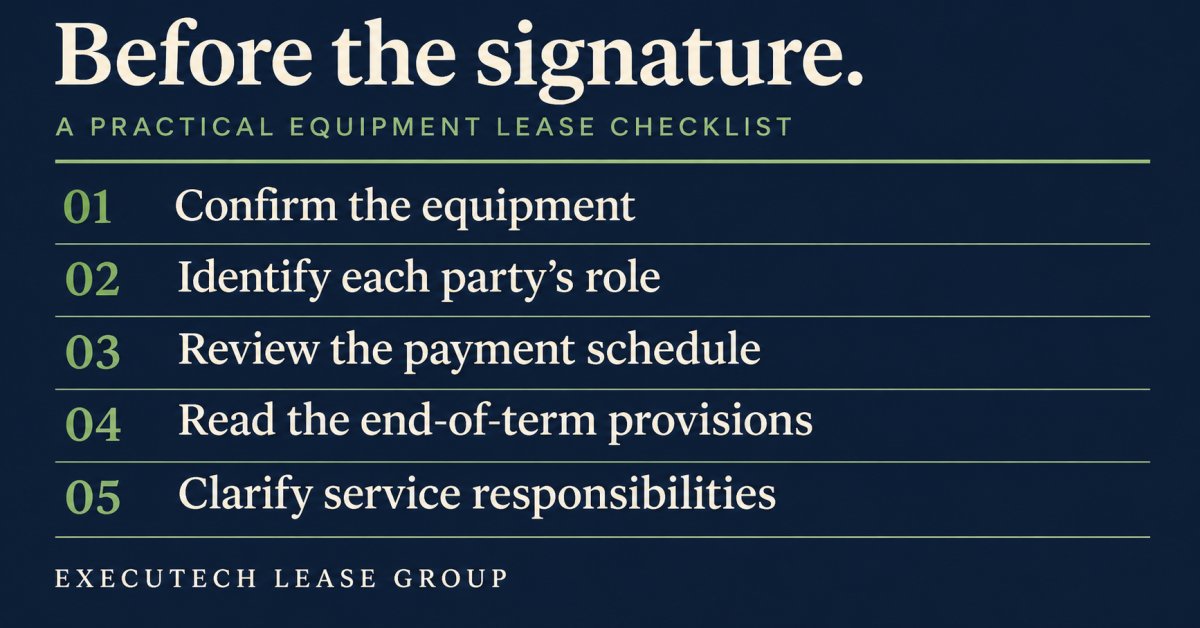
A monthly payment is only one part of a business equipment lease agreement. For a POS system or credit-card terminal, the useful questions are specific: which equipment is covered, how long the payments continue, who handles each part of the transaction, and what happens at the end of the term?
A clear review brings those answers together before the equipment is placed. It also helps an ISO or payment provider explain the leasing option accurately without promising services, tax results or contract rights that have not been established.
Key takeaways
- Review the equipment description, payment schedule, term and end-of-term provisions together.
- Identify the named parties and their responsibilities. A sales contact, equipment supplier, payment processor and lessor are not interchangeable roles.
- Keep the lease obligations separate from assumptions about warranties, processing services or future equipment changes.
- Have your accountant distinguish financial-reporting treatment from tax treatment using the actual agreement.
In this article
- Start with the equipment and the parties
- Read the payment schedule and total commitment
- Check the end-of-term and service provisions
- Separate contract terms, accounting and tax
- ELG’s POS and card-terminal leasing options
- Frequently asked questions
Start with the equipment and the parties
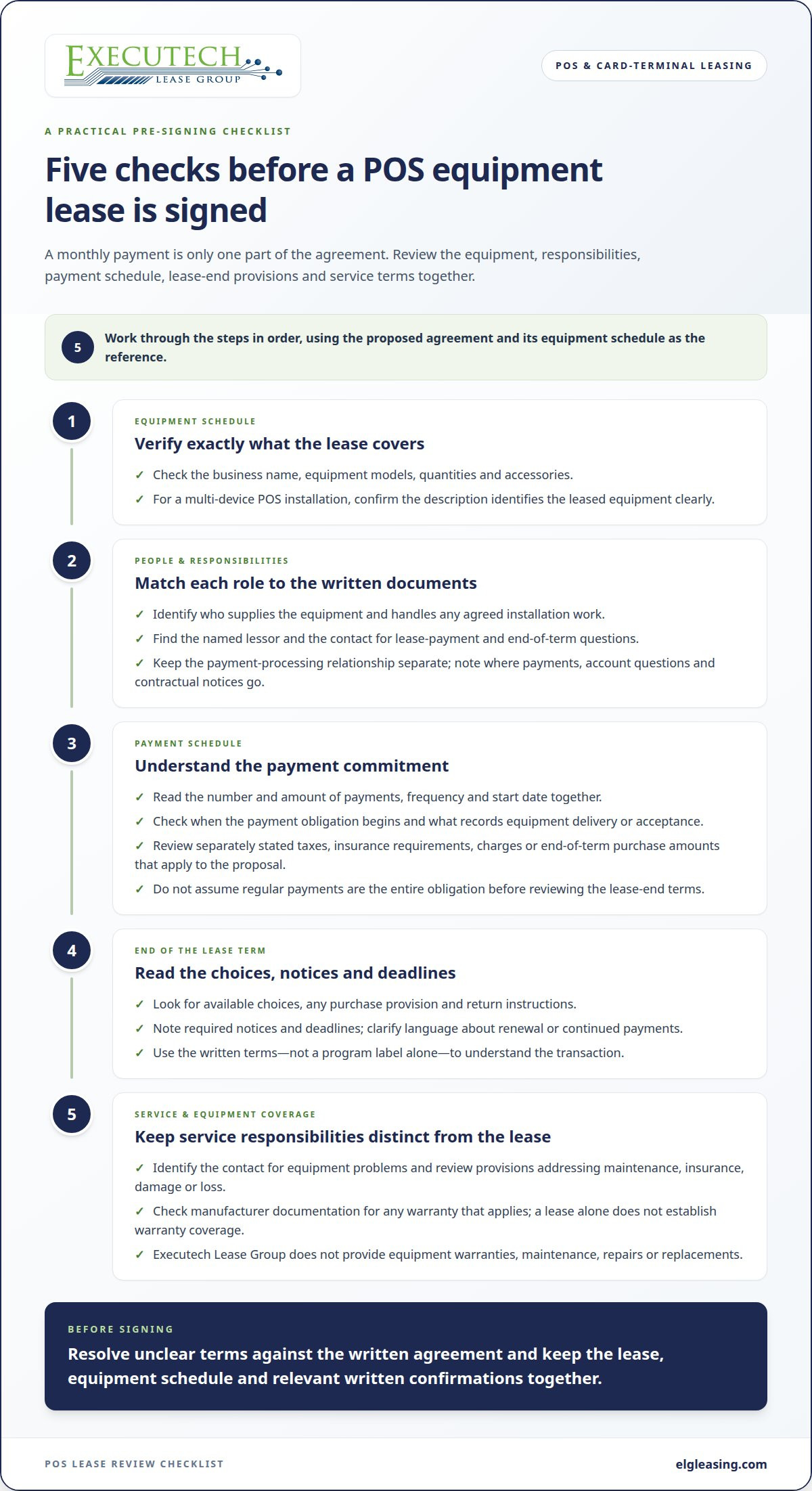
Begin with the proposed agreement and its equipment schedule. Check the business name, equipment models, quantities and accessories. If several devices are included in a POS installation, make sure the description is specific enough to identify what the lease covers.
Then identify the parties named in the documents and the contact for each responsibility:
- Equipment and installation: who supplies the devices and handles the agreed installation work?
- Lease documentation: who is the named lessor, and who can explain the payment and end-of-term provisions?
- Payment processing: who provides the processing relationship and answers questions about that separate service?
- Servicing and notices: where do payments, account questions and contractual notices go?
Do not infer a party’s responsibilities from a website description or a job title. An intermediary’s involvement does not, by itself, identify the lessor or equipment owner. Use the actual agreement and written confirmations to resolve any mismatch between a sales explanation and the documents.
For an ISO presenting the transaction, this is also a useful quality check: the merchant’s understanding of the equipment, lease and processing relationship should match the package being signed.
Read the payment schedule and total commitment
Read the number of payments, payment amount, frequency and start date together. Check when the payment obligation begins and what documentation records equipment delivery or acceptance. If a provision is unclear, resolve it before signing rather than relying on an estimate or a verbal summary.
Use the written payment schedule to understand the commitment over the stated term. Review any separately stated taxes, insurance requirements, charges or end-of-term purchase amount that apply to the proposed agreement. These are items to check in the documents, not a statement that every lease contains each charge.
Keep the payment schedule and lease-end choice distinct. A regular payment amount alone does not explain whether an additional purchase payment, return process or notice is involved at term-end. Avoid treating the sum of regular payments as the entire obligation until those provisions have been reviewed.
There is no need to substitute a generic rate example for a specific proposal. Ask for a written explanation of the actual payment schedule and any amounts that are not already clear. Keep the signed lease, equipment schedule and relevant written confirmations together so future account questions can be checked against the same record.
Also compare the contract term with the business’s expected use of the equipment. A plan to change technology or payment processors later is a question to resolve under the documents; it is not an established early-return, upgrade or cancellation option.
Check the end-of-term and service provisions
Read the end-of-term section before choosing a leasing option. Look for the available choices, any purchase provision, required notices, deadlines and return instructions. If the documents refer to renewal or continued payments, ask how that language applies to the proposed agreement.
Program names are useful starting points, but the written terms explain the transaction. Do not assume that a label such as “FMV” or “lease-to-own” supplies every purchase condition, notice requirement or ownership detail.
Review operational responsibilities separately. Identify the contact for equipment problems and the provisions addressing maintenance, insurance, damage or loss. Check any separate service agreement or manufacturer documentation for the coverage actually offered; do not assume it is included in the lease.
Warranties are not included in ELG’s leasing offering. A lease proposal is not evidence that a device has a particular manufacturer warranty, repair plan or replacement entitlement. Obtain the applicable documentation if any separate coverage is part of the equipment arrangement.
For merchants and their ISO partners, an accurate explanation of responsibilities is more useful than a broad promise that the lease “covers everything.” It gives the merchant a clear contact and a written basis for understanding what happens if an operational question arises.
Separate contract terms, accounting and tax
The contract’s ownership and payment provisions, its financial-reporting treatment and its tax treatment are separate questions. Do not use an accounting label as a substitute for reading the agreement.
For businesses applying U.S. GAAP, FASB Topic 842 generally requires a lessee to recognize a right-of-use asset and a lease liability for both operating and finance leases; an accounting-policy election is available for short-term leases. An operating-lease label therefore does not automatically mean an arrangement stays off the balance sheet. Ask your accountant which requirements and elections apply to your business. FASB’s review of Topic 842 explains the accounting model.
For federal income tax, the IRS distinguishes an equipment lease from a conditional sales contract using the agreement and the surrounding facts. A payment’s label or a purchase-option amount alone is not a reliable basis for claiming a deduction. Give your CPA the complete documents and obtain advice on the treatment of the specific arrangement.
If the agreement raises a legal question about ownership, a filing, default or enforcement, ask your attorney to review that provision under the applicable law. This article does not classify a particular ELG contract or instruct anyone to make a filing.
ELG’s POS and card-terminal leasing options
Executech Lease Group’s current equipment offerings include 12–60 month credit-card and POS equipment leases, lease-to-own programs and FMV lease options. The equipment focus includes POS and card-terminal devices, including Clover devices; mentioning a device brand does not imply a manufacturer partnership.
Use the proposed lease to confirm the equipment, available term, payments and end-of-term provisions for the particular transaction. The program list does not establish credit approval, funding timing or a guaranteed outcome.
For ISOs, merchant-services providers and payment partners, the practical opportunity is to make the equipment-leasing option understandable to the merchant. Explain the lease and processing relationship clearly, identify the relevant parties, and resolve questions about the documents before the transaction moves forward.
If you are an ISO or payment provider interested in discussing a vendor relationship, contact Executech Lease Group through its vendor inquiry form. The form starts a conversation; it is not a credit decision or a promise of funding.
Frequently asked questions
What belongs in a business equipment lease review?
Start with the equipment description, named parties, term, payment schedule and start date. Then review the purchase or return provisions, notices, insurance and other responsibilities addressed by the documents. Ask for clarification wherever the sales explanation and written terms do not match.
How do I compare FMV and lease-to-own options?
Compare the actual end-of-term language, not just the program names. Identify any purchase amount or method, notice requirement, return condition and continuing payment obligation stated in each proposal. Use those written terms to evaluate the option for the intended equipment use.
Does a small buyout mean the payments are fully deductible?
Do not assume that result. The IRS’s equipment-leasing guidance considers the complete arrangement when distinguishing a lease from a conditional sale. Ask your CPA to determine the treatment before claiming deductions; a small purchase option is not a promise of a particular tax result.
Does an operating lease stay off the balance sheet?
Not automatically under U.S. GAAP. Topic 842 includes operating leases in its balance-sheet recognition model, subject to applicable requirements and elections. Your accountant can determine how the actual agreement is recorded.
Can the equipment be returned early if the business changes processors?
Check the lease and processing documents before making that decision. Ask the relevant parties for a written explanation of the obligations and any available options. A change in business plans is not evidence that an early-return or cancellation right exists.
Are equipment warranties included with ELG leasing?
No. Warranties are not included. Check separate manufacturer or service documentation for any coverage offered with the device, including its provider, terms and exclusions. Do not assume that equipment leasing includes repairs or replacement coverage.
What if the agreement refers to a UCC filing?
Ask what the provision covers and have your attorney review it with the rest of the agreement under the applicable law. Do not decide the transaction’s legal or tax classification from the presence of a filing reference alone.
What should an ISO or payment partner explain to the merchant?
Explain which equipment is covered, the proposed payment schedule and term, the parties’ separate roles, and where the merchant can find the end-of-term and service provisions. Keep that explanation consistent with the written agreement and avoid unverified approval, tax or service promises.
This article reflects the author’s opinion for general information only and isn’t tax, legal, or accounting advice. Consult your CPA or attorney about your specific situation.

Article by
Robert Ensminger
Robert Ensminger is the founder and CEO of Executech Lease Group (ELG Leasing), which specializes in equipment leasing and financing solutions for the merchant-services, payments, POS, and FinTech industries. Robert helps ISOs, payment processors, POS providers, and software companies build practical equipment leasing programs. He founded ELG in 2010. His work focuses on responsive service, transparent program structures, SaaS-monetization programs, and helping ELG’s partners close more business while creating sustainable revenue.