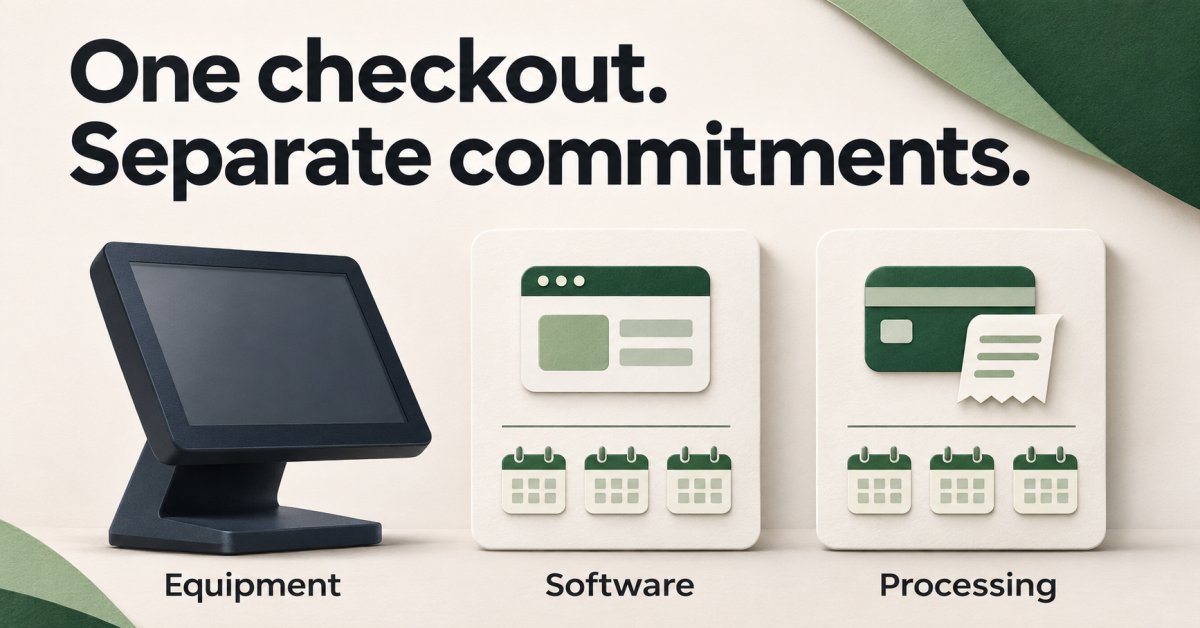
A POS equipment payment and a software subscription describe different commitments. When evaluating a cloud-based point-of-sale (POS) setup, separate how the equipment is financed from how software access and payment processing are arranged. A merchant can need to understand all three relationships at the same time.
For an independent sales organization (ISO) or equipment partner, the useful explanation goes beyond one monthly total. Identify what each charge covers, who supplies it, which agreement applies and what happens when that agreement reaches its stated end.
Executech Lease Group (ELG) offers equipment leasing. ELG does not currently offer hardware subscription programs or SaaS financing, and it does not sell cloud-based SaaS POS software. The comparison below explains the separate commitments without presenting those services as ELG products.
Key Takeaways
- Hardware financing, software access and payment processing are separate parts of the POS decision.
- A combined monthly amount does not establish that every component has the same provider, term or ending.
- Use actual equipment and software proposals; do not assume a standard hardware lifespan, price or savings result.
- Review ownership, end-of-term provisions and any continuing obligations in the applicable agreement.
- ELG does not provide equipment warranties, maintenance, repairs or replacements.
Separate hardware, software and processing
Start with the physical equipment: the POS devices, card terminals and included peripherals that the proposed arrangement identifies. Check the quantities and intended locations against the business’s checkout plan.
Then identify the software provider and the access being offered. Review the functions, licenses, locations and charges in that provider’s proposal. A familiar device name or the label “cloud POS” does not establish which software features are included.
Payment processing needs its own entry. Identify the processor, applicable agreement and stated charges. ELG does not process payments, supply a merchant account or set transaction pricing.
Confirm compatibility with the responsible provider before treating the equipment and services as a complete operating setup. An equipment financing arrangement does not prove software licensing, processor portability or device compatibility.
Map each charge to its agreement
Organize the proposal so the merchant can see which relationship creates each obligation. This is useful even when one provider presents several components together.
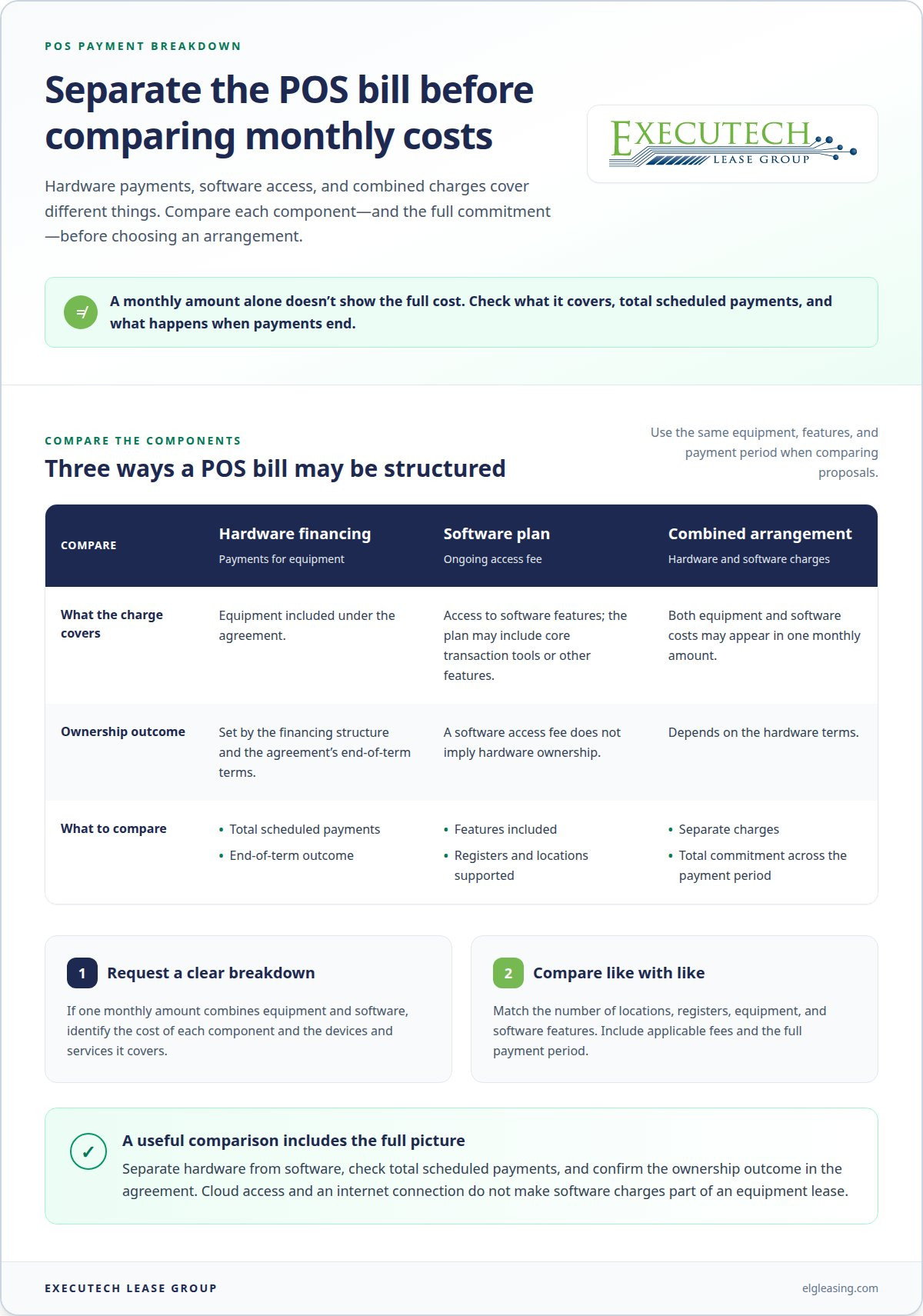
| Component | Information to record | Question to resolve |
|---|---|---|
| Equipment lease | Covered devices, payment schedule, term and end-of-term provisions | What does the particular equipment agreement require? |
| Software subscription | Provider, licensed access, charges and applicable subscription terms | Which software costs are separate from equipment payments? |
| Payment processing | Processor, pricing and processing agreement | Which charges relate to transaction processing? |
| Installation and training | Provider, included work and documented charges | What does the ISO supply or bundle with the equipment? |
| Warranty and service | Responsible provider and applicable terms | What coverage is actually documented? |
Lease financing can include an ISO’s installation and training when the ISO bundles those services with the equipment. The ISO supplies that work; ELG does not perform installation or training.
Do not place recurring software or processing charges inside the equipment commitment merely because they appear on the same presentation. Clarify the actual arrangement and record each charge once. An omitted charge is an unanswered question, not a confirmed zero cost.
Compare the full commitment
Choose a planning period that reflects the business’s intended use and the actual proposed commitments. State that period as a planning assumption. Do not treat a generic replacement cycle as a verified lifespan for the proposed devices.
Use the same equipment quantities, locations and software needs when reviewing alternatives. Otherwise, a different monthly amount can reflect a different setup or scope rather than a different financing structure.
Record scheduled equipment payments separately from software, processing and service charges. Identify any stated end-of-term payment under the relevant lease structure. Keep charges supported by documents separate from estimates used for planning.
If a proposed software price covers a particular scope, ask how it applies to the intended setup rather than assuming it covers every register or location. If existing equipment is being considered, ask its provider to confirm suitability and compatibility; do not assume reuse will reduce the final cost.
Leasing spreads equipment payments across a contract term. Compare the documented payment schedules and end-of-term provisions for the same equipment scope, alongside the business’s other obligations.
Review each agreement’s ending
Equipment payments, software access and processing arrangements do not necessarily follow one timetable. For each agreement, identify its stated term, payment schedule and relevant end-of-term provisions.
ELG’s fair-market-value (FMV) and lease-to-own structures have different equipment outcomes. Use the particular agreement to understand the applicable purchase provisions and any remaining obligations. Do not assume that a date on a payment schedule automatically transfers ownership or resolves every charge.
Review the software provider’s terms separately. If the merchant is considering a change to software access, ask how the relevant agreements address it. Do not assume that changing one service resolves a separate equipment obligation.
Likewise, a device that is owned still needs suitable software and processing arrangements to perform the intended work. Ownership alone does not establish access to a particular service or its price.
Ask the relevant contracting party to explain unclear renewal, notice or ending provisions. Consult an attorney when interpretation is needed, and bring tax or accounting questions to the business’s CPA. This guide does not supply cancellation rights, tax benefits or a standard end-of-term procedure.
Make the partner explanation practical
Consider an illustrative retail proposal with POS equipment, software access and a processing relationship. The partner’s task is to explain the scope and documents for each component, not simply combine them into an attractive monthly figure. This example describes a review method, not a customer transaction or standard package.
A concise explanation can answer:
- Which devices are included, and where will they be used?
- Which agreement establishes the equipment payments and end-of-term provisions?
- Who supplies the software and payment processing?
- What installation or training does the ISO provide?
- Who handles warranty and service questions, and what is documented?
Keep unresolved items visible until the responsible provider answers them. A clear division of responsibilities gives the merchant a more useful basis for the equipment decision than an unexplained combined payment.
Where ELG fits
ELG is an equipment lease brokerage serving the merchant-services and payments-technology ecosystem. ELG leases POS and card terminal equipment, including Clover devices. Device references do not establish an authorized manufacturer, reseller or processor partnership.
Its equipment leasing role is separate from software and processing. Hardware subscription programs and SaaS financing are not currently available through ELG. An equipment lease must not be presented as a subscription to cloud-based POS software.
ELG does not provide equipment warranties, maintenance, repairs, replacements, protection plans or equipment support. Any manufacturer warranty must be checked separately; the equipment lease term does not establish coverage.
ISOs, agents and equipment partners interested in developing equipment leasing business with ELG can use the vendor inquiry form: Discuss becoming an ELG vendor.
Frequently Asked Questions
Does ELG process payments?
No. The equipment lease and the payment-processing relationship are separate.
Does ELG provide an equipment warranty?
No. ELG does not provide warranties, maintenance, repairs or replacements. Any manufacturer warranty must be checked separately.
This article reflects the author’s opinion for general information only and isn’t tax, legal, or accounting advice. Consult your CPA or attorney about your specific situation.

Article by
Robert Ensminger
Robert Ensminger is the founder and CEO of Executech Lease Group (ELG Leasing), which specializes in equipment leasing and financing solutions for the merchant-services, payments, POS, and FinTech industries. Robert helps ISOs, payment processors, POS providers, and software companies build practical equipment leasing programs. He founded ELG in 2010. His work focuses on responsive service, transparent program structures, SaaS-monetization programs, and helping ELG’s partners close more business while creating sustainable revenue.