The “cheaper” option of buying your POS system upfront is often the most expensive mistake a growing business can make. You want to own your assets. It’s a natural instinct to avoid recurring debt and keep your balance sheet clean. However, when premium hardware becomes obsolete within thirty-six months, that upfront investment often transforms into a sunk cost that drains your liquid capital.
Deciding between buying vs leasing POS systems requires more than just comparing a lump sum to a monthly payment. It’s about strategic technology refreshes and operational agility. You need a setup that grows with you, not one that anchors you to the past. This 2026 financial guide delivers the transparency you’ve been missing.
We’ll show you how to protect your cash flow while accessing the latest Clover and cloud-based tech. You’ll discover how 12 to 60 month lease structures turn complex software costs into predictable expenses. We’re stripping away the hidden terms to reveal the highest ROI path for your specific growth stage. Efficiency is the goal. Clarity is the standard.
Key Takeaways
- Preserve your liquid capital by shifting from heavy upfront Capex to predictable monthly Opex.
- Understand the 3-year technology lifecycle and how FMV leases act as a strategic refresh tool against hardware obsolescence.
- Evaluate the long-term ROI of buying vs leasing POS systems to determine which model supports your current growth phase.
- Learn how to bundle “soft costs” like cloud-based SaaS software and subscriptions into a single, streamlined lease agreement.
- Compare the benefits of $1 Buyout programs for asset ownership against FMV options for maximum operational flexibility.
The Upfront Capital Challenge: Why POS Acquisition Strategy Matters
Modern business demands more than a simple cash register. Your Point of Sale (POS) system is now your primary operating system. It handles everything from inventory management to employee scheduling and customer data. This shift from a basic tool to a “Hidden Hub” fundamentally changes the financial math for merchants. Efficiency is no longer just a goal; it’s a requirement for survival.
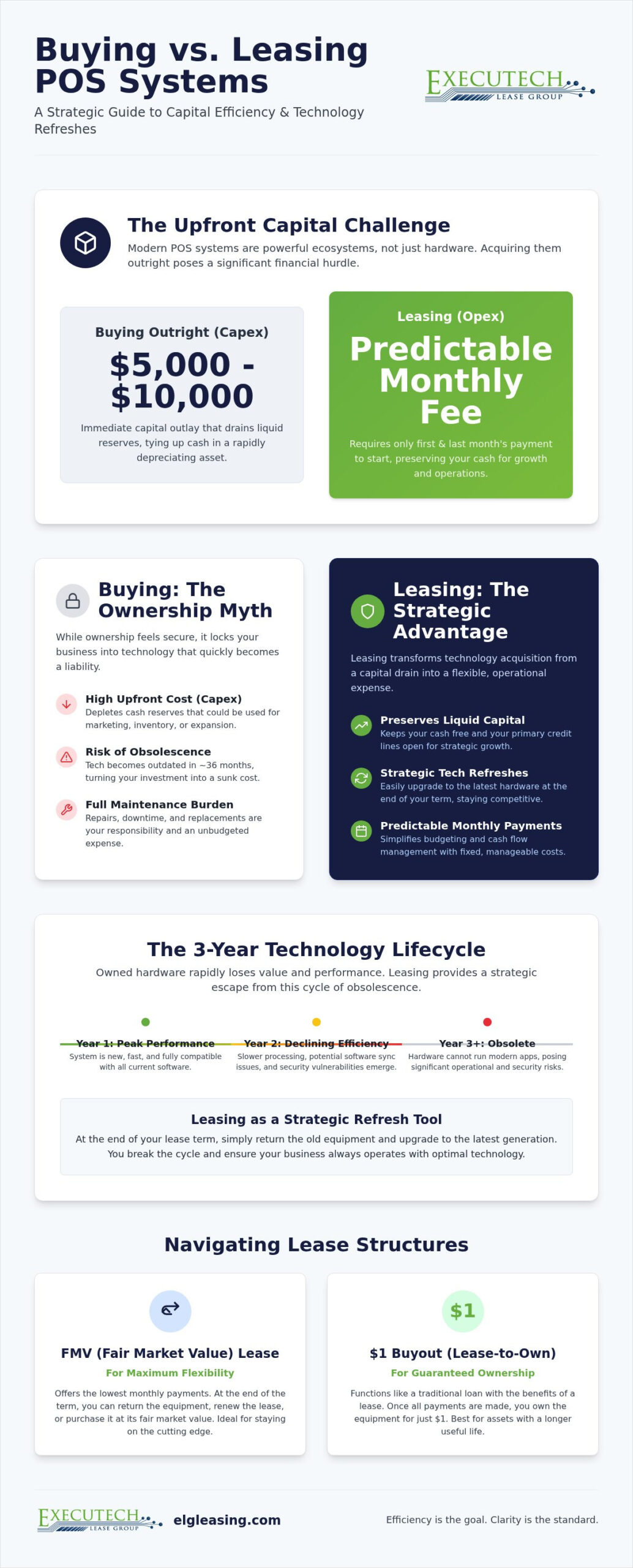
When analyzing buying vs leasing POS systems, you must account for the full tech stack. It’s not just a terminal on a counter. It’s a network of scanners, printers, and cloud-based SaaS software. A complete setup for a growing business often requires an immediate capital outlay of $5,000 to $10,000. That is a heavy weight for any balance sheet to carry at once. Ownership feels like a victory, but it often comes at the cost of your operational agility.
The Shift from Hardware to Integrated Ecosystems
Buying legacy hardware is a trap. These older units often fail to sync with modern inventory apps or mobile payment platforms, leading to massive integration headaches later. Premium systems like Clover Station and Clover Mini provide the power you need, but the total initial investment is steep. You aren’t just paying for the screen. You’re paying for the implementation, the software configuration, and the training hours required to get your team up to speed. When you buy these assets, you lock yourself into today’s technology. If the hardware becomes obsolete in two years, your investment evaporates.
Modern POS ecosystems provide several critical functions that legacy hardware cannot match:
- Real-time inventory tracking across multiple locations.
- Automated employee performance reporting and payroll integration.
- Integrated customer loyalty programs that drive recurring revenue.
- Seamless cloud-based data backups for security and compliance.
Liquidity vs. Asset Ownership in 2026
Volatility is the new normal. In this environment, cash-on-hand is your most powerful tool. It provides a safety net that equipment ownership simply cannot match. When you buy equipment outright, you tie up capital that could be used for marketing, hiring, or emergency repairs. This is the core conflict of buying vs leasing POS systems. Ownership is an ego play; liquidity is a survival play.
Buying equipment can also negatively impact your business credit by depleting your liquid reserves. This makes your business appear less stable to traditional lenders. Leasing functions as an alternative credit line. It allows you to access high-end technology while keeping your primary bank lines untouched for strategic expansion. This approach ensures you have the capital necessary to pivot when the market shifts. We focus on results, not just hardware. Maintaining liquid capital is the smartest move you can make for your business’s future.
Buying vs. Leasing POS Systems: A Direct Comparison
The “Ownership Myth” is a dangerous trap for modern merchants. In the world of consumer electronics, owning your equipment feels like a victory. In the world of business technology, owning a five-year-old tablet is a liability. It’s a security risk. It’s a speed bottleneck. It’s a device that lacks the processing power to run the latest cloud-based inventory updates. When you analyze buying vs leasing POS systems, you aren’t just comparing prices. You are comparing a stagnant asset to a strategic equipment acquisition strategy that evolves with your business.
Ownership places the entire burden of maintenance on your shoulders. When the screen goes dark on a Friday night, an owner pays for the repair out of pocket or waits days for a replacement. A lease structure often includes swap-out programs or prioritized support. This shift from Capital Expenditure (Capex) to Operating Expense (Opex) protects your balance sheet. It keeps your credit lines open for expansion while ensuring your front-line technology remains elite.
Financial Impact: Upfront Outlay vs. Monthly Predictability
Budgeting requires precision. Monthly payments at ELG Leasing streamline your cash flow management by replacing massive, unpredictable hits with fixed, manageable costs. Buying a system requires a full capital commitment on day one. Leasing typically only requires first and last month payments to get started. This allows you to deploy premium hardware immediately without draining your reserves. Inflation also plays a role. By leasing, you pay for today’s technology with tomorrow’s “cheaper” dollars. It’s a pragmatic hedge against rising costs. You keep your cash. You get the tech. You stay liquid.
The Tax Advantage: Section 179 and Deductions
The tax code often favors the flexible. While owned hardware must be depreciated over several years, lease payments can often be treated as a 100% deductible operating expense. This provides an immediate impact on your bottom line. Section 179 remains a powerful tool for merchants, potentially allowing for the full deduction of equipment costs in the year they are put into service. Because tax laws and limits change annually, you should always consult a qualified tax professional regarding the specific Section 179 benefits for your 2026 filings. Choosing the right path depends on your specific growth trajectory. You can explore our POS leasing options to see which structure fits your current financial goals.
Navigating Lease Structures: FMV vs. Lease-to-Own Programs
Success in 2026 requires matching your financial strategy to your technology’s expiration date. When evaluating buying vs leasing POS systems, you must decide which lease structure aligns with your long-term roadmap. Most merchants fall into the trap of choosing a one-size-fits-all contract. We don’t. We provide structures that respect the difference between a high-speed processor and a heavy steel cash drawer. Efficiency comes from choosing the right vehicle for the right asset.
Standard terms typically range from 12 to 60 months. This is the industry sweet spot. A 12-month term provides rapid turnover for cutting-edge tech. A 60-month term offers the lowest possible monthly payment for established operations. Your five-year business plan should dictate this choice. If you anticipate rapid scaling or frequent software shifts, shorter terms keep you agile. If stability is your priority, longer terms provide predictable, fixed costs that inflation cannot touch.
Fair Market Value (FMV) for High-Tech Components
FMV leases are the smartest choice for high-speed hardware like Clover stations and tablets. These components have a finite peak-performance window. With an FMV structure, you enjoy lower monthly payments because you aren’t paying for the full cost of the equipment. You’re paying for its use during its most productive years. At the end of the term, you have three clear paths:
- Return the equipment and walk away.
- Upgrade to the latest hardware generation immediately.
- Purchase the equipment at its current fair market value.
It’s a low-risk way to ensure your front-end never slows down your sales. You get the best tech without the burden of disposal or the frustration of outdated processing speeds.
Lease-to-Own for Durable Hardware
Not every piece of equipment becomes obsolete in three years. For durable goods like cash drawers, heavy-duty receipt printers, and certain credit card terminals, a Lease-to-Own ($1 Buyout) program is often superior. This structure allows you to build equity in your hardware over 36 to 48 months. Once the lease term ends, you pay a symbolic $1 to take full ownership. It’s a calculated move. You preserve your liquid capital during the initial years while securing a long-term asset for your balance sheet. This approach combines the cash flow benefits of leasing with the eventual goal of ownership for equipment that actually lasts. We streamline the process. You reap the rewards.
The Technology Lifecycle: Using Leasing as a Strategic Refresh Tool
Competitors often claim that POS hardware can last seven to ten years. This is a dangerous misconception that ignores the reality of software bloat and evolving security standards. In 2026, three years is the functional limit for high-performance equipment. When weighing buying vs leasing POS systems, you must view your hardware as a perishable asset rather than a long-term investment. If your processor cannot handle the latest PCI DSS security patches, your entire business is at risk. If your system lags during a lunch rush, your customer experience suffers immediately.
Leasing functions as a strategic refresh tool. It allows you to cycle through technology before it becomes a bottleneck. Scaling from one location to five requires massive capital if you choose to buy every terminal and peripheral. POS equipment leasing allows you to replicate your tech stack across new sites without depleting your liquid cash. ELG Leasing facilitates these transitions with precision. We provide the flexibility to upgrade your equipment as your business grows. We don’t believe in mid-contract penalties that trap you in obsolete technology. Our model is built for momentum.
Avoiding the ‘Legacy Tech’ Trap
Slow processing speeds are silent profit killers. Customers today expect instant, frictionless transactions. Legacy systems often struggle with modern software updates, leading to crashes at the worst possible moments. Furthermore, new payment methods like biometrics and cryptocurrency require specialized hardware that older units simply do not possess. Leasing acts as a built-in insurance policy against these shifts. It ensures you never get stuck with a “brick” while your competitors are accepting the latest payment forms. You stay relevant. You stay secure.
SaaS and Software Financing: The New Frontier
The modern POS ecosystem isn’t just about the screen on the counter. It’s about the cloud-based SaaS software that powers your data. One of the unique advantages of working with a specialized partner is the ability to finance these “soft costs” alongside your hardware. We allow you to bundle your software subscriptions and installation fees into a single, manageable monthly payment. This simplifies your accounting and protects your cash flow from the high initial costs of premium software licenses. You can access our Clover leasing programs to see how we streamline the entire acquisition process. It’s a comprehensive approach to technology management that traditional banks simply cannot match. We focus on the end goal; getting you the tools you need with minimal friction.
Streamlining Your Tech Stack: The ELG Leasing Advantage
Traditional bank financing is built for “old-fashioned” assets. It’s cumbersome. It’s slow. Most banks don’t understand that a modern Point of Sale system is a rapidly depreciating tech asset, not a real estate investment. Our “No-Nonsense” approach eliminates the bureaucracy. We focus exclusively on the payment industry. This specialization allows us to move at the speed of your business. Execution matters. From the moment you submit an application to the delivery of your terminals, our process is optimized for streamlined efficiency.
We aren’t for everyone. ELG Leasing operates as a disciplined gatekeeper. By working with high-standard ISOs and serious merchants, we maintain a secure and efficient ecosystem. This selectivity ensures that our 12 to 60 month programs remain flexible and powerful. We understand the nuances of buying vs leasing POS systems better than any general lender because we live in the digital operations space. We prioritize results over flowery promises.
Tailored Solutions for Merchants and Agents
Independent Sales Organizations (ISOs) use ELG to provide premium Clover technology to their clients without the friction of upfront costs. It’s a strategic partnership that drives growth. Our application process is designed for clarity. No hidden terms. No complex legalese. We help you monetize your potential by providing access to cloud-based SaaS POS software alongside the hardware. This integrated approach simplifies your tech stack. You get the tools. You get the results. Minimal friction is the standard we set for every partner.
Next Steps: Evaluating Your POS Needs
Deciding between buying vs leasing POS systems comes down to your growth trajectory and your need for liquid capital. Use this checklist to determine your best path:
- Do you need to maintain maximum cash-on-hand for operational expansion?
- Is your current hardware approaching the three-year obsolescence mark?
- Do you want to bundle software subscriptions into a single, predictable monthly payment?
- Are you planning to scale to multiple locations in the next 12 to 24 months?
If you answered “yes” to these points, leasing is your strategic advantage. Our specialists provide transparent quotes that reflect your specific business stage. We don’t hide behind “maybe” or “later.” We provide the hard data you need to make an informed move. Access modern payment technology today and secure your business’s financial future with a partner that values your time.
Secure Your Strategic Advantage
Success in today’s market depends on how you manage your capital. Choosing between buying vs leasing POS systems isn’t just a matter of price. It’s a choice between stagnant ownership and operational agility. You’ve seen how upfront costs can drain your reserves. You understand that hardware performance degrades within three years. Ownership often leads to technical debt. Leasing provides a clear path to constant innovation.
We provide the tools you need to stay ahead. Our 12 to 60 month flexible terms allow you to preserve liquid cash for expansion. We offer specialized Clover financing and unique SaaS and software lease programs to cover your entire tech stack. You don’t have to settle for outdated equipment or complex bank loans. We streamline the process so you can focus on results. It’s time to modernize your approach to technology acquisition.
Streamline your business with a flexible POS lease from ELG. Take the first step toward a more predictable and powerful financial future today. Your growth starts here.
Frequently Asked Questions
Is it better to buy or lease a POS system for a startup?
Leasing is generally superior for startups to preserve liquid capital. Startups face high failure rates and unpredictable cash flow; tying up thousands in hardware is risky. Leasing allows access to premium Clover tech with minimal upfront cost. It shifts the burden from a heavy capital expense to a manageable monthly operating cost. This strategy keeps your bank lines open for critical marketing or inventory needs.
Can I lease just the POS software without the hardware?
Yes, you can finance cloud-based SaaS POS software independently or as part of a bundle. Many modern merchants choose subscription leases to cover high upfront licensing fees or specialized industry modules. This approach streamlines your accounting by consolidating soft costs into a single monthly payment. It’s a pragmatic way to access powerful enterprise-grade software without a massive initial investment. We specialize in these integrated financial structures.
What happens at the end of a Fair Market Value (FMV) lease?
You have three distinct options at the end of an FMV lease term. You can return the equipment and walk away, upgrade to the newest hardware generation, or purchase the current units at their fair market value. This flexibility is the core benefit of the FMV model. It acts as a hedge against technology obsolescence. You never get stuck with outdated terminals that slow down your processing speeds or compromise security.
Does leasing a POS system include a maintenance or support plan?
Most lease agreements include prioritized support or hardware replacement programs to minimize downtime. When you are deciding between buying vs leasing POS systems, consider the cost of a Friday night system failure. Owners handle repairs out of pocket. Lessees often benefit from hot swap services where replacement hardware is shipped immediately. This ensures your business stays operational. Professional support is an essential component of a high-standard lease agreement.
Can I upgrade my POS hardware in the middle of a lease term?
Many specialized lease programs allow for mid-term upgrades to ensure you stay ahead of the technology curve. We don’t believe in trapping growing businesses in obsolete contracts. If your volume increases or you need new payment capabilities, we can often restructure your agreement. This flexibility is a primary reason why merchants choose 12 to 60 month terms over traditional bank loans. It allows your tech stack to evolve with your revenue.
Are POS lease payments tax-deductible for my business?
Lease payments are typically treated as a 100% deductible operating expense under current tax laws. This provides an immediate reduction in your taxable income compared to the multi-year depreciation schedule of owned assets. Section 179 may also apply, allowing for significant deductions in the year you acquire the equipment. You should always consult a tax professional to verify the specific limits and benefits for your 2026 financial filings.
How does leasing affect my business credit score?
Timely lease payments can help build a positive commercial credit history for your business. Unlike a massive upfront purchase that depletes your cash reserves, a lease shows lenders you can manage recurring obligations responsibly. It keeps your primary bank lines untouched for emergencies or strategic expansion. This disciplined approach to buying vs leasing POS systems protects your overall borrowing power. It’s a calculated move for long-term financial health.
What is the typical length of a POS equipment lease?
The industry standard for POS equipment leasing ranges from 12 to 60 months. Short 12-month terms are ideal for testing new concepts or high-turnover tech. Longer 60-month terms provide the lowest monthly payments for established businesses seeking long-term stability. Most merchants find the sweet spot at 36 or 48 months. This duration aligns perfectly with the functional lifespan of modern processors and security standards.