
Your POS lease is not a permanent debt. It is a strategic pivot point between asset ownership and technological agility. Most merchants fear the evergreen clause that quietly auto-renews a contract indefinitely. You want transparency; you don’t want a perpetual payment cycle for aging hardware. We understand the pressure of balancing the cost of a buyout against the urgent need for updated security standards. This 2026 guide simplifies the POS equipment lease renewal options for merchants. It’s a complex decision. It impacts your bottom line and your operational efficiency.
You will master the end-of-lease transition with a clear breakdown of buyout structures and renewal strategies. We provide a framework for deciding between full ownership and a hardware refresh. You will also understand the 2026 tax implications of lease buyouts. This article maps a predictable path to upgrading your technology while maintaining the high standards of 12-60 Month Credit Card and POS Equipment Leases. You deserve a clear exit strategy. Let’s streamline your next move.
Key Takeaways
- Establish a clear exit strategy during the initial negotiation to successfully navigate POS equipment lease renewal options for merchants.
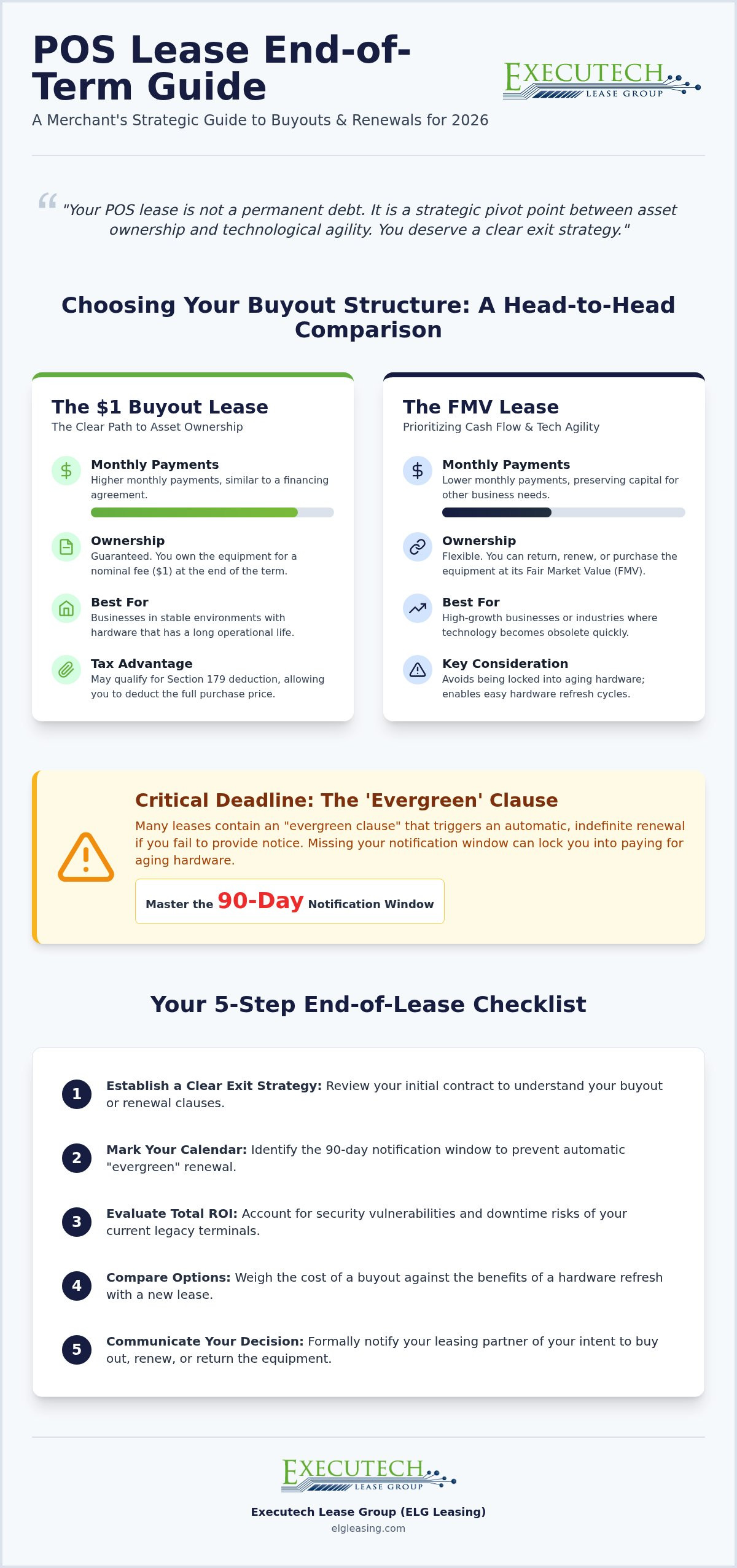
- Compare $1 Buyout structures for guaranteed ownership against Fair Market Value (FMV) leases that prioritize monthly cash flow and flexibility.
- Evaluate the total ROI of a hardware refresh by accounting for the security vulnerabilities and downtime risks of legacy terminals.
- Master the 90-day notification window to prevent “evergreen clauses” from triggering automatic, indefinite lease extensions.
- Consolidate hardware and cloud-based software into transparent 12-60 Month Credit Card and POS Equipment Leases for maximum operational efficiency.
Strategic Overview of POS Lease Buyout and Renewal Options
Strategic planning for POS equipment lease renewal options for merchants begins the day you sign your contract. A POS lease buyout is the process of acquiring full legal title to your payment hardware at the end of a contract term. It is the final transition from renting a tool to owning an asset. High-performing merchants treat this as a strategic acquisition, not a surprise expense. You must establish your exit strategy during the initial negotiation of 12-60 Month Credit Card and POS Equipment Leases. Waiting until the final month limits your leverage. Early planning ensures you aren’t forced into a decision that harms your cash flow.
Your final purchase price often hinges on the residual value of the equipment. This is the estimated worth of the hardware at the end of the lease. Some agreements use a fixed price, while others rely on market assessments. It’s also vital to distinguish between renewal options and mandatory buyout clauses. A renewal extends your usage rights. A buyout ends the relationship by transferring ownership. Knowing which path your contract dictates is the difference between a clean break and a lingering debt.
The Importance of End-of-Term (EOT) Planning
Effective EOT planning balances long-term asset value against the reality of technological obsolescence. While owning hardware eliminates monthly payments, it also makes you responsible for security upgrades. Ownership impacts your business valuation. It moves equipment from the expense column to the asset column on your balance sheet. This looks better to lenders and potential buyers. However, the greatest risk in EOT planning is the “evergreen” clause. These clauses trigger automatic renewals if you fail to act. They keep you paying for aging terminals that no longer meet 2026 security standards. When evaluating POS equipment lease renewal options for merchants, you must identify and avoid these automatic traps. You want a partner that prioritizes transparency over technicalities.
Key Terminology for Merchants in 2026
Success requires mastering industry language. A Purchase Option gives you the choice to buy, whereas a Mandatory Buyout is a legal obligation. You need to know which one is in your file. Fair Market Value (FMV) is the price a used terminal would command in a competitive market. It is often a cost-effective way to gain ownership if you don’t require the latest features. Timing is everything. The 90-day notification window is your most critical deadline. Missing this date can lock you into another year of payments. Focus on these details to maintain your operational agility and financial health.
Comparing POS Buyout Structures: FMV vs. $1 Buyout
Choosing the right financial structure is a decision that dictates your long-term profitability. When evaluating POS equipment lease renewal options for merchants, the choice usually falls between a $1 Buyout and a Fair Market Value (FMV) lease. These aren’t just accounting preferences. They are strategic tools. A $1 Buyout acts as a lease-to-own program. You pay higher monthly installments, but ownership is guaranteed at the end of the term for just one dollar. Conversely, an FMV lease offers lower monthly payments. It preserves your capital while giving you the right to return or purchase the hardware at its current market rate when the term concludes. These structures are fundamental parts of our 12-60 Month Credit Card and POS Equipment Leases, designed to give you total control over your hardware lifecycle.
The $1 Buyout: The Path to Asset Ownership
This structure is ideal for hardware that doesn’t need frequent updates. Think of kitchen displays or ruggedized handhelds in a stable retail environment. Since you own the equipment at the end, it’s a capital purchase. In 2026, many merchants leverage this through Section 179 tax deductions. This allows you to deduct the full purchase price of qualifying equipment in the year you put it into service. It’s a powerful way to monetize your hardware investment early. If your operational environment is consistent, this long-term cost analysis often favors ownership. You stop paying for the asset while it continues to generate value. You gain a permanent asset for a minimal final cost.
The FMV Lease: Prioritizing Technical Agility
FMV leases are the standard for high-growth merchants. They provide maximum flexibility. Technology moves fast. You don’t want to be stuck with legacy hardware when your competitors are using faster, more secure systems. This structure allows for seamless POS hardware refresh programs. At the end of your term, you can simply return the old units and start a new lease with the latest tech. This is particularly relevant for Clover terminal leasing. Clover hardware evolves quickly. An FMV lease ensures you always have access to premium features without the burden of disposal or resale. You pay for the value you use, not the metal itself.
If you need a middle ground, the 10% Purchase Option offers a predictable compromise. You get lower monthly payments than a $1 buyout, but your final purchase price is capped at 10% of the original cost. This makes budgeting for your next upgrade cycle simple and organized. Whether you want to own your assets or maintain a constant state of innovation, selecting the right partner is the first step. You can explore your custom leasing options to find the structure that fits your specific business goals.
Buyout vs. Hardware Refresh: Evaluating the ROI
ROI is more than a simple math problem. It’s a calculation of the “Economic Life” of your payment terminals. If your hardware is three years old, it might still process a transaction. But is it still a profitable asset? When exploring POS equipment lease renewal options for merchants, you must factor in the hidden costs of legacy systems. Security vulnerabilities and hardware downtime are silent profit killers. A single data breach or a terminal failure during a lunch rush costs significantly more than a monthly lease payment. Some competitors argue that ownership is always superior. They fail to mention the compliance risks of owning hardware that can’t support the latest encryption or 2026 security standards.
Strategic merchants compare the buyout price against the cost of starting a new 12-60 month lease. For high-volume businesses, the “Refresh and Return” model offers a competitive edge. It ensures your staff always works with the fastest processors and the most responsive touchscreens. This is especially true for Clover hardware. These units have a specific lifecycle where performance peaks in the first three years. Refreshing at the end of your term prevents the operational friction that occurs as processors age. It keeps your business agile, modern, and ready for shifting consumer demands.
When to Execute a Buyout
A buyout makes sense when your hardware remains at the top of its class. If your current terminals already meet all 2026 EMV and contactless security standards, ownership is a viable path. You should choose this when the buyout price is significantly lower than the cost of a full replacement. If your business doesn’t require new software features, acquiring the title to your current units stabilizes your overhead. This is a sound move for established, stable retail environments where hardware wear and tear is minimal.
When to Choose a Technological Refresh
A technological refresh is the standard choice for merchants who prioritize growth and efficiency. Modern cloud-based SaaS POS software requires specific processing power and memory that older units lack. By refreshing, you gain access to these advanced capabilities without a massive upfront capital expenditure. You also eliminate the risk of out-of-warranty repairs. New hardware comes with fresh manufacturer protections. This keeps your operations stable and your customer experience premium. Fast, sleek hardware tells your customers that your business is modern and secure. Don’t let a slow terminal be the reason a customer doesn’t return.
End-of-Lease Checklist: Managing the Transition
The end of a lease is a logistical operation. It requires precision. You don’t want to leave your next steps to chance or let a deadline slip by unnoticed. Managing the POS equipment lease renewal options for merchants involves more than just a final payment. It’s a structured transition that protects your data and your bottom line. You must move from a usage mindset to an ownership or refresh mindset with clear documentation. This ensures your business remains agile and compliant as you enter your next phase of operations.
Data security is your primary concern in 2026. Before hardware leaves your premises or changes title, you must de-provision all sensitive merchant data. This is not just about deleting apps. It’s about a complete factory reset and ensuring the terminal is removed from your processing profile. Once the hardware is clean, focus on the final documentation. A lease doesn’t just “end.” It requires a formal title transfer or a lease closure certificate to ensure you aren’t billed for insurance or maintenance on assets you no longer use. Precision here prevents administrative headaches later.
The 90-Day Countdown
The most critical phase begins three months before your final payment. You must review your original 12-60 Month Credit Card and POS Equipment Lease terms to identify notification requirements. If you intend to buy out the equipment, request a formal quote from the lessor immediately. This gives you time to consult with a tax professional. They can help you align the buyout with your 2026 depreciation schedules, ensuring you maximize your Section 179 benefits. Don’t wait for the lessor to contact you. Take control of the timeline.
Operational Handover
If you choose a refresh over a buyout, coordination is vital. You must manage the logistics of returning old equipment while ensuring software continuity. You don’t want your storefront to go dark because the new terminals haven’t arrived or aren’t programmed yet. If you are buying out, update your internal asset registry. Document the serial numbers, condition, and location of the newly acquired hardware. This creates a clean audit trail for future maintenance or eventual resale. A well-managed handover ensures that POS equipment lease renewal options for merchants remain a benefit, not a burden.
Streamlined End-of-Lease Solutions with ELG Leasing
Executech Lease Group (ELG Leasing) delivers the clarity merchants need at the end of a contract. We don’t hide behind legalese or complex evergreen clauses. Our leasing programs are built specifically for ISOs and sales agents who value efficiency and professional transparency. We integrate hardware and SaaS software into a single, manageable buyout plan. This eliminates the need for multiple vendors and conflicting timelines. You get one predictable path to ownership or refresh. Our no-nonsense communication style ensures you always know where you stand. Executech Lease Group (ELG Leasing) prioritizes high standards over high volume. This selectivity fosters a sense of trust and security that is rare in equipment financing.
Transitioning your current merchant portfolio to a more flexible model requires a partner who understands the intersection of finance and technology. We move away from old-fashioned, cumbersome methods. Our 12-60 Month Credit Card and POS Equipment Leases are designed to monetize your assets while protecting your cash flow. We provide the tools to accelerate your growth by removing the friction from the end-of-lease process. You deserve a partner that acts as a disciplined gatekeeper for your business interests. We focus on the end goal; getting you what you need with minimal friction.
SaaS and Subscription Lease Flexibility
Modern POS systems are more than just physical terminals. They are complex ecosystems powered by cloud technology. We address the industry gap by financing the “soft costs” of modern cloud-based POS software alongside your hardware. Our subscription programs simplify end-of-term decisions. They bundle software and hardware into a single, cohesive agreement. This structure allows you to maintain a competitive edge with recurring revenue models without the burden of massive upfront licensing fees. When your lease ends, your software and hardware transitions are perfectly aligned. This prevents the operational downtime caused by mismatched vendor schedules.
Partnering with Executech Lease Group (ELG Leasing) for Long-Term Growth
We provide a premium experience for merchant service providers who demand excellence. Accessing our benefits means joining a network that values quality and results. Our process flow is logical and fast-paced, moving you from application to final buyout with minimal friction. ELG Leasing streamlines the transition to ownership by providing clear, 12-60 month terms that eliminate the friction of traditional equipment financing. We provide the framework. You provide the growth. Together, we ensure that POS equipment lease renewal options for merchants are handled with the precision your business requires.
Master Your Next Hardware Transition
Your POS strategy doesn’t end with a signature. It evolves. Successful merchants prioritize end-of-term planning to avoid hidden traps and security risks. You now have the framework to evaluate POS equipment lease renewal options for merchants with confidence. Whether you choose the asset ownership of a $1 buyout or the technological agility of an FMV lease, your decision impacts your 2026 bottom line. Ownership isn’t always the goal. Agility is.
ELG Leasing provides the specialized 12-60 month terms and transparent programs you need to stay competitive. We offer dedicated support for ISOs and agents who demand professional efficiency. Our transparent FMV and lease-to-own programs eliminate the friction of traditional financing. We don’t hide behind complex clauses. We provide clarity. It’s time to move toward a more organized and predictable financial future.
Your business deserves modern hardware and clear exit strategies. We’re here to facilitate your growth. Let’s streamline your path to success.
Frequently Asked Questions
What is the difference between an FMV lease and a $1 buyout for POS systems?
An FMV (Fair Market Value) lease offers lower monthly payments and provides the choice to return, upgrade, or purchase hardware at its market price at term end. It prioritizes cash flow and technical agility. A $1 buyout, or lease-to-own program, requires higher monthly payments but guarantees ownership for one dollar after the final payment. This structure is best for merchants seeking long-term asset ownership for hardware with extended lifespans.
Can I upgrade my Clover Station before my 60-month lease term ends?
Early upgrades depend on your specific contract, but most 60-month agreements require a buyout or a trade-up provision. You can’t simply swap hardware without settling the remaining balance or restructuring the lease. We recommend reviewing your agreement for a technological refresh clause. This allows you to roll the remaining balance into a new contract for the latest Clover hardware, maintaining your operational momentum and security standards without a massive capital outlay.
What happens if I forget to notify the lessor of my intent to buyout the equipment?
Forgetting the 90-day notification window usually triggers an evergreen clause. This automatically renews your lease for a set period, often six to twelve months, at the same monthly rate. You lose your right to a $1 buyout or return during this extension. It’s a common industry trap. You must track your deadlines to maintain control over your POS equipment lease renewal options for merchants and avoid unnecessary, recurring expenses for aging hardware.
Is the POS lease buyout price negotiable at the end of the term?
Buyout prices for $1 and 10% options are fixed by contract and are non-negotiable. However, Fair Market Value (FMV) buyouts are based on the terminal’s used market worth at the time the lease expires. While lessors use standardized valuation tools, there is sometimes room for discussion if the hardware is significantly damaged or obsolete. Always request your buyout quote at least 90 days early to understand your final financial obligation before the lease ends.
How do POS lease buyouts affect my Section 179 tax deductions in 2026?
In 2026, Section 179 allows merchants to deduct the full cost of qualifying POS hardware buyouts in the tax year they take ownership. This is particularly beneficial for $1 buyout structures, which are treated as capital purchases. You should consult a tax professional to verify the 2026 deduction limits for your specific business. Proper documentation of your lease closure and title transfer is required to support these claims during the upcoming tax season.
Are software subscription costs included in the final equipment buyout price?
Software subscription costs are typically separate from the physical equipment buyout price. A buyout transfers the title of the hardware, but cloud-based SaaS POS software requires ongoing licensing to remain functional. You will continue to pay for software access even after you own the terminals. We offer integrated plans that simplify these costs, but the hardware buyout itself does not grant a lifetime software license; it only secures the physical device.
What are the common hidden fees associated with POS lease renewals?
Hidden fees often include insurance surcharges, administrative closure fees, and equipment return shipping costs. Some lessors also charge for restocking or refurbishing if you return the units instead of buying them out. Review your 12-60 Month Credit Card and POS Equipment Leases for these details. Transparency is our priority, so we eliminate these surprises by providing clear, upfront terms that define every cost from the first day of your partnership with us.
Can an ISO manage buyout options on behalf of their merchants?
Yes, an ISO can manage the POS equipment lease renewal options for merchants to ensure a seamless transition for their clients. Proactive ISOs track lease expirations to help merchants avoid automatic renewals and high FMV prices. This service strengthens the partner relationship. We provide specialized support for ISOs and agents, offering the tools needed to facilitate hardware refreshes or buyouts without administrative friction. We prioritize efficiency for every partner in our ecosystem.

Article by
Robert Ensminger
Robert Ensminger is the founder and CEO of Executech Lease Group (ELG Leasing), which specializes in equipment leasing and financing solutions for the merchant-services, payments, POS, and FinTech industries. With more than 20 years of industry experience, Robert helps independent sales organizations, payment processors, POS providers, and software companies develop practical leasing, subscription, and SaaS-monetization programs. He founded ELG in 2010 and guided the company to recognition on the Inc. 5000. His work focuses on responsive service, transparent program structures, and helping ELG’s partners close more business while creating sustainable revenue.