
Giving away free hardware is the fastest way to bankrupt your long-term residual growth. You likely know the frustration of watching a promising deal stall because a merchant refuses to pay upfront for a premium Clover Station. Or worse, you eat the cost yourself. You watch your margins evaporate before the first transaction even clears. Learning how to sell POS systems with financing isn’t just another sales tactic. It’s a survival strategy for the high-standard ISO. We agree that the old model of hardware giveaways is unsustainable in a competitive market.
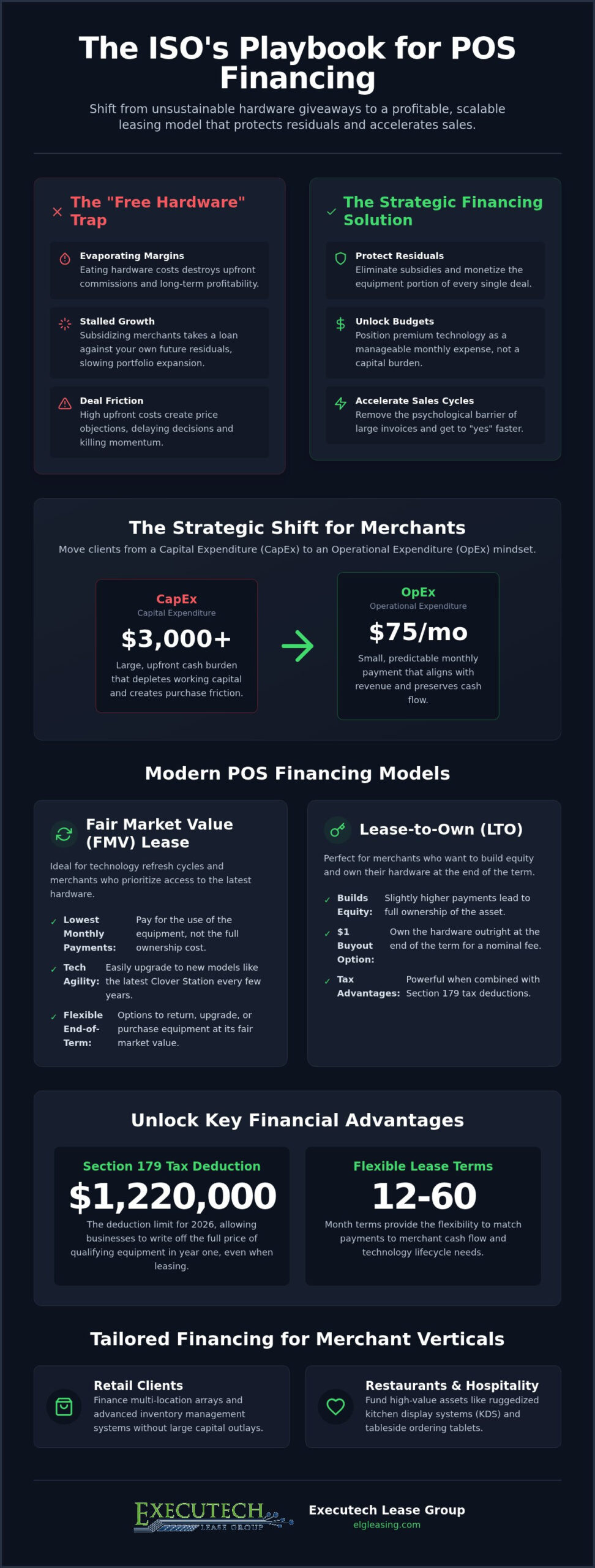
This playbook promises to help you master 12 to 60 month equipment leases to protect your residuals and secure higher upfront commissions. You’ll learn to position premium technology as a manageable monthly expense rather than a capital burden. We’ll preview the exact financial structures, including FMV options and the $1,220,000 Section 179 tax deduction limit for 2026, that streamline your sales cycle and eliminate the margin drain for good. It’s time to stop subsidizing your merchants and start scaling your portfolio with professional transparency.
Key Takeaways
- Transition merchants from a capital expenditure mindset to an operational expenditure model to unlock budget for premium hardware.
- Master how to sell POS systems with financing by leveraging 12 to 60 month terms to overcome upfront price objections and accelerate the sales cycle.
- Utilize Fair Market Value leases to establish a predictable technology refresh cycle, ensuring your merchants never fall behind with obsolete equipment.
- Protect your long-term residual income by eliminating the need for hardware subsidies and monetizing the equipment portion of every deal.
- Apply vertical-specific strategies to finance high-value assets like ruggedized kitchen displays for restaurants and multi-location arrays for retail clients.
The Strategic Shift: Why Selling POS Systems with Financing Wins in 2026
The payments industry has reached a tipping point. In 2026, the most successful ISOs have stopped selling hardware and started selling financial flexibility. Understanding how to sell POS systems with financing means moving your merchants from a capital expenditure (CapEx) mindset to an operational expenditure (OpEx) strategy. A modern Point of Sale (POS) system is no longer just a cash register; it’s a sophisticated data hub. Asking a merchant to drop thousands of dollars upfront for this technology creates unnecessary friction and stalls your momentum.
The “free equipment” model is a trap that destroys your long-term value. When you give away hardware, you’re essentially taking a loan against your own future residuals to fund a merchant’s startup costs. It drains your margins. It slows your growth. By utilizing 12 to 60 month leases, you eliminate this drain. You provide the merchant with premium technology like the Clover Station, Mini, or Flex without the initial sticker shock. This shift stabilizes your portfolio and ensures you’re paid for the value you provide on day one.
Preserving Working Capital for the Merchant
Business owners protect their cash flow at all costs. They prefer predictable monthly payments that align with their revenue cycles. Financing allows them to match the cost of the POS system to the profit it generates in real-time. In a 2026 retail environment, OpEx efficiency means leveraging cloud-based tools through a subscription-style lease to maintain liquidity while accessing elite hardware. This approach is further bolstered by tax incentives. For example, the 2026 Section 179 deduction limit is $1,220,000. This allows many businesses to deduct the full price of qualifying equipment in the first year even if they are leasing it through a 12 to 60 month term.
The Psychology of the Monthly Payment
Complexity kills deals. A $3,000 invoice for a multi-lane setup triggers immediate buyer remorse and lengthy approval delays. Conversely, a conversation about a manageable $75 monthly payment feels like a utility bill. It’s easier to digest. It speeds up the decision-making process significantly. When you know how to sell POS systems with financing, you remove the psychological barrier of immediate loss and replace it with the logic of incremental gain. The Benefits of POS leasing extend beyond the math; they create a seamless path to “yes” by reducing the perceived risk of the investment and letting the merchant focus on their operations.
A Roundup of Modern POS Financing Models: FMV, Lease-to-Own, and SaaS
Mastering how to sell POS systems with financing requires more than a one-size-fits-all approach. You need a suite of financial tools that match the specific lifecycle of the technology you’re placing. The U.S. Small Business Administration notes that equipment financing and leasing allows companies to acquire the tools they need without depleting their cash reserves. In 2026, ISOs must differentiate between models that prioritize ownership and those that prioritize technology agility.
FMV vs. Lease-to-Own: Which to Pitch?
Choosing between Fair Market Value (FMV) and Lease-to-Own (LTO) depends entirely on your merchant’s long-term goals. FMV leases are the ultimate tool for technology refresh cycles. They offer the lowest monthly payments because the merchant is essentially paying for the use of the equipment rather than the full cost of ownership. This is ideal for high-growth retail environments where hardware becomes obsolete every few years. At the end of the term, the merchant can return the gear, upgrade to the latest Clover Station, or purchase it at its then-current value.
Ownership matters to a different subset of clients. Lease-to-Own programs, often featuring a $1 buyout option, appeal to merchants who want to build equity in their hardware. While the monthly payments are slightly higher than FMV, the merchant owns the asset outright at the end of the 12 to 60 month term. This structure is particularly powerful when combined with the 2026 Section 179 tax deduction, allowing businesses to potentially write off the full purchase price. You can explore these options further through our leasing programs to see which lever fits your next deal.
Financing the “Soft Costs”: SaaS and Cloud Software
Modern POS systems are as much about software as they are about screens. A major innovation in 2026 is the rise of subscription-based leases that merge hardware costs with cloud software fees. ELG Leasing supports this by allowing ISOs to finance the “soft costs” of a deal. This includes setup, training, and SaaS POS software licenses. Instead of the merchant paying a separate, fluctuating monthly bill to a software provider, you bundle everything into a single, fixed monthly line item.
Bundling creates a “sticky” merchant. It streamlines their accounting and makes the total cost of ownership transparent. By using SaaS subscription lease programs, you monetize the entire solution rather than just the terminal. This approach protects your margins and prevents competitors from “cherry-picking” the software side of your accounts. If you want to offer this level of professional financial engineering to your clients, you can apply to partner with ELG today.
Overcoming Price Objections with 12-60 Month Lease Terms
Price isn’t the primary barrier to closing a deal. Cash flow is. When a merchant balks at the cost of a premium setup, they’re rarely questioning the value of the technology. They’re questioning their ability to part with thousands of dollars in liquidity. Learning how to sell POS systems with financing allows you to pivot the conversation from a one-time cost to a manageable monthly lever. You can use term length to fit the specific needs of the business. A 12 month lease is perfect for small terminals, while a 60 month lease makes enterprise-grade hardware arrays affordable for expanding brands.
The sweet spot for 2026 technology cycles is often the 36 to 48 month lease. This timeframe aligns with the natural lifespan of modern hardware before a refresh is required. It keeps the merchant’s payments low while ensuring they don’t get stuck with obsolete gear. You should also lead with the massive tax advantages available. In 2026, the Section 179 tax deduction limit is $1,220,000. This allows merchants to potentially deduct the full purchase price of the equipment in the first year. They get the tax break now while paying for the system over the next five years. It’s a powerful financial argument that most “free equipment” agents simply can’t match.
The ROI Calculation for Sales Agents
You must teach your merchants to view the lease as a tool for revenue generation. If a new POS system costs $100 per month, the merchant only needs to see a tiny increase in efficiency to break even. For a high-volume restaurant, a lease payment that represents less than 1% of monthly revenue is an easy trade for the labor savings of a ruggedized kitchen display system. When you frame the cost against the efficiency gains, the hardware pays for itself. This clarity is a core reason why choose ELG for your financing is the preferred path for high-standard ISOs who value professional deal structures.
Stabilizing Your ISO Residuals
The “free equipment” model is a race to the bottom. Every time you subsidize hardware, you’re eating into your processing margins. Financing preserves your residuals. By moving the equipment cost to a 12 to 60 month lease, you keep your processing revenue intact. You don’t have to hike rates to recover hardware costs. This makes your offer more competitive and your portfolio more stable. It protects you from competitors who try to lure your clients away with lower rates because your equipment is already paid for through a separate, professional agreement. If you’re ready to stop draining your margins, you can apply for POS financing now and start closing cleaner deals.
Industry-Specific Strategies: Matching Financing to the Merchant Vertical
Vertical focus is where a generalist sales agent becomes a specialized consultant. Knowing how to sell POS systems with financing requires you to speak the specific language of the merchant’s industry. A retail chain with five locations has different financial hurdles than a single high-volume bistro. By tailoring the lease structure to the vertical, you remove the friction inherent in generic hardware pitches. You provide a solution that fits their specific operational rhythm.
Retailers often struggle with scaling across multiple sites. A master lease agreement allows them to manage multi-location arrays under a single financial umbrella. This simplifies their accounting; it also makes adding a new storefront as easy as adding a new line item to the existing contract. For restaurants, the focus shifts to durability and mobility. Financing ruggedized kitchen displays and Clover Flex handhelds ensures the staff has professional tools that survive the heat and spills of a busy shift without a massive upfront capital drain.
Service-based businesses like HVAC or landscaping companies need mobile-first solutions. They don’t need a heavy counter terminal; they need cloud-based booking and invoicing software integrated with a mobile reader. Subscription leases lower the barrier for these high-end software packages. Finally, high-risk merchants often find themselves locked out of traditional bank financing. Specialized leasing partners provide the stability these businesses need to access premium hardware without the volatility of banking red tape.
The Clover Advantage in Retail and Hospitality
The Clover ecosystem is the gold standard for versatility. Financing the Clover Station, Mini, and Flex allows you to offer a cohesive technology stack that grows with the merchant. You can find more details in our Clover Terminal Leasing: A Strategic Guide. Managing hardware lifecycles becomes predictable when every device in a multi-storefront operation is on a synchronized refresh schedule. It keeps the brand consistent and the technology current across all locations.
Cloud-Based POS for Service Providers
The market is moving away from legacy hardware. Modern service providers demand mobile-first SaaS solutions that handle everything from scheduling to final payment. This transition is easier when you know how to sell POS systems with financing to bridge the gap between old tech and new software. Our guide on Cloud-Based POS Financing: Modernizing Merchant Tech explores how these models work. By bundling the software costs into the lease, you make high-end automation affordable for small service firms.
Partnering with ELG: Streamlined Financing for ISOs and Agents
ELG doesn’t do “fluff.” We provide a no-nonsense approach to funding that prioritizes speed, professional transparency, and operational efficiency. In a market crowded with amateurish “free equipment” offers, we position you as a high-standard gatekeeper. You aren’t just an agent; you’re a strategic partner offering elite financial engineering. Mastering how to sell POS systems with financing through ELG means you monetize the hardware portion of every deal. You don’t leave money on the table. You access upfront commissions on the equipment while protecting your long-term residuals from the drain of hardware subsidies.
Efficiency is our core promise. We streamline the entire funding cycle to ensure you get paid faster. Our selective partnership model means we work with ISOs who value quality over quantity. We provide the tools; you provide the expertise. It’s a symbiotic relationship built on results. By removing the capital burden from the merchant and the residual risk from the agent, we create a path for scalable portfolio growth that traditional bank financing cannot match.
Empowering the Merchant Services Ecosystem
We act as the invisible financial engine for your tech-forward sales pitch. ELG offers white-label potential and specialized support for independent sales agents who want to maintain their brand’s authority. This isn’t just about a lease; it’s about a growth resource. You can find more details on this in our guide to POS Leasing for Independent Sales Agents: The 2026 ISO Growth Resource. We handle the complex logistics of asset management so you can focus on prospecting and closing high-value accounts.
Getting Started: The ELG Process Flow
Simplicity is a relief. Our workflow moves with surgical precision from the initial application to hardware deployment. We’ve removed the friction often found in legacy banking environments. The ELG Process Flow ensures that every stakeholder knows exactly where the deal stands in real-time. This predictability allows you to manage merchant expectations and close deals with unwavering confidence.
The steps are direct:
- Submit the merchant application through our secure portal.
- Receive a decision based on our streamlined credit review.
- Execute the professional lease documents digitally for maximum speed.
- Deploy the hardware and trigger the funding process.
We don’t work with everyone. We work with professionals who understand that how to sell POS systems with financing is the key to a scalable, high-margin portfolio in 2026. If you’re ready to upgrade your sales arsenal and join an elite ecosystem that values your time, it’s time to take action.
Scaling Your Portfolio with Professional Financial Engineering
Transitioning to a financing-first model is the most effective way to protect your residuals and offer premium technology without draining your own margins. You now have the playbook to leverage specialized 12 to 60 month merchant hardware leases to close enterprise-grade deals. By removing the capital burden from your clients, you eliminate the “free equipment” trap that stalls growth. Mastering how to sell POS systems with financing positions you as a sophisticated consultant rather than a commodity salesperson.
We provide the expert support ISOs and independent sales agents need to streamline their funding workflow. Whether you’re placing a Clover Station, Mini, or Flex ecosystem, our no-nonsense approach ensures you monetize the equipment portion of every deal with surgical precision. The market in 2026 demands efficiency and transparency. You have the tools to deliver both while accelerating your own revenue growth.
It’s time to stop subsidizing your merchants and start building a high-standard portfolio that lasts. We look forward to fueling your next big deal.
Frequently Asked Questions
How does selling POS systems with financing benefit an ISO?
Selling with financing protects your long-term residual income by eliminating the need to subsidize hardware costs from your processing margins. You earn upfront commissions on the equipment while providing the merchant with premium technology. This approach makes your accounts more “sticky” because the merchant has a professional financial commitment. It also allows you to compete against low-rate processors without sacrificing your own profitability.
Can I include POS software in a 12-60 month equipment lease?
You can absolutely include cloud-based SaaS POS software in a 12 to 60 month equipment lease. ELG Leasing specializes in bundling soft costs like setup, training, and software subscriptions into a single monthly payment. This helps you monetize the entire solution rather than just the hardware. It streamlines the merchant’s accounting by providing one fixed bill for their entire payment technology stack.
What is the difference between FMV and Lease-to-Own for a merchant?
Fair Market Value (FMV) leases offer the lowest monthly payments and maximum flexibility for merchants who want to upgrade their technology every few years. At the end of the term, they can return the gear or buy it at its current value. Lease-to-Own programs usually feature a $1 buyout option. These are designed for merchants who intend to keep their hardware for its entire functional life and want full ownership.
How long does the approval process take for a Clover terminal lease?
The approval process for a Clover terminal lease is built for speed and minimal friction. Our streamlined credit review typically provides a decision quickly after the application is submitted. Once approved, documents are executed digitally to accelerate the funding cycle. This efficiency ensures that you can deploy hardware and start processing transactions without the lengthy delays common in traditional banking environments.
Are POS lease payments tax-deductible under Section 179?
POS lease payments often qualify for immediate write-offs under Section 179. For the 2026 tax year, the deduction limit is $1,220,000. This allows many businesses to deduct the full purchase price of qualifying equipment in the first year even if they are paying for it over a 12 to 60 month term. You should advise your merchants to consult with a tax professional to maximize these specific financial advantages.
Can I finance high-end hardware like the Clover Station for my clients?
Yes, you can easily finance high-end hardware like the Clover Station, Mini, and Flex through our programs. Knowing how to sell POS systems with financing allows you to pitch these premium systems without causing merchant sticker shock. We provide the financial engine that makes enterprise-grade technology accessible to small and mid-sized businesses. This ensures your clients have the best tools to manage their operations efficiently.
What happens at the end of a 48-month POS lease term?
What happens at the end of a 48 month term depends on the specific lease structure you chose. In a Fair Market Value lease, the merchant can return the equipment, upgrade to a newer model, or purchase the hardware at its current value. If they are on a Lease-to-Own plan, they typically exercise a $1 buyout option to take full ownership. This flexibility allows merchants to manage their technology lifecycle according to their specific budget.
Does ELG Leasing support independent sales agents and smaller ISOs?
ELG Leasing provides specialized support for both independent sales agents and established ISOs. We act as a selective partner, focusing on tech-forward professionals who value transparency and efficiency. Our programs offer the white-label potential you need to maintain your brand authority while we handle the complex financial logistics. This partnership empowers you to scale your portfolio by mastering how to sell POS systems with financing to diverse merchant verticals.

Article by
Robert Ensminger
Robert Ensminger is the founder and CEO of Executech Lease Group (ELG Leasing), which specializes in equipment leasing and financing solutions for the merchant-services, payments, POS, and FinTech industries. With more than 20 years of industry experience, Robert helps independent sales organizations, payment processors, POS providers, and software companies develop practical leasing, subscription, and SaaS-monetization programs. He founded ELG in 2010 and guided the company to recognition on the Inc. 5000. His work focuses on responsive service, transparent program structures, and helping ELG’s partners close more business while creating sustainable revenue.