
Why would you hand over a massive chunk of your seed capital to a hardware vendor before you’ve even processed your first transaction? It’s a common mistake that drains cash runways and leaves new businesses vulnerable. You need high-end technology to compete, but the upfront costs for premium systems are often staggering. Traditional banks rarely help; they see a lack of time in business as a red flag rather than an opportunity. We understand that frustration. POS leasing for startups is the strategic bridge that connects your new venture to enterprise-grade tools without the financial strain.
You already know that cash is your most valuable asset during the first year. This guide explores how flexible leasing allows you to access the latest Clover hardware and cloud-based SaaS software while preserving your capital for marketing and hiring. We’ll clarify the confusion between hardware leases and software subscriptions. You’ll learn how to maximize your 2026 tax benefits and secure the equipment you need to scale immediately. Let’s look at how to build a tech stack that works for your balance sheet, not against it.
Key Takeaways
- Preserve your cash runway by replacing high upfront equipment costs with predictable, low-impact monthly payments.
- Access a complete tech stack by financing your cloud-based SaaS software and premium hardware terminals through a single provider.
- Maximize your business’s financial health by using POS leasing for startups to claim full Section 179 tax deductions in your first year of operation.
- Accelerate the approval process with a clear understanding of the 12–60 month terms and documentation standards required for new business ventures.
- Avoid technical obsolescence by leveraging flexible lease-to-own or FMV options that ensure your business always uses current technology.
Why POS Leasing is a Strategic Capital Move for Startups
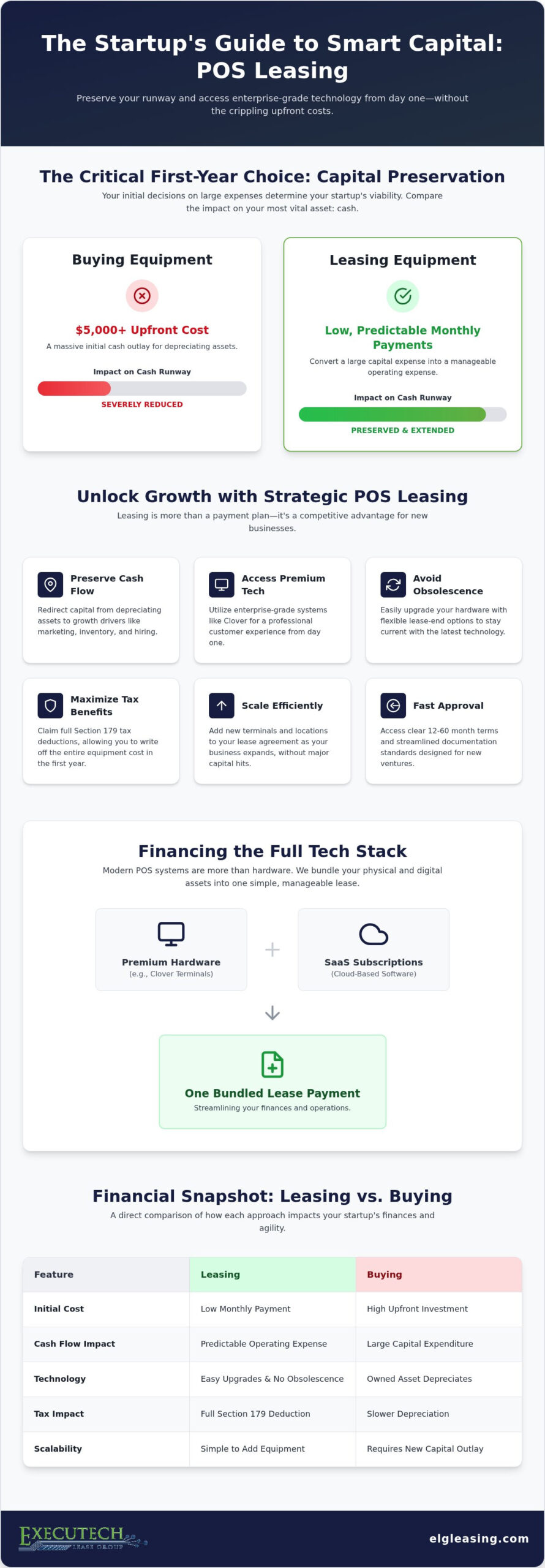
A Point of Sale (POS) system is the heartbeat of your retail or restaurant operations. It’s the point where your hard work translates into revenue. For a new business, POS leasing for startups converts a heavy capital expenditure into a manageable operating expense. You pay a fixed monthly fee to use both the hardware and the cloud-based SaaS software. It’s a transparent model that prioritizes your liquidity over equipment ownership. You get the tools you need today while keeping your cash where it belongs: in your bank account.
Protecting your runway is vital during the early stages of growth. Avoiding an upfront cost of $5,000 or more can extend your operational life by months. That’s capital that should stay available for emergencies or pivot opportunities. Technology also moves fast. Leasing protects you from tech obsolescence. When the next generation of terminals arrives, you aren’t stuck with outdated plastic and wires. You simply upgrade through your lease terms. This flexibility ensures your business stays modern without requiring a second round of hardware investment.
Preserving Cash Flow for Growth
Cash is king during the first 18 months of business. You shouldn’t tie up your initial seed capital in depreciating assets. By choosing a lease, you redirect those funds into inventory, hiring, or marketing campaigns that drive sales. Predictable monthly payments make budgeting straightforward. You know exactly what’s leaving your account every month. This stability is essential for maintaining a healthy burn rate. It allows you to plan your growth with confidence rather than worrying about the high cost of equipment failure or replacement.
Accessing Enterprise-Grade Technology
Startups often settle for “cheap” tablet solutions that lack robust security or professional features. This is a mistake that can hurt your brand. Leasing gives you immediate access to premium systems like the Clover Station or Clover Mini. These benefits ensure a seamless checkout experience for your customers from day one. You get the security, speed, and reliability of an enterprise-level setup without the enterprise-level price tag. A professional POS system signals to your customers that you’re a serious, established player in the market.
Growth shouldn’t be a financial burden. As your startup adds locations or mobile units, you can add terminals to your lease agreement. It’s an efficient way to scale your infrastructure without taking massive capital hits. You stay agile, responsive, and ready for whatever the market demands. This modular approach to technology is why POS leasing for startups is the preferred choice for founders who value speed and efficiency.
Financing the Full Stack: Hardware and SaaS Software
Modern commerce requires a hybrid of tangible hardware and intangible code. When you look at POS leasing for startups, you must consider the “full stack.” It isn’t enough to just lease a terminal. You have to manage the recurring costs of the software that makes that terminal functional. In 2026, the industry has shifted entirely to subscription models. You no longer buy a software license once; you subscribe to a service that evolves with your business. This creates a dual financial burden of upfront hardware costs and ongoing software fees that can quickly erode a new company’s cash reserves.
Many traditional lenders ignore the software component. They see it as an unsecured risk because they can’t repossess code if a business fails. We take a different approach. By bundling hardware and SaaS into a single, manageable monthly lease, you streamline your digital operations. This clarity allows you to focus on your product rather than juggling multiple vendor invoices. If you’re wondering how to qualify for equipment financing that covers both your physical and digital assets, the process is more straightforward than most banks would have you believe. It’s about demonstrating the value of the integrated system to your business plan.
Cloud-Based POS Software Financing
Financing SaaS is a necessity for digital-first startups. These companies rely on real-time data, remote management, and integrated inventory. Our Cloud-Based POS Financing programs are designed to cover these recurring costs. You get the power of high-end analytics and inventory management without the strain of large, unfinanced software bills. This structure ensures your tech stack remains a catalyst for growth rather than a drain on your liquidity. We bridge the gap that leaves many startups stuck with basic, non-scalable tools.
Clover Leasing Solutions
The Clover ecosystem is the gold standard for modern merchants. Whether you need the robust Clover Station, the compact Clover Mini, or the portable Clover Flex, specialized financing is available. Our Clover Terminal Leasing options support the entire hardware suite. This ensures your startup has access to a premium, integrated experience from day one. You don’t have to settle for fragmented systems that don’t talk to each other. You can start your application today to see which programs fit your specific business model.
Bundling these costs is a strategic move. It transforms a complex web of subscriptions and hardware payments into a predictable line item. You gain the latest technology while maintaining the agility needed to survive your first few years. This integrated approach to POS leasing for startups is what separates successful founders from those who get bogged down in technical debt.
Startup ROI: Leasing vs. Buying POS Systems
Many founders look at the sticker price of a POS system and assume buying is the most economical route. This is a narrow view of financial health. When you buy, you’re responsible for the hidden costs of ownership. This includes maintenance, mandatory hardware upgrades, and the eventual disposal of obsolete gear. POS leasing for startups shifts these responsibilities, turning a stagnant asset into a flexible operational tool. You aren’t just paying for a machine; you’re paying for the ability to use your cash elsewhere.
Consider the opportunity cost of a $3,000 purchase. That capital is locked in a depreciating box on your counter. In a startup environment, that same cash could fund a targeted ad campaign or secure a high-quality inventory shipment. Leasing keeps your capital liquid. It allows you to invest in growth-driving activities while still utilizing premium technology. You maintain the agility to pivot your strategy without being weighed down by heavy equipment investments.
The Section 179 Tax Advantage
Section 179 of the tax code remains a powerful incentive for small businesses in 2026. It allows you to deduct the full purchase price of qualifying equipment from your gross income in the year it’s placed in service. For startups, this means you can often write off the total value of your leased POS equipment immediately. This applies even if you’ve only made a few monthly payments by year-end. Consult with a tax professional to maximize these lease-related write-offs. This strategy drastically reduces your tax liability during those critical first months of operation.
Operational ROI and Maintenance
Ownership often leads to tech debt. As your hardware ages, it becomes slower and less secure. You’re stuck with the bill for repairs or replacements. With a 12–60 month lease, you eliminate this risk. Your lease terms ensure you always have working, compliant equipment. Comparing a 5-year cost of ownership against a 60-month lease often reveals that the lease is more cost-effective when you factor in support and upgrades. You avoid the sudden, large expenses that come with equipment failure.
At the end of your term, you aren’t stuck with junk. You have choices. You can upgrade to the newest model, return the equipment, or exercise a buyout option. This strategic flexibility is what makes POS leasing for startups a superior ROI move compared to traditional purchasing. You stay agile while your competitors are weighed down by aging assets.
How Startups Secure Approval for POS Leases
Securing traditional financing is a notorious hurdle for new businesses. Most banks demand at least two years of operating history before they’ll even consider an application. POS leasing for startups bypasses this rigid requirement by focusing on the utility of the equipment and the potential of your business model. The approval process is designed for speed and efficiency; it recognizes that you need tools now to generate the revenue that proves your viability later. Transparency is your biggest asset during this phase. When you provide a clear picture of your startup’s financials, you accelerate the path to funding.
The calculation for Credit Card Terminal Monthly Payments is straightforward. It’s based on the total equipment cost, the lease factor (the rate), and your chosen term length. Most startups find their balance between 36 and 48 months. This range keeps payments low enough to protect your monthly runway while avoiding an excessively long commitment. Your Merchant Services Provider plays a critical role here; they coordinate between the hardware requirements and the lease structure to ensure the full stack is covered. You’ll typically need basic documentation: a business license, your tax ID (EIN), and the last three months of business bank statements.
Understanding Lease Terms and Options
You must choose a structure that aligns with your long-term goals. Fair Market Value (FMV) leases offer the lowest monthly payments and the most flexibility. They are ideal if you want to upgrade to the latest technology at the end of the term. If your goal is equipment equity, a Lease-to-Own program allows you to own the hardware for a nominal fee, often just one dollar, once the lease concludes. You can explore these specific Leasing Programs to determine which path preserves your capital most effectively.
The Application Process for New Businesses
Time is a finite resource for any founder. We prioritize a streamlined 24-48 hour approval window to keep your momentum high. During this time, underwriters review your documentation to assess risk and verify your business’s legal standing. Being direct about your financial position leads to faster results. We skip the red tape common in traditional banking to get your terminals shipped and your software activated. If you are ready to move forward, you can access our Apply Now portal to start the process immediately.
Choosing the right term is a strategic decision. A shorter 12-month lease might offer the lowest total cost of ownership, but it puts more pressure on your early-stage cash flow. A 60-month term offers maximum cash preservation but requires a longer commitment to the hardware. Most successful founders use POS leasing for startups to find a middle ground that keeps their burn rate predictable while ensuring their team has enterprise-grade tools from day one.
ELG Leasing: The Selective Partner for Startup Success
ELG Leasing operates with a singular focus: speed. In the fast-paced startup culture of 2026, waiting weeks for a traditional bank to review a terminal request is a liability you can’t afford. We provide a no-nonsense alternative that prioritizes clarity and execution. As a specialized arm of Executech, we understand that POS leasing for startups isn’t just about the hardware. It’s about the entire ecosystem, including the cloud-based SaaS software that drives modern commerce. We empower payment processors and ISOs to offer their merchants premium technology without the barrier of high upfront costs.
We don’t work with everyone. We are a selective partner that seeks out ambitious startups and reliable ISOs. This selectivity fosters a secure ecosystem where quality is prioritized over quantity. By bridging the gap between finance and technology, we ensure your startup has the enterprise-grade tools necessary to dominate your niche. POS leasing for startups through ELG is more than a financial arrangement; it’s a strategic alliance designed for long-term operational success.
Efficiency and Transparency
Traditional bank financing is often riddled with friction and outdated requirements. We eliminate these hurdles through a streamlined process that values your time. Our commitment to professional transparency means you won’t encounter hidden fees or complex, “old-fashioned” contract structures. We act as a high-standard gatekeeper, ensuring that every lease is structured for the mutual success of the merchant and the vendor. You can learn more about our specific approach by visiting our Why ELG page.
The ISO and Sales Agent Connection
Startups rarely secure their technology in a vacuum. They work with sales agents and ISOs who understand the local market. ELG Leasing serves as the powerful engine behind these partnerships. By providing specialized financing for both hardware and recurring software costs, we allow agents to close deals faster and merchants to access better tech. This synergy is essential for scaling a new business quickly. If you are an agent looking to enhance your offering, our guide on How to Sell POS Systems with Financing provides a strategic roadmap for the 2026 sales environment.
Our programs are designed to monetize your potential. Whether you need access to subscription-based leases or specialized SaaS-specific financing, we provide the tools to accelerate your growth. We streamline the path between the sales agent, the ISO, and the merchant, ensuring that everyone in the chain benefits from a more efficient financial process. This results-driven professional approach is why we remain the preferred choice for startups that demand more from their financial partners.
Scale Your Startup with Strategic Capital Preservation
Success in the first year of business requires precise cash management. Choosing POS leasing for startups allows you to access premium hardware and cloud-based software without the heavy upfront costs that drain your runway. You’ve learned how 12–60 month flexible terms provide the breathing room your budget needs. By utilizing specialized SaaS software financing and the tax benefits of Section 179, you create a tech stack that supports your growth instead of hindering it.
We offer a transparent, no-nonsense approval process designed to match the speed of your operations. You don’t have to settle for outdated equipment or settle for the high friction of traditional bank loans. You have the tools and the strategy to build a modern, efficient business from day one. Take the next step toward securing your operational future.
Your vision deserves the best technology available. We’re here to ensure you get it without compromising your financial stability.
Frequently Asked Questions
Can I lease a POS system if my startup has been open for less than a year?
Yes, you can secure a lease even if your business has been open for less than a year. Traditional banks often reject new ventures due to a lack of history, but POS leasing for startups is designed to accommodate this exact scenario. We focus on the utility of the equipment and your business’s revenue potential. This allows you to access enterprise-grade technology immediately without waiting for years of tax returns to prove your viability.
What is the difference between an FMV lease and a lease-to-own program for a startup?
A Fair Market Value (FMV) lease offers the lowest monthly payments and provides the option to return or upgrade equipment at the end of the term. This is ideal for startups that want to stay current with technology. A lease-to-own program involves slightly higher payments but allows you to purchase the hardware for a nominal fee, such as one dollar, once the term concludes. You choose between maximum flexibility or eventual equipment equity.
Does POS leasing include the software, or just the hardware?
Our programs cover the full stack, including both physical hardware and cloud-based SaaS POS software. Many providers only finance the terminals, leaving you to pay for expensive software subscriptions out of pocket. We bundle these costs into a single, manageable monthly payment. This ensures your startup has a fully functional, integrated system from day one without the complexity of managing multiple vendor invoices for your digital and physical tools.
How long are the typical lease terms for startup POS equipment?
Typical lease terms range from 12 to 60 months. Most startups find that a 36 or 48-month term provides the best balance between low monthly payments and total cost. Shorter terms like 12 months preserve less cash monthly but lead to faster ownership. Longer 60-month terms maximize your initial cash runway. We work with you to determine which duration aligns with your specific growth projections and operational needs.
Are POS lease payments tax-deductible for new businesses?
Yes, POS lease payments are generally tax-deductible for new businesses. Under Section 179 of the tax code, startups can often deduct the full value of the leased equipment in the year it’s placed in service. This provides a significant immediate tax break that further preserves your capital. You should consult with a tax professional to ensure you’re maximizing these deductions based on your specific lease structure and 2026 tax regulations.
What happens at the end of my 12–60 month POS lease?
At the end of your 12 to 60-month term, your options depend on the lease type you selected. If you have an FMV lease, you can return the equipment, upgrade to the latest model, or purchase it at its current market value. If you chose a lease-to-own program, you typically pay a nominal buyout fee to take full ownership. This structured transition prevents you from being stuck with obsolete technology or unexpected costs.
Do I need a high credit score to qualify for startup POS financing?
You don’t necessarily need a perfect credit score to qualify for POS leasing for startups. While credit is a factor, we place significant weight on your business plan, revenue potential, and the specific equipment being leased. We understand that new founders may not have extensive business credit profiles yet. Our goal is to provide a transparent approval process that looks at the big picture of your startup’s health rather than just a single number.
Can I upgrade my POS hardware in the middle of a lease term?
Yes, you can often upgrade your POS hardware in the middle of a lease term. Technology evolves rapidly, and we provide flexible trade-up options that allow you to roll your remaining balance into a new lease for newer equipment. This ensures your business never falls behind competitors due to aging hardware. It’s a strategic way to keep your checkout experience modern without the friction of canceling your existing agreement or paying a massive upfront fee.

Article by
Robert Ensminger
Robert Ensminger is the founder and CEO of Executech Lease Group (ELG Leasing), which specializes in equipment leasing and financing solutions for the merchant-services, payments, POS, and FinTech industries. With more than 20 years of industry experience, Robert helps independent sales organizations, payment processors, POS providers, and software companies develop practical leasing, subscription, and SaaS-monetization programs. He founded ELG in 2010 and guided the company to recognition on the Inc. 5000. His work focuses on responsive service, transparent program structures, and helping ELG’s partners close more business while creating sustainable revenue.