Your business risk profile should never be the reason you’re stuck with second-rate technology. Mainstream providers like Square or Stripe see a high-risk label and immediately close the door. This leaves you trapped between two bad options. You either drain cash flow to cover significant upfront hardware costs or sign a predatory “free equipment” contract. It’s a bottleneck that prevents growth. Strategic POS financing for high risk merchants provides a third way. It allows you to access premium hardware while keeping your capital liquid.
We understand the frustration of being a high-standard business in a misunderstood industry. You deserve transparent monthly payments and the ability to use elite tools like Clover without being held hostage by your processor. This 2026 guide explains how to secure flexible 12 to 60 month leases that separate your equipment from your processing agreement. We’ll show you how to streamline your operations, protect your cash flow, and finally get the modern point-of-sale system your business requires to scale.
Key Takeaways
- Learn why specialized POS financing for high risk merchants is the most effective way to bypass mainstream processor rejections and secure premium hardware.
- Discover how to bundle “soft costs” like cloud-based SaaS software into a single, predictable 12 to 60 month lease.
- Compare Fair Market Value (FMV) and Lease-to-Own options to find the right balance between low monthly payments and equipment ownership.
- Identify the red flags of predatory “free equipment” traps and how to vet a partner for transparent, high-risk underwriting.
- Master the strategy of decoupling your hardware from your processing contract to maintain operational flexibility and protect your cash flow.
What is POS Financing for High Risk Merchants?
High-risk industries don’t fit into the neat boxes required by traditional banks. When a business operates in a “hard-to-place” sector, securing a loan for equipment feels like an uphill battle. POS financing for high risk merchants solves this by providing specialized access to hardware and software through leasing. This isn’t a standard bank loan. It’s a targeted financial structure for businesses that mainstream lenders often ignore. It provides a path to premium technology without the friction of traditional credit hurdles.
Specialized leasing companies bridge the gap between your operational needs and the rigid standards of the financial world. Whether you’re in CBD, travel, nutraceuticals, or running a subscription-based model, you need a functional Point of Sale (POS) system to survive. Without it, you can’t process payments or track inventory efficiently. These programs ensure you don’t have to settle for outdated terminals just because your industry carries a specific risk profile.
The High-Risk Label: Why Lenders Are Cautious
Traditional lenders fear volatility. In 2026, regulatory shifts and chargeback ratios remain the primary triggers for rejection. For example, Mastercard’s Excessive Chargeback Program (ECP) flags merchants with a chargeback-to-transaction ratio of 1.5% or higher. Banks see these numbers and see potential loss. Reputational risk also plays a role. Many institutions avoid specific industries to maintain a certain corporate image. This bias extends to mainstream payment providers like Square or Stripe. These platforms are known for fast approvals followed by sudden account terminations when they detect high-risk activity. Specialized leasing programs look past these labels to evaluate the actual health of your business.
The Shift from Upfront Purchase to Strategic Leasing
Buying hardware outright is often a poor use of capital. A full setup can cost up to $2,000 per station, which is a heavy burden for growing companies. High-risk POS financing is a strategic tool for capital preservation, allowing businesses to maintain liquidity while accessing top-tier technology. By choosing a lease, you preserve your working capital for inventory and marketing efforts. Technology also moves fast. Hardware that seems cutting-edge today will likely be obsolete in three years. Leasing allows you to upgrade at the end of your term without being stuck with a closet full of useless plastic. It’s about efficiency and forward-thinking asset management.
Mechanics of High-Risk POS Equipment Leasing
Understanding the mechanics of POS financing for high risk merchants is essential for maintaining a lean operation. Most specialized programs offer terms ranging from 12 to 60 months. This range allows you to align your monthly overhead with your projected revenue growth. Shorter terms work well for businesses wanting to own equipment quickly. Longer terms prioritize immediate cash flow preservation. You choose the duration that matches your specific business cycle.
The process usually begins with an Independent Sales Organization (ISO) or a sales agent. These professionals act as the bridge between your business and the specialized leasing entity. They understand the nuances of high-risk underwriting and help package your application to ensure it meets the necessary standards. You should expect a streamlined digital application. Approval times vary, but the focus is on efficiency and getting hardware into your hands without the bureaucratic delays common in traditional banking.
A major advantage of modern leasing is the ability to finance “soft costs.” This includes the cloud-based software required to run your system. Instead of paying a separate monthly bill to a software vendor and another to a hardware provider, you bundle them. This approach mirrors the consumer trends highlighted in the CFPB Buy Now, Pay Later Report, where structured, predictable payments are becoming the standard for managing significant expenses. It simplifies your accounting and ensures all your tools are covered under one agreement.
Hardware Options: From Terminals to Full POS Systems
High-risk merchants need durable, premium hardware to handle complex transactions. Options range from basic credit card terminals to sophisticated setups like the Clover Station, Mini, and Flex models. The Flex is ideal for mobility and line-busting, while the Station serves as a robust central hub for high-volume storefronts. Choosing the right setup depends on your industry’s specific workflow. You can explore various leasing programs to see which hardware configuration best fits your operational footprint.
SaaS and Subscription Lease Models
Fragmented billing is a silent killer of productivity. When you manage separate subscriptions for inventory, reporting, and payment software, “app fatigue” sets in. Modern subscription-based leases solve this by combining everything into one monthly payment. This creates a predictable line item on your balance sheet. It also ensures your software remains updated and integrated with your hardware. This level of technical cohesion is vital for high-risk businesses that must maintain strict compliance and reporting standards. If you’re ready to modernize your tech stack, you can start the application process today.
Comparing Programs: FMV vs. Lease-to-Own for High Risk
Choosing the right structure for POS financing for high risk merchants depends on your long-term operational goals. You aren’t just selecting a payment plan. You’re choosing an asset management strategy. The two primary paths, Fair Market Value (FMV) and Lease-to-Own, offer distinct advantages depending on your industry and growth trajectory. Understanding these differences ensures you don’t overpay for technology or get stuck with outdated hardware.
FMV leases prioritize flexibility and cash flow. These programs typically offer the lowest monthly payments because you’re essentially paying for the use of the equipment rather than its full value. At the end of the term, you have the option to return the hardware, buy it at its current market value, or upgrade to the latest technology. This “refresh” cycle is vital for high-volume environments where hardware takes a beating and needs frequent replacement.
When to Choose an FMV Lease
An FMV lease is the strategic choice for businesses that need to stay on the cutting edge. Technology moves fast. In high-risk retail, having a system that supports the latest security protocols and customer engagement tools is a competitive necessity. By choosing this path, you avoid the burden of owning obsolete gear. You can read more about Why FMV Leases Benefit Rapidly Growing Businesses to see if this alignment fits your current scale and technical requirements.
The Case for Lease-to-Own
If you prefer long-term stability and want to build equity in your hardware, Lease-to-Own is the superior model. This program is structured so that you own the equipment outright at the end of the 12 to 60 month term. It’s an excellent fit for established high-risk sectors where the workflow is consistent and hardware requirements don’t change annually. This path helps you avoid the “forever lease” trap by establishing a clear finish line for your payments. For a deeper dive, consult our POS Lease to Own Guide for Merchants and ISOs 2026.
Tax considerations also play a major role in this decision. Under Section 179 of the tax code, many high-risk businesses can deduct the full cost of leased equipment in the first year it’s put into service. This accelerates your tax benefits and immediately improves your bottom line. Whether you choose FMV or Lease-to-Own, the ability to write off these expenses makes leasing a powerful financial lever. At the end of your lease, you maintain total control. You can choose to upgrade your tech stack, return the equipment to clear space, or finalize a buyout to keep your proven tools in place.
Checklist: Evaluating a High-Risk POS Financing Partner
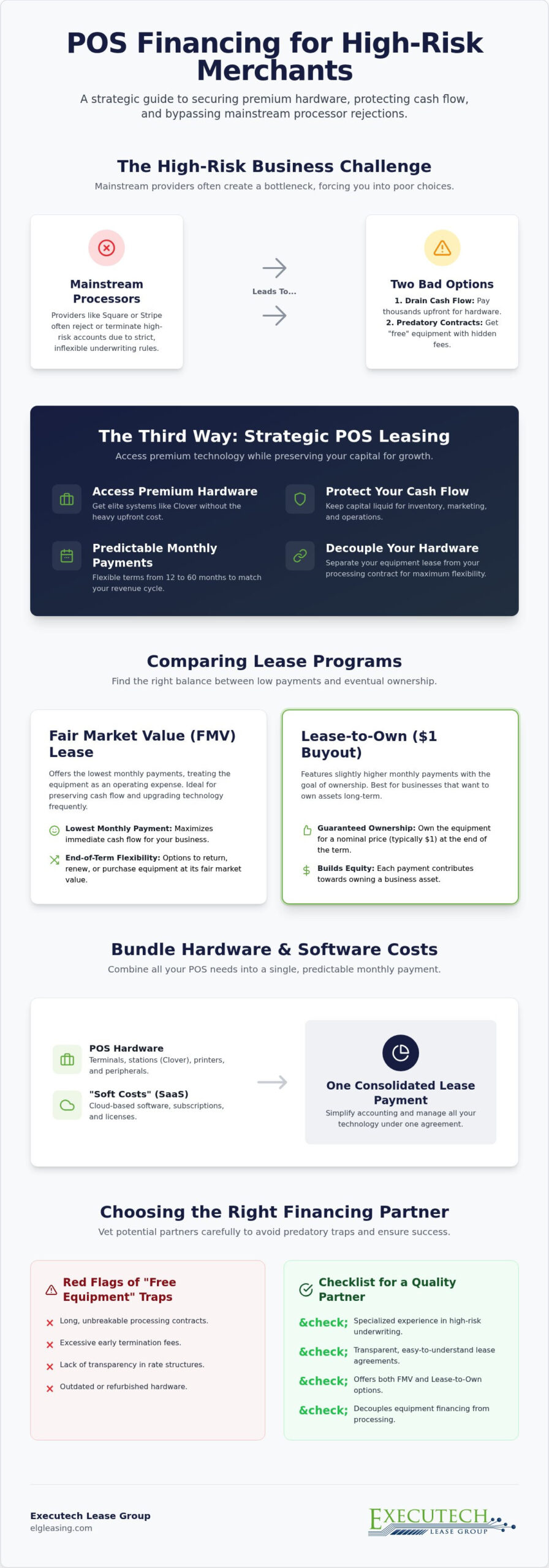
Choosing a partner for POS financing for high risk merchants requires a disciplined approach. You aren’t just looking for a vendor; you’re selecting a gatekeeper who understands your industry’s specific challenges. The wrong choice can lead to predatory terms that stifle your growth. A professional partner provides a clear breakdown of every cost from day one. There should be no “junk fees” or surprise escalations hidden in the fine print. Transparency is the hallmark of a reliable financial relationship.
Flexibility is equally important. Your partner should offer term lengths that match your business plan, whether that’s a short 12-month commitment or a longer 60-month lease. They must also support modern, premium hardware. If a provider is pushing legacy terminals instead of Clover Station or Flex models, they don’t understand the technical requirements of a 2026 business. Premium hardware ensures you have the cloud-based reporting and inventory tools necessary to maintain compliance in a high-risk environment.
Decoupling your equipment lease from your processing contract is a critical safety measure. This independence prevents a single point of failure. If your payment processor suddenly freezes your account or terminates your service, you don’t lose your hardware. You maintain control over your POS system, allowing you to integrate a backup processor and continue operations without a total shutdown. This separation of concerns is the most effective way to protect your business infrastructure.
Avoiding the “Free Equipment” Trap
“Free” hardware is a marketing illusion that often hides predatory costs. High-risk processors use this hook to lock you into long contracts with significantly higher transaction rates. The math rarely favors the merchant. A business paying an extra 1% in processing fees to cover “free” hardware will often pay triple the equipment’s value over a 36-month term. A transparent lease with a fixed monthly payment allows you to secure lower processing rates, saving you thousands in the long run. Always look for liquidated damages clauses that make it impossible to exit these “free” agreements.
Underwriting Requirements for High-Risk Merchants
In 2026, underwriters look beyond simple credit scores. They analyze your processing history, chargeback management protocols, and overall operational stability. You must be prepared to provide clean financial statements and a professional digital footprint that proves your business is compliant with current industry regulations. Underwriters favor merchants who demonstrate a proactive approach to risk mitigation. Securing premium terms requires an application that demonstrates professional transparency and consistent operational history.
The ELG Advantage: Selective Leasing for High-Risk Success
ELG Leasing is a selective partner. We don’t try to be everything to everyone. Our focus is narrow. We specialize in the merchant services and payment processing industry. This specialization allows us to offer POS financing for high risk merchants that general equipment lessors simply cannot match. We understand that your industry requires powerful tools to manage complex transactions and compliance. Our 12 to 60 month lease programs are built to provide that access without the friction of traditional bank underwriting.
We also act as a force multiplier for ISOs and sales agents. By providing a reliable, transparent leasing platform, we empower these professionals to offer their high-risk clients better hardware options. This isn’t just about moving equipment. It’s about building a stable foundation for a long-term processing relationship. We prioritize speed and clarity because we know that in the high-risk world, delays are costly. Our no-nonsense approach ensures that you get the answers you need to make informed capital decisions.
Empowering Merchants with Clover Technology
Accessing premium hardware shouldn’t be a privilege reserved for low-risk businesses. Our programs provide access to the Clover Station, Mini, and Flex models. These devices are more than just card readers. They are integrated business management systems. In high-risk environments, the advanced reporting and security features of a tech-forward POS are essential for risk mitigation. You can explore the strategic advantages in our guide to Clover Terminal Leasing: A Strategic Guide to POS Financing in 2026. We make it simple to equip your business with the best technology available.
Ready to Accelerate Your Business Technology?
Our process flow is designed for efficiency. We move from application to deployment with minimal administrative overhead. Transparency is our highest standard. We believe merchants should understand every aspect of their agreement before they sign. There are no hidden fees or complex legal traps. We simply provide the capital and the equipment you need to scale your operations. If you’re ready to modernize your storefront or digital operations, we’re ready to facilitate that growth through a structured, professional lease program.
Securing Your Operational Future in 2026
High-risk merchants don’t need to settle for outdated terminals or predatory “free” equipment traps. Strategic POS financing for high risk merchants provides the leverage needed to access premium Clover hardware while maintaining essential cash flow. By utilizing flexible 12 to 60 month terms and specialized high-risk underwriting, you can decouple your technology from your processing contract. This structure ensures operational stability and technical superiority even in volatile markets.
We prioritize transparency and speed, ensuring you have the tools to scale without hidden fees or complex hurdles. As a Clover Certified Leasing Partner, we offer the expertise required to navigate the unique demands of “hard-to-place” industries. You deserve a partner that understands your business model and provides a clear path to modern efficiency. Our no-nonsense approach removes the friction from financial growth and simplifies your path to deployment.
Take control of your tech stack today and position your business for sustainable success in 2026.
Frequently Asked Questions
Can I get POS financing if my business is in a high-risk industry?
Yes, you can secure POS financing for high risk merchants even if traditional banks have rejected your application. Specialized lenders like Executech Lease Group (ELG Leasing) focus specifically on “hard-to-place” industries such as CBD, travel, and nutraceuticals. We look past the high-risk label to evaluate your actual operational health. This selectivity ensures that businesses in misunderstood sectors still have access to the premium hardware and software needed to remain competitive and compliant in 2026.
What is the difference between an FMV lease and lease-to-own for POS systems?
A Fair Market Value (FMV) lease offers the lowest monthly payments and maximum flexibility at the end of your term. It’s ideal if you want to refresh your technology every few years. In contrast, a lease-to-own program allows you to build equity in your hardware. You own the equipment outright once the 12 to 60 month term concludes. Your choice depends on whether you prioritize long-term asset ownership or the ability to upgrade hardware frequently.
How long are the typical lease terms for high-risk merchant equipment?
Typical lease terms range from 12 to 60 months. This flexibility allows you to align your equipment costs with your specific business plan and revenue projections. Shorter terms are excellent for businesses that want to own their assets quickly or anticipate rapid growth. Longer terms, such as 48 or 60 months, prioritize capital preservation by keeping monthly overhead as low as possible. You select the duration that best supports your operational liquidity.
Do high-risk POS leases include software costs or just hardware?
Modern leasing programs cover both hardware and cloud-based SaaS POS software. Financing your “soft costs” prevents fragmented billing and simplifies your monthly accounting by combining your tools into a single payment. This approach is vital for high-risk merchants who utilize sophisticated reporting and inventory management platforms. You can bundle your terminal leasing with your recurring software subscriptions to create a cohesive, tech-forward environment that supports your entire payment ecosystem.
Why should I lease my POS system instead of getting “free” equipment from my processor?
Leasing provides transparency that “free” equipment offers often lack. Processors offering free hardware usually recoup the costs through significantly higher transaction rates and predatory contract clauses. By choosing a transparent 12 to 60 month lease, you decouple your hardware from your processing agreement. This separation protects your business. If your processor freezes your account, you still own or control your equipment, allowing you to switch to a backup provider without operational downtime.
What documents do I need to apply for high-risk POS financing in 2026?
To apply for POS financing for high risk merchants in 2026, you should prepare your financial statements and processing history. Underwriters prioritize professional transparency and a clean digital footprint. You’ll likely need to provide recent bank statements and proof of your merchant account history. Demonstrating a proactive approach to chargeback management and regulatory compliance will significantly improve your chances for approval. A well-organized application helps streamline the underwriting process and accelerates your deployment.
Can I upgrade my POS hardware before the lease term ends?
Upgrading hardware is a standard feature of many Fair Market Value (FMV) programs. While terms are fixed for 12 to 60 months, an FMV lease specifically allows you to return outdated gear at the end of the term and start a new lease for the latest technology. If your business scales faster than expected, you should consult with your leasing partner about mid-term upgrade options. This ensures your high-risk operation never falls behind due to obsolete point-of-sale tools.
Is Clover hardware available for high-risk merchants through leasing?
Yes, premium Clover hardware is fully available for high-risk merchants through specialized leasing programs. You can access the Clover Station, Mini, and Flex models without the large upfront capital investment typically required for these devices. This includes the latest 2026 models designed for high-volume retail and service environments. Accessing these tech-forward systems through a lease allows you to utilize elite inventory management and reporting tools that help mitigate industry-specific risks effectively.
Article by
Robert Ensminger
Robert Ensminger is the founder and CEO of Executech Lease Group (ELG Leasing), which specializes in equipment leasing and financing solutions for the merchant-services, payments, POS, and FinTech industries. With more than 20 years of industry experience, Robert helps independent sales organizations, payment processors, POS providers, and software companies develop practical leasing, subscription, and SaaS-monetization programs. He founded ELG in 2010 and guided the company to recognition on the Inc. 5000. His work focuses on responsive service, transparent program structures, and helping ELG’s partners close more business while creating sustainable revenue.