
Owning your POS hardware in 2026 is a liability, not an asset. When you sink capital into upfront hardware costs, you’re tethering your business to technology that begins depreciating the moment it’s unboxed. You already know that a strategic approach to merchant cash flow equipment leasing is the difference between stagnant operations and aggressive growth. High costs for Point of Sale systems shouldn’t stall your momentum. You need hardware that accelerates your business, not a balance sheet weighed down by outdated equipment and complex, fee-heavy contracts.
This guide reveals how to optimize your working capital by leveraging flexible POS and credit card terminal leasing strategies. We’ll show you how to access premium hardware like the Clover Station while keeping your cash reserves intact for inventory and scaling. You’ll learn the specific advantages of 12 to 60 month lease structures and how they provide the predictable monthly payments necessary for modern financial planning. We’re moving past the era of hardware ownership and into a streamlined model of integrated technology ecosystems that prioritize your bottom line.
Key Takeaways
- Preserve your operational liquidity by shifting from heavy upfront hardware costs to manageable monthly payments.
- Master the strategic link between merchant cash flow equipment leasing and sustainable growth through structured 12 to 60 month terms.
- Compare Fair Market Value (FMV) and Lease-to-Own models to identify the most efficient path for your technology refresh cycle.
- Discover how to bundle premium hardware with cloud-based SaaS software into a single, predictable monthly expense.
- See how streamlined leasing processes remove price objections, allowing ISOs to scale their portfolios with minimal friction.
The Intersection of Merchant Cash Flow and Equipment Leasing
Merchant cash flow represents the pulse of your business. It is the liquid capital available to handle daily operations, pay staff, and respond to market shifts. When you lock that capital into depreciating hardware, you limit your ability to scale. Upfront costs for modern POS systems remain the single largest drain on small business capital. This is why merchant cash flow equipment leasing has evolved from a simple financing option into a core strategic tool for the 2026 business environment. It converts a heavy capital hit into a predictable, manageable operating expense.
Why Capital Preservation Matters for Modern Merchants
Cash is your most versatile asset. Maintaining a robust cash cushion allows you to pivot during unexpected market volatility without taking on predatory debt. Every dollar you spend on a terminal is a dollar you can’t spend on high-margin inventory or customer acquisition. The opportunity cost of buying hardware is high. You’re trading liquid growth potential for a static asset that loses value the moment it’s unboxed. Smart merchants prioritize liquidity over ownership. ELG’s leasing programs are designed specifically to keep your cash where it belongs: in your business.
Leasing as a Hedge Against Technology Obsolescence
The pace of innovation in payment technology is relentless. Software updates and security requirements move faster than ever. If you buy your hardware outright, you’re often trapped in a “legacy tech” cycle that slows down customer throughput and frustrates your team. Using equipment leasing allows for regular hardware refreshes. You stay at the cutting edge without the burden of disposal or the financial hit of a total replacement. It is an efficient way to ensure your checkout experience remains seamless and secure.
In 2026, the market has shifted away from “hardware-only” deals. Modern leasing focuses on the entire tech ecosystem. This includes the physical terminal, the cloud-based SaaS POS software, and the ongoing support required to keep them running. By choosing structured 12 to 60 month terms, you stabilize your cash flow and ensure your business never falls behind the competition. This transition to ecosystem-focused leasing is how modern merchants maintain their competitive edge while keeping their capital working where it matters most. It’s about access to power, not just ownership of parts.
Financial Mechanics: How POS Leasing Optimizes Working Capital
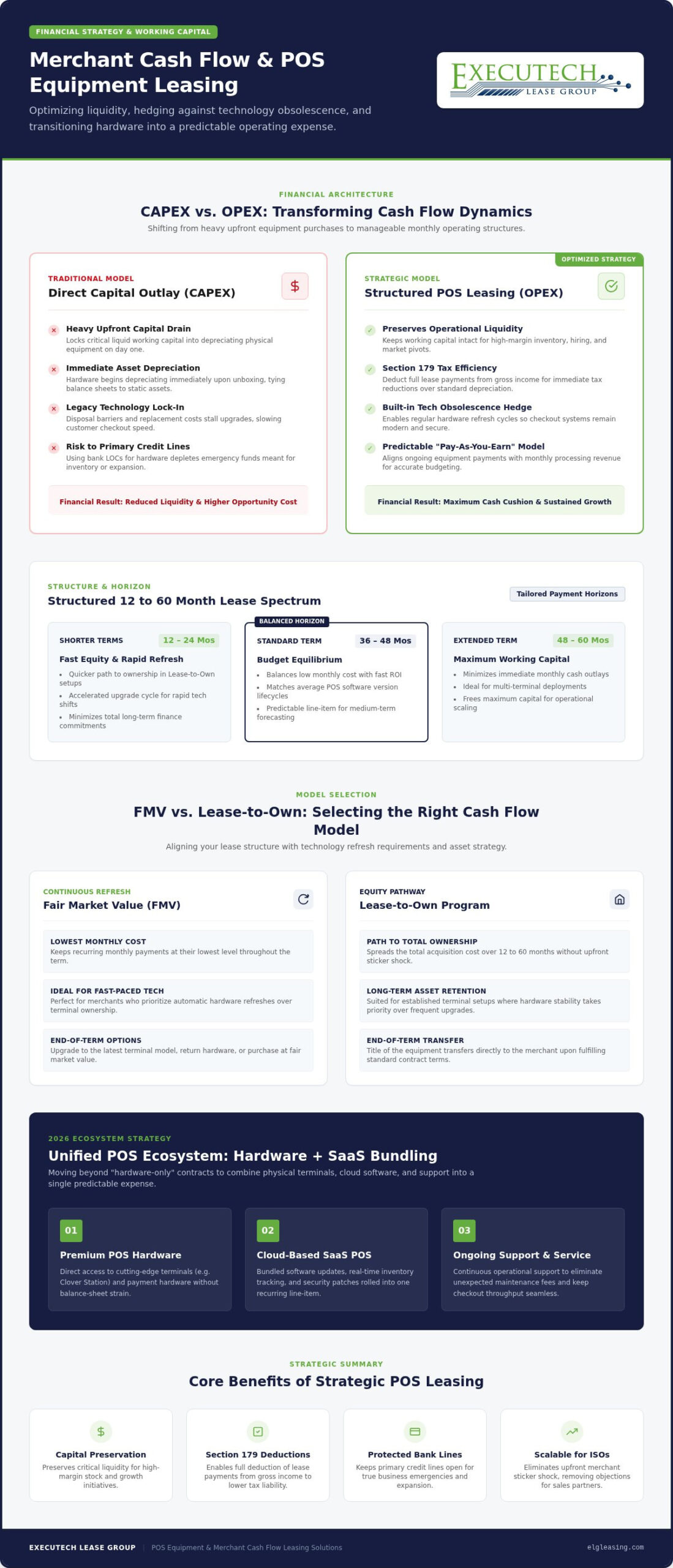
Transitioning from Capital Expenditure (CAPEX) to Operating Expense (OPEX) is a fundamental move for modern businesses. When you buy equipment, you use up cash today for a benefit spread over years. Leasing flips this. It turns a large, upfront cost into a steady, tax-deductible expense. In 2026, merchant cash flow equipment leasing remains a top strategy because it allows you to utilize Section 179 tax deductions. This provision often lets businesses deduct the full amount of lease payments from their gross income. It’s an immediate reduction in tax liability that ownership can’t match through standard depreciation schedules.
Fixed monthly payments are the cornerstone of accurate budgeting. Unlike variable processing fees or fluctuating interest rates, a lease payment is a set number. This stability is critical when managing business finances and working capital. With terms ranging from 12 to 60 months, you can align your payments with your projected revenue growth. Short terms offer quick ownership through lease-to-own programs. Longer terms maximize monthly cash flow by keeping the monthly commitment low. This flexibility ensures your technology costs never outpace your earnings.
Predictable Payments vs. Variable Costs
High upfront costs for POS systems create “sticker shock” that can paralyze decision-making. Leasing eliminates this barrier entirely. It aligns your equipment costs with your monthly processing volume. This “pay-as-you-earn” model ensures your technology is generating revenue before the next payment is due. There is a significant psychological benefit to this approach. You avoid the stress of large, irregular outflows and replace them with a “no-surprises” financial model.
Protecting Your Primary Credit Lines
Many business owners make the mistake of using a bank Line of Credit (LOC) for hardware. This is a strategic error. Bank lines are for emergencies, inventory spikes, or major expansions. Dedicated merchant cash flow equipment leasing keeps your primary credit lines open and untouched. It also preserves your debt-to-income ratio, which is vital for future borrowing needs. By keeping equipment debt separate from your bank relationships, you maintain maximum financial flexibility. It’s a cleaner, more professional way to operate. If you’re ready to secure your hardware without tapping into your bank lines, you can start your application today.
FMV vs. Lease-to-Own: Choosing the Right Cash Flow Model
Choosing the right lease structure isn’t just a technicality. It’s a strategic decision that dictates your long-term liquidity. You have two primary paths: Fair Market Value (FMV) and Lease-to-Own. Both impact your merchant cash flow equipment leasing strategy differently over a standard 36-month period. One prioritizes the lowest possible monthly outflow. The other builds equity in your hardware. Understanding the mechanics of each ensures you don’t overpay for technology that might be obsolete in a few years.
The FMV Advantage: Lowest Monthly Payments
FMV leases are the ultimate tech-refresh tool. Because you aren’t paying for the full cost of the equipment, your monthly payments are significantly lower. This structure maximizes your immediate monthly cash flow. It’s the ideal scenario for merchants who want access to premium hardware, like the newest Clover devices, every three years. At the end of the lease, you have three clear choices: return the equipment, renew the lease, or purchase the hardware at its fair market value. It’s a model built for flexibility and speed. It keeps your business agile and your checkout lines moving.
Lease-to-Own: Building Equity in Your Technology
Lease-to-Own is a path to long-term asset ownership. This model usually features a $1 buyout option at the end of the term. While your monthly payments will be higher than an FMV lease, you own the equipment outright after the final payment. This makes sense for businesses with long-term stability that don’t require frequent hardware upgrades. However, you must balance ownership with the risk of hardware aging. A terminal you own in 2029 might not support the security protocols or customer expectations of that era. You’re trading future flexibility for a permanent asset.
To determine your primary goal, consider the 36-month financial impact. Over three years, an FMV lease keeps your liquid reserves higher for inventory and marketing. A Lease-to-Own program results in a zero-balance payment at month 37 but requires more capital each month during the term. Use this checklist to decide which of our leasing programs fits your needs:
- Do you need to refresh your hardware every 3 years to stay competitive? (Choose FMV)
- Is your primary goal the absolute lowest monthly overhead? (Choose FMV)
- Do you prefer to own assets and avoid recurring payments after the term? (Choose Lease-to-Own)
- Are you comfortable using hardware for 5 or more years? (Choose Lease-to-Own)
The right choice depends on your specific growth trajectory. We don’t believe in one-size-fits-all financing. We provide the options that allow you to scale on your own terms.
Modernizing with SaaS and Subscription-Based POS Leasing
In 2026, a terminal without integrated software is just a paperweight. Traditional lenders often fail to understand this. They focus strictly on physical assets. We don’t. We provide “soft cost” financing that covers the cloud-based software powering your hardware. This shift is vital for effective merchant cash flow equipment leasing. By financing your SaaS costs alongside your equipment, you avoid multiple monthly invoices and simplify your accounts payable process. You get one predictable payment for your entire technology stack.
Financing the Full Tech Stack
Bundling is about efficiency. You can include hardware, cloud-based software, and even professional installation into a single lease agreement. This streamlines your vendor management. Instead of juggling three different bills, you deal with one. It’s a cleaner way to manage your operational expenses. Our approach to Cloud-Based POS Financing ensures you have the tools to compete without the fragmentation of traditional tech procurement.
Subscription Leases: The Future of Merchant Services
Modern businesses don’t buy tech; they consume it. Our subscription-based models mirror this reality. These leases offer the flexibility that seasonal businesses and high-growth startups require. You scale your technology as your revenue grows. This model removes the friction of massive upfront software licensing fees. It’s a plug-and-play financial structure. You can explore our specific SaaS Subscription Programs to see how we’ve modernized the leasing experience for the digital age.
Consider the Clover Station. It is a powerful piece of hardware, but its true value lies in its cloud ecosystem. Through ELG, you can lease the physical terminal and finance the monthly SaaS software fees in one package. This case study in efficiency shows how we prioritize your liquidity. You get the premium hardware you need and the software required to run it, all while keeping your merchant cash flow equipment leasing strategy optimized and lean. This model is particularly effective for high-volume retail environments where software updates are constant. We don’t just lease boxes; we lease complete business solutions that evolve with your market. It’s about maintaining a high standard of operation without the burden of separate, uncoordinated tech costs.
Scaling Your Portfolio: The ELG Leasing Advantage for ISOs
ISOs face a crowded market in 2026. Traditional banks don’t understand the merchant services ecosystem. We do. ELG Leasing serves as the premier partner for ISOs and payment processors who need a high-standard gatekeeper for their hardware financing. By integrating merchant cash flow equipment leasing into your sales strategy, you transform your value proposition. You move from being a commodity processor to a full-service technology facilitator. This shift allows you to monetize equipment effectively. You increase immediate residuals and upfront commissions by including hardware in the deal rather than giving it away or letting the merchant buy it elsewhere.
Empowering Sales Agents with Flexible Financing
Price objections kill deals. When an agent presents a high-end POS system, the upfront cost often halts the conversation. Using Lease-to-Own as a closing tool removes this friction. It simplifies the pitch. You focus on the manageable monthly payment, not the intimidating total price. This approach keeps the merchant’s capital liquid and their business moving. Our resource on POS Leasing for Independent Sales Agents provides the framework for these conversations. It’s about giving your team the confidence to sell premium hardware like Clover without fear of budget constraints.
By including hardware in the lease, you aren’t just solving a merchant’s problem. You’re creating a new revenue stream for your agency. Monetizing equipment allows you to capture upfront commissions that traditional processing-only deals lack. It strengthens the merchant’s commitment to your service. When you provide the hardware, you’re no longer just a vendor. You’re a selective partner invested in their operational success.
The ELG Process: Transparency and Speed
Efficiency is our standard. We’ve built a no-nonsense application flow that moves from submission to funding with minimal friction. Sales agents don’t have time for black-box underwriting or endless paperwork. We provide clear, transparent lease terms that build long-term trust between you and your merchants. There are no hidden fees or complex legalese to explain away later. This speed allows you to close more deals in less time. We handle the heavy lifting of asset management so you can focus on building your portfolio. If you’re ready to accelerate your growth, Apply Now to Join the ELG Partner Network.
Scaling Your Business with Strategic Technology Capital
Optimizing your business in 2026 requires a departure from traditional ownership models. You’ve seen how merchant cash flow equipment leasing provides the liquidity needed to outpace competitors while accessing the latest hardware. By shifting from CAPEX to OPEX, you protect your bank lines and simplify your tax strategy. Whether you choose FMV for rapid refreshes or Lease-to-Own for long-term stability, the goal remains the same: efficiency.
We offer 12 to 60 month flexible terms and specialized Clover financing to ensure your technology stack is a growth driver, not a financial burden. For ISOs, our direct support means closing more deals with total transparency. It’s time to move away from fragmented tech procurement and toward a streamlined, high-standard ecosystem. We prioritize your results with minimal friction and maximum clarity.
Your business deserves a partner that values quality and speed. We’re ready to help you accelerate your operations with a no-nonsense approach to equipment finance. Secure your future growth now.
Frequently Asked Questions
How does equipment leasing improve my merchant cash flow?
Leasing improves your merchant cash flow by eliminating the heavy upfront capital hit required for new hardware. Instead of sinking thousands of dollars into a terminal today, you spread the cost over several years. This keeps your cash liquid for high-priority needs like payroll, marketing, or inventory. It’s a strategic move that aligns your technology expenses with your monthly revenue. It ensures your hardware starts generating income before you’ve fully paid for it.
Can I lease cloud-based SaaS POS software along with my hardware?
You can bundle cloud-based SaaS POS software with your physical hardware into a single lease agreement. ELG Leasing specializes in “soft cost” financing. This includes the software licenses and setup fees required for modern systems. This integration simplifies your accounts payable by providing one predictable monthly payment for your entire tech stack. It’s a more efficient way to manage digital operations without the friction of separate, uncoordinated billing cycles for hardware and software.
What are the typical lease terms for credit card terminals?
Typical lease terms for credit card terminals range from 12 to 60 months. This range allows you to customize your payment schedule based on your specific financial goals. Short-term 12-month leases are ideal for businesses looking to acquire assets quickly. Longer 60-month terms are best for merchants who want to minimize their monthly overhead. These flexible structures ensure that your merchant cash flow equipment leasing strategy stays aligned with your business’s long-term growth trajectory.
What is the difference between an FMV lease and Lease-to-Own?
The primary difference lies in the end-of-term options and monthly costs. A Fair Market Value (FMV) lease offers the lowest monthly payments and serves as a tech-refresh tool. It’s ideal if you want to upgrade to newer devices every few years. A Lease-to-Own program has slightly higher monthly payments but includes a path to ownership; often with a $1 buyout. You choose FMV for maximum liquidity and Lease-to-Own for building long-term equipment equity.
Do I need a separate processor contract to lease a Clover terminal?
ELG Leasing does not provide direct payment processing. You’ll need a processing agreement with an ISO or payment processor to use a Clover terminal. However, we work closely with your chosen provider to ensure the hardware lease integrates seamlessly with your merchant account. This separation of hardware and processing gives you more control. It allows you to shop for the best processing rates while securing premium technology through our flexible 12 to 60-month lease terms.
Are POS equipment lease payments tax-deductible in 2026?
POS equipment lease payments are generally tax-deductible as an operating expense. In 2026, many businesses utilize Section 179 to deduct the full amount of their lease payments from their gross income. This immediate tax benefit is often more advantageous than the slow depreciation schedules associated with buying equipment outright. You should consult with a tax professional to confirm how these specific merchant cash flow equipment leasing structures will impact your business’s unique tax liability and financial reporting.
What happens at the end of my 12–60 month lease term?
Your options at the end of a 12 to 60-month lease depend on the agreement type you selected. If you have an FMV lease, you can return the equipment, renew the lease at a lower rate, or purchase the hardware at its current market value. If you chose a Lease-to-Own program, you’ll typically pay a nominal buyout fee; often just $1; and take full ownership of the terminal. We prioritize transparency, so these options are clearly defined before you sign.
Can ISOs use white-label leasing programs for their merchants?
ISOs can leverage ELG Leasing’s partner network to offer flexible financing directly to their merchants. While we operate as a specialized leasing arm, we provide the direct ISO support needed to close more deals in the field. This partnership allows sales agents to remove price objections by focusing on the monthly payment instead of the total hardware cost. It’s an efficient way to monetize equipment and increase upfront commissions while building a more loyal, technology-forward merchant portfolio.

Article by
Robert Ensminger
Robert Ensminger is the founder and CEO of Executech Lease Group (ELG Leasing), which specializes in equipment leasing and financing solutions for the merchant-services, payments, POS, and FinTech industries. With more than 20 years of industry experience, Robert helps independent sales organizations, payment processors, POS providers, and software companies develop practical leasing, subscription, and SaaS-monetization programs. He founded ELG in 2010 and guided the company to recognition on the Inc. 5000. His work focuses on responsive service, transparent program structures, and helping ELG’s partners close more business while creating sustainable revenue.