A lease program can strengthen an ISO’s merchant offer, but a poor fit can add friction instead of clarity. Equipment financing for ISOs should account for the technology merchants need and the way your team sells and onboards, especially when a large upfront equipment purchase gives them pause.
That hesitation is understandable. Merchants need clear choices, and your team needs to explain lease structures without making the decision harder. The right program is not defined by one term or feature. It should align the equipment, contract structure, and partner workflow with the merchant’s needs.
This guide explains how equipment and software financing can fit into a merchant technology offer. You’ll learn what to compare across 12-60-month leases, including Fair Market Value, lease-to-own, and subscription options; how to assess a specialist partner’s fit with your sales and onboarding process; and what to clarify before exploring a partnership. Use it as a framework for evaluating options, not as a promise about approval or merchant outcomes.
Key Takeaways
- In this guide, ISO means independent sales organization. Learn how equipment financing can become part of a merchant technology offer.
- Compare Fair Market Value, lease-to-own, and subscription structures against merchants’ equipment needs and term-end preferences.
- Use a partner checklist to assess equipment scope, contract clarity, and how applications, questions, documents, and updates are handled.
- Use a simple workflow: identify the merchant’s need, match a program, explain next steps, and connect the merchant with the provider.
- Explore how equipment financing for ISOs may fit your portfolio, including ELG’s programs and 12-60-month lease terms.
What Equipment Financing for ISOs Means in Merchant Services
In this context, an ISO is an independent sales organization, not an ISO certification standard. Equipment financing for ISOs means presenting a financing provider’s program as one way for a merchant to consider the payment technology their business needs. Available options depend on the provider’s programs and a merchant-specific review. An ISO can introduce an option, but should not imply that every merchant or piece of equipment will qualify.
An arrangement may involve four parties: the ISO or its agent, who identifies a potential need; the merchant, who evaluates the offer; the financing provider, which explains and administers its program; and the equipment or software provider, which supplies the technology. Their roles can vary by program. Clarify who handles each step rather than assuming the ISO controls the financing.
This video offers a general introduction to equipment finance brokerage:
How an ISO can fit into a merchant equipment financing arrangement
Your role starts with discovery. Ask which payment equipment the merchant needs, how it will be used, and what preferences they have about the program structure. Then introduce relevant options and explain which provider can clarify terms and the review process. The financing provider’s role is separate from payment processing and supplying the equipment. Don’t suggest that you set credit decisions, contract terms, or approval outcomes unless that authority is explicitly part of your arrangement.
Which merchant technology may be considered
Eligible technology may include credit card terminals, POS systems, and Clover devices. Some programs may also include cloud-based SaaS POS software. Before discussing an option with a merchant, confirm with the provider whether the specific equipment or software is covered.
A program name alone does not explain the contract. Review the applicable documents and clarify responsibilities and term-end choices. For a closer look at POS options, see the POS equipment leasing guide.
Compare Equipment Financing Structures for ISO Merchant Offers
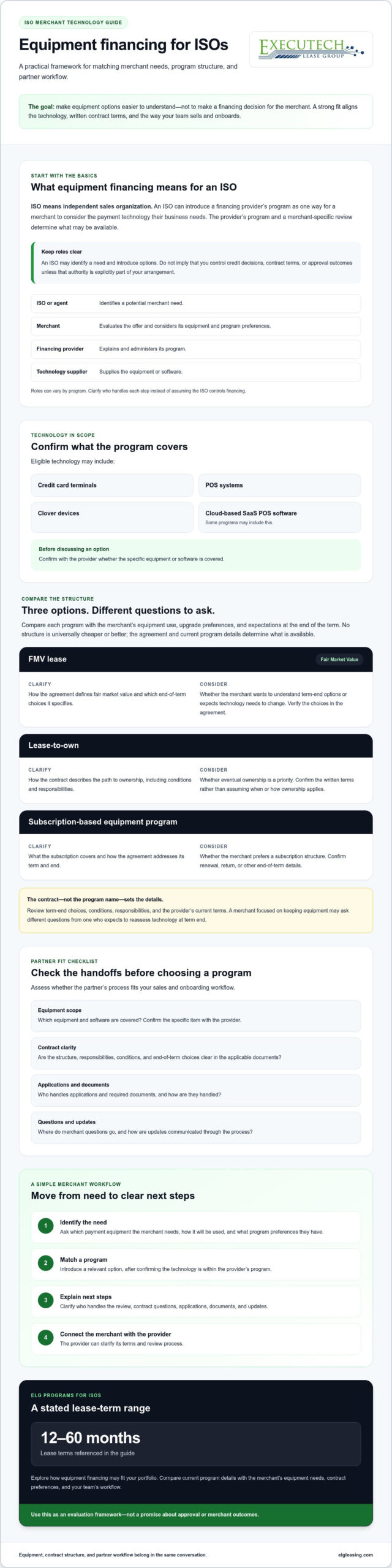
Structure affects what the merchant should ask, not just what an offer is called. For equipment financing for ISOs, compare each program with the merchant’s intended equipment use, upgrade preferences, and expectations at the end of the term. Don’t assume a structure is universally cheaper or better. The agreement and the provider’s current program details determine what is available.
| Structure | What to clarify | Merchant priorities to consider |
|---|---|---|
| FMV lease | Confirm how the agreement defines fair market value and which end-of-term choices it specifies. | May be worth discussing when the merchant wants to understand options at term end or expects technology needs to change. Verify the choices in the agreement. |
| Lease-to-own | Ask how the contract describes the path to ownership, including any conditions and responsibilities. | May be relevant if the merchant prioritizes eventual ownership. Confirm the written terms rather than assuming when or how ownership applies. |
| Subscription-based equipment program | Check what the subscription covers and how the agreement addresses its term and end. | Consider whether the merchant prefers a subscription structure for payment equipment. Confirm renewal, return, or other end-of-term details rather than assuming them. |
FMV lease versus lease-to-own for payment equipment
The names identify different program types, but they do not reveal every contractual detail. For an FMV lease, clarify how fair market value is handled. For lease-to-own, check how the ownership process is described. With either option, review the contract for term-end choices, conditions, and responsibilities. Use an FMV and lease-to-own program comparison as a starting point, then verify current terms with the provider.
Compare the full written terms with the merchant’s preferences. A merchant focused on keeping equipment may ask different questions from one who expects to reassess technology at the end of a term. Neither priority alone establishes which program is suitable.
When subscription or SaaS financing may be relevant
A subscription-based equipment program concerns payment equipment. Financing for cloud-based SaaS POS software concerns software. They are distinct options, even if a merchant is considering both as part of a technology offer. Confirm what each program covers, its terms, and whether it fits the merchant’s stated requirements. ELG provides SaaS POS financing programs; verify availability and eligibility for the specific situation.
Loan programs are another route to assess separately from equipment leases. The SBA loan-program overview provides information about SBA offerings. To discuss whether ELG’s listed programs fit your ISO’s needs, review its partnership inquiry process.
How ISOs Can Evaluate an Equipment Financing Partner
A provider should make the offer easier to explain, not harder to understand. Evaluate equipment financing for ISOs against two practical tests: does the program fit your merchant portfolio, and can your team explain the process and obligations clearly? A polished pitch is not enough. You need current details about covered equipment, contract terms, merchant communications, and handoffs.
Use this checklist during partner discussions:
- Program fit: Which structures and term options are currently available, and what eligibility requirements apply?
- Equipment scope: Does the provider support the credit card terminals, POS systems, Clover devices, or cloud-based POS software your merchants may need?
- Contract clarity: Can the merchant see payment obligations, ownership terms, and term-end options in clear written materials?
- Communication: Who handles applications, merchant questions, document requests, and status updates?
- Operational fit: Does the provider’s process align with how your team introduces and supports a merchant offer?
Financing should help merchants consider access to equipment without obscuring what they are agreeing to. If the provider cannot clearly explain obligations or ownership details, pause before presenting the program. The Equipment Leasing and Finance Association can provide broader context on the equipment finance industry. Your evaluation should still focus on the provider’s actual program and documentation.
Questions to ask before presenting a program to merchants
Ask for a current list of supported equipment categories, program structures, term options, and eligibility requirements. Confirm who explains contract terms and who responds to merchant servicing questions. Request written materials that show payment obligations and any term-end choices. Don’t rely on verbal summaries or assume details carry over from one agreement to another.
How to assess operational fit and transparency
Review current process documentation before sending merchants into an application or handoff. Trace what happens at each stage: who receives an inquiry, who communicates with the merchant, what documentation is requested, and how status updates are shared. Verify the provider’s answers directly. Avoid promising approval, timing, or outcomes your team does not control.
Then test the materials against real merchant conversations. Can your team describe the next step without overstating eligibility? Can merchants tell whom to contact with questions? You can review the ELG leasing process flow alongside any provider’s current documentation to assess how clearly responsibilities and handoffs are presented.
Build a Clear Merchant Workflow for Equipment Financing
A consistent handoff makes equipment financing for ISOs easier to explain and manage. Focus discovery on what the merchant needs, describe only program details the provider has confirmed, and make the next contact clear. The ISO can guide the conversation. The provider handles its own application and review process according to its requirements.
- Identify the need. Ask what equipment or software the merchant is considering, how they plan to use it, and what preferences they have about equipment use or program structure.
- Match the program category. Determine whether the request concerns a credit card terminal, POS system, Clover device, or cloud-based POS software. Check the provider’s current materials to see which options may apply.
- Explain the next steps. Tell the merchant who will receive the inquiry and who can answer questions about the application, review, contract, and payment obligations. Confirm the process before describing it.
- Connect with the provider. Make the agreed handoff, share only information the merchant has authorized, and direct questions about eligibility or terms to the appropriate provider contact.
Match the merchant need to the right program category
Start with the technology, not an assumed financing outcome. A merchant looking for a standalone terminal may have different requirements from one considering a complete POS system or Clover device. A cloud-based software request is also distinct from an equipment need. Merchant preferences can guide which program materials you review, but they do not guarantee qualification or specific terms. Refer the merchant to the provider’s current documentation for the full agreement details.
Keep handoffs and expectations straightforward
Before making an introduction, verify who receives the inquiry, what information the provider needs, and how the merchant can follow up. Application steps, documentation, and status updates are provider-specific. Don’t promise a decision or timing that has not been confirmed. Record unanswered questions about payment obligations, ownership, or term-end choices, then route them to the provider contact responsible for explaining the agreement.
For additional context on POS leasing for independent sales agents, review the available leasing program information and confirm which details apply to your arrangement.
Explore ELG Equipment Financing Programs for ISOs
Executech Lease Group (ELG Leasing) specializes in payment equipment leasing for merchant services providers, independent sales organizations, and payment processors. Its equipment categories include credit card terminals, POS systems, and Clover devices. ELG Leasing lists 12-60-month lease terms for credit card and POS equipment, alongside Fair Market Value (FMV), lease-to-own, and subscription-based program options.
ELG Leasing also offers financing for cloud-based SaaS POS software. This is separate from leasing physical equipment. When assessing a merchant technology offer, first identify whether the merchant needs a terminal, POS system, software, or a combination. Then check which current program details apply to that need.
What ELG confirms it offers to merchant services partners
ELG Leasing’s program categories give ISOs several structures to review, but they do not guarantee that a particular program will be available or suitable for every ISO or merchant. Confirm eligibility, current availability, and specific terms directly before presenting an option. Review payment obligations, contract responsibilities, and any term-end choices in the applicable documentation. Don’t assume approval, rates, savings, or decision speed.
- Equipment: Credit card terminal, POS, and Clover device leasing.
- Lease structures: FMV, lease-to-own, and subscription-based equipment programs.
- Software: Financing for cloud-based SaaS POS software.
- Term range: 12-60 months for credit card and POS equipment leases.
Start with ELG Leasing’s current leasing program information. Compare the listed categories with your portfolio and note what needs confirmation, including eligibility, covered equipment or software, contract terms, and how the provider handles merchant inquiries. A specialist option is worth evaluating when its scope and process align with your business, but it is not an automatic fit.
Choose a practical next step for your ISO
Before making an inquiry, define the merchant technology needs your portfolio commonly encounters and list the program questions that remain unanswered. Then use the application page to submit an inquiry and discuss whether a partnership may fit. An inquiry is a starting point, not a promise of approval or specific terms.
Put a Clear ISO Program in Motion
Strong equipment financing for ISOs starts with merchant fit, clear program terms, and a handoff your team can explain. Match the merchant’s equipment or software need to a provider’s current options, then direct questions about eligibility, payment obligations, and contract details to the provider. Clear expectations matter as much as program choice.
Executech Lease Group offers 12-60-month credit card and POS equipment lease programs, with FMV, lease-to-own, and subscription options. It also offers financing for cloud-based SaaS POS software. These are options to evaluate, not a guarantee of suitability or availability for every ISO or merchant. Review current program information and confirm applicable terms before presenting an offer.
Start with your portfolio’s equipment needs and the questions your team needs answered. A focused inquiry can help you explore whether ELG’s programs align with your workflow.
Apply to explore equipment financing programs
With clear roles and transparent information, you can assess a potential partnership and keep the merchant conversation straightforward.
Frequently Asked Questions
What does equipment financing for ISOs mean?
Equipment financing for ISOs means connecting merchants with a provider’s program for eligible payment equipment or software. Here, ISO refers to an independent sales organization, not an ISO certification standard. The ISO can identify a merchant’s technology needs and introduce relevant options, while the provider explains its program and review process. Available structures, eligibility, and terms depend on the provider and the merchant’s specific circumstances.
Can an ISO offer financing for POS equipment to merchants?
An ISO can present POS equipment options through a financing provider’s program, subject to the provider’s current offerings and eligibility requirements. The ISO’s role is to understand the merchant’s needs and make an appropriate introduction, not to set contract terms or make approval decisions. Before presenting an option, confirm who handles the application, explains the agreement, and answers questions about obligations.
What types of payment equipment can be financed?
Depending on the provider’s program, payment equipment may include credit card terminals, POS systems, and Clover devices. Confirm that the specific equipment a merchant needs is covered before discussing a program. Executech Lease Group (ELG Leasing) offers leasing for credit card terminals, POS equipment, and Clover devices, with 12-60-month lease terms for credit card and POS equipment. Confirm availability and eligibility for each situation.
What is the difference between an FMV lease and lease-to-own?
An FMV lease and a lease-to-own program are different structures, but their names alone do not establish the merchant’s exact rights or obligations. For an FMV lease, review how the agreement defines fair market value and specifies term-end options. For lease-to-own, check how the contract describes the path to ownership and any conditions. Compare the written agreement, not assumptions about either structure.
Can equipment financing include cloud-based POS software?
Yes, some providers offer financing for cloud-based SaaS POS software, separately from programs for physical equipment. Executech Lease Group (ELG Leasing) offers financing for cloud-based SaaS POS software, as well as leasing and subscription-based programs for payment equipment. Confirm what the specific program covers, whether it fits the merchant’s requirements, and which terms apply. Don’t assume software and hardware share the same agreement or eligibility.
How should an ISO choose an equipment financing partner?
Assess whether the provider’s equipment and software scope matches your merchant portfolio, then compare its program structures and terms. Ask for current written materials that explain payment obligations, ownership details, and term-end options. Verify who handles applications, documentation, merchant questions, and status updates. A suitable partner should make responsibilities clear and support accurate conversations without requiring your team to promise approval, timing, or outcomes.
Does equipment financing guarantee that a merchant will be approved?
No. Offering a financing program does not guarantee approval for a merchant. The financing provider handles its own review, and eligibility depends on its requirements and the merchant’s circumstances. An ISO can explain the next steps and direct the merchant to the provider, but should not predict the decision. Confirm the current application process and avoid promising approval, specific terms, or a decision timeline.

Article by
Robert Ensminger
Robert Ensminger is the founder and CEO of Executech Lease Group (ELG Leasing), which specializes in equipment leasing and financing solutions for the merchant-services, payments, POS, and FinTech industries. With more than 20 years of industry experience, Robert helps independent sales organizations, payment processors, POS providers, and software companies develop practical leasing, subscription, and SaaS-monetization programs. He founded ELG in 2010 and guided the company to recognition on the Inc. 5000. His work focuses on responsive service, transparent program structures, and helping ELG’s partners close more business while creating sustainable revenue.