The lowest monthly payment may not be the best fit for your checkout lanes. With Multi-lane POS system leasing, start by defining the equipment and software your operation needs, then compare lease structures and written terms against those requirements.
Before committing, consider how many lanes need terminals or other equipment, which software capabilities must work across the setup, and what happens at the end of the lease. Clear answers make it easier to compare offers on equal terms.
This guide explains how to document multi-lane requirements, compare FMV, lease-to-own, and subscription structures, and review contract details that may affect your decision. It also covers what to prepare for a financing conversation about equipment and cloud-based POS software. Executech Lease Group offers 12 to 60 month leasing options for POS equipment and cloud-based SaaS software, with program structures for different ownership preferences. Start with the setup, then assess the terms.
Key Takeaways
- Start multi-lane POS system leasing by documenting your checkout workflow, lane count, transaction patterns, and required peripherals.
- Compare FMV, lease-to-own, and subscription options based on ownership preferences, software requirements, and end-of-term terms.
- Review the equipment scope, software, lease term, payment schedule, and end-of-term provisions before signing.
- Ask for unclear contract terms in writing, and use the agreement to confirm your obligations.
- Once your setup is defined, explore whether ELG’s 12 to 60 month POS and credit card equipment leases, FMV, lease-to-own, subscription, Clover, or SaaS options fit your requirements.
What Does Multi-Lane POS System Leasing Cover?
A multi-lane POS setup brings together multiple checkout positions within one business operation. Each lane handles sales, while the business determines how equipment and software should work across the full setup. The specific tools in each lane depend on the operation and on what the offer covers.
Lane count is only a starting point. Two businesses with the same number of checkout positions may need different equipment, software, and contract structures. One may be refreshing existing equipment, while another is planning a new checkout layout. Assess multi-lane POS system leasing against your actual requirements rather than assuming a standard package includes every device or service.
Keep the arrangements distinct. Equipment leasing covers the equipment identified in the offer. Cloud-based POS software may have separate financing considerations, and payment processing is a separate service. Executech Lease Group offers POS and credit card equipment leases, as well as cloud-based SaaS POS software options, but doesn’t provide direct payment processing. Confirm whether software, support, installation, or other services are included, and whether they have separate terms.
Which equipment and software may be part of a multi-lane setup?
Begin with an inventory of the checkout terminals and related POS equipment your operation requires. Treat each item as something to verify, not as an automatic inclusion in a lease. For software, clarify whether you need a cloud-based POS platform and whether it is included in the offer or handled separately. Before comparing options, ask the provider to confirm device compatibility, quantities, and the precise software scope.
Who typically evaluates multi-lane POS leasing?
Merchants planning multiple checkout points or refreshing POS technology can evaluate leasing alongside equipment options and contract terms. Independent sales organizations (ISOs) and merchant-services providers may also present leasing options to merchants. Your role is to define the operational needs; the provider explains its program and application process. Describing your lane setup does not confirm a particular configuration, eligibility, or approval.
Confirm what the offer actually covers
Before evaluating a payment schedule, establish what the proposed arrangement includes. Ask for the equipment scope, software details, and any separate service terms in writing. Check that the listed quantities match your intended checkout setup, and raise compatibility questions with the relevant provider. ELG offers 12 to 60 month POS and credit card equipment leases, with FMV, lease-to-own, and subscription options. Confirm the configuration and terms for the specific offer you’re considering.
How to Match a POS Lease to Your Checkout Requirements
Start with how checkout works, not with a lease quote. A requirements list gives providers a consistent basis for discussing equipment and program options. Map the workflow, list equipment, define software needs, compare lease structures, and then review the contract. This keeps operational decisions separate from financing terms.
Before requesting options, document the number of checkout positions, transaction patterns, and peripherals each position requires. Note whether activity differs by lane or changes during peak periods. A provider can then respond to a defined setup instead of relying on lane count alone. For more background, review this POS equipment leasing guide.
Document lane-by-lane operating needs
Describe the role of each position. Record expected staff use, space or mobility constraints, and the payment and POS tasks the lane must support. For example, a fixed checkout counter and a position that needs to move through a sales area may have different equipment requirements. Use this distinction to guide your questions, not as a promise that a particular device is available.
Ask the provider to confirm in writing whether the proposed configuration addresses each requirement. Raise compatibility questions before comparing offers.
Check the equipment and software scope
Make one inventory of requested terminals, POS devices, peripherals, and software. Include quantities and note where one component needs to work with another. Then use the list to compare each offer. This helps prevent a comparison between arrangements that cover different equipment or software.
Clarify whether hardware and cloud-based POS software appear under one agreement or separate arrangements. Ask what support or other services, if any, are included and where those terms are documented. Confirm device compatibility, availability, and implementation details with the provider. Don’t treat them as settled until the offer specifies them.
Then compare the lease and contract. With your requirements in hand, review the proposed structure, term, payment schedule, and end-of-term provisions against your priorities. If hardware and software use separate arrangements, assess their terms both independently and together. The agreement controls, so request written clarification of anything unclear before moving forward.
Once your lane, equipment, and software needs are defined, you can explore an application with ELG. Use your requirements list to guide the conversation, and confirm the configuration and terms for any offer.
FMV, Lease-to-Own, or Subscription: Compare Multi-Lane POS Options
The right structure depends on what you want from the equipment and how the agreement handles software and the end of the term. For Multi-lane POS system leasing, compare the written terms rather than assuming similarly named programs work the same way. FMV and lease-to-own are distinct options; subscription-based leasing is another structure to review.
| Structure | Ownership preference | Software fit | End-of-term questions |
|---|---|---|---|
| FMV lease | May suit a business that wants to evaluate options rather than assume ownership. | Confirm whether software is included, financed separately, or not part of the offer. | Does the agreement allow return, renewal, or purchase? What conditions apply? |
| Lease-to-own | May be relevant if eventual ownership is a priority. | Check whether the agreement covers equipment, software, or both. | How does ownership transfer, and what payment or action is required? |
| Subscription lease | Review the agreement to understand what access or ownership expectations it sets. | Confirm which equipment or cloud-based software the subscription covers. | What happens when the term ends, renews, or the business changes its setup? |
When might an FMV lease fit a multi-lane deployment?
An FMV option may be worth exploring if you want to consider equipment use and end-of-term choices without focusing solely on ownership. The label alone doesn’t confirm your rights. Before signing, verify the agreement’s return, renewal, and purchase provisions, including any conditions or costs that apply. Compare those details across the full lane setup, not just one device. See this FMV and lease-to-own program comparison for more on the available program structures.
When might lease-to-own or subscription leasing be relevant?
If you expect to keep the equipment, ask how the lease-to-own agreement handles ownership at the end of its term. Don’t assume a particular buyout amount or transfer process; check the contract. For a subscription, identify exactly what the agreement covers. Hardware and cloud-based POS software may have separate terms, so confirm whether both appear in the offer and how each arrangement ends or renews.
ELG offers FMV, lease-to-own, and subscription-based options, and can finance cloud-based SaaS POS software. These are program categories, not confirmation that a particular multi-lane configuration or software package is included. Request the proposed scope and terms in writing, then compare them against your ownership preference, software needs, and checkout plan. The agreement controls.
What to Review Before Applying for Multi-Lane POS Leasing
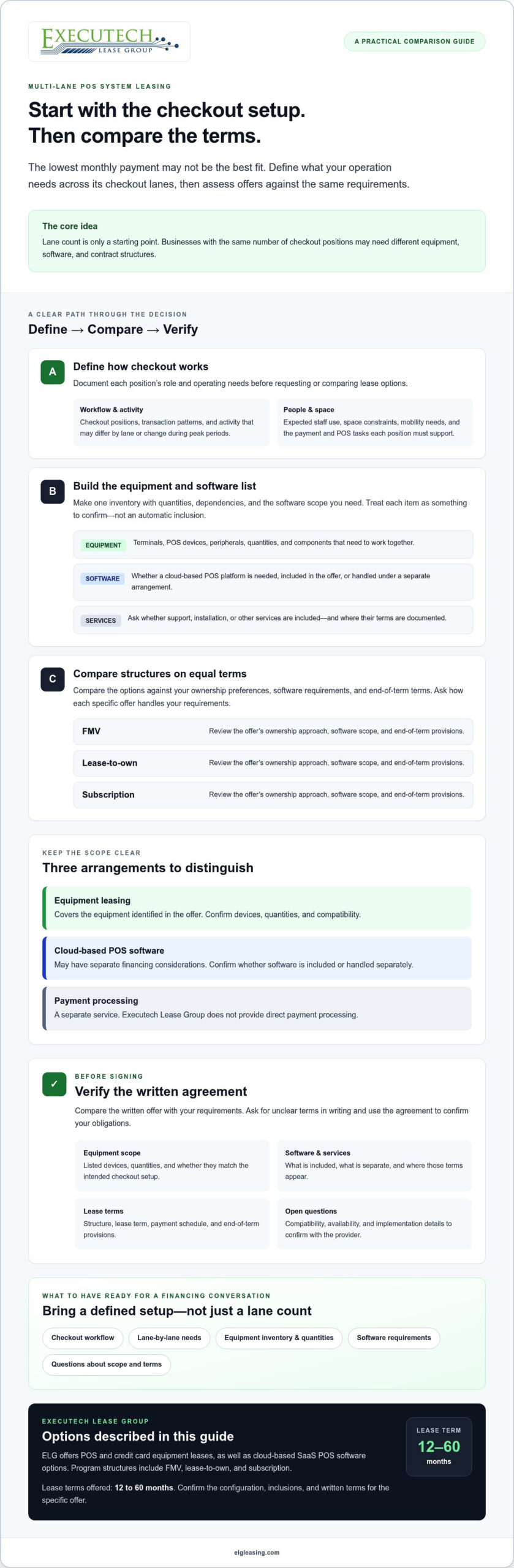
A clear checklist makes offers easier to assess. For Multi-lane POS system leasing, compare proposals using the same equipment quantities and software assumptions. Otherwise, differences in the proposed payment schedule may reflect different setups rather than different lease structures.
Review the offer and contract together. The written agreement controls, so ask for unclear provisions in writing before signing.
Lease agreement checklist
- Term: Confirm the length of the agreement and the date payments begin.
- Payment schedule: Check the amount, frequency, and timing stated in the written offer.
- Fees and conditions: Ask what fees may apply and what conditions could affect your obligations.
- End of term: Confirm which options are available and what steps, deadlines, or conditions apply to each.
- Responsibility: Clarify who handles servicing, replacement, and software-related support. Don’t assume these services are included in the lease.
Multi-lane configuration checklist
- Equipment scope: Match every listed device and peripheral to the quantities and checkout positions you need.
- Compatibility: Ask the provider to confirm that the proposed devices work with the specified POS setup.
- Installation: Identify who is responsible for installation and any related implementation steps.
- Software: Check the software requirements and whether cloud-based POS software is part of the agreement or handled separately.
- Changes: Ask whether changing the lane count or equipment affects the agreement, and get the answer in writing.
To compare offers fairly, give each provider the same lane requirements, equipment list, and software scope. Then compare the written terms side by side. If an offer leaves a device, service, or responsibility undefined, request clarification rather than treating it as included. ELG’s POS equipment lease process can help you understand the steps to review as you explore an option.
Once you’ve defined your requirements, use the written offer to confirm the specific equipment and terms under consideration.
Explore Multi-Lane POS Leasing Through ELG
After defining the checkout setup and comparing contract structures, Executech Lease Group is one option to explore. ELG offers 12 to 60 month leases for POS and credit card equipment, with Fair Market Value (FMV), lease-to-own, and subscription-based options. Its offerings also include Clover leasing and financing for cloud-based SaaS POS software.
These program categories are a starting point, not confirmation that a specific multi-lane configuration is available or that particular terms will apply. The application process determines eligibility and the terms available for consideration. Confirm the equipment scope, software arrangements, and contract provisions for your proposed setup before proceeding.
How ELG’s financing options relate to your shortlist
Use your shortlist to identify which program categories may be relevant. If eventual ownership matters, ask about lease-to-own. If you’re considering FMV or subscription leasing, clarify how each agreement handles the equipment and its end of term. For software needs, ask whether cloud-based SaaS POS software can be included in the proposed arrangement or requires separate terms. Review ELG’s available POS leasing programs as you prepare your questions.
What to prepare before taking the next step
Gather your proposed equipment list, quantities, lane requirements, and cloud software needs. Prepare questions about the term, payment schedule, eligibility, and end-of-term options. Ask which equipment configurations are available and request the specific scope and contract terms in writing. This keeps the discussion focused on your operation instead of assumptions based on lane count alone.
Multi-lane POS system leasing is easier to assess when your requirements are clear and the offer is specific. Use the application process to explore whether an ELG program fits your equipment and software needs. An application does not guarantee approval or particular terms.
Turn Your POS Requirements Into a Clear Next Step
A well-matched lease starts with a clear picture of your checkout operation. Document lane needs, equipment, and software before comparing offers, then assess FMV, lease-to-own, and subscription options against your ownership preferences. Review the written agreement closely, including the payment schedule, responsibilities, and end-of-term provisions.
Multi-lane POS system leasing is easier to evaluate when each offer covers the same defined setup. Executech Lease Group offers 12 to 60 month POS and credit card equipment leases, with FMV, lease-to-own, and subscription-based program options. The application process determines eligibility and the specific terms available, so confirm the proposed equipment scope and contract details directly.
With your requirements organized and questions ready, explore whether ELG’s leasing options fit your business.
Frequently Asked Questions
What is a multi-lane POS system?
A multi-lane POS system coordinates multiple checkout positions within one business operation. Each lane uses POS equipment and software to support sales, while the overall setup meets the business’s checkout needs. The configuration can vary. Lane count alone doesn’t establish which devices, peripherals, software, or lease terms are appropriate, so define what each position must do before comparing equipment or requesting leasing options.
Can you lease POS equipment for multiple checkout lanes?
POS equipment leasing can be considered for a setup with multiple checkout lanes, but the specific equipment configuration and terms need to be confirmed. ELG offers 12 to 60 month leases for POS and credit card equipment. Start with a clear list of the devices and quantities you need, then ask the provider which items can be included and check the proposed scope in the written offer.
What equipment can be included in a multi-lane POS lease?
A proposed lease may cover POS equipment such as checkout terminals or credit card terminals, depending on the offer. Related peripherals should be listed and confirmed rather than assumed to be included. ELG’s offerings include POS and credit card equipment leases, as well as Clover leasing. Before comparing options, ask the provider to specify device quantities, compatibility, and any equipment exclusions in writing. The offer determines what the lease covers.
How do FMV and lease-to-own POS programs differ?
FMV and lease-to-own are distinct program structures. An FMV lease may provide end-of-term choices such as returning, renewing, or purchasing the equipment, subject to the agreement. A lease-to-own program is structured around eventual ownership according to its contract terms. Don’t assume a particular purchase amount, transfer process, or end-of-term option. Review the written agreement to confirm which choices apply, any conditions, and the steps you must take.
Can POS software be financed with leased equipment?
Cloud-based POS software may be financed, but confirm whether it’s included with the equipment arrangement or covered under separate terms. ELG can finance cloud-based SaaS POS software and also offers subscription-based leases. Ask the provider to specify which software and equipment are covered, how the terms are structured, and whether support services are included. Don’t assume a software subscription automatically forms part of an equipment lease.
What should I check before signing a POS system lease?
Check that the written offer matches your equipment list, lane quantities, and software requirements. Confirm the lease term, payment schedule, fees, conditions, and end-of-term provisions. Clarify who handles installation, servicing, replacement, and software-related support, since these may have separate arrangements. Compare offers using the same equipment and software assumptions. If a term or responsibility is unclear, request a written explanation before signing. The agreement controls your obligations.
How do I apply for multi-lane POS system leasing?
Prepare your proposed equipment list, lane requirements, and software needs. Then review the provider’s application process and ask what information it requires. ELG offers POS and credit card equipment leases, with FMV, lease-to-own, and subscription-based options. The application process determines eligibility and the specific terms available, so an application doesn’t guarantee approval or a particular configuration. Apply through ELG to explore POS leasing options.

Article by
Robert Ensminger
Robert Ensminger is the founder and CEO of Executech Lease Group (ELG Leasing), which specializes in equipment leasing and financing solutions for the merchant-services, payments, POS, and FinTech industries. With more than 20 years of industry experience, Robert helps independent sales organizations, payment processors, POS providers, and software companies develop practical leasing, subscription, and SaaS-monetization programs. He founded ELG in 2010 and guided the company to recognition on the Inc. 5000. His work focuses on responsive service, transparent program structures, and helping ELG’s partners close more business while creating sustainable revenue.