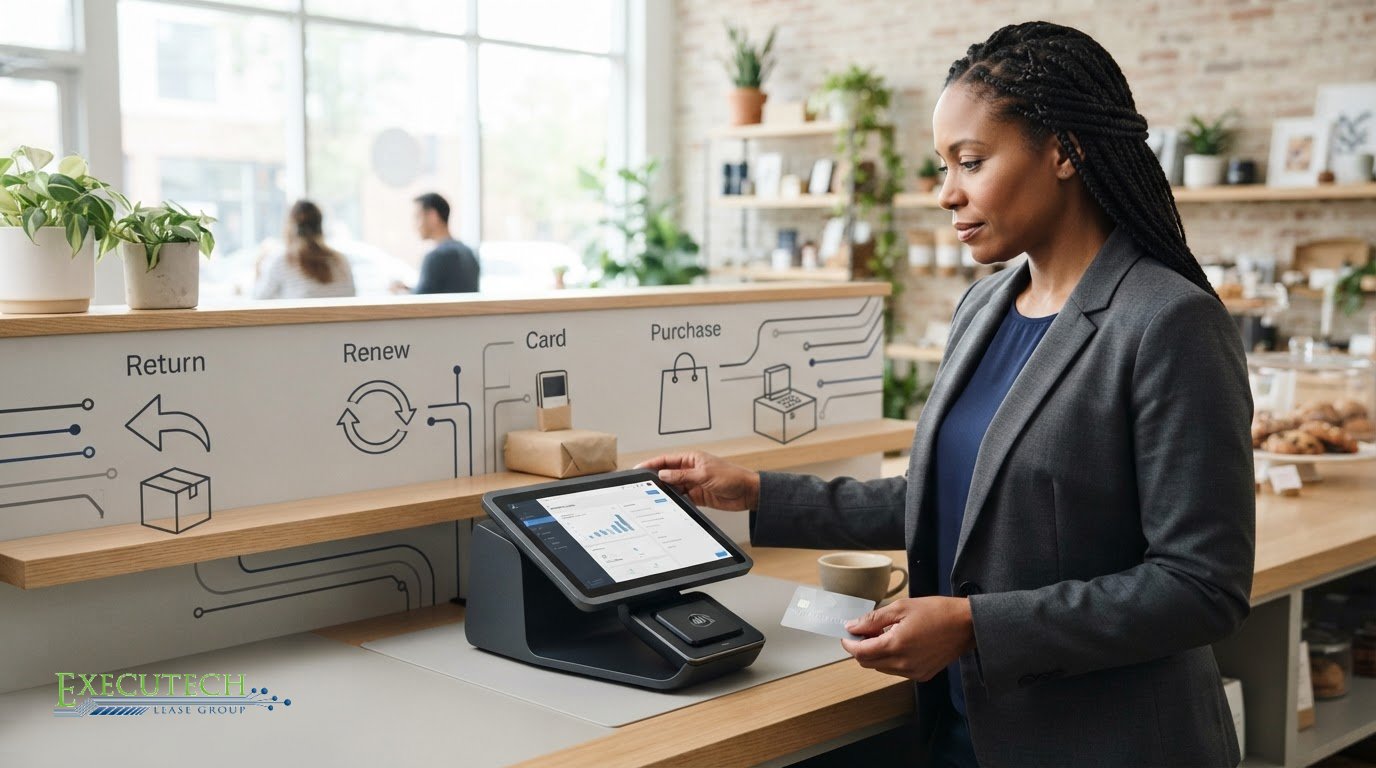
The best POS equipment lease isn’t necessarily the one with the lowest monthly payment. Fair market value leasing programs may offer lower payments than lease-to-own arrangements, but the right fit depends on what happens at the end of the term and whether the equipment will still meet your needs.
It’s reasonable to want predictable costs and a clear path to ownership. An FMV lease generally lets your business use equipment for a set term, then choose from the options in the agreement. These may include returning the equipment, renewing the lease, or purchasing it at its current fair market value. The available choices and return requirements vary by agreement, so check the terms rather than assuming how the process works.
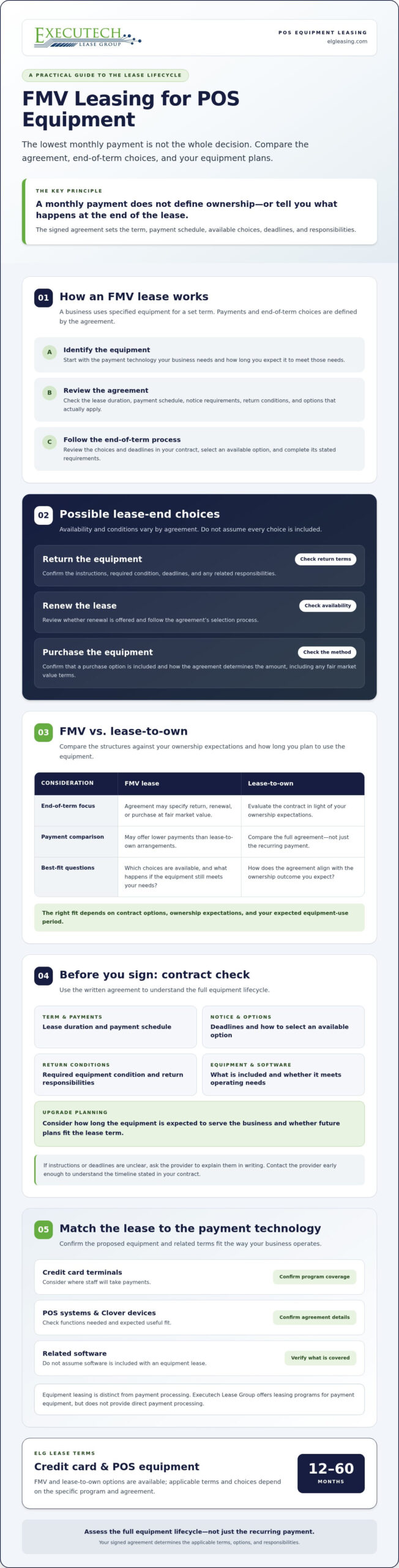
This guide explains FMV leasing and compares it with lease-to-own options. It covers what to review in the term, end-of-lease choices, equipment-return conditions, and upgrade plans before applying. The goal is to assess the full equipment lifecycle, not just the recurring payment, and decide whether an FMV program fits your POS plans.
Key Takeaways
- Fair market value leasing programs set equipment use and end-of-term choices through the signed agreement. Check the specific terms rather than assuming you’ll own, return, renew, or purchase the POS equipment.
- Compare FMV leasing with lease-to-own based on ownership expectations, contract options, and how long you expect to use the equipment.
- Review the lease duration, payment schedule, notice requirements, and return conditions before you apply.
- Confirm that the POS equipment and any related software match your business’s operating needs and upgrade plans.
- Executech Lease Group offers 12-60-month credit card and POS equipment lease terms, including FMV and lease-to-own options.
What Are Fair Market Value Leasing Programs for POS Equipment?
A fair market value (FMV) lease lets a business use specified equipment for a set term, with payments and end-of-term choices defined by the signed contract. Depending on the agreement, you may be able to return the equipment, renew the lease, or purchase it at a value determined under the contract. Those choices aren’t universal. Check which options apply and the conditions attached to each one.
Businesses may lease payment terminals and POS systems to spread equipment payments over a contract term instead of making a large upfront purchase. This can help align equipment commitments with operating plans, but a recurring payment doesn’t establish who owns the equipment or what happens at the end. The agreement’s terms matter more than the FMV label.
How an FMV lease works over its term
Begin by identifying the equipment your business needs. Before signing, compare the proposed lease terms with that equipment list and your plans for using it. During the term, make scheduled payments as stated in the agreement. As the end approaches, follow the contract’s process for reviewing and selecting an available option, including any deadlines or conditions.
Don’t use the monthly payment as a shortcut for deciding whether you’ll own the equipment. Payment amounts alone don’t define ownership or establish whether you can return, renew, or purchase it. Executech Lease Group (ELG) offers credit card and POS equipment lease terms ranging from 12-60 months. The applicable term and end-of-term choices depend on the specific program and agreement. Review ELG’s leasing program details as you consider which structure to explore.
Which payment technologies may be considered
Equipment for a payment technology lease may include credit card terminals, POS systems, and Clover devices. Start with the operational need: where staff will take payments, which functions the business requires, and how long the equipment is expected to meet those needs. Then confirm that the proposed equipment is included in the specific program and agreement.
Equipment leasing is distinct from payment processing. ELG offers leasing programs for payment equipment, but it doesn’t provide direct payment processing. Cloud-based POS software may also be a relevant financing category, but don’t assume it’s included with a particular equipment lease. Confirm what the proposal covers across the equipment, software, and contract terms before applying. This keeps the decision grounded in what your business will use and what the agreement actually includes.
How FMV Leasing Handles POS Equipment at the End of the Term
The end-of-term process isn’t the same for every POS lease. Your agreement determines which options are available, how to select one, and what steps you must complete. Lease-end rights and responsibilities depend on the signed agreement.
Use a simple sequence: identify the lease end date, review the options listed in the agreement, follow the notice and selection process, then complete the chosen option under the stated terms. The contract may allow you to return the equipment, renew the lease, or purchase it. Don’t assume all three options are available or that they work the same way across agreements.
What to check before the lease ends
Start with the written agreement. Find the end date, notice requirements, and specific options. Then check the equipment-return instructions, including its required condition and any related responsibilities. If the instructions or deadlines are unclear, ask the provider to explain them in writing.
Contact the provider early enough to understand the timeline stated in your contract. This gives you time to weigh the available options and plan for the equipment your business will need next. Don’t substitute a general description of fair market value leasing programs for the terms of your own lease.
How to evaluate purchase, return, or renewal language
Read each option separately. Don’t assume a purchase option or renewal is available unless the agreement says so and explains how to exercise it. If you’re considering a purchase tied to fair market value, ask how the amount will be established under your specific contract. Rely on a valuation method only if the agreement or provider confirms it.
- Purchase: Confirm whether the agreement offers this option and how it defines the purchase amount.
- Return: Check the return instructions, equipment-condition requirements, and any notice steps.
- Renewal: Verify whether renewal is available and what terms would apply.
If you’re comparing FMV with a lease-to-own structure, review the wording side by side. ELG’s POS leasing program information can help you explore its program options. To review the application process, visit the application page and confirm the relevant terms before proceeding.
FMV Leasing vs. Lease-to-Own: Compare the Right POS Program
Compare the contract structure with your equipment plans, not just the recurring payment. Fair market value leasing programs and lease-to-own programs can set different expectations for ownership and end-of-term choices. The agreement determines the actual terms, so use this comparison to identify what to verify, then review the specific offer.
| Comparison point | FMV lease | Lease-to-own |
|---|---|---|
| Ownership expectation | Ownership at the end isn’t automatic. Check whether the agreement offers a purchase option and how it defines the amount. | Review the contract for the stated path to ownership and any conditions you must meet. |
| End-of-term options | Options may include returning, renewing, or purchasing, if the agreement provides for them. | Follow the agreement’s stated terms for completing the lease and any ownership transfer. |
| Equipment lifecycle fit | Consider it if you may want to reassess your POS equipment as business needs change. Confirm any return or renewal terms. | Consider it if eventual ownership is a priority. Check how the equipment will serve your business over the full contract term. |
When an FMV structure may fit a business
If your POS setup may change, consider how often you expect to refresh terminals, devices, or systems. A contract that includes return or renewal options may suit a business that wants to reassess its equipment at the end of the term. Flexibility isn’t guaranteed by the FMV label, however. Verify the options in your agreement, along with the notice and return requirements.
When lease-to-own may better match the goal
If keeping the equipment is important, focus on the ownership path. Read the full agreement to see what actions and payments are required and how the contract treats the equipment at the end. Don’t judge the overall commitment by the recurring payment alone. ELG offers lease-to-own programs alongside FMV options; the terms of a specific program and agreement determine what applies.
For more context on POS leasing structures and equipment planning, review ELG’s POS leasing program information. You can also review the application page once you’ve identified the structure and terms you want to evaluate.
How to Evaluate an FMV Leasing Program Before You Apply
Before focusing on the payment schedule, compare the proposed agreement with your actual POS requirements. Fair market value leasing programs can differ in the equipment they cover, contract duration, and end-of-term options. The details in your specific agreement matter more than assumptions based on a program label.
Use this checklist to organize your review:
- Equipment: Confirm the specific terminals, POS devices, and related services covered by the proposal.
- Duration: Check the full contract term and consider whether it aligns with your equipment plans.
- Payment schedule: Verify the schedule and any fees stated in the agreement.
- End-of-term language: Identify the available options and the steps, deadlines, and conditions for exercising each one.
- Responsibilities and eligibility: Review the requirements, obligations, and charges that apply to your agreement.
Questions to ask the leasing provider
Get clear answers before proceeding. Ask which exact equipment and services the agreement covers, what options it provides at the end of the term, and how to exercise each option. Confirm applicable notice deadlines, equipment-return responsibilities, fees, and other obligations. If a term is unclear, request an explanation in writing and compare it with the proposed agreement.
Match the agreement to your equipment plan
Map your payment workflow first. Consider where transactions take place, which devices your staff need, and how the proposed POS setup supports daily operations. Then check that the equipment listed in the agreement matches that plan.
Cloud-based POS software may need separate or coordinated consideration alongside hardware. Confirm what the proposal includes rather than assuming the software and equipment share the same terms. Compare the contract with your expected business needs over its full duration. If you anticipate changing or upgrading equipment, include that in your planning, but don’t assume it’s a contract option.
ELG provides leasing programs for payment equipment and cloud-based POS software. Review its leasing program details to explore available program categories, then check the proposed agreement for the terms that apply to your equipment and plans.
Explore ELG Fair Market Value Leasing Programs for Payment Technology
Executech Lease Group (ELG) focuses on payment-industry equipment leasing, with 12-60-month lease terms for credit card terminals and POS equipment. Its program categories include fair market value leasing programs and lease-to-own options. The equipment, term, eligibility criteria, and available contract choices depend on the program and proposed agreement, so confirm those details before deciding.
What ELG’s payment-technology focus means
ELG offers leasing for credit card terminals, POS systems, and Clover devices, as well as financing for cloud-based SaaS POS software. Merchants access these programs through merchant services providers, independent sales organizations (ISOs), and payment processors. ELG focuses on equipment and related offerings, not payment processing itself. It does not provide direct payment processing.
That distinction helps set expectations. A leasing program covers the equipment or other offering named in its agreement. It doesn’t, by itself, establish which payment services your business uses or whether separate software and hardware arrangements are coordinated. If your proposed setup includes both a POS system and cloud-based software, check what each part covers and whether the terms are presented together or separately.
Program fit depends on your equipment requirements and the options stated in the agreement. Confirm availability and eligibility directly, then review the contract for the term, payment schedule, responsibilities, and end-of-term language that apply to your situation.
Take the next step with clear expectations
Before applying, gather the details that will make a program review more useful: the equipment you need, how it supports your payment workflow, whether related software is part of the plan, and any questions about ownership or returning equipment. This preparation helps you assess a proposal against your operations instead of focusing on one contract feature alone.
Use the application process to verify which programs may fit and clarify the exact terms presented. An FMV or lease-to-own label is a starting point, not a replacement for reading the agreement. Check that its equipment list and options match what your business intends to use.
Choose a POS Lease That Fits Your Next Move
Your POS lease should fit the equipment you need now and your plans for it later. Compare FMV and lease-to-own options by their ownership expectations, payment structure, and agreement-specific end-of-term choices. Before committing, confirm the equipment covered, contract duration, responsibilities, and any notice or return requirements in writing.
Fair market value leasing programs may suit businesses weighing future equipment choices, but the agreement determines which options are available. Start with your operating needs, not the program label or payment alone.
Executech Lease Group focuses on merchant-services equipment and POS leasing, with 12-60-month terms and offerings that include FMV, lease-to-own, and SaaS POS financing. Review the proposed terms and confirm program availability and eligibility for your situation.
A clear equipment plan and careful contract review can help you make a decision that fits your business.
Frequently Asked Questions
What is a fair market value lease for POS equipment?
A fair market value (FMV) lease lets a business use POS equipment for a set term under contract-defined conditions. The agreement states the payment schedule and which end-of-term options are available. These may include returning the equipment, renewing the lease, or purchasing it, but the options aren’t universal. Review the signed contract for the equipment covered, responsibilities, deadlines, and how any purchase amount is determined.
How does an FMV lease work at the end of the term?
At the end of an FMV lease, follow the options and process stated in your agreement. Depending on its terms, you may be able to return the equipment, renew the lease, or purchase it. Check the end date, notice requirements, return conditions, and related responsibilities in advance. If the agreement offers a purchase option based on fair market value, ask how the amount will be established under that contract.
Is an FMV lease the same as a lease-to-own program?
No. An FMV lease and a lease-to-own program can set different ownership expectations and end-of-term terms. An FMV agreement may include options such as returning, renewing, or purchasing equipment, if its contract says so. A lease-to-own agreement should state the path and requirements for eventual ownership. Compare the full agreement, including payment obligations and final options, rather than assuming either structure is cheaper or better.
Can a business lease Clover devices through an FMV program?
ELG offers Clover leasing and FMV lease options, but don’t assume a particular Clover device is available under a specific FMV program. Confirm that the proposed agreement covers the device you need and clearly states its term, payment schedule, and end-of-term options. ELG works with merchants through merchant services providers, ISOs, and payment processors. Check the program details and contract for the terms that apply to your situation.
What should I compare before choosing an FMV leasing program?
Compare the equipment covered, contract duration, payment schedule, and end-of-term language. Check notice deadlines, return conditions, fees, and responsibilities, and confirm how a purchase option would work if included. Consider whether the equipment and related software meet your operating needs for the full term. Fair market value leasing programs vary by agreement, so use the proposed contract rather than assumptions based on the label.
Does a fair market value lease mean I own the POS equipment?
No. An FMV lease doesn’t, by itself, establish that you’ll own the POS equipment. Ownership depends on the signed agreement and whether it includes a purchase option or another stated path to ownership. Read the end-of-term section carefully. If purchasing is available, confirm how the agreement determines the amount and what steps you must take. Don’t infer ownership from the monthly payment or the FMV label.
Can FMV leasing cover POS software as well as hardware?
It may, but confirm the specific program and agreement. ELG offers financing for cloud-based SaaS POS software, as well as leasing for payment equipment. That doesn’t establish that software is included in a particular FMV equipment lease. Check whether the proposal covers hardware, software, or both, and whether the terms are coordinated or separate. Verify the payment schedule, duration, and applicable options for each item before proceeding.

Article by
Robert Ensminger
Robert Ensminger is the founder and CEO of Executech Lease Group (ELG Leasing), which specializes in equipment leasing and financing solutions for the merchant-services, payments, POS, and FinTech industries. With more than 20 years of industry experience, Robert helps independent sales organizations, payment processors, POS providers, and software companies develop practical leasing, subscription, and SaaS-monetization programs. He founded ELG in 2010 and guided the company to recognition on the Inc. 5000. His work focuses on responsive service, transparent program structures, and helping ELG’s partners close more business while creating sustainable revenue.