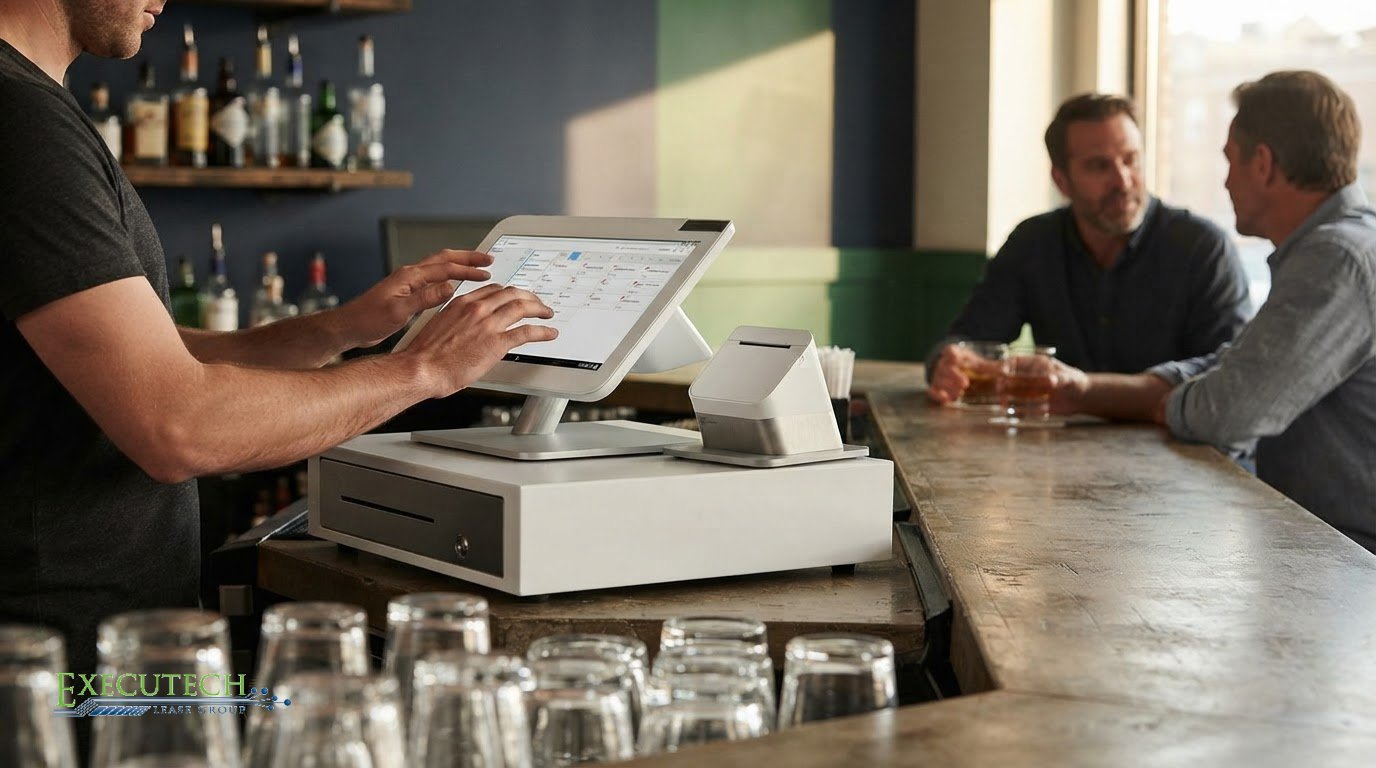
The lowest monthly payment isn’t always the lowest-cost way to equip a bar. Financing a POS system for a bar with tab management means weighing the equipment payment alongside recurring software and payment-processing costs. Tab features matter, too, because the system needs to support the way your bar opens, tracks, and closes customer tabs.
It’s reasonable to want a clear monthly figure before choosing a system. The total depends on the equipment, recurring software costs, and financing structure. A lease covers equipment use, while software and payment processing may be separate expenses.
This guide breaks down the costs to account for, how eligibility is assessed, and what to compare across financing options. You’ll also learn what information helps move an application forward and what to expect during setup, so you can assess the full monthly commitment before deciding.
Key Takeaways
- Build a realistic monthly budget by separating equipment payments from recurring software and processing expenses.
- Understand which business and application details can affect financing eligibility before choosing a payment option.
- Compare equipment leasing, lease-to-own, and buy now, pay later based on payment structure and total contract obligations.
- Know how a POS provider can coordinate the financing application and system setup, including tab management needs.
How a POS provider can help a bar apply for financing and arrange system setup
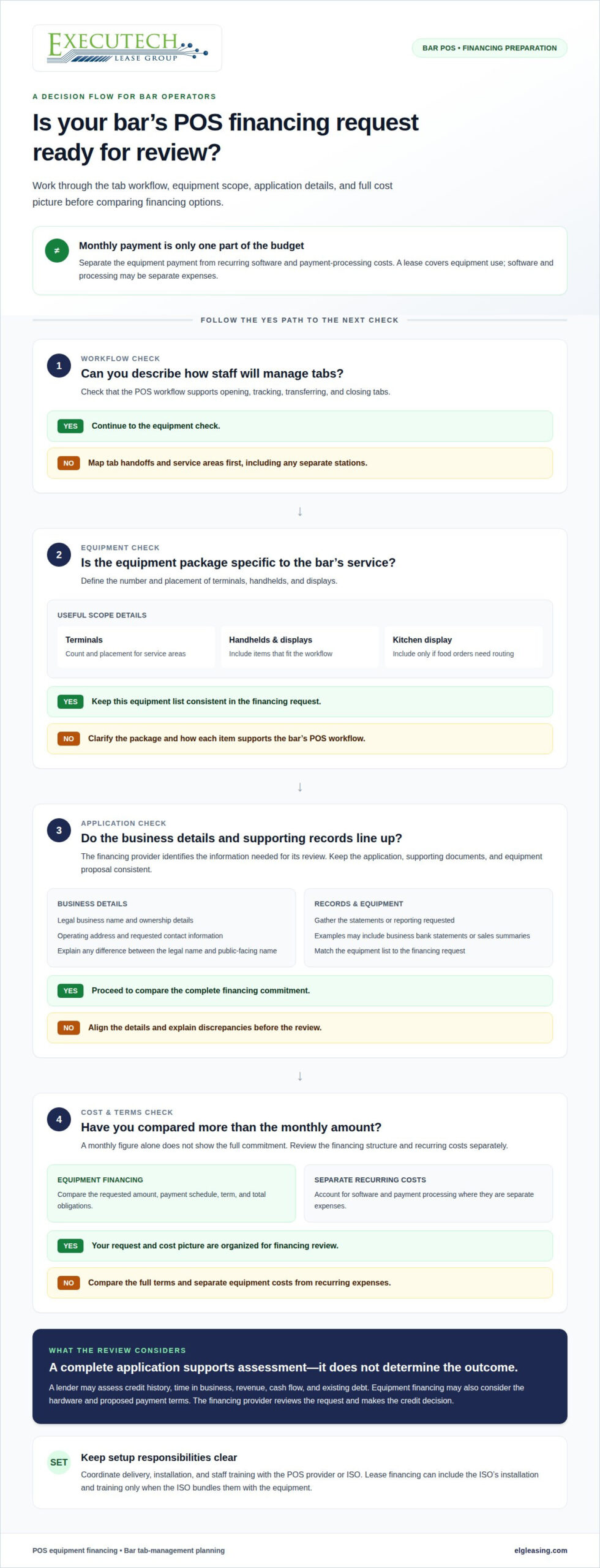
A POS provider can help define the equipment package and organize the financing application. Start with the bar’s point of sale requirements: terminals, displays, and tab-management functions. A single-location restaurant may need a different configuration from a nightclub with several service areas. A clear equipment scope helps the financing review and setup plan stay aligned with the bar’s actual operations.
When evaluating a POS system for tab management, check how it opens, tracks, transfers, and closes tabs, and review its connections to essential business systems. Read the provider’s written support terms, including available channels and coverage. These details matter during busy service, when accurate tab records support ordering, payments, and staff handoffs.
The equipment proposal should identify the package and explain which business information the financing company requests. The bar supplies the requested business and applicant details, and the financing company makes the credit decision. Keep the equipment list consistent with the request. Installation and staff training are separate tasks handled by the POS provider or ISO, not the equipment lessor.
- Define the configuration. Specify the number and placement of terminals, handhelds, and displays. Include a kitchen display only if food orders need routing.
- Match equipment to service. A counter-service bar may need a different layout from a nightclub managing tabs across separate stations.
- Prepare the application. Submit requested business information and align the proposed equipment list with the financing request.
- Plan the setup. Coordinate delivery, installation, and staff training with the POS provider or ISO. Lease financing can include the ISO’s installation and training only when the ISO bundles them with the equipment.
During setup, the POS provider or ISO can configure and test the agreed workflow. For example, testing might cover opening a tab, adding an item, transferring the tab to another station, and closing it at checkout. Menu categories and order routing should reflect the bar’s operations, including any kitchen display used for food orders.
Before launch, the provider or ISO can check that each terminal sends orders to the intended display and that staff training covers closing tabs. A test run may reveal issues, such as an item appearing at the wrong station or a transferred tab becoming difficult to find. Keep the financing documents, equipment scope, and setup responsibilities clear to coordinate the application and deployment.
Loans and financing eligibility
Eligibility depends on the financing structure and the bar’s financial profile. A lender reviewing a loan may assess credit history, time in business, revenue, cash flow, and existing debt. Equipment financing may also consider the hardware being acquired and proposed payment terms. The financing provider uses these factors to assess the request against its criteria.
For example, a bar with steady card sales may present a different risk profile from a new nightclub with limited operating history. Sales records can document transaction activity, while bank statements may help show cash flow. Neither document alone determines eligibility. A reviewer may consider the full application, including existing obligations and the amount requested.
Prepare consistent records before applying. Business details should match across the application, equipment proposal, and supporting documents. If the bar’s legal name differs from its public-facing name, explain the difference. Mismatched records can lead to follow-up questions. Clear documentation helps the reviewer understand who is applying and what the financing would cover.
- Business information: Provide the legal business name, ownership details, operating address, and requested contact information.
- Financial records: Gather the statements or reporting the financing provider requests, such as business bank statements or sales summaries.
- Equipment scope: Match the hardware request to the intended use, including terminals for bartenders, a kitchen display, or a receipt printer.
- Application review: Respond accurately to requests for clarification about revenue, existing financing, or the equipment order.
Keep the equipment request focused. Describe how the bar will use terminals for tabs, inventory tracking, or drink orders. Equipment that does not fit the business plan can make the request harder to assess. Explain how each item supports the bar’s POS workflow, rather than implying the financing covers inventory or general operating expenses.
Authorization for a credit review may be part of the application. Read the consent language and understand what information the financing provider will use. A credit review is different from payment authorization at the register, where a customer approves a card transaction. Clear terminology avoids confusion between business financing and everyday payment operations.
Before submitting, compare the requested amount, payment schedule, term, and total obligations across the documents. A loan and an equipment lease can use different structures, so the monthly amount alone does not show the full commitment. For an equipment application, submit a financing application with the business and equipment details ready.
POS system financing and buy now, pay later options
Financing a POS system for a bar with tab management starts with separating equipment payments from software costs and customer checkout options. Buy now, pay later may describe a customer payment choice, not a way for the bar to finance its own POS system. Before comparing options, identify who borrows, who receives the funds, and which agreement creates the payment obligation.
Financing Risks and Contract Terms
Equipment financing spreads hardware costs over a stated term, while an outright purchase pays for equipment upfront. A 36-month bar POS hardware lease can cost more than purchasing the same equipment outright. Compare total scheduled payments, payment frequency, contract length, and end-of-term obligations, not just the monthly amount. Those terms show the full commitment attached to the equipment.
Check exactly what the agreement finances. It may cover terminals and displays, while POS software, payment processing, or other recurring services appear under separate agreements. A bar comparing equipment payments alone could overlook software charges. List each agreement and its costs separately to understand the full operating commitment.
Distinguish business financing from buy now, pay later at checkout. A bar might be financing its own equipment or offering customers a deferred-payment option. These arrangements involve different parties and obligations. When financing a POS system for a bar with tab management, focus on the business’s equipment contract rather than assuming customer checkout financing covers the hardware.
Consider how the payment obligation fits the bar’s revenue cycle. Card sales may fluctuate by season, but the agreement follows its stated schedule. If the bar plans to change its service model, consider whether the equipment and term still fit. Assess the scheduled commitment against current operating needs, rather than relying on projected revenue alone.
Choosing and Financing a POS System
A POS equipment lessor can explain the equipment request and application steps. Describe the number of terminals, tab workflows, and required integrations. This helps distinguish essential hardware from optional features and gives the financing review a clearer picture of the equipment supporting daily operations.
When financing a POS system for a bar with tab management, compare software functions as well as equipment terms. A venue managing tabs across several stations may prioritize tab lookup and transfer. A restaurant serving food may also need order routing to a kitchen display. Identify employee workflows, loyalty tools, and integration needs, then separate recurring software charges from equipment payments.
Keep the comparison focused on four items:
- Equipment: Match each terminal and display to the planned service layout.
- Software: Identify tab management, reporting, and integration requirements.
- Agreement: Compare payment schedule, term, total obligation, and end-of-term terms.
- Operations: Consider whether bartenders can manage tabs without disrupting ordering or checkout.
What are the risks and contract terms of POS financing?
A POS agreement creates a payment obligation that can continue even when bar revenue changes. Compare the equipment’s useful role with the contract term before signing. A 36-month hardware lease can cost more than purchasing the same equipment outright, so compare total scheduled payments with the purchase alternative, not only the monthly amount.
Separate equipment financing from recurring software and payment-processing charges. A contract may cover terminals and displays, while software or processing appears in another agreement. A bar reviewing only its equipment payment could overlook a separate recurring charge. Put each obligation in one cost summary to understand the full ongoing commitment.
Review the agreement’s payment schedule, start date, term, and total scheduled payments. Confirm the equipment listed and whether installation or training is included in the financed package. If a quote includes one terminal but the contract lists additional hardware, resolve the difference before signing. Matching the quote to the agreement clarifies what the financing covers.
- Term and payment: Identify when payments begin, how often they are due, and how long the obligation lasts.
- End-of-term options: Read what happens when the term ends, including any purchase, return, or renewal provisions stated in the contract.
- Default provisions: Understand how missed payments are handled and what steps the agreement allows after a payment default.
- Equipment scope: Match every financed terminal, display, and accessory to the final equipment order.
- Separate services: Identify software, processing, and other recurring charges outside the equipment agreement.
Don’t assume a bar can end or change an agreement whenever operations shift. A seasonal slowdown, relocation, or change in service model does not determine what the contract allows. Read the specific early-termination, assignment, or modification language and understand any stated conditions before committing. Rely on the written terms, not just a verbal summary.
Tab management makes equipment fit important. If the bar relies on several terminals to open and close tabs, the payment obligation may remain even if the layout changes. Match the equipment quantity to planned operations, and understand the agreement’s end-of-term process before signing. Review both the tab workflow and financial commitment.
Keep a signed copy of the agreement with the final equipment list. Compare the first invoice with the scheduled payment and listed equipment. If a charge or item differs, document it and follow the agreement’s process for raising the issue. This gives the bar a clear record throughout the contract term.
What tax deductions or accounting rules apply to financing POS equipment for a bar?
Tax and accounting treatment depends on the agreement, not simply on the word “financing.” Give your CPA the signed contract, equipment invoice, and payment schedule. These records help distinguish equipment costs from software or payment-processing charges that may be billed separately. Your CPA can assess the specific arrangement and how to record it.
Leasing can shift equipment costs from a capital expense to an operating expense. Under an FMV lease, payments may be deductible as an operating expense. Treatment depends on the lease structure, so don’t assume every lease payment receives the same treatment. Ask your CPA to review the agreement before recording payments or estimating a tax effect.
A POS purchase and a lease can create different accounting records. For a purchase, retain the invoice and payment documentation. For a lease, keep the agreement with each payment record. Treatment may depend on the contract and the business’s accounting method. Your CPA can determine how those details apply to the bar.
Keep equipment separate from connected services. A bar’s monthly statement may include POS hardware, software, and payment processing. Save invoices or statements that itemize each charge instead of combining them under one unclear bookkeeping label. This helps the bookkeeper and CPA identify what the bar paid for.
Before signing, give your CPA the proposed agreement and ask them to review these points:
- Contract structure: Is the arrangement a lease, a purchase, or another financing structure?
- End-of-term terms: What options or obligations does the contract describe when its term ends?
- Itemized charges: Which amounts relate to equipment, software, setup, or payment services?
- Recordkeeping: Which documents and payment records should the bar retain for its accounting process?
For example, if a bar leases a terminal and pays separately for POS software, keep both agreements or invoices. That distinction gives the CPA the details needed to assess each expense. Don’t assume an equipment payment is automatically deductible or apply the same accounting treatment to every charge.
A bookkeeper can reconcile payments against the contract, while the CPA advises on tax and accounting treatment. Keep the signed agreement, invoice, payment records, and end-of-term documents together. Clear records support consistent bookkeeping throughout the lease and make later reviews easier.
Executech Lease Group (ELG Leasing): Point of Sale system leasing
Executech Lease Group (ELG Leasing) helps bars acquire point of sale equipment through leasing when purchasing hardware upfront doesn’t fit their plan. Its options include 12-60 Month Credit Card and POS Equipment Leases, Lease-to-Own Programs, and FMV Lease Options. The right structure depends on your equipment needs, preferred term, and end-of-term plans.
For a bar setting up tab management, define the equipment package first. Identify the terminals and related POS hardware needed for staff workflows, then review the payment schedule and end-of-term terms. Leasing covers equipment, not payment processing, so include software and processing costs separately in the overall budget.
Contact Executech Lease Group (ELG Leasing) to discuss POS equipment leasing for your bar.
Choose a POS financing path that fits your next step
Before committing, define what a successful rollout means for your bar. Priorities might include tracking tabs across stations, minimizing setup disruption, or fitting equipment payments to the operating plan. Clear priorities help you assess the agreement against the way your team serves guests.
Financing a POS system for a bar with tab management is a business decision, not just a hardware choice. Discuss the equipment scope and contract terms together, and involve your CPA when accounting treatment matters. Executech Lease Group (ELG) offers equipment leasing options for POS needs, including FMV and lease-to-own structures.
When you’re ready, discuss your bar’s equipment requirements with ELG.
Frequently Asked Questions
What is the average monthly cost for a bar POS system?
There isn’t one monthly figure for every bar POS setup. Your recurring budget depends on the software plan, number of terminals, and payment-processing charges, while equipment financing is a separate commitment. A bar with several service stations may have different costs from a counter-service venue. Use actual proposals to estimate the full monthly operating cost.
How much does a bar POS system with tab management cost?
The total depends on the equipment configuration and whether tab management is included in the software plan. A single-terminal setup differs from one with multiple stations, handhelds, and displays. Separate equipment financing from recurring software and processing charges when reviewing a quote. This breakdown shows which costs relate to tab functions, which recur, and which depend on the hardware.
What POS financing options are available for bars?
Bars may consider an equipment loan, a POS equipment lease, or a lease-to-own structure. Buy now, pay later may refer to customer checkout financing, which is different from financing the bar’s POS equipment. Executech Lease Group (ELG) offers equipment leasing, including FMV and lease-to-own options. Compare the contract structure and end-of-term obligations to see how each option fits the business.
What are the eligibility requirements for POS financing for a new bar?
Requirements vary by financing provider, but a new bar should expect an assessment based on business and applicant information, the equipment request, and available financial records. A business with limited operating history may have fewer sales records to provide. Keep the equipment list consistent with the application and prepare requested ownership and business details so the reviewer can assess the request.
Can bars finance POS hardware and software together?
Hardware and software may be covered by different agreements, so don’t assume one financing arrangement covers both. A bar might lease terminals and pay separately for a POS software subscription. Ask for equipment and software charges to be itemized, then check which agreement covers each item. This matters when forecasting recurring expenses or changing software plans.
How do POS financing interest rates and fees compare with leasing or equipment loans?
There’s no meaningful rate comparison without the actual offers and contract terms. A loan may disclose an interest rate and fees, while a lease sets out scheduled payments and end-of-term terms. Compare the total scheduled obligation, payment timing, charges, and ownership or return provisions. For a fair comparison, assess agreements for the same equipment and term, rather than choosing by monthly payment alone.
This article reflects the author’s opinion for general information only and isn’t tax, legal, or accounting advice. Consult your CPA or attorney about your specific situation.

Article by
Robert Ensminger
Robert Ensminger is the founder and CEO of Executech Lease Group (ELG Leasing), which specializes in equipment leasing and financing solutions for the merchant-services, payments, POS, and FinTech industries. Robert helps ISOs, payment processors, POS providers, and software companies build practical equipment leasing programs. He founded ELG in 2010. His work focuses on responsive service, transparent program structures, SaaS-monetization programs, and helping ELG’s partners close more business while creating sustainable revenue.