
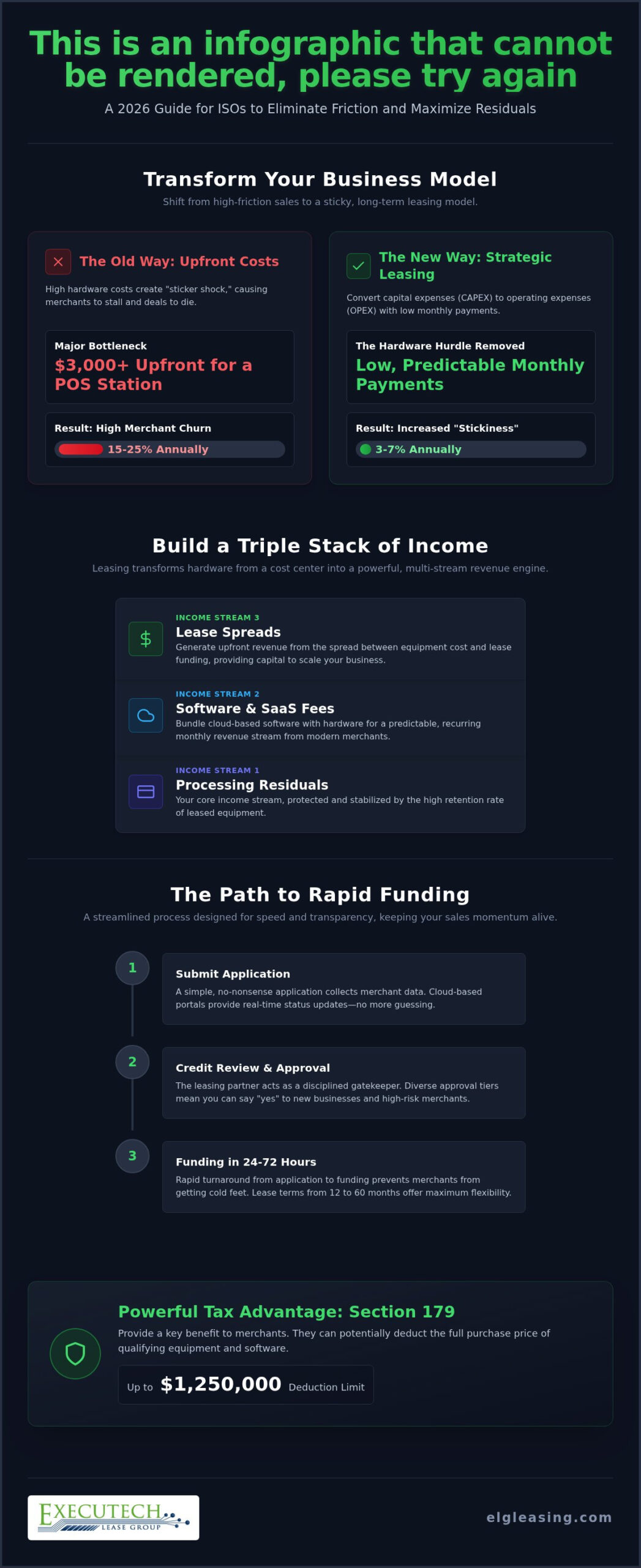
What if your hardware delivery tool was actually your most powerful engine for long-term portfolio growth? Many ISOs watch deals die because a merchant won’t pay $3,000 upfront for a countertop station. It’s a common bottleneck. You know that processing-only merchants leave at rates of 15% to 25% annually. By integrating POS leasing residual programs, you flip the script. You remove the cost barrier and lock in stickiness that drops attrition to as low as 3% to 7%.
This 2026 guide teaches you how to use strategic equipment leasing to eliminate merchant friction and accelerate your portfolio residuals. You’ll learn to streamline funding for Clover and SaaS POS hardware while capturing higher upfront revenue from lease spreads. We’ll cover the tax advantages like the $1,250,000 Section 179 limit and show you how to build a triple stack of income. It’s time to transform your business into a high-standard, resilient machine that prioritizes quality and efficiency.
Key Takeaways
- Eliminate the hardware hurdle. Convert upfront costs into manageable payments to secure merchant loyalty and reduce attrition.
- Leverage POS leasing residual programs to monetize equipment placement and build a “triple stack” of recurring revenue.
- Select the right structure. Compare FMV flexibility against Lease-to-Own asset ownership to meet specific merchant technology needs.
- Accelerate your funding cycle. Use a no-nonsense approval process to maintain sales momentum and close deals faster.
- Bundle for impact. Combine cloud-based SaaS software and POS hardware into a single, predictable monthly lease for 2026 merchants.
The Role of POS Leasing in Accelerating Agent Residuals
POS leasing residual programs are strategic assets. They aren’t just financing options; they’re revenue accelerators for high-performance ISOs. Traditionally, agents viewed hardware as a necessary evil or a cost center. That’s a mistake. By utilizing a finance lease structure, you transform hardware from a barrier into a profit center. This approach allows you to monetize the equipment placement itself. It creates a “triple stack” of income: processing residuals, software fees, and lease spreads.
Strategic leasing eliminates the friction that kills most contracts. When a merchant sees a $3,000 bill for a countertop station, they stall. If you provide that same technology for a low monthly payment, the objection vanishes. This isn’t just about closing the deal today. It’s about securing the merchant for the long term. Equipment financing builds deep roots. A merchant running their entire business on a leased system is far less likely to switch processors for a few basis points. You aren’t just selling a terminal; you’re installing a retention engine.
Why Hardware Costs Block Your Residual Growth
High upfront costs trigger “sticker shock.” In 2026, savvy merchants have shifted their focus from CAPEX to OPEX. They want predictable, monthly operating expenses rather than heavy capital outlays. If you demand thousands of dollars upfront, you’re fighting against modern business logic. Leasing allows you to lead with premium technology like Clover stations without the price objections. You provide the power of high-end tech while keeping the merchant’s cash flow intact. This shift removes the “hardware hurdle” and lets you focus on the value of your processing services. It makes the “yes” easier and the deal faster.
Monetizing the Lease Spread
Leasing offers immediate financial rewards. The “spread” between the equipment cost and the lease funding provides an upfront revenue stream. This isn’t just extra pocket money. It is capital you can use to scale. Upfront lease funding provides the necessary cash flow to reinvest in marketing, lead generation, or hiring more agents. It creates a self-funding growth loop. For a deeper dive into these strategies, explore our resource on POS leasing for independent sales agents. We provide the tools to turn every terminal into a high-yield asset. Efficiency is the goal. Transparency is the standard. Results are the focus.
How POS Leasing Residual Programs Work for ISOs
ISOs need a workflow that mirrors their own speed. The process starts with a simple application where you submit the merchant data. The leasing partner then acts as a disciplined gatekeeper. This role is vital. It protects your portfolio from high-risk defaults while ensuring viable deals cross the finish line. Modern agents use cloud-based portals to monitor every stage of the deal. You see the status in real-time. No more guessing. No more phone tag. Efficiency is the baseline for high-standard partnerships.
The Application and Funding Lifecycle
Speed is the ultimate currency in sales. If a funding cycle drags on, merchants get cold feet. You need to move from application to funding in 24 to 72 hours. This rapid turnaround prevents second-guessing. It keeps the momentum of the initial sale alive. We focus on streamlined documentation for our 12 to 60 month leases. You can view the exact steps in the ELG process flow to see how we prioritize your time. This structured approach ensures that complex financial arrangements feel organized and predictable for both you and your client.
Credit Requirements and Approval Tiers
Not every merchant has a perfect credit history. A rigid partner kills your growth. Successful POS leasing residual programs offer diverse approval tiers. This flexibility allows you to say “yes” to new businesses and high-risk merchants that traditional banks often ignore. When leasing business equipment, transparency is paramount. You need to know exactly why a merchant was approved or declined. This clarity builds a foundation of trust. It allows you to set realistic expectations with your clients.
If you’re ready to see how our tiers can support your specific portfolio, you can apply now to start the partnership. Our goal is to provide the access you need without the “old-fashioned” friction of legacy finance firms. We value quality. We reward momentum. We deliver results with minimal friction. By aligning with a partner that understands the intersection of finance and technology, you accelerate your path to a more profitable portfolio.
Comparing FMV vs. Lease-to-Own: Which Maximizes Agent Profit?
Choosing between Fair Market Value (FMV) and Lease-to-Own determines the long-term health of your portfolio. It isn’t just a merchant preference. It’s a strategic decision for your residuals. In 2026, cloud-based SaaS POS software has become the industry standard. Traditional hardware-only leases are no longer enough. You need a partner that allows you to bundle software costs into the lease. This subscription-based approach ensures you monetize the entire tech stack. It creates a more comprehensive revenue stream than processing alone could ever provide.
Your recommendation should align with the merchant’s business goals. High-growth businesses need modern tech. Cost-conscious shops want ownership. By offering both, you position yourself as an expert rather than a vendor. This versatility is what separates top-tier ISOs from the rest. You aren’t just selling a payment tool. You’re providing a financial strategy that scales with their business.
FMV Leases and the Upgrade Cycle
FMV leases offer the ultimate flexibility for tech-heavy environments. Merchants in fast-paced industries need to stay current. An FMV structure creates a natural “refresh” opportunity every 36 to 48 months. For an agent, this is a built-in retention touchpoint. When the lease ends, you re-engage the merchant with the latest hardware. This prevents attrition and keeps your portfolio modern. It turns a one-time sale into a recurring cycle of upgrades and renewals. Explore our FMV lease options to see how we support Clover and other premium systems with streamlined funding.
Lease-to-Own for Long-Term Stability
Price-sensitive small business owners often prefer the path to ownership. Lease-to-Own programs, specifically those with a $1 buyout option, provide the lowest total cost of ownership for the merchant. This builds significant trust. They see you as a partner helping them acquire a long-term asset. While the refresh cycle is longer, the merchant stickiness is exceptionally high. These programs are essential pillars of stable POS leasing residual programs. They lock in the processing relationship for the life of the equipment and beyond. For specific contract nuances, refer to our POS lease to own guide. Use this framework to decide:
- Tech-Heavy Merchants: Recommend FMV to ensure they always have the latest features.
- Budget-Focused Merchants: Recommend Lease-to-Own for the $1 buyout and long-term asset value.
- SaaS-Centric Businesses: Use subscription-based leases to bundle software and hardware into one payment.
5 Steps to Implementing a Merchant Equipment Leasing Program
Implementation requires a shift from vendor to strategic partner. You aren’t just selling a terminal; you’re providing a financial vehicle. Successful ISOs follow a disciplined roadmap to integrate POS leasing residual programs into their daily operations. This isn’t about adding a brochure to your kit. It’s about changing how your team views hardware acquisition. Follow these five steps to modernize your portfolio and accelerate your revenue growth.
- Step 1: Partner with a Specialist. Work with an agent-focused company like ELG Leasing. You need a partner that understands the ISO model and provides the “Efficient Expert” support required for rapid growth.
- Step 2: Pitch ROI, Not Cost. Stop leading with the hardware price tag. Lead with the monthly value. Show the merchant how the technology pays for itself through increased efficiency.
- Step 3: Leverage Tax Incentives. For the 2026 tax year, the Section 179 deduction limit is $1,250,000. Train your team to explain how merchants can deduct the full equipment price in the year it is placed in service.
- Step 4: Branded Consistency. Use white-label options to keep your brand at the forefront of the transaction. This builds significant authority during the closing process.
- Step 5: Manage the Lifecycle. Use your portal to track lease expirations. This triggers a proactive upgrade conversation before the merchant starts looking elsewhere for new tech.
Integrating Leasing into the Sales Pitch
The conversation must move from “What does this cost?” to “What does this earn?”. Use scripts that highlight the relief of simplicity. Instead of asking for a heavy upfront payment, say: “We can bundle your hardware, cloud-based software, and shipping into one predictable monthly payment.” This approach eliminates the sticker shock that kills momentum. You’re offering a stress-free path to premium technology. It is a psychological trigger. Merchants value cash flow over ownership in the modern tech-forward environment. By presenting a single monthly figure, you make the decision easy and the “yes” faster.
Using White-Label Leasing to Build Authority
Branded financing makes your ISO look established and powerful. It signals to the merchant that you have the infrastructure to handle their complex needs. Utilizing white label POS leasing allows you to maintain brand equity throughout the funding lifecycle. When the merchant sees your logo on the financing documents, it streamlines the closing process. It removes the friction of introducing a third-party name into the middle of a delicate deal. Branded documents reinforce your role as the primary facilitator of their business technology. It projects an air of exclusivity and professionalism that builds long-term trust.
Scaling Your Portfolio with ELG Leasing’s Specialized Programs
ELG Leasing acts as the Modern Facilitator for ISOs who demand more from their financial partners. We provide the infrastructure you need to scale. Our national coverage ensures that you can support merchants across the United States without geographic restrictions. We serve as a high-standard gatekeeper, protecting your portfolio while providing the no-nonsense support required to accelerate your funding cycles. Efficiency is our standard. Transparency is our promise. Our specialized POS leasing residual programs are designed to help you monetize every aspect of the merchant relationship.
Financing the Future: SaaS and Subscription Leases
In 2026, merchants are digital-first. They don’t just need a terminal; they need a complete operating system. This is why our SaaS programs are critical for modern agents. We allow you to finance the “soft costs” that competitors often ignore. This includes cloud-based software, professional installation, and staff training. Unified commerce platforms can deliver a 22% improvement in total cost of ownership compared to fragmented systems. By bundling these costs into one lease, you help merchants capture that value while increasing your own deal profitability. It is the ultimate tool for securing high-tech retail and restaurant clients. They want one predictable payment for their entire technology stack. You provide that solution.
Getting Started with ELG Leasing
Joining our partner ecosystem is a streamlined process designed for results-driven professionals. We don’t claim to be for everyone. We work with agents who value quality and high standards. Our onboarding is fast. Our portal is intuitive. Our funding is reliable. By leveraging our POS leasing residual programs, you ensure that every deal contributes to long-term wealth with minimal friction. We prioritize the end goal: getting you what you need to grow your business.
The path to higher residuals starts with a single step. You can apply now to begin the partnership. Once approved, you gain immediate access to our flexible 12 to 60 month lease options. We provide the expertise. You provide the momentum. Together, we build a more resilient and profitable portfolio. Stop letting high hardware costs kill your deals. Accelerate your growth with a partner that understands the intersection of finance and modern technology.
Future-Proof Your Merchant Portfolio Growth
Strategic hardware placement is the foundation of a resilient ISO. By integrating POS leasing residual programs, you move beyond simple payment processing. You create a sticky, high-value ecosystem. This protects your portfolio from attrition. We’ve explored how flexible FMV options and Lease-to-Own structures meet diverse merchant needs. They maximize your upfront revenue. The logic is simple. Merchants using leased systems stay longer. They produce higher lifetime value.
ELG Leasing provides specialized 12 to 60 month terms. We offer national US coverage. Our dedicated agent support ensures your funding cycles stay fast and predictable. Our no-nonsense approach prioritizes your momentum. It’s time to stop letting hardware costs kill your deals. Use technology to accelerate your growth.
Take the first step toward a more efficient and profitable future today. We’re ready to help you streamline your operations and unlock the full potential of your merchant relationships.
Frequently Asked Questions
What are the typical terms for merchant equipment leasing programs in 2026?
Typical terms range from 12 to 60 months. These specialized durations allow merchants to align their technology lifecycle with their budget requirements. In 2026, most programs focus on flexibility, offering both Fair Market Value and Lease-to-Own options. These terms empower ISOs to provide high-end hardware without the merchant feeling the pressure of a massive upfront capital expenditure. It ensures that the merchant’s cash flow remains healthy while they access premium tech. This structure supports long-term business stability.
Can sales agents earn commissions or ‘spreads’ on POS leases?
Yes, sales agents can monetize equipment placements through a lease spread. This spread represents the difference between the equipment cost and the total funded amount of the lease. It provides immediate upfront revenue for the agent. By leveraging POS leasing residual programs, agents can create a multi-layered income stream that includes these upfront earnings alongside long-term processing residuals. This structure rewards the agent for the initial sale while building future wealth through consistent, recurring portfolio growth.
How does POS leasing help an ISO improve merchant retention?
Leasing increases merchant stickiness by embedding the technology deeply into the business operations. Merchants running their storefronts on leased POS systems have significantly lower attrition rates, often between 3% and 7%. This contrasts sharply with processing-only merchants who switch providers more frequently. When the hardware and software are bundled into a monthly lease, the merchant is far more likely to remain loyal to the agent who provided the solution. It builds a long-term professional relationship based on integrated value.
Is it possible to lease POS software (SaaS) without hardware?
ELG Leasing provides specialized financing for cloud-based SaaS POS software. While many providers focus solely on physical terminals, modern programs allow agents to lease soft costs like software subscriptions, installation, and training. This approach ensures that digital-first merchants can access the tools they need with a single, predictable monthly payment. It allows agents to secure high-tech clients who prioritize software functionality over basic hardware. This flexibility is essential for high-standard partnerships in the current tech-forward environment.
What is the difference between an FMV lease and a lease-to-own program for an agent?
Fair Market Value (FMV) leases offer lower monthly payments and a natural upgrade cycle every few years. This is ideal for merchants who want the latest technology. Lease-to-Own programs usually feature a $1 buyout option at the end of the term, appealing to merchants who want long-term asset ownership. For the agent, FMV leases create recurring re-engagement opportunities, while Lease-to-Own structures provide maximum long-term stability for the portfolio. Both options are critical tools for modern ISO growth and revenue acceleration.
How quickly can an agent expect funding for a Clover terminal lease?
Agents can typically expect a rapid funding cycle of 24 to 72 hours for Clover terminal leases. This streamlined process is designed to maintain sales momentum and prevent merchant second-guessing. A no-nonsense approval workflow ensures that documentation is handled efficiently. Rapid funding allows agents to reinvest their commissions back into lead generation and business growth without waiting weeks for a payout. Speed is the ultimate currency in the competitive merchant services market. It ensures every deal crosses the finish line.
Does ELG Leasing offer national coverage for US-based sales agents?
Yes, ELG Leasing provides national coverage across the entire United States. This broad scope allows sales agents to support merchants regardless of their physical location. Whether your clients are based in major metropolitan hubs or rural areas, the leasing programs remain consistent and accessible. This national reach is essential for ISOs looking to scale their portfolios without being limited by regional geographic boundaries. It provides the freedom to pursue deals in any state with total confidence in the funding partner.
What credit requirements do merchants need to meet for POS lease approval?
Approval standards are designed to be inclusive, utilizing diverse credit tiers to support a wide range of businesses. While traditional banks often have rigid requirements, specialized POS leasing residual programs provide paths for new businesses and merchants with varied credit histories. Transparency in these standards helps agents set realistic expectations. The goal is to act as a disciplined gatekeeper that protects the portfolio while still saying yes to viable deals. This balanced approach ensures a high-quality ecosystem for all partners.

Article by
Robert Ensminger
Robert Ensminger is the founder and CEO of Executech Lease Group (ELG Leasing), which specializes in equipment leasing and financing solutions for the merchant-services, payments, POS, and FinTech industries. With more than 20 years of industry experience, Robert helps independent sales organizations, payment processors, POS providers, and software companies develop practical leasing, subscription, and SaaS-monetization programs. He founded ELG in 2010 and guided the company to recognition on the Inc. 5000. His work focuses on responsive service, transparent program structures, and helping ELG’s partners close more business while creating sustainable revenue.