
Buying a card reader outright isn’t automatically simpler, and leasing isn’t automatically cheaper. Card reader device leasing lets a business use payment equipment under a contract with scheduled payments, but it also creates obligations to understand before signing. The device must fit your POS and processor setup, too. A mismatch can disrupt the way you accept payments.
Before choosing, get clear on the payment schedule, the term, what happens when it ends, and whether leasing suits your equipment plans. This guide explains how to compare leasing with buying without assuming one option always costs less. No money down refers to the down-payment requirement only. It doesn’t mean free equipment or no ongoing lease obligations.
Executech Lease Group (ELG) offers equipment leases with terms of 12, 24, 36, 48, or 60 months. Its FMV equipment lease ends with about a 10% buyout, while its lease-to-own equipment lease ends with a $1 buyout. These end-of-lease options differ, so compare the structure and written terms with your plans for the device.
Key Takeaways
- Card reader device leasing provides equipment through a contract with recurring obligations. Compare those commitments with the upfront outlay of buying.
- Distinguish the card reader or terminal from the broader POS system it connects to, and assess how each part fits your payment setup.
- Review the lease structure and end-of-term language, including the applicable buyout and the agreement’s requirements.
- Use a practical checklist: define the device’s role, assess setup compatibility, read the contract, and clarify responsibilities.
- ELG focuses on equipment leasing for the merchant-services and payment-technology ecosystem.
What Does Card Reader Device Leasing Mean for a Business?
Card reader device leasing provides payment equipment through a contract with scheduled, recurring obligations. Instead of paying the full purchase amount upfront, a business makes payments over the agreed lease term. The contract defines the equipment arrangement and its terms. It does not, by itself, determine how transactions are processed.
A card reader or terminal is the hardware used to capture payment information. A broader point-of-sale (POS) system may include that terminal alongside software and other equipment used to manage sales. A reader can operate on its own or as part of a larger setup, depending on how the business takes payments and uses its POS.
Keep the equipment lease separate from payment processing. Leasing concerns the equipment and its scheduled payments. A merchant account and processor relationship handle separate parts of accepting and settling transactions. An equipment lease doesn’t automatically provide either one or change the obligations in an existing processor agreement.
Whether leasing fits depends on the equipment you need, how you plan to operate, and the contract terms. Start by defining the device’s role, then assess how it connects with your POS and processing setup. Don’t assume every reader works with every platform or processor.
Which equipment can a card reader lease cover?
Payment-processing equipment can include a standalone card reader, a countertop terminal, or a POS system that incorporates payment hardware. The right category depends on the job. A standalone reader may serve as the primary device for taking payments, while a terminal in a POS setup works alongside the system’s software and other components.
Be specific about what equipment the agreement covers. Identify whether you need only a reader or a wider POS configuration, and consider how the device will be used at checkout. Compatibility depends on the specific equipment and setup. A lease isn’t confirmation that a particular device, brand, model, or integration will work with your POS or processor.
How leasing differs from renting or buying
A lease is a contract with scheduled payments and defined terms. Review the agreement for its duration, payment obligations, and end-of-term provisions. The word “lease” alone doesn’t tell you what happens when the term ends, so use the written contract rather than assumptions based on another arrangement.
Buying means paying to purchase the equipment, while leasing creates payments over a contracted term. Compare the amount and timing of those payments with your equipment plans and business operations. Neither approach is automatically cheaper or more suitable. The answer depends on the purchase terms, lease structure, and how long you expect to use the equipment.
Renting is a separate arrangement, and its terms may differ from a lease. Don’t assume rental-style replacement or service policies apply to leased equipment. Read the agreement to understand its responsibilities and the options it provides at the end of the term.
How Card Reader Lease Structures Differ at the End of the Term
The monthly payment is only one part of a lease decision. The end-of-term structure matters because it describes the agreement’s equipment buyout option. ELG offers two equipment lease structures to compare: a fair market value (FMV) equipment lease and a lease-to-own equipment lease. Their buyout terms differ, so consider which structure fits your plans for the equipment.
Keep the buyout separate from the payment schedule. It isn’t a monthly payment or the total price of the equipment. Review the written contract to understand the full payment commitment and the steps that apply as the lease term concludes.
| Lease structure | Buyout structure | Questions the contract must answer |
|---|---|---|
| FMV equipment lease | About 10% of original equipment cost | What steps, timing, and other obligations apply at the end of the term? |
| Lease-to-own equipment lease | $1 buyout | What does the agreement require before the buyout can be completed? |
What does an FMV equipment lease mean?
ELG’s FMV equipment lease ends with a buyout of about 10% of the original equipment cost. Review the written agreement for the specific steps and obligations that apply. Don’t infer renewal rules, notice deadlines, or other options from the FMV label alone. The contract language should guide your understanding of what happens when the term concludes.
How does lease-to-own differ from FMV?
ELG’s lease-to-own equipment lease ends with a $1 buyout, distinct from the FMV structure. Compare the written terms, including the payment schedule and the process for completing the buyout. Don’t assume the end-of-term details of one structure also apply to the other. Treat each option as a separate agreement with its own terms to review.
Match the structure to your plans for the equipment. Confirm the applicable buyout in the agreement, keep it separate from recurring payments, and review the remaining contract language before committing. This grounds your decision in the specific terms rather than assumptions about what a lease label means.
If you’re evaluating an equipment lease as a vendor, ISO, or MSP, ELG’s vendor inquiry form provides a way to start a conversation about equipment leasing.
Card Reader Leasing vs. Buying: Which Fits Your Business Situation?
Compare the timing and obligations, not just the payment format. Buying requires an upfront purchase, while leasing creates scheduled payments under a contract. Neither approach is automatically cheaper. Your decision should reflect how you plan to use the equipment, how you prefer to allocate funds, and what the agreement says you receive and owe.
Card reader device leasing may suit a business that wants to evaluate contracted payments as part of its equipment plan. Buying may suit a business that prioritizes direct ownership and can make the purchase without disrupting other priorities. In either case, account for the device’s role in your payment setup and how long you expect to use it.
When might leasing align with a business plan?
Leasing may be worth considering if avoiding a large upfront equipment purchase is important to your planning. A defined contract term can help you map equipment obligations against the period you expect to use the device. But scheduled payments don’t mean a lower total cost, and no-money-down leasing still involves recurring payments and other lease obligations.
Before choosing this route, check whether the contract’s duration fits your plans. Consider whether the equipment’s role is likely to remain consistent during that period and whether the payment schedule works alongside your other business commitments. The term and obligations matter as much as the initial payment structure.
When might buying be a better fit?
Buying may align with your priorities if you want to own the equipment directly and prefer a purchase over an ongoing lease commitment. It may also fit if the upfront outlay works with your business plan. That doesn’t prove buying will cost less overall. Compare the purchase terms with the full lease obligations before deciding.
Ownership is a preference, not a universal financial advantage. Consider whether you want to manage the equipment as an owned asset and whether the purchase affects funds needed for other operations. Assess the equipment’s expected role and the purchase terms rather than relying on broad rules that say established businesses should buy or newer ones should lease.
Use these questions to bring the decision into focus:
- What matters more for your plan? Keeping the upfront purchase outlay or avoiding recurring lease commitments?
- How long do you expect to use the equipment? Compare that horizon with the contract term or your plans for an outright purchase.
- What do the written terms require? Review the payment schedule, contract obligations, and end-of-term provisions.
- Does the device fit your operating setup? Assess its role alongside your POS and processing arrangements.
The right choice depends on your business circumstances and the actual contract or purchase terms. Compare the total commitments and how each option fits your operating plans. A careful review helps you decide based on your priorities, not the assumption that leasing or buying is always better.
What to Review Before Leasing a Card Reader
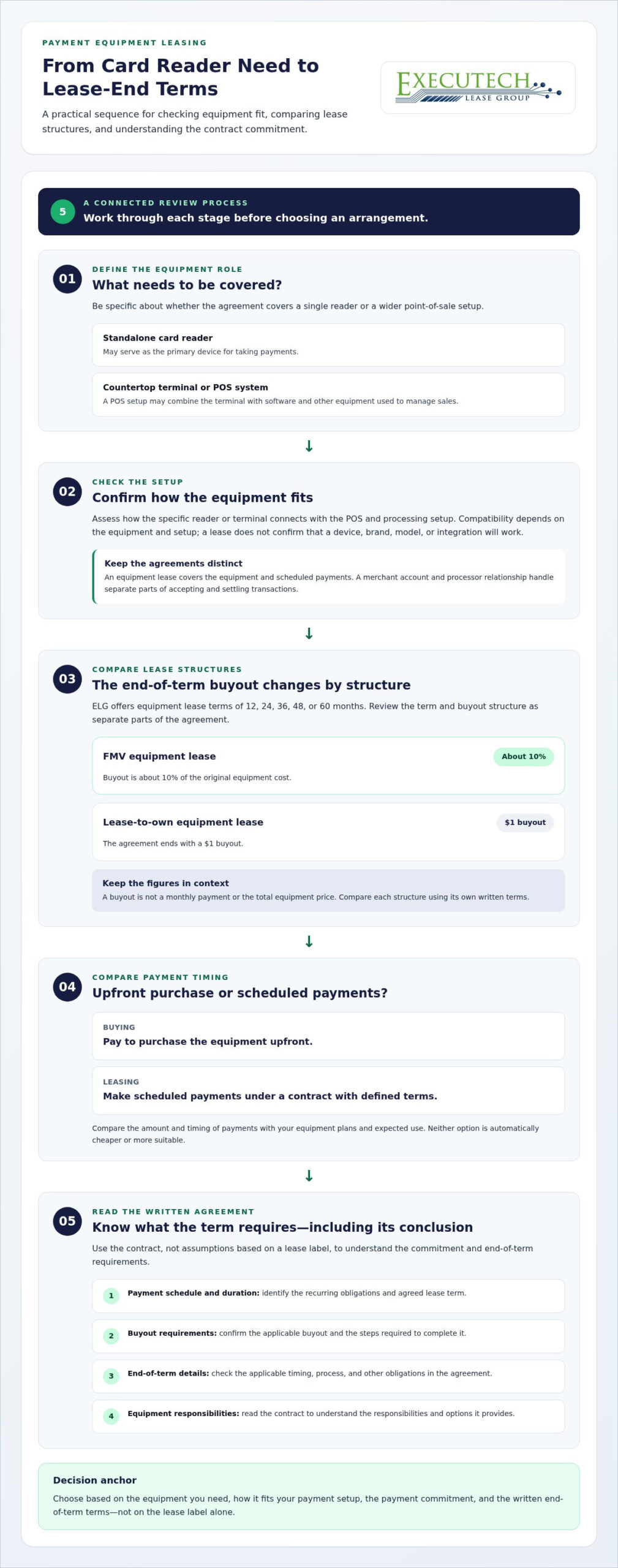
Before signing, review the device and agreement together. A reader that doesn’t fit your POS or processing setup can create operational friction, while unclear contract language can leave obligations uncertain. Use this checklist to assess fit, payments, term, and equipment responsibilities.
- Identify the device’s role. Decide whether you need a standalone card reader or a terminal that operates within a broader POS configuration. Specify the equipment you expect the lease to cover so the written agreement matches your intended setup.
- Assess setup fit. Review the relevant device, software, POS, and processor requirements. Compatibility isn’t universal across devices, brands, models, or processors. Assess the specific configuration you plan to use rather than assuming a reader will work with your existing arrangement.
- Read the contract terms. Locate the payment schedule, selected lease term, and end-of-lease structure in the written agreement. Make sure you understand the obligations tied to the term and any applicable buyout, rather than relying on a verbal summary or general label.
- Clarify equipment responsibilities. Identify what the contract says about responsibilities during the lease and at its conclusion. Don’t assume it includes maintenance, repairs, replacements, upgrades, renewals, or early-termination rights unless the agreement explicitly states the applicable terms.
Check the card reader and payment setup
Start with how transactions will be taken. A standalone reader may serve a different role from a terminal used as part of a POS configuration. Consider the device alongside the software and processor requirements for your planned setup. Card reader device leasing doesn’t itself establish compatibility, so assess the exact equipment and configuration before entering a lease term.
This review connects the equipment decision to day-to-day operations. If the reader is part of a larger POS arrangement, account for that relationship when identifying what you intend to lease. Keep equipment selection separate from processor arrangements. A lease doesn’t supply a merchant account or determine processor obligations.
Read the lease obligations and equipment responsibilities
Review the agreement for the payment schedule, lease duration, and the end-of-term structure that applies. Read the language rather than inferring early termination, renewal, replacement, or upgrade rights. Any equipment warranty comes from the manufacturer, not ELG. ELG doesn’t provide warranties, maintenance, repairs, or replacements, so don’t treat those services as part of the lease.
Before committing, make sure the documented obligations match your operating plans. A careful review helps you understand both the equipment arrangement and what the agreement does not cover. Vendors, ISOs, and MSPs can submit an equipment lease inquiry to start a conversation with ELG.
Explore Card Reader Equipment Leasing Through Executech Lease Group (ELG)
ELG is a U.S. equipment lease brokerage serving the merchant-services and payment-technology ecosystem. Its focus is equipment used to accept and manage payments, including credit card terminals, POS systems, and related payment-processing equipment. For businesses evaluating card reader device leasing, keep the equipment arrangement distinct from the services that process transactions.
What ELG’s equipment-leasing role covers
ELG leases payment equipment. It does not process payments, supply merchant accounts, or control the obligations in a business’s processor agreement. Those are separate arrangements. A terminal lease addresses the equipment and its contract terms; your processor relationship governs payment processing. Keep both sets of obligations clear as you plan your setup.
ELG offers equipment lease terms of 12, 24, 36, 48, or 60 months. The term is an important planning detail, but it doesn’t establish device compatibility or determine the terms of a separate processor agreement. Match the equipment to your operating needs, then review the written lease terms to understand the commitment.
How to begin an ELG conversation
Vendors, ISOs, and MSPs can use the Become a Vendor inquiry form to start a conversation about equipment leasing. It’s a contact mechanism, not a financing application. Submitting the form does not submit a financing application or produce a credit decision.
Keep the stages distinct. Our goal is to deliver credit decisions in under 2 business hours. That goal applies to the decision stage only; it does not state how long funding, equipment delivery, or deployment will take. The inquiry form is not a promise of approval or a timeline for those later steps.
Before starting an inquiry, organize the equipment and lease details you want to discuss. Identify the role of the terminal or POS equipment, your intended operating setup, and the lease term you’re considering. Keep processor questions separate, since ELG’s equipment lease does not replace or manage your processor arrangement. This preparation makes the conversation more focused without confusing a vendor inquiry with a credit application.
Merchants can use the same distinctions when considering a payment equipment lease: clarify what equipment the contract covers, understand the term and end-of-lease structure, and keep processing obligations separate. A clear view of the equipment need and lease commitment gives you a practical basis for evaluating whether the arrangement fits your business.
Put Your Equipment Decision Into Motion
A sound equipment decision starts with a clear business case. Write down what the reader needs to do, how it fits into your operations, and which commitments your team is prepared to manage. This gives decision-makers a shared reference point and keeps equipment planning distinct from payment-processing arrangements.
Card reader device leasing is one way to structure access to payment equipment, but the useful question is whether the arrangement supports your operating priorities. Treat the decision as part of a broader plan, not an isolated hardware purchase. A focused discussion can help you move from general evaluation to a practical next step.
Vendor, ISO, or MSP? Use ELG’s inquiry form to open a conversation about equipment leasing. The form is a contact mechanism, not a financing application.
With your priorities clearly defined, you can approach the next equipment decision with a clearer view of the terms and responsibilities.
Frequently Asked Questions
Does ELG process card payments?
No. ELG does not process payments. Its equipment-leasing role is separate from payment processing.
Does ELG provide a warranty, maintenance, or repair service for leased card readers?
No. ELG does not provide equipment warranties, maintenance, or repairs. Any warranty comes only from the equipment manufacturer. Keep the manufacturer’s warranty documentation with your equipment records and review the coverage and process it describes. A lease isn’t a service plan, so keep equipment coverage questions distinct from ELG’s equipment-leasing role.
Will any card reader work with every POS system and payment processor?
No. Don’t assume a reader will work across all POS systems or processors. Compatibility depends on the specific equipment and setup. Before committing to a device, compare its model and intended use with the POS configuration and processor requirements you plan to use. Assess the complete setup rather than relying on the device category alone.
How fast does ELG make a credit decision, and what does that timing cover?
Our goal is to deliver credit decisions in under 2 business hours. Keep that separate from the funding and equipment-deployment stages. The decision timeframe doesn’t estimate how long funding, equipment delivery, or deployment may take.
Does submitting ELG’s vendor inquiry form submit a financing application?
No. ELG’s Become a Vendor form is a contact mechanism for vendors, ISOs, and MSPs, not a financing application. Submitting it doesn’t itself submit a financing application or produce a credit decision. Use the form to begin a vendor inquiry, and treat any financing application or credit decision as a separate step.
Does no-money-down card reader leasing mean the equipment is free?
ELG offers no-money-down equipment leasing. That does not mean the equipment is free or that there are no ongoing lease obligations. “No money down” refers to the down-payment requirement, not the total cost or lease obligations. Before proceeding, review the payment schedule and end-of-term terms so you understand the financial commitment.

Article by
Robert Ensminger
Robert Ensminger is the founder and CEO of Executech Lease Group (ELG Leasing), which specializes in equipment leasing and financing solutions for the merchant-services, payments, POS, and FinTech industries. Robert helps ISOs, payment processors, POS providers, and software companies build practical equipment leasing programs. He founded ELG in 2010. His work focuses on responsive service, transparent program structures, SaaS-monetization programs, and helping ELG’s partners close more business while creating sustainable revenue.