
A low quote alone doesn’t make a strong POS leasing partner. Choosing a POS leasing partner for ISOs means comparing pricing alongside platform support, fit with your business goals, exit clauses, and technical integration. The right choice is the one that supports how you serve merchants now and how you want the relationship to work over time.
Equipment access matters, but so does the partner behind the lease. The program can shape how you match POS equipment to merchant needs, coordinate handoffs, and manage changes in your business priorities. Assess those details alongside the lease terms.
This guide gives you a practical way to compare partner models and trade-offs. You’ll see what to assess in pricing and platform support, how to connect the decision to your business goals, which exit and integration terms can affect the relationship, and where equipment leasing fits into an ISO’s offer to merchants.
Key Takeaways
- Compare the full cost structure, platform capabilities, and onboarding responsibilities, not just the headline lease terms.
- Match a partner’s equipment and platform approach to the merchants you serve and the role you want your ISO to play.
- Review exit clauses early so you understand how a provider change could affect merchant relationships and ongoing obligations.
- Map technical integration needs across devices, software, data flows, and merchant workflows before committing to a solution.
- Explore how 12-60 month equipment leases, lease-to-own programs, and FMV options may fit your merchants’ equipment needs.
Evaluating platform support and pricing concerns
Compare the overall operating model, not just the monthly payment. Equipment fit, software compatibility, integration needs, merchant handoffs, and written lease terms all affect how well a program suits your business.
Compare POS leasing partners by checking device models, platform compatibility, integration requirements, certification support, onboarding responsibilities, and the full pricing schedule. Then match each item to your ISO’s workflow and merchant needs.
Support and Onboarding
Be clear about who handles each handoff. ELG provides equipment leasing; it does not provide installation, training, maintenance, repairs, or replacements. Define which tasks your ISO and merchant will manage, and identify the relevant equipment manufacturer for warranty questions. Make these roles clear before incorporating a leasing program into your sales process.
Equipment Options and Lease Terms
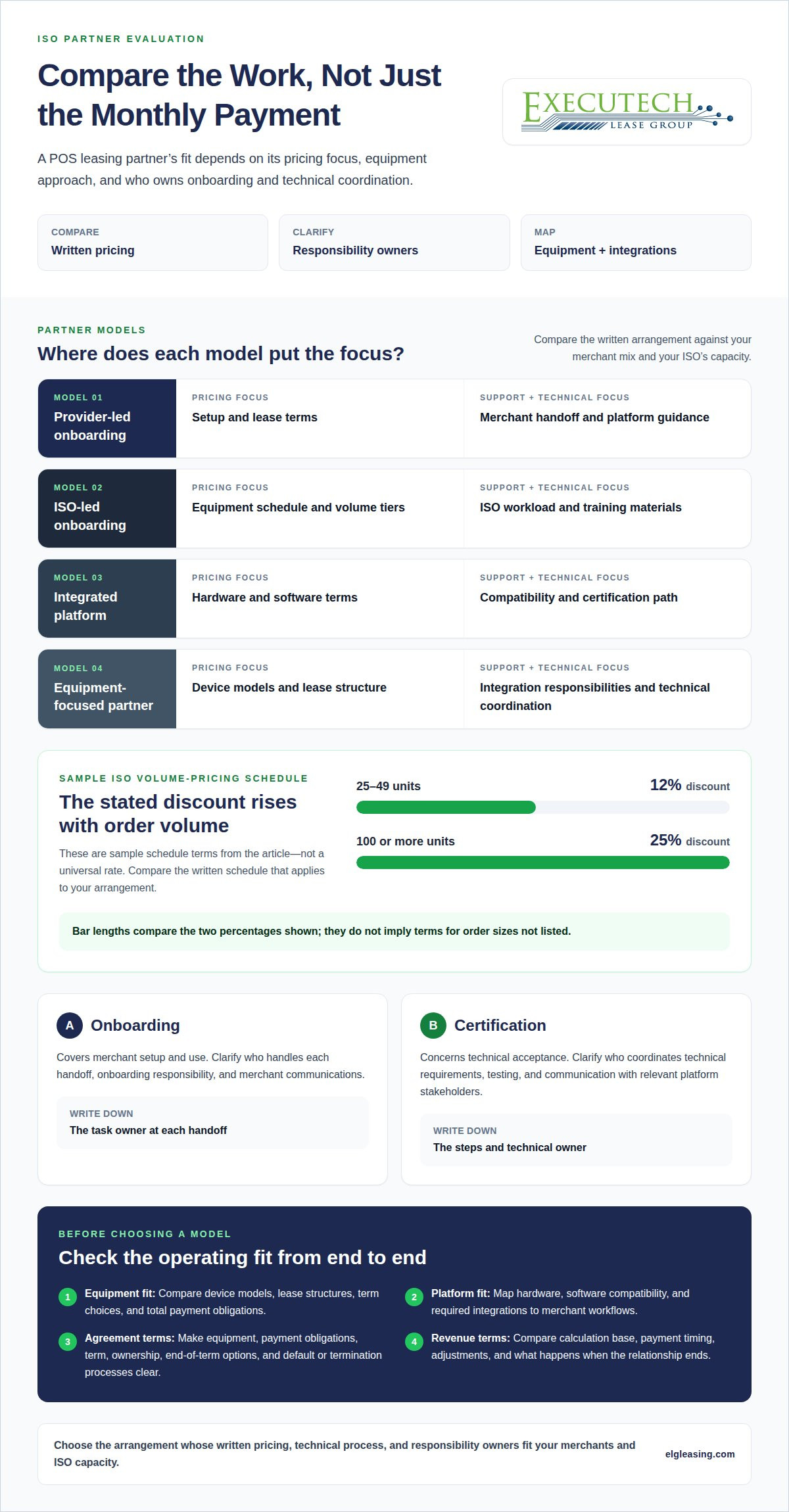
Equipment options determine whether you can match a terminal or POS system to each merchant’s workflow. Compare available models, lease structures, term choices, and how the provider presents the total payment obligation. A sample ISO volume-pricing schedule gives a 12% discount for orders of 25 to 49 units and a 25% discount for orders of 100 or more. Treat that as a sample, not a universal rate; compare the written schedule that applies to your arrangement.
Hardware, Software, and Integrations
Hardware and software fit determine whether the setup supports the merchant’s daily operations. Map the terminal, POS platform, and required integrations before choosing a model. For terminal certification support, clarify which party coordinates technical requirements, testing, and communication with relevant platform stakeholders. This differs from onboarding: certification concerns technical acceptance, while onboarding covers merchant setup and use. Record the steps and owners for both.
For U.S. compliance review, examine the lease disclosures and merchant contracts together. Make the equipment, payment obligations, term, ownership, end-of-term options, and default or termination processes clear, then have counsel review applicable federal and state requirements.
The partnership agreement sets commission, residual, and revenue-share terms. Compare the calculation base, payment timing, adjustments, and treatment when the relationship ends. Don’t assume equipment-related revenue follows the same formula as processing residuals.
| Partner model | Pricing focus | Support and technical focus |
|---|---|---|
| Provider-led onboarding | Setup and lease terms | Merchant handoff and platform guidance |
| ISO-led onboarding | Equipment schedule and volume tiers | ISO workload and training materials |
| Integrated platform | Hardware and software terms | Compatibility and certification path |
| Equipment-focused partner | Device models and lease structure | Integration responsibilities and technical coordination |
Choose the model whose written pricing, certification process, and support ownership fit your merchant mix and ISO capacity.
Choosing a partner based on business goals
Assess an equipment leasing program against your merchant mix, service model, and growth priorities. Put responsibilities, branding, revenue calculations, merchant handoffs, and exit procedures in the partnership agreement. A clear fit supports the way your ISO serves merchants without adding tasks your team cannot sustain.
Start with your portfolio. A retailer may need credit card terminals or a POS system; a restaurant may have different equipment needs. Define the merchant types you serve, then identify where your team adds value, such as payment expertise, relationship management, or technology recommendations.
That expertise matters. ISOs bring payment knowledge that many independent software vendors may not offer at the same depth. A technology partner can add platform expertise and a network of complementary capabilities. The strongest fit combines those strengths without making your ISO responsible for work it cannot consistently support.
Merchant needs also shape the decision. Some businesses may prefer a POS setup with components that work together. For example, an ISO serving restaurants might prioritize a POS system suited to restaurant workflows, while a retail portfolio may need a different setup. Define the use case first, then compare the equipment and lease options available.
A disciplined approach to choosing a POS leasing partner for ISOs starts with specific business objectives. Use these steps to assess fit and prepare for a partnership conversation:
- Set the objective: Decide whether the priority is portfolio growth, merchant retention, or a broader technology offer.
- Map merchant segments: Separate retail, restaurant, and other relevant merchant workflows.
- Assign responsibilities: Record who manages sales, onboarding, platform questions, and merchant communications.
- Define branding: Specify how your ISO name appears in proposals and customer-facing materials.
- Document revenue terms: State how commissions, residuals, and revenue shares are calculated and reported.
Negotiation should turn broad promises into operating terms. Use a sample merchant journey, from proposal through installation, to identify handoffs and unresolved tasks. Document how pricing changes are communicated, which party owns each merchant interaction, and how the agreement handles disputes or a provider transition. Clear definitions make the partnership easier to manage as your portfolio changes.
Consider capacity, too. A partner model that relies on your staff for every technical question may be difficult to scale. Compare it with a model that provides platform expertise while leaving merchant relationships in your hands. The final decision in choosing a POS leasing partner for ISOs should reflect your team’s workload, merchant needs, and the role your ISO wants to retain.
If equipment access fits your merchant strategy, use the ISO and vendor inquiry form to start a conversation about the partnership.
Provider exit clauses
Review partner responsibilities, early termination terms, payment-dispute processes, and equipment obsolescence before entering a program. Each affects a different part of your business, so document responsibilities in the relevant agreements.
Early Termination
An early termination clause explains what happens if a party ends the partnership before its planned conclusion. That is separate from an equipment lease: a change in your provider relationship does not by itself resolve a merchant’s lease obligations. Review notice procedures, outstanding merchant accounts, unpaid obligations, and who communicates changes to merchants. Make sure the partnership agreement and equipment lease are treated as distinct arrangements.
Equipment Obsolescence
Obsolescence concerns whether deployed hardware remains suitable for merchants as software and operational needs change. It differs from termination: a device can become outdated while the partner program continues. Define how the parties handle equipment at the end of its lease term, who communicates replacement options, and how merchants receive details about ownership or return obligations. Keep end-of-term planning separate from any active lease.
Partner stability affects continuity across your portfolio. Review the operating model, account-management process, and how responsibilities remain clear if staffing or ownership changes. Ask who will manage open applications, merchant records, and unresolved equipment matters during a transition. Put the contact and handoff process in writing rather than relying on informal assurances.
Payment disputes and equipment lease questions are separate issues. The partnership terms should identify who handles merchant communication, documentation, and escalation for each. If a merchant disputes a transaction and also asks about a terminal lease, your team needs a clear route for both questions. Define responsibilities and recordkeeping without assuming one process resolves the other. ELG does not process payments; its equipment-leasing role is separate from payment processing.
Use this review sequence before signing or renewing:
- Identify events that trigger termination and the required notice process.
- Map merchant accounts, hardware records, and open issues to a named transition owner.
- Separate chargeback handling from equipment billing and lease obligations.
- Document end-of-term equipment steps and merchant communications.
- Review how the independent sales program preserves revenue reporting during a provider change.
Test the terms against a practical example: your ISO changes providers while a merchant still has leased equipment. The agreements should make responsibilities and merchant communications clear at each step.
Technical integration requirements
Technical fit depends on how each device, POS platform, and processing workflow connects. Map those connections before deployment, then test a complete merchant transaction from checkout through reporting.
Start with the merchant’s actual workflow. A restaurant may need orders to move from its POS platform into payment processing without duplicate entry. A rental business may need online reservations connected to in-store order management. Rental POS systems can also update inventory when items are rented or returned. These examples reveal whether an integrated setup supports the merchant’s daily tasks.
Next, document the data and device path. Identify which system sends transaction details, where inventory records live, and how staff access reports. For example, if a merchant tracks stock in its POS software, confirm that the chosen device and platform preserve that workflow. Record each integration point, the party responsible for configuration, and how testing will confirm that information moves as intended.
- Device compatibility: Match the terminal and peripherals to the selected POS platform.
- Processing flow: Trace a payment from checkout to the merchant’s transaction records.
- Inventory capabilities: Confirm how sales, returns, and stock changes appear in the merchant’s system.
- Connected workflows: Map links such as online reservations and in-store order management.
- Testing ownership: Assign responsibility for setup, test transactions, and issue handoffs.
Underwriting and merchant eligibility are separate from technical integration. A lease review assesses the applicant’s credit profile, ability to meet the payment obligation, requested equipment, and fit with program terms. The review process and required application details depend on the lease program; make those criteria clear in the merchant’s application workflow.
Subscription models add another integration question: whether recurring software access and equipment financing are handled as separate agreements or a combined merchant offer. A cloud-based payments platform can be offered as a SaaS solution, allowing an ISO to bundle services for customer segments and deliver them by subscription. That model requires clear coordination between software access, device setup, and payment processing.
Before broader adoption, walk through a representative merchant scenario. Identify the equipment and software involved, the steps staff take, and who handles questions about each part of the setup. This practical review can reveal gaps that a general feature list misses and gives your ISO a consistent way to assess fit.
Comparing POS leasing: equipment, pricing, and terms
POS leasing programs can differ in the equipment they cover, lease structure, term, and end-of-term options. Compare proposals using the same equipment needs and merchant scenario, then review the written terms rather than focusing on a headline payment.
Begin with equipment scope. A restaurant may need a POS system, while a smaller checkout setup may center on a card terminal. List the required devices and any bundled installation or training, then confirm how each proposal treats those items. Comparing the same package keeps the equipment basis consistent across partner options.
Lease structure changes the merchant’s end-of-term path. A lease-to-own program is designed around acquiring the equipment through the agreement. A fair market value lease follows a different structure, so review its end-of-term options and obligations directly. A fixed-term equipment lease sets payments across an agreed period. Avoid comparing these choices by payment alone; ownership outcomes and contract language matter.
| Option | Equipment fit | Pricing comparison | Term-end focus |
|---|---|---|---|
| Lease-to-own | Specified POS or terminal equipment | Review scheduled payments and total obligations | Understand how ownership is addressed |
| FMV lease | Equipment suited to the merchant’s workflow | Compare payment schedule and agreement terms | Review the stated end-of-term choices |
| Fixed-term equipment lease | Equipment identified in the contract | Compare the full schedule across the agreed term | Check return, purchase, or other stated steps |
For example, compare proposals for the same terminal and POS configuration, with matching installation or training assumptions. Separate equipment charges from any bundled services, and check whether the agreement identifies each financed item. A clear itemization makes it easier to explain the merchant’s obligation and reconcile the proposal with the selected equipment.
Term length affects the payment schedule and how long the merchant remains obligated. Available equipment lease terms can run from 12 to 60 months. Compare the selected duration with the merchant’s expected use of the system, planned location needs, and ability to meet scheduled payments. Don’t treat a longer term as automatically cheaper or a shorter one as automatically better.
Use a consistent comparison: match the equipment, identify the lease structure and term, review the payment schedule, and read the end-of-term language. Then ensure the explanation given to the merchant matches the written agreement. This keeps the equipment, costs, and obligations aligned.
Executech Lease Group (ELG Leasing): 12-60 Month Credit Card and POS Equipment Leases
Executech Lease Group (ELG Leasing) helps ISOs and merchant services providers offer equipment leasing to merchants who need POS or card terminal technology. Its 12-60 month credit card and POS equipment leases support a defined equipment acquisition path without requiring merchants to treat the full equipment cost as an upfront purchase.
Match the lease structure to the merchant’s equipment and ownership goals. ELG offers FMV and lease-to-own options, as well as POS and credit card terminal leasing, including Clover devices. The applicable end-of-lease buyout depends on the selected structure, so review the agreement’s terms.
If equipment leasing fits your ISO’s merchant program, contact Executech Lease Group to discuss the available options.
Turn your partner criteria into a practical next step
A strong partnership decision should make your ISO’s operating model easier to carry out. Create a short internal decision record that identifies your priorities, assigns responsibilities, and explains how the proposed agreement supports your merchant strategy. This gives your team a consistent basis for evaluating the program.
Choosing a POS leasing partner for ISOs is also an opportunity to align equipment access with the way you want to serve merchants. A focused conversation can help clarify how a leasing program fits your portfolio and how to move from evaluation to a workable next step.
Executech Lease Group (ELG Leasing) works with ISOs and merchant services providers seeking equipment leasing options for their merchants. Bring your priorities and questions to the discussion, then consider how the available approach fits your business.
Make the next decision with a clear framework and a partnership structure your team can put into practice.
This article reflects the author’s opinion for general information only and isn’t tax, legal, or accounting advice. Consult your CPA or attorney about your specific situation.
Frequently Asked Questions
What should ISOs look for when choosing a POS leasing partner?
Choose an equipment program that fits your merchant portfolio and has clear written responsibilities. Consider how applications move from your sales team to lease review, how merchants receive contract documents, and how account records are handled. Map one merchant journey from equipment selection through the leasing process. This can reveal handoffs your team needs to manage and help you assess whether the program fits your workflow.
What are typical POS equipment lease costs and fees for merchants in the United States?
There isn’t one typical cost that applies to every POS lease. The price depends on the case and is given after a quote request. Equipment type, the lease structure, term, and any installation or training bundled with the equipment affect the proposal. Compare the full payment schedule and documented fees, not just a recurring payment. That gives merchants a clearer view of the financial commitment without relying on a generic industry estimate.
Who owns the POS equipment, and what happens at the end of a lease?
Ownership and end-of-term choices depend on the lease structure and its written terms. These buyout figures apply at the end of the lease, not to monthly payments. Before signing, ensure the merchant understands the applicable option and the steps the agreement requires at term end.
What service-level, installation, maintenance, and replacement terms should an ISO negotiate?
Define who coordinates installation, who trains merchant staff, and where operational questions go. ELG provides equipment leasing, not installation, maintenance, repairs, or replacements; equipment warranties come from the manufacturer. For example, an ISO can document its own installer’s scope separately from the lease and identify the manufacturer’s warranty contact for equipment issues. Keep those responsibilities distinct from lease billing so merchants know which agreement or contact applies to each need.
This article reflects the author’s opinion for general information only and isn’t tax, legal, or accounting advice. Consult your CPA or attorney about your specific situation.
What compliance rules govern POS leasing, disclosures, and merchant contracts in the United States?
Review lease disclosures and merchant contracts together, making the equipment, payment obligations, term, ownership, end-of-term options, and default or termination processes clear. Have counsel review applicable federal and state requirements.
How are ISO commissions, residuals, and revenue shares structured in POS leasing partnerships?
The partnership agreement sets commission, residual, and revenue-share terms. Compare the calculation base, payment timing, adjustments, and treatment when the relationship ends. Don’t assume equipment-related revenue follows the same formula as processing residuals.

Article by
Robert Ensminger
Robert Ensminger is the founder and CEO of Executech Lease Group (ELG Leasing), which specializes in equipment leasing and financing solutions for the merchant-services, payments, POS, and FinTech industries. With more than 20 years of industry experience, Robert helps ISOs, payment processors, POS providers, and software companies build practical equipment leasing programs. He founded ELG in 2010. His work focuses on responsive service, transparent program structures, subscription and SaaS-monetization programs, and helping ELG’s partners close more business while creating sustainable revenue.