
A cloud POS subscription doesn’t automatically cover the equipment used to run it. Cloud POS software lease options may finance SaaS access, POS hardware, or a combination of the two. The label alone won’t tell you what’s included.
When comparing a recurring subscription with lease-based payments, check what you’re paying for, how long the agreement runs, and what responsibilities or choices apply when it ends.
This guide compares subscription-based arrangements, fair market value (FMV) leases, and lease-to-own programs. It also explains what to confirm about software, services, and equipment before applying. ELG Leasing offers financing for cloud-based SaaS POS software, as well as POS and payment-terminal equipment leases. Its stated 12-60-month terms apply to equipment leases, so confirm the available term for any software arrangement. Use the checklist below to prepare specific questions for a provider experienced in merchant services and payment technology.
Key Takeaways
- Cloud POS software lease options vary, so compare the agreement’s purpose and covered items rather than relying on its label.
- Separate SaaS access, POS hardware, and payment processing in your comparison. One agreement may not cover all three.
- Review the payment schedule, contract term, named parties, and end-of-term choices before you commit.
- List the software access and equipment your checkout workflow requires, then use that list to compare proposals.
- ELG Leasing offers FMV, lease-to-own, and subscription-based programs. Confirm which software, services, or equipment a specific program covers before applying.
What Cloud POS Software Lease Options Actually Cover
Cloud POS software lease options are financing arrangements related to cloud-based point-of-sale software, but the agreement determines what they cover. SaaS access, physical POS hardware, and payment processing are separate components. A recurring software subscription isn’t automatically a lease, and a hardware lease doesn’t necessarily include software access or payment processing.
A POS setup can combine software with equipment used at checkout. When reviewing a proposal, check the specific items and responsibilities listed in writing. The broad phrase “POS system” doesn’t establish what a program includes. Identify who supplies each item and who handles ongoing services.
What does a cloud POS software lease pay for?
Start with the proposal. Look for the software, equipment, and services covered, as well as the parties responsible for providing them. Financing for cloud SaaS software is distinct from leasing physical POS hardware, although a specific arrangement may address one or both. Don’t assume an equipment lease includes a software subscription, or that a software arrangement includes equipment.
Check whether setup, support, or other charges are included or handled separately. If the proposal describes a complete POS solution, ask for an itemized explanation. For example, compare the listed software access, hardware, and services against your needs, and ask which costs fall outside the agreement. This separates written obligations from assumptions.
Who uses cloud POS software financing?
Merchants may explore financing when they want access to cloud POS technology and need to understand how a payment arrangement fits their business. First list the software access and technology the checkout workflow requires. Then compare that list with the items named in the proposed program.
ISOs, sales agents, and payment processors may also work with financing providers to present technology options to merchants. Their involvement doesn’t mean software, equipment, and processing are all covered by one agreement. Clarify who provides each component and which terms apply. ELG Leasing offers financing for cloud-based SaaS POS software alongside POS and payment-terminal equipment leasing. Confirm the scope and terms of the specific program with the provider.
Compare Cloud POS Software Lease and Subscription Structures
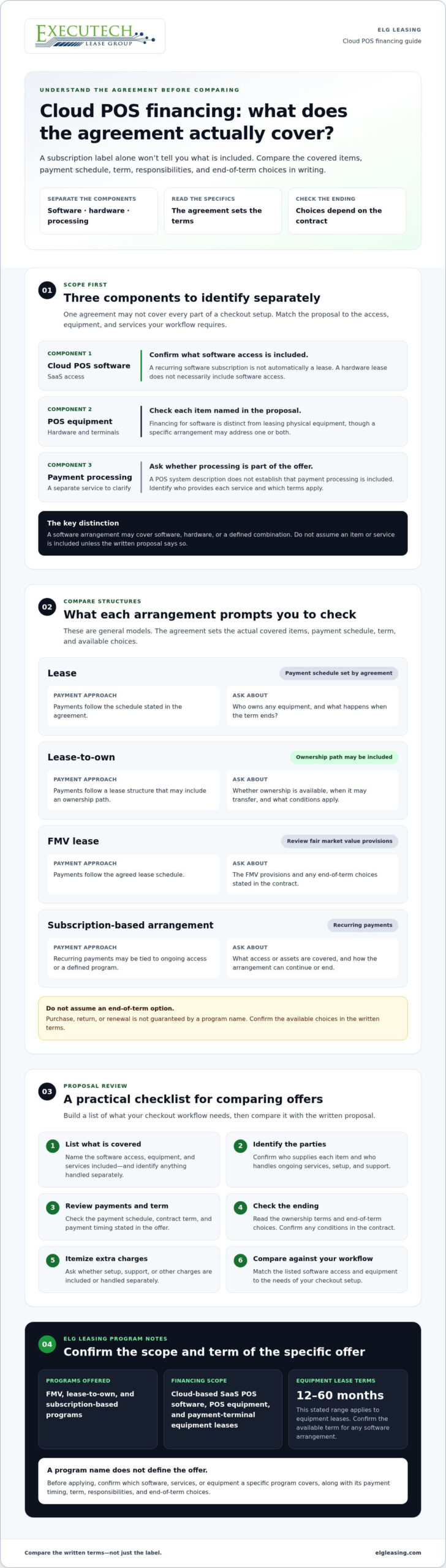
Cloud POS software lease options can differ in payment approach and end-of-term choices. Compare the written structure, not just its label. The descriptions below are general models. The agreement sets the actual payment schedule, covered items, term, and available choices.
| Structure | Payment approach | Ownership and end-of-term questions |
|---|---|---|
| Lease | Payments follow the schedule set out in the agreement. | Check who owns any equipment and what happens when the term ends. |
| Lease-to-own | Payments follow a lease structure that may include an ownership path. | Confirm whether ownership is available, when it may transfer, and what conditions apply. |
| FMV lease | Payments follow the agreed lease schedule. | Review the fair market value (FMV) provisions and any end-of-term choices stated in the contract. |
| Subscription-based arrangement | Recurring payments may be tied to ongoing access or a defined program. | Confirm what access or assets are covered and how the arrangement can continue or end. |
ELG offers FMV, lease-to-own, and subscription-based programs. A program name doesn’t establish the details of a particular offer. Review ELG’s SaaS financing programs as a reference, then confirm the covered items, payment timing, term, and end-of-term choices for the proposal you’re considering.
How do lease-to-own and FMV options differ?
These structures call for different questions. For lease-to-own, confirm the ownership path and any conditions in the agreement. For an FMV lease, check the choices available at term end. Don’t assume purchase, return, or renewal is available unless the written terms say so. ELG’s POS lease-to-own guide offers additional context on equipment arrangements.
When should you compare a subscription-based option?
Consider whether recurring payments align with how your POS provider delivers software access. Then clarify whether the arrangement finances software, equipment, or a defined combination. A SaaS access subscription and a subscription-based lease aren’t necessarily the same agreement. Review ELG’s subscription-based lease programs and confirm the terms that apply to your offer.
Once you’ve compared the structures, use your business needs and the written terms to guide your next step. If you’re ready to discuss an option, you can apply for review.
Evaluate Agreement Scope, Payments, and End-of-Term Terms
Read the proposed agreement line by line. Confirm the software, equipment, and services covered; the payment schedule and term; and the parties responsible for providing each item. A product description or sales conversation can help explain the offer, but the written agreement should spell out the actual obligations.
Keep separate charges separate. Identify what the agreement includes and what it lists as an additional charge. Don’t treat payment processing, software access, setup, or ongoing service as included unless the documents say so. If you’re still deciding which platform fits your workflow, Forbes’ overview of best cloud POS systems can provide product-selection context. It doesn’t replace review of the proposed financing agreement.
Which payment and contract details should you verify?
Focus on the details that affect your obligations. Ask the provider to clarify anything that’s missing or unclear before you proceed.
- Payment schedule: Confirm how often payments are due and where the schedule is documented.
- Term: Verify the agreement’s length. Don’t assume equipment lease terms also apply to software.
- Covered items: Match each software, equipment, and service item in the proposal to the written agreement.
- Responsible parties: Identify who provides software access and who handles ongoing service or support.
- Changes and interruptions: Ask how the agreement addresses changes to your POS needs, cancellation requests, or interruptions to service.
Separate written charges and obligations from assumptions. If a salesperson describes a service or payment as part of the arrangement, check that the agreement reflects it. Cloud POS software lease options may involve different providers for software, equipment, and processing, so clarify whom to contact and which terms govern each part.
What does the agreement say happens at term end?
Look for explicit language about what happens when the term ends. The agreement may identify purchase, return, renewal, or continuation choices, but don’t assume an option is available unless it’s stated. Confirm whether each choice applies to software access, physical equipment, or both.
Ask whether you need to provide notice or take another step to select an available option, and where the agreement explains the process. Ownership doesn’t transfer automatically unless the contract says so. Don’t assume renewal either. Before accepting, resolve unclear terms with the relevant provider and rely on the final written agreement for the options, deadlines, and obligations that apply.
Use This Checklist to Choose a Cloud POS Lease Option
Compare offers against your checkout workflow, not a generic feature list. Cloud POS software lease options differ in coverage and structure, so clarify the essentials before applying.
- Define your needs. Map how staff take payments, manage sales, and use the POS system. List the software access your workflow requires, along with any equipment needs.
- Identify covered items. Match each software, hardware, and service item you need to the proposal. Ask what is included and what is separate.
- Compare structures. Review the proposed lease, lease-to-own, FMV, or subscription-based arrangement. Compare the payment approach and end-of-term choices in the written terms.
- Review the agreement. Check the parties, payment schedule, term, disclosed charges, service responsibilities, and any stated options at the end of the term.
- Confirm next steps. Resolve unanswered questions with the provider or agent, and clarify what information is needed before moving forward.
Questions merchants should ask before choosing
Ask which software, equipment, and services the proposal specifically includes. Confirm the payment schedule, term, and written end-of-term options. Establish who provides software access and support, and who handles changes to the merchant account. If an answer relies on a verbal explanation, ask where that detail appears in the agreement.
Questions ISOs and payment providers should resolve
Before presenting a program to a merchant, clarify which merchant and POS software use cases it is designed to support. Confirm what information you can share about covered items, payment structure, and end-of-term choices so the offer is described accurately. If the proposal also includes physical POS equipment, review its terms separately from software access.
ELG Leasing serves merchant services providers, ISOs, sales agents, and payment processors, and offers financing for cloud-based SaaS POS software alongside POS and payment-terminal equipment leasing. Its application process overview can help you understand the next steps before applying. Confirm the details that apply to your specific program.
Explore ELG Leasing Options and Prepare Your Application
Once you’ve clarified your business needs and what an agreement should cover, discuss a program with a financing provider. Executech Lease Group (ELG Leasing) offers financing for cloud-based SaaS POS software, alongside POS and payment-terminal equipment leasing. Its program types include FMV, lease-to-own, and subscription-based options. The structure, covered items, and terms depend on the program, so confirm what applies to your situation.
Keep software financing separate from software development and payment processing. ELG provides financing for POS technology; it isn’t a cloud POS software developer or a direct payment processor. Also distinguish equipment terms from software terms: the 12-60-month range applies to credit card and POS equipment leases. Confirm the available term for any software arrangement rather than assuming the equipment range applies.
What to prepare before contacting a financing provider
Bring clear information about the technology you’re considering and the questions you need answered. This helps focus the discussion on fit and agreement scope without assuming a particular program or outcome.
- Technology and use: Identify the cloud POS software or technology under consideration and how the business plans to use it.
- Related equipment: Note any POS or payment-terminal equipment you want considered alongside software financing.
- Program details: Gather the proposal or available program information, if you have it, and mark any unclear items.
- Questions to resolve: List what you need to know about payment structure, term, included items, and end-of-term choices.
How ELG fits merchant-services technology financing
ELG focuses on merchant-services technology financing and serves merchant services providers, ISOs, sales agents, and payment processors. It offers cloud-based SaaS POS software financing as well as equipment leasing. Assess cloud POS software lease options against your specific software needs and the written terms, not the program label alone.
Before proceeding, confirm which software costs, services, or equipment a specific program may cover, along with its payment schedule, term, and end-of-term options. An application doesn’t guarantee approval or a particular structure. Review the details, then submit an application for an ELG program.
Choose Your Next Step with Confidence
Cloud POS software lease options are easier to compare when you know what the agreement covers. Software access, POS equipment, and payment processing are distinct, and a program’s label doesn’t replace its written terms.
Compare the payment structure and end-of-term choices, then confirm the covered items, parties, schedule, and responsibilities in the agreement. A clear checklist helps you focus on what your business needs and resolve open questions before applying.
ELG Leasing offers financing for cloud-based SaaS POS software and equipment, with FMV, lease-to-own, and subscription-based programs. Its focus on merchant services and payment technology may be relevant to providers, ISOs, sales agents, and payment processors exploring POS financing. Confirm specific program terms and coverage directly.
When you’ve reviewed your needs and agreement questions, explore the application process.
A well-matched arrangement starts with clear expectations. Use the written terms to guide your decision and choose the path that aligns with your business needs.
Frequently Asked Questions
Can cloud POS software be leased separately from POS hardware?
It may be possible to arrange financing for software, equipment, or both, depending on the program. Cloud software access and physical POS hardware are distinct items, but don’t assume every provider separates them or bundles them together. Review the proposal for covered items, payment terms, and which provider handles each part. Confirm the arrangement directly with the financing provider before relying on a particular structure.
What is the difference between a cloud POS software lease and a subscription?
A subscription is generally a recurring way to access software, while a lease or financing arrangement is defined by its agreement and payment structure. Terms vary by program, so the label alone won’t tell you what you’re paying for. Check what the arrangement finances, how long software access continues, which payments apply, and what obligations or choices the agreement specifies at term end.
Does ELG Leasing offer financing for cloud POS software?
Yes. ELG Leasing offers financing for cloud-based SaaS POS software, with programs tailored to the merchant services and payment processing industry. The specific software costs, terms, and requirements depend on the opportunity and program. Ask which items are covered and confirm the applicable payment structure and term in writing. Equipment lease terms shouldn’t be assumed to apply to software financing.
Can a cloud POS software lease include hardware?
A proposal may address software and equipment, but the agreement determines the scope. Check whether it lists POS systems, terminals, software access, or related services, and confirm which provider is responsible for each. Don’t assume every program combines these items. If equipment is included, verify its applicable lease term and end-of-term obligations separately from any software terms.
What should I check before choosing a cloud POS software lease option?
Confirm the covered items, payment schedule, agreement term, and service responsibilities. Review how the agreement handles changes or cancellation requests, and identify any purchase, return, renewal, or continuation options stated for term end. Compare the actual documents, not just a label such as FMV or subscription. Ask the provider to clarify any unclear point before you apply or sign.
Do ELG’s 12-60-month lease terms apply to cloud POS software?
ELG’s 12-60-month terms apply to credit card and POS equipment leases. Don’t extend that range to cloud POS software financing unless the specific program confirms it. Ask for the applicable software term, payment structure, covered items, and agreement details for your proposal. If equipment and software are both involved, verify the terms for each rather than treating them as one arrangement.
Who can explore ELG cloud POS software financing?
ELG focuses on merchant services providers, ISOs, sales agents, and payment processors helping merchants access payment technology. If you’re exploring a program, confirm that your software use case and requested arrangement fit the available option, along with its terms and requirements. Applying doesn’t guarantee eligibility, approval, or a particular structure. Interested readers can apply for an ELG program to begin the process.

Article by
Robert Ensminger
Robert Ensminger is the founder and CEO of Executech Lease Group (ELG Leasing), which specializes in equipment leasing and financing solutions for the merchant-services, payments, POS, and FinTech industries. With more than 20 years of industry experience, Robert helps independent sales organizations, payment processors, POS providers, and software companies develop practical leasing, subscription, and SaaS-monetization programs. He founded ELG in 2010 and guided the company to recognition on the Inc. 5000. His work focuses on responsive service, transparent program structures, and helping ELG’s partners close more business while creating sustainable revenue.