Owning your payment hardware might feel like financial prudence, but it’s often the fastest way to trap vital liquidity in rapidly depreciating assets. When structured with complete transparency, modern digital payment terminal leasing transforms a heavy capital expenditure into a streamlined operational advantage. You need state-of-the-art checkouts across every register without gutting your balance sheet. Yet, justifiable concerns over restrictive, non-cancellable contracts and predatory buyout terms often stall decisions.
You don’t have to choose between cash preservation and modern retail performance. In this guide, you’ll discover how strategic leasing models protect your working capital, eliminate hardware obsolescence before security compliance mandates catch you off guard, and simplify checkout operations. Predictable monthly costs. Total operational agility. Enterprise-grade payment hardware that scales directly alongside your transaction volume.
Ahead, we examine the differences between Fair Market Value and Lease-to-Own paths, break down shifting security lifecycles, and show you how decoupling hardware financing from payment processing protects your independence.
Key Takeaways
- Understand how digital payment terminal leasing protects critical working capital by converting heavy upfront deployment expenses into predictable operational costs.
- Compare Fair Market Value and Lease-to-Own frameworks to identify whether recurring hardware refreshes or eventual asset ownership matches your financial strategy.
- Align checkout hardware cycles directly with evolving PCI security mandates to eliminate expensive compliance surcharges and prevent terminal obsolescence.
- Discover why decoupling hardware financing from your payment processor protects operational independence and prevents restrictive vendor lock-in.
- Learn the critical contractual benchmarks to audit before signing, ensuring transparent end-of-term provisions and seamless cloud software integration across all touchpoints.
What Is Digital Payment Terminal Leasing and How Does It Work?
At its core, digital payment terminal leasing is a dedicated commercial agreement that finances point-of-sale hardware over an agreed schedule. Instead of absorbing heavy upfront capital expenditures to buy devices outright, you spread equipment costs across manageable monthly operational expenses. This structure keeps your working capital intact for inventory, payroll, and expansion.
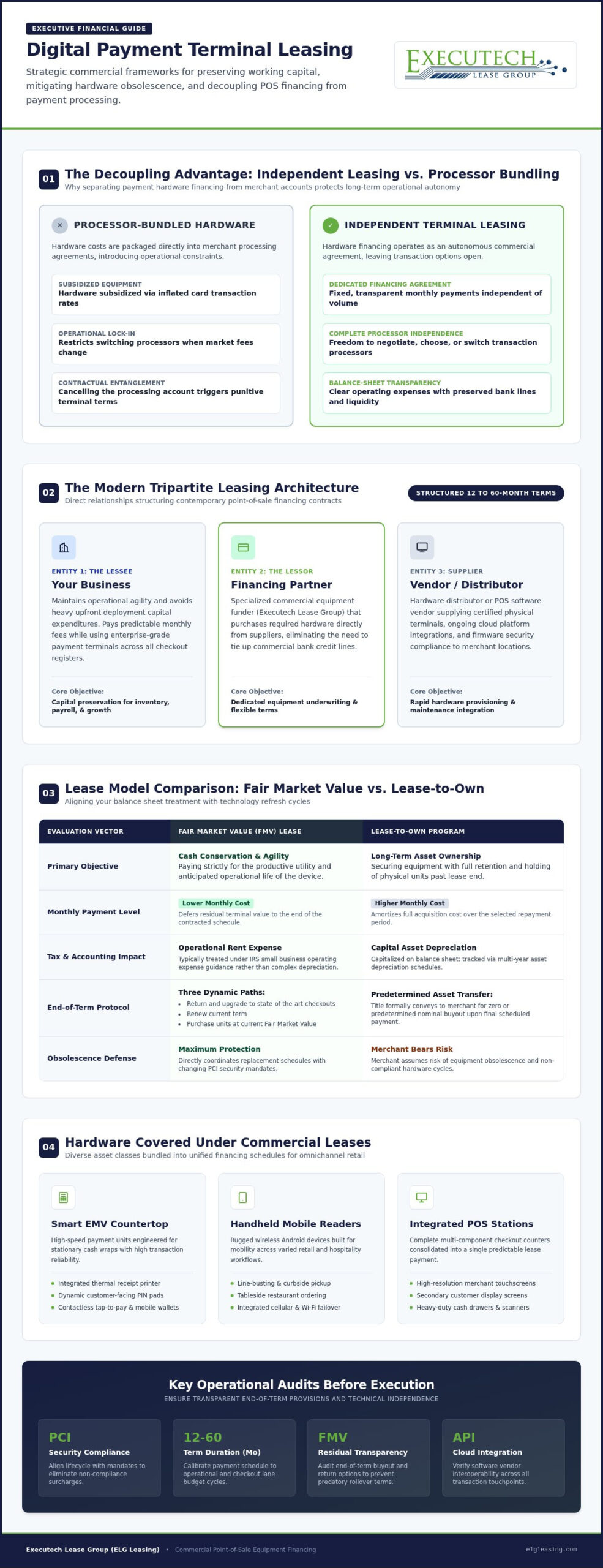
Crucially, true commercial leasing operates independently from your merchant processing account. Many payment processors bundle hardware into restrictive merchant services agreements, quietly locking you into inflated processing rates to subsidize the device. Independent equipment financing breaks that trap. You secure modern payment terminal hardware through a dedicated financing contract, leaving you free to choose, negotiate, or switch transaction processors whenever market rates dictate.
The Mechanics of Modern Payment Equipment Leases
A professional commercial lease runs on a transparent tripartite framework connecting three parties: your business (the lessee), the specialized financing entity (the lessor), and the equipment distributor or software vendor. The financing partner purchases the required hardware directly from the manufacturer or distributor, delivering it to your retail locations without draining your credit lines.
Contracts are built around structured 12 to 60-month financing terms, giving you the power to match payment schedules directly to your operational budget. Rather than financing individual registers piecemeal, forward-thinking operators utilize full-scale POS equipment leasing to bundle complete checkout counters into a single, predictable monthly payment.
Hardware Covered Under Contemporary Commercial Leases
Modern agreements adapt to omnichannel retail environments, covering diverse asset classes under unified financing schedules:
- Smart EMV Countertop Terminals: High-speed units with integrated thermal receipt printers, dynamic customer-facing PIN pads, and support for contactless tap-to-pay and mobile wallets.
- Handheld Mobile Readers: Rugged, wireless Android devices engineered for line-busting, curbside pickup, and tableside ordering with integrated cellular and Wi-Fi failover.
- Integrated POS Station Bundles: Multi-component checkouts combining high-resolution merchant touchscreens, customer display monitors, heavy-duty cash drawers, and barcode scanners.
By treating digital payment terminal leasing as a standalone financial instrument rather than a processor add-on, you maintain complete balance-sheet clarity and technical agility across every retail lane.
Comparing Terminal Lease Models: Fair Market Value vs. Lease-to-Own
Selecting the right financing model dictates your balance-sheet treatment and determines what happens to your checkout hardware at the end of the term. In digital payment terminal leasing, two primary frameworks dominate commercial agreements: Fair Market Value (FMV) and Lease-to-Own. Conflating the two is an expensive mistake. Your decision must hinge on how quickly your store demands technology upgrades versus whether your business benefits from holding depreciating hardware as long-term assets.
Fair Market Value (FMV) Lease Structures
An FMV lease prioritizes cash conservation and agility. Under this structure, your monthly payments are lower because you finance only the anticipated operational life of the device, deferring residual value to the end of the term. You don’t buy the equipment; you pay for its productive utility.
Tax accounting often favors this route. Lessees typically treat monthly payments as operational rent expenses under standard IRS small business guidance on lease deductions rather than managing asset depreciation schedules. When your agreement concludes, you return the devices and roll seamlessly into current hardware, renew the term, or purchase the terminals at their current fair market value. Businesses navigating rapid transaction growth can review tailored commercial options through structured leasing programs built around continuous equipment refresh cycles.
Lease-to-Own Programs for Long-Term Deployments
Lease-to-own structures (often organized as finance leases or dollar-buyout plans) are engineered for long-term operational equity. Instead of deferring residual value, your scheduled installments steadily amortize the full cost of the hardware. Once you make the final scheduled payment, full ownership title transfers to your enterprise for a nominal sum agreed upon upfront.
This approach fits stationary, durable infrastructure that experiences low technical turnover:
- Heavy-duty cash drawers and structural POS countertop enclosures
- Dedicated kitchen display monitors and thermal kitchen order printers
- Barcode scanning rigs and stationary back-office verification terminals
Because the eventual buyout price is locked in at contract origination, you eliminate surprise balloon fees or arbitrary residual assessments. You own the assets outright once paid, letting you sweat the equipment across secondary locations without continuing liabilities.
Whether you prioritize continuous access to modern devices or planned equity in your checkout footprint, you can submit a quick financing application to structure terms that match your cash-flow objectives.
The Financial Case: Leasing vs. Buying Payment Terminals in 2026
Buying checkout hardware outright drains liquid capital. Sinking substantial reserves into multi-lane hardware deployments starves growing retail operations of vital cash flow. Digital payment terminal leasing converts this heavy capital expenditure (CapEx) into predictable operational expenditure (OpEx). Under current tax rules, qualifying finance lease agreements allow businesses to leverage Section 179 expensing up to the $2,560,000 threshold alongside 100% bonus depreciation, capturing upfront tax relief without draining cash reserves.
Preserving Cash Reserves and Credit Facilities
Liquidity drives business resilience. Tying up operating cash in physical payment hardware limits your ability to purchase inventory, expand payroll, or absorb supply chain fluctuations. Specialized equipment financing operates as a distinct commercial channel, safeguarding revolving bank credit lines for strategic initiatives rather than depreciating countertop devices.
Crucially, independent financing protects your enterprise from predatory processor lock-in. Processors often bury restrictive, non-cancellable hardware terms inside merchant accounts, penalizing merchants who try to renegotiate processing rates. Reading the FTC merchant warnings on equipment leases reveals how common these restrictive traps remain. Decoupling hardware financing keeps your processing options open and your banking facilities untouched.
Mitigating Payment Technology and Security Obsolescence
Payment security standards evolve quickly. Regulatory compliance dictates hardware retirement schedules, not physical device wear. With PCI DSS v4.0.1 now fully active and PCI PTS v5 hardware facing its deployment sunset in April 2027, acquiring banks routinely issue penalty surcharges to merchants running out-of-spec hardware.
Purchasing terminals locks your enterprise into hardware that could soon become a compliance liability. Smart digital payment terminal leasing structures build systematic upgrade cycles directly into the agreement. When compliance mandates tighten or new payment protocols emerge, you refresh your point-of-sale infrastructure cleanly without writing off unamortized capital assets or handling e-waste disposal logistics.
How to Evaluate a Digital Payment Terminal Lease Agreement
Signing an equipment contract without auditing the fine print exposes your business to unexpected operational liabilities. Evaluating a digital payment terminal leasing agreement requires a systematic audit rather than casual sales consultation. You need transparency around device control, notification windows, and software integration before entering a multi-year commitment.
Execute this five-step checklist before approving any master lease agreement:
- Audit Transaction Workflows: Map peak checkout volume and mobility requirements across your retail floor to define the exact mix of countertop and wireless units required.
- Verify Gateway Compatibility: Confirm that the specified payment hardware communicates with your core business applications and intended transaction rails without proprietary restrictions.
- Align Term to Hardware Utility: Match lease duration against real-world device lifecycles, ensuring your contract does not outlast the technical or operational lifespan of the terminal.
- Scrutinize End-of-Term Mechanics: Confirm exact protocols for device returns, trade-ins, or predetermined ownership buyouts to eliminate arbitrary residual fees.
- Partner with Independent Lessors: Ensure your contract is held by an independent equipment finance specialist rather than embedded as an unalterable rider inside a merchant processing agreement.
Verifying Processor Independence and Device Portability
Hardware portability protects your operating margin. Restrictive contracts frequently bind proprietary terminal firmware to a single gateway, preventing you from changing processors when processing rates increase. An independent financing model keeps the equipment separated from the payment network.
Ensure the terminal can be injected with new encryption keys or reprovisioned across different acquiring platforms. Retaining device control ensures that switching your payment processor never triggers early termination damages or forces a premature checkout replacement.
Auditing Master Agreement Terms and End-of-Lease Conditions
The operational risk in equipment financing sits in end-of-term mechanics. Scrutinize the notification window required to terminate or upgrade the agreement. Standard contracts often demand written notice between 30 and 90 days prior to maturity; missing this window can trigger automatic, multi-month contract rollover clauses.
Clarify return logistics before signing. Check who pays return freight, determine asset condition standards, and verify that nominal buyout paths are locked in writing. Clear buyout language eliminates subjective fair-market-value markups at term completion.
Deploying Premium POS Hardware and Software with ELG Leasing
Hardware agility requires financing that operates on your terms, not your processor’s agenda. Executech Lease Group (ELG Leasing) delivers dedicated commercial financing across structured 12 to 60-month terms, giving businesses the freedom to secure advanced point-of-sale technology without operational compromises. Modern digital payment terminal leasing decouples your checkout hardware from your processing contract, ensuring you retain complete operational independence.
Financing Modern Smart Terminals and POS Systems
Contemporary retail operations require more than standalone card swipers. ELG equips high-volume retail and hospitality venues with complete, multi-component checkout ecosystems. Through specialized Clover terminal leasing solutions, businesses deploy high-performance Clover Station Duo units, versatile Clover Mini setups, and mobile Clover Flex handhelds under a unified agreement.
Hardware represents only half of the point-of-sale equation. ELG bundles physical terminals with cloud-based SaaS POS software subscriptions into a single predictable monthly payment. No separate billing platforms. No software renewal friction. You deploy premium touch-screen stations alongside the operating software required to run your business, making digital payment terminal leasing an integrated growth tool.
Streamlined Underwriting and Partner Execution
Securing capital shouldn’t stall your store openings. ELG operates rapid digital underwriting channels engineered to eliminate administrative friction for merchants and software vendors alike. Clear standards. Fast turnaround. Zero guesswork.
We don’t process payments or trap clients in closed-loop merchant accounts. Instead, ELG serves as an independent financing partner for merchant operators, Independent Sales Organizations (ISOs), and payment agents seeking long-term client retention. By separating equipment financing from payment rails, ISOs deliver competitive hardware programs while merchants retain full processing flexibility. When you are ready to modernize your registers, you can apply now to structure terms that match your operational goals.
Take Control of Your Point-of-Sale Capital Strategy
Structuring your checkout infrastructure shouldn’t force a compromise between trapped capital and obsolete technology. Strategic digital payment terminal leasing gives your enterprise the leverage to deploy state-of-the-art hardware while keeping liquid reserves intact. By separating equipment financing from merchant processing accounts, you eliminate vendor lock-in, simplify balance-sheet management, and maintain continuous alignment with evolving payment security standards.
ELG Leasing delivers direct financing for Clover terminals and comprehensive point-of-sale platforms across customizable 12 to 60-month terms. Tailored for merchant operators, ISOs, and sales agents nationwide, our independent programs remove operational friction so you can focus entirely on customer transactions.
Equipping your business with enterprise-grade payment technology is simple, predictable, and built to scale.
Frequently Asked Questions
Can I lease a payment terminal without being locked into a specific processor?
Yes, independent digital payment terminal leasing separates hardware financing entirely from your payment processing contract. When you work with a dedicated financing partner like ELG Leasing, you finance the equipment directly rather than signing a bundled processor agreement. This gives you complete freedom to switch merchant service providers, negotiate lower interchange rates, or change acquiring banks without triggering equipment penalties or forfeiting your active checkout hardware.
What happens at the end of a digital payment terminal lease agreement?
End-of-term options depend on whether you structured a Fair Market Value (FMV) lease or a Lease-to-Own agreement. Under an FMV contract, you can return the terminals to upgrade to current hardware models, extend your lease, or purchase the units at residual value. With a Lease-to-Own structure, title transfers directly to your business for a nominal, predetermined fee once your final scheduled monthly payment clears.
How do monthly lease payments compare against purchasing terminal hardware outright?
Purchasing requires full upfront capital allocation, whereas digital payment terminal leasing distributes hardware costs into predictable, budget-friendly operating expenses. Outright purchasing ties up essential cash reserves in depreciating checkout hardware that risks obsolescence within three to four years. Commercial leasing preserves working capital for inventory and daily operations while providing structured upgrade paths that prevent your stores from falling behind security standards.
Can my business lease both POS hardware and cloud software subscriptions together?
Yes, modern commercial financing programs can bundle cloud-based SaaS software licenses directly alongside physical checkout hardware. Rather than managing fragmented software invoices and separate equipment bills, you consolidate your entire checkout stack into one monthly payment. This approach covers advanced point-of-sale platforms, proprietary operating systems, and back-office management tools under the same predictable financing schedule, simplifying monthly accounting across all your retail locations.
What credit requirements are typically needed to qualify for terminal equipment leasing?
Commercial equipment underwriting evaluates business operational history, corporate credit profiles, and overall cash-flow consistency. Established commercial lessors maintain streamlined digital approval channels designed for rapid merchant onboarding. While strong corporate credit profiles secure optimal terms, flexible tier structures accommodate growing enterprises and high-volume merchant networks. Providing verified commercial operating records and healthy bank cash flow represents the standard qualification threshold.
Is terminal equipment leasing tax-deductible for commercial businesses?
Yes, commercial terminal leases generally qualify for significant federal tax deductions depending on the underlying contract structure. Operating and FMV leases allow you to deduct monthly payments as ordinary operational business expenses. Finance leases and Lease-to-Own agreements frequently qualify for Section 179 expensing and bonus depreciation, enabling businesses to deduct qualifying equipment costs during the tax year hardware is deployed. Consult your tax advisor to optimize asset treatment.
What is the standard contract length for commercial payment terminal financing?
Commercial financing terms generally span from 12 to 60 months, with 24, 36, and 48-month options serving as common industry standards. Shorter 12 to 24-month terms suit operations demanding rapid device refreshes to match evolving software demands. A 36-month schedule represents the most practical midpoint, delivering manageable operational payments while aligning terminal hardware updates directly with evolving PCI compliance lifecycles.

Article by
Robert Ensminger
Robert Ensminger is the founder and CEO of Executech Lease Group (ELG Leasing), which specializes in equipment leasing and financing solutions for the merchant-services, payments, POS, and FinTech industries. With more than 20 years of industry experience, Robert helps independent sales organizations, payment processors, POS providers, and software companies develop practical leasing, subscription, and SaaS-monetization programs. He founded ELG in 2010 and guided the company to recognition on the Inc. 5000. His work focuses on responsive service, transparent program structures, and helping ELG’s partners close more business while creating sustainable revenue.