What if a terminal offer that requires no money down still creates ongoing obligations? That’s the key distinction to understand when comparing EMV terminal leasing programs. Leasing, buying equipment, and receiving equipment through a processor arrangement work differently, so compare the terms before committing.
It’s reasonable to want a clear answer on what you’ll pay over the lease term, who owns the equipment at the end, and what a credit decision actually means. No money down doesn’t mean free equipment or no recurring lease payments. The end-of-term option matters too: an FMV lease ends with a buyout of about 10% of the original equipment cost, while a lease-to-own program ends with a $1 buyout.
This guide explains how terminal leasing works and how to compare structures with your business needs or merchant-channel workflow. You’ll learn what to clarify about equipment, lease terms, credit decisions, and the steps after an inquiry. You’ll also see where Executech Lease Group (ELG) fits: equipment leasing, not payment processing. The goal is a more informed inquiry, with fewer surprises.
Key Takeaways
- Start with your terminal and POS requirements so you can assess whether the hardware fits your day-to-day payment workflow.
- EMV terminal leasing programs are one way to finance payment hardware. Compare them with purchasing and processor-provided equipment using practical criteria.
- Separate hardware compatibility from processor portability. A terminal’s fit with your setup doesn’t automatically determine whether it can move between processors.
- Review the lease term and end-of-term structure together to understand the commitment beyond the initial equipment decision.
- For merchant-channel inquiries, distinguish a vendor contact form from a lease application and identify what information each step requires.
What Is an EMV Terminal Leasing Program, and Who Is It For?
An EMV terminal is payment hardware that reads EMV chip-enabled cards. An EMV terminal leasing program finances that hardware through a lease; it does not provide payment processing. Keeping the roles separate clarifies four parts of a merchant setup: the terminal reads card information, the processor handles transaction routing, the merchant account supports the business’s payment relationship, and POS software manages checkout or other business functions. These components may work together, but they are not interchangeable.
The EMV label describes the terminal’s chip-card function, while a lease describes how the equipment is financed. Keeping those terms separate helps merchants assess the hardware arrangement without confusing it with the services or account relationships used alongside the terminal.
What Does an EMV Terminal Leasing Program Cover?
The lease covers payment-terminal equipment under an agreed contract. The contract sets the lease term and the stated end-of-term option, which can differ by structure. That option is a key part of the commitment, not a detail to leave until the final payment. Review the equipment and lease terms as one arrangement, while treating processing services and merchant-account terms as separate relationships.
A lease doesn’t automatically select a processor, establish a merchant account, or determine which POS software a business uses. Nor does “EMV” alone establish that a particular terminal will work with every processor or software setup. Check the equipment’s fit with the merchant’s actual environment as a separate compatibility question.
Who Uses These Programs in the Merchant-Services Channel?
Merchants may consider leasing when they need payment-terminal equipment but prefer not to make a large upfront equipment purchase. Start by identifying the checkout setup and hardware needed, then evaluate the lease structure separately from processing arrangements. Leasing finances equipment; it doesn’t change how a merchant accepts or settles payments.
ISOs and independent agents may consider equipment leasing as one element of a merchant relationship. Vendors, resellers, and POS dealers may also discuss leasing options with merchants. In each case, keep the roles explicit: a channel partner may introduce or discuss equipment, while the lease concerns the hardware and the processor relationship remains separate.
For merchants and channel partners, equipment leasing programs are easiest to assess when the equipment, lease contract, and payment services are considered as distinct parts of the overall setup. ELG focuses on equipment leasing, keeping that distinction clear as you evaluate the arrangement.
How EMV Terminal Lease Structures Work
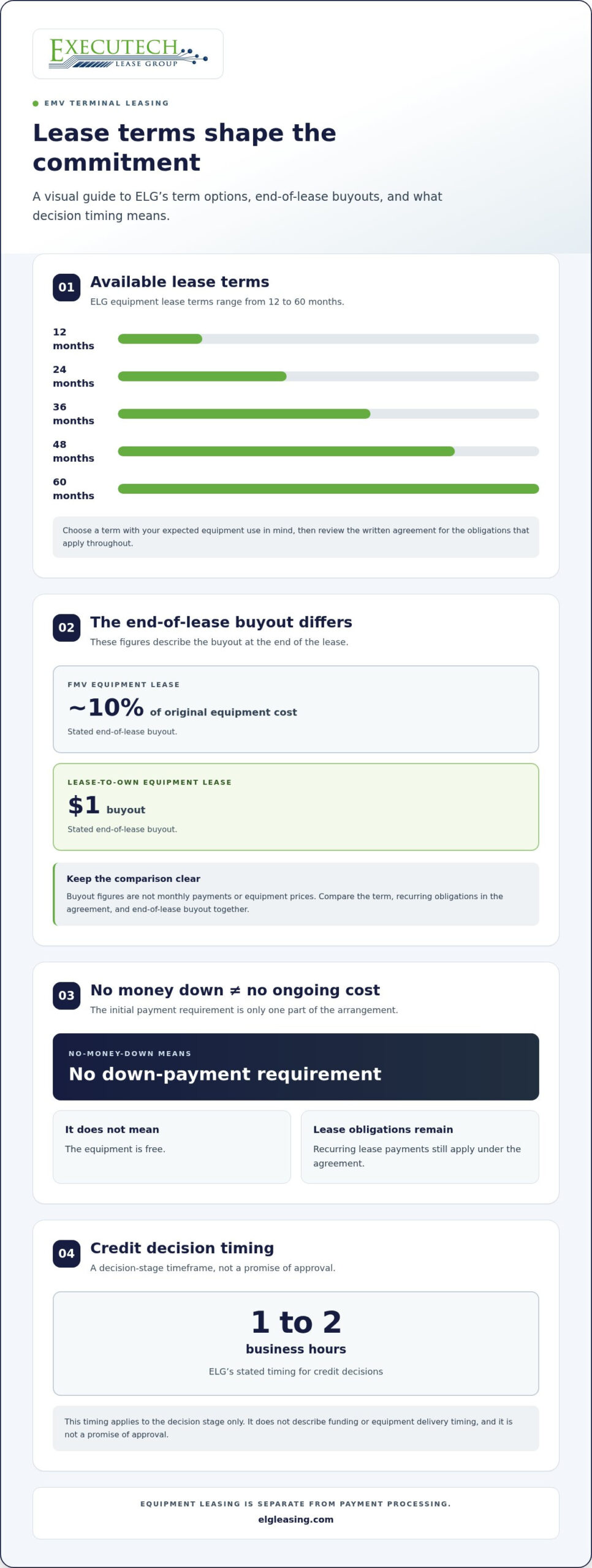
The lease structure shapes both the length of the commitment and the stated buyout at the end. ELG’s equipment lease terms are 12, 24, 36, 48, or 60 months. Choose a term by considering how long you expect to use the equipment and whether the end-of-term option suits your plans. Then review the written agreement for the obligations that apply throughout.
Quick comparison: An FMV equipment lease ends with a buyout of about 10% of the original equipment cost; a lease-to-own equipment lease ends with a $1 buyout. These are end-of-lease figures, not monthly payments or equipment prices.
FMV Equipment Lease and Lease-to-Own: The Buyout Difference
The buyout is the clearest distinction between these structures. With an FMV lease, the stated end-of-lease buyout is about 10% of the original equipment cost. With lease-to-own, the stated end-of-lease buyout is $1. These figures describe the buyout at the end of the lease, not recurring payments or the equipment’s purchase price.
Use that difference to frame the decision: consider whether the stated end-of-term option of an FMV buyout or the $1 lease-to-own buyout better matches your plans. Don’t assume that the lease structure changes processor services or guarantees compatibility with other systems; those are separate matters. EMVCo publishes technical specifications for EMV technology. Its official website is a reference for the standards themselves, not the terms of an equipment lease.
What No-Money-Down and Decision Timing Mean
No-money-down means there’s no down-payment requirement. It doesn’t mean the equipment is free or remove recurring lease obligations. Evaluate the full commitment, including the term and end-of-lease buyout, rather than treating the initial payment requirement as the total cost of the arrangement.
Our goal is to deliver credit decisions in under 2 business hours. That goal applies to the decision stage only. It doesn’t describe how long funding, equipment delivery, or any other step may take, and it isn’t a promise of approval. Keep those stages distinct as you plan.
For a practical comparison, look at three items together: the term, the recurring obligations stated in the agreement, and the end-of-lease buyout. For example, comparing a 36-month FMV lease with a 36-month lease-to-own option isolates the buyout structure while keeping the term the same. The fit depends on your equipment plans and contract preferences, not on a universal claim that one structure is better.
EMV terminal leasing programs finance equipment separately from payment processing. If you’re ready to move from comparing structures to an inquiry, use ELG’s online inquiry form. An inquiry is a contact step, not a credit application.
How to Evaluate an EMV Terminal Leasing Program Against Alternatives
Compare the arrangement, not just the way the terminal is supplied. Leasing finances equipment through a contract with ongoing obligations. Purchasing is a separate acquisition choice. Processor-provided equipment follows the terms of that processor’s arrangement. None is automatically the least expensive or best fit for every merchant. Compare how each option fits your cash-flow preferences, equipment needs, and payment-processing relationship.
Use the same criteria for each option. That keeps the decision grounded in actual terms rather than assumptions about “free” equipment, ownership, or savings.
Compare Equipment Access Without Assuming One Option Is Best
Leasing may suit a business that prefers a defined equipment contract over a large upfront equipment purchase, but recurring lease payments still apply. Purchasing is another route to obtaining hardware, with its own upfront commitment. Processor-provided equipment is a distinct arrangement, and its terms vary. Compare the equipment and obligations attached to each choice.
Upfront commitment: What does each arrangement require at the start? A lease may have no money down, but recurring lease obligations still apply. A purchase involves the equipment purchase terms; processor-provided equipment follows its own arrangement.
Term: How long does the equipment commitment last? A lease has a stated term. A purchase doesn’t use a lease term, while a processor-provided arrangement may have separate conditions.
Buyout structure: What does the lease specify at its end? The buyout depends on the lease type. Purchasing and processor-provided equipment follow different arrangements, so don’t treat their end-of-term terms as equivalent.
Equipment fit: Does the terminal meet your checkout and POS requirements? Compare the hardware, then consider its compatibility with the software and payment setup you use. A lease doesn’t establish universal compatibility.
Processor relationship: Does the equipment arrangement change your processing relationship? Equipment leasing and payment processing are separate. Processor-provided equipment is connected to a processor arrangement, so consider those terms separately from any equipment lease.
Keep Equipment, Processing, and Manufacturer Warranty Responsibilities Separate
ELG leases payment-processing equipment. It doesn’t process payments, set processing prices, or control processor obligations. An equipment lease shouldn’t be treated as a merchant account or processing agreement. Any equipment warranty comes only from the equipment manufacturer. ELG doesn’t provide equipment warranties, maintenance, repairs, or replacements.
For example, a merchant could compare a leased terminal with a purchased one while evaluating processor services under a separate agreement. Keep each document and responsibility distinct. EMV terminal leasing programs are easiest to assess when the comparison covers the equipment commitment, the lease’s stated end terms, and the separate processor relationship, without assuming one option is universally preferable.
A Practical Checklist Before Choosing EMV Terminal Leasing
Make the equipment decision in stages: start with the merchant’s checkout workflow, then assess hardware fit and lease terms. Keep those questions separate from assumptions about processing portability. A terminal that fits a POS setup doesn’t automatically work with every processor, and a lease doesn’t define the merchant’s processing relationship.
Match the Equipment to the Merchant’s Payment Workflow
Begin by documenting how the merchant takes payments and how the terminal should fit into the POS setup. Separate the terminal’s EMV chip-reading function from the broader capabilities of POS software and payment-processing services. Compatibility depends on the actual equipment and setup, so don’t assume every brand, model, or processor works together.
- Define the checkout requirements. Note where the terminal will be used, whether it needs to work with POS software, and which payment methods the merchant intends to accept. Treat these as requirements to evaluate, not proof that a specific device supports them.
- Identify the hardware and software roles. Specify which equipment is part of the lease and which functions belong to POS software or processing services. This helps keep equipment financing distinct from the merchant account and transaction-processing arrangements.
- Assess compatibility separately. Consider how the selected terminal is expected to connect with the POS setup. Don’t assume that compatibility with one part of the setup means the equipment is portable to another processor or account.
- Compare the lease term and buyout. Review the stated contract length and the end-of-lease option together. The buyout structure is a separate decision from the terminal’s technical fit.
- Account for ongoing obligations. No money down describes the down-payment requirement only. Review recurring lease obligations and the full written terms before proceeding.
- Separate processor terms. Identify which responsibilities and conditions belong to the processor relationship. An equipment lease doesn’t set processing prices or determine processor obligations.
- Clarify warranty responsibility. Any equipment warranty comes from the manufacturer. Keep warranty terms separate from lease terms and payment-processing arrangements.
Review the Lease Structure Before Moving Forward
Use the checklist to compare the equipment need with the lease commitment, rather than treating a low initial payment as the whole decision. ELG’s equipment lease program options help explain the available structures. Merchants and channel partners can also consider how the equipment conversation fits their sales workflow without confusing a lease inquiry with a processor application.
Before taking the next step, make sure the terminal requirements, POS expectations, processor relationship, warranty responsibility, lease term, buyout type, and recurring obligations are understood as distinct items. This gives the merchant and channel partner a shared basis for discussing fit.
How ELG Supports EMV Terminal Leasing Inquiries
ELG is an equipment lease brokerage focused on merchant-services and payment technology. Its role is to arrange equipment leasing, not to process transactions, provide merchant accounts, or set a merchant’s processor obligations. Keeping those responsibilities distinct helps vendors and channel partners describe the equipment arrangement accurately.
ELG’s payment-terminal equipment lease options include no-money-down structures and terms of 12, 24, 36, 48, or 60 months. The two end-of-lease buyout choices differ: an FMV lease ends with a buyout of about 10% of the original equipment cost, while a lease-to-own lease ends with a $1 buyout. No money down refers to the down-payment requirement only; recurring lease obligations still apply. These terms describe equipment leasing, not processing services.
ELG doesn’t provide equipment warranties, maintenance, repairs, or replacements. Any equipment warranty comes only from the manufacturer. A lease inquiry isn’t a request for hardware support, implementation, or a change to a processor relationship.
What Happens After an Equipment-Leasing Inquiry?
For a vendor, ISO, or MSP, the Become a Vendor form starts an inquiry about a merchant equipment-leasing relationship. It is a contact mechanism, not a financing application, and submitting it doesn’t itself produce a credit decision. Keep the inquiry stage distinct from any later credit decision or other steps related to funding and equipment delivery.
That separation matters for channel communication. An inquiry is a conversation starter, not a promise of approval, funding timing, delivery timing, or installation. ELG’s equipment-leasing role doesn’t determine the merchant’s processor requirements or provide installation and support coverage. Keep those expectations clear when discussing a potential equipment arrangement with a merchant.
Start a Conversation About Merchant Equipment Leasing
Before submitting an inquiry, have the basic context ready: the merchant’s equipment need, the channel relationship, and the lease structure under consideration. This gives the inquiry a clear focus without confusing a vendor contact form with a credit application. Merchants and channel partners can then keep equipment questions separate from processing terms and manufacturer responsibilities.
For vendors, ISOs, and MSPs exploring EMV terminal leasing programs, use the inquiry form to open a conversation about equipment leasing. The form does not submit a financing application or generate a credit decision.
Turn Your Equipment Plan Into a Clear Next Step
An informed leasing decision starts with shared expectations. Before submitting an inquiry, align the merchant, sales contact, and equipment decision-maker on checkout needs, the terminal’s role, and the questions still to resolve. This keeps an equipment discussion focused and prevents assumptions about processing, compatibility, or what happens after a form is submitted.
For channel partners, EMV terminal leasing programs can be part of a broader merchant conversation, but clarity makes the next step useful. Treat an inquiry as a way to open that conversation, with the equipment need and intended lease structure in view. A concise internal brief can capture who owns each decision, what needs evaluation, and what information the team still needs before discussing a lease in detail.
The objective isn’t to rush a decision. It’s to understand what’s being discussed and which responsibilities remain separate. Start with the merchant’s actual needs, then take the next step with clear expectations.
Frequently Asked Questions
Can I lease an EMV terminal without changing my payment processor?
Potentially, because leasing equipment and processing payments are separate relationships. ELG leases payment equipment; it doesn’t process transactions or control processor obligations. Whether a specific terminal works with your current processor depends on the actual device and setup. Identify the terminal model and the POS integration it needs before deciding it will fit. Don’t assume a lease guarantees processor compatibility or portability.
Does ELG require money down?
ELG offers no-money-down equipment leasing. That does not mean the equipment is free or that there are no ongoing lease obligations. Before an inquiry, consider how those obligations fit the business’s equipment plans and review the proposed lease structure. The term and end-of-lease buyout are important parts of that review, not details to infer from the no-money-down description.
How fast does ELG make a decision?
Our goal is to deliver credit decisions in under 2 business hours. Keep that separate from the funding and equipment-deployment stages. This goal doesn’t promise approval or set a timeline for funding, equipment delivery, or installation. If you’re a vendor beginning a conversation through the Become a Vendor form, remember that the form is an inquiry mechanism, not a financing application.
How do ELG’s FMV and lease-to-own buyouts differ?
ELG’s FMV option ends with about a 10% buyout. Its lease-to-own option ends with a $1 buyout. Those are end-of-lease figures. The $1 figure applies only to lease-to-own. To understand the obligation for a particular arrangement, review the applicable lease agreement rather than assuming terms carry across structures.
Does ELG provide a warranty or repair service for leased EMV terminals?
No. ELG doesn’t provide equipment warranties, maintenance, repairs, replacements, or swap-out coverage. Any warranty comes only from the equipment manufacturer. For a merchant, the lease and warranty are separate matters: review the manufacturer’s warranty information for the specific terminal, and don’t treat leasing as a promise of technical support or a replacement device if equipment needs attention.
Does ELG process card payments for merchants?
No. ELG does not process payments. Its equipment-leasing role is separate from payment processing. The merchant’s processor relationship, merchant account, and transaction pricing remain separate from an equipment lease. A lease can address the terminal hardware without deciding how transactions are handled or what processing terms apply.
Can an ISO or ISV discuss an equipment or SaaS program with ELG?
Yes. ISOs and other channel partners can use the Become a Vendor form to begin an equipment-leasing inquiry. ELG is actively staging ISVs for its SaaS funding program and invites a conversation about the software business and program fit. That invitation is a conversation about fit, not a promise that funding is immediately available or guaranteed. Keep SaaS discussions separate from equipment lease terms and buyout options.

Article by
Robert Ensminger
Robert Ensminger is the founder and CEO of Executech Lease Group (ELG Leasing), which specializes in equipment leasing and financing solutions for the merchant-services, payments, POS, and FinTech industries. Robert helps ISOs, payment processors, POS providers, and software companies build practical equipment leasing programs. He founded ELG in 2010. His work focuses on responsive service, transparent program structures, SaaS-monetization programs, and helping ELG’s partners close more business while creating sustainable revenue.