
Yes, you can sometimes pay off an equipment lease early, but the contract determines whether you’ll owe a payoff amount, a termination charge, or both. Some agreements set a fixed termination charge, while others calculate it from the remaining payments. Ending the lease and returning the equipment can also involve costs such as dismantling, packing, shipping, or storage.
Wanting to stop payments sooner is understandable, especially if your business needs have changed. But an early payoff, a return, and an end-of-term purchase can lead to different costs and outcomes. This guide explains how to read the termination terms, which fees and remaining payments may affect the total, and how purchase options and automatic-renewal clauses can shape your next move. You’ll also learn what to weigh before signing an equipment lease, so you can compare the full commitment, not just the monthly payment.
Key Takeaways
- Compare the written payoff terms with the cost of continuing the lease, including any equipment return expenses.
- Identify whether an early termination charge is fixed or based on the remaining payments before estimating what you may owe.
- Review termination rights and penalty formulas before signing, and negotiate clearer limits where possible.
- Check whether a contract accelerates future rent or accounts for the value of returned equipment.
- Separate an early payoff from an end-of-term purchase option; the contract’s ownership language affects the available paths.
1. Can you pay off an equipment lease early?
Often, yes, if the agreement provides a payoff or termination process. Your contract determines what to do: an early payoff may require a written quote, a termination charge, or both. Paying early doesn’t automatically mean you own the equipment. Check whether the agreement transfers ownership or requires you to return it.
Operating or capital classification can affect accounting treatment, but it doesn’t tell you how much it will cost to end the lease. Focus on the contract’s payoff formula, purchase option, remaining payments, and return requirements. Ask how the lessor calculated each line, then compare the written total with your remaining obligations.
State law may affect how an early-termination clause is enforced, so there’s no single penalty amount that applies to every U.S. equipment lease. Article 2A of the Uniform Commercial Code provides remedies for lessors, while courts often uphold lease terms. The agreement’s governing-law provision and specific wording matter.
Use this checklist before deciding:
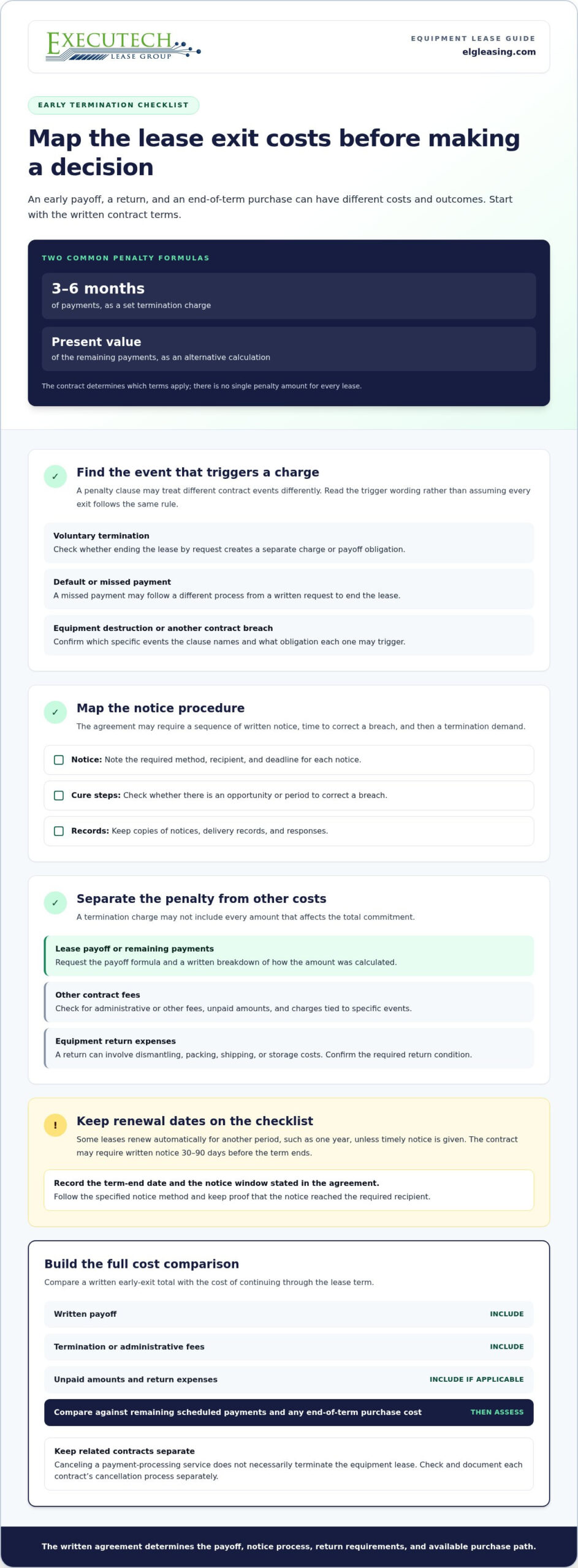
- Find the lease term, early termination clause, notice deadline, and required notice method.
- Identify the payoff formula, purchase option, and any administrative or other contract fees.
- Confirm whether you’ll keep the equipment or return it, and record the return condition requirements.
- Ask for a written payoff breakdown and the date through which its amount remains valid.
- Compare the total payoff with the remaining scheduled payments and any end-of-term purchase cost.
For example, an illustrative U.S. equipment lease managed by Executech Lease Group (ELG Leasing) might feature a discounted remaining payment formula plus a nominal administrative fee. These figures illustrate one contract, not a standard payoff formula.
Calculate the total by adding the written payoff, termination or administrative fees, unpaid amounts, and return expenses. Include dismantling, packing, shipping, or storage if returning the equipment. Compare that sum with the cost of continuing through the lease term, including any purchase option.
To avoid unnecessary costs, give notice using the contract’s required method and by its deadline. Keep delivery records, arrange the return, and document the equipment’s condition. If the payoff calculation is unclear, consult an attorney or accountant before signing or paying. Written terms and a complete itemization make the comparison easier to assess.
2. Early termination penalties
A penalty clause defines which contract events can trigger an extra obligation. It may distinguish voluntary termination from default, equipment destruction, or failure to meet another lease requirement. Read the trigger language closely. A charge tied to one event doesn’t necessarily apply to every way of ending the agreement.
The clause may also specify a sequence: notice of breach, an opportunity to correct it, and then a termination demand. Check whether written notice is required and whether a cure period applies. A missed payment and a written request to end the lease can follow different procedures. Record each notice and response so you can track the next contractual step.
Other charges may fall outside the named termination penalty. Equipment agreements can include application, origination, commitment, filing, document-preparation, or processing fees. Insurance, tax handling, and loss-and-destruction charges may also affect the total commitment. Identify which fees are one-time, recurring, or triggered by a specific event. This helps separate what the penalty clause itself requires.
Keep related contracts separate. Canceling a payment-processing service doesn’t necessarily terminate the equipment lease. If a business closes its processing account, lease payments may still be due under the equipment agreement. Treat each contract’s cancellation procedure as a separate task, and retain written confirmation for both relationships.
Renewal language can create another obligation if you miss a deadline. Some equipment leases renew automatically for another period, such as one year, unless the lessee gives timely notice. The contract may require written notice 30-90 days before the term ends. Add that date to the business calendar and preserve proof that the notice reached the required recipient.
- Find the triggering event: Separate voluntary termination, default, destruction, and nonrenewal.
- Map the procedure: Note required notice, cure steps, and the recipient for each notice.
- Sort the charges: Distinguish the termination penalty from other contract fees.
- Track renewal: Record the end date and the notice window stated in the agreement.
Some lease terms require payments to continue despite equipment problems or the lessor’s performance. This can affect a dispute about whether to stop paying while seeking resolution. Keep communications in writing and follow the contract’s stated process rather than assuming a separate complaint ends your payment obligations.
If your business is planning a new equipment commitment, consider the written terms as carefully as the equipment itself. You can explore equipment leasing options as part of that planning.
3. Negotiating early termination rights and penalties
Negotiate the exit terms before signing, while the lessor can still revise the agreement. A clear clause can define when termination is allowed, how to give notice, and how to calculate the final amount. A low monthly payment doesn’t reveal the full cost of ending a lease early.
Start with the lessor’s termination formula. Scrutinize a payment that gives the lessor a greater all-in, after-tax yield for early termination than for continued performance. Ask for a formula tied to the lessor’s investment, its investment yield, and the present value of the equipment’s expected fair value at the scheduled lease end.
Put each requested change in writing. Define permitted termination events, the notice method, the calculation date, and any credits for equipment returned or sold. Specify whether the agreement charges a fixed amount or uses the present value of remaining payments. A verbal assurance offers little clarity if the signed clause says otherwise.
- Set the trigger: Define which business events allow early termination, such as a sale or closure.
- Cap the calculation: Tie any termination amount to stated components, not an open-ended estimate.
- Credit the asset: Explain how returned equipment or its expected value affects the amount due.
- Document notice: Name the delivery method, address, and effective date in the contract.
For example, if a business asks to terminate after closing a location, the clause should say whether closure qualifies and how the lessor calculates the amount due. A written cap, a clear formula, and a defined return process make the financial obligation easier to assess before signing.
Some state and federal laws may affect early-termination rights; ask an attorney how they apply to your lease.
Some equipment contracts require advance rent as collateral during the lease term. If a draft includes this, negotiate how the amount will be credited or returned when the agreement ends. Clarify whether the lessor can apply it to unpaid obligations, termination charges, or equipment-return costs. The written agreement should explain the treatment rather than leave it open to later interpretation.
Before signing, compare the proposed clause with the lease’s payment schedule and purchase terms. Have counsel review the wording if the termination value appears to reward an early exit more than scheduled performance. A precise formula can help prevent disputes over the amount due, the equipment’s value, and each party’s remaining obligations.
4. Liquidated damages and rent acceleration
Rent acceleration and liquidated damages address different parts of a lease dispute. An acceleration clause changes when amounts become payable after a specified breach. A liquidated-damages clause sets an agreed method for measuring a loss. One clause may require immediate payment, while another determines the amount claimed.
Do equipment leases require payment of all remaining rent after early termination? Not in every situation. Some commercial leases contain acceleration clauses that demand unpaid rent immediately after a breach, but the contract wording and applicable law govern how the provision operates.
Read the acceleration trigger carefully. It may refer to missed payments, insolvency, unauthorized equipment removal, or another stated default. Then check whether the agreement requires notice or gives the lessee time to cure the breach. If a business misses a payment, for example, the next step may be a notice and cure process rather than immediate acceleration.
Liquidated damages set out a contractual consequence in advance instead of leaving the amount entirely open to later dispute. Check whether the clause identifies the events it covers and provides a consistent calculation method. It should clarify whether it applies to a voluntary early exit, default, or equipment loss. The label alone doesn’t explain what the lessee must pay.
Defaulting on equipment payments or termination fees can trigger the contract’s stated remedies. The lessor may demand payment, enforce an acceleration clause, or pursue collection of an amount due. The agreement may also assign responsibility for related costs. Keep payment records, default notices, and responses together to document the timeline and each party’s actions.
For example, a business that receives an acceleration demand should compare the stated trigger with what actually happened. If the lessor cites a missed payment, locate the payment record and any cure notice. If the demand relies on another alleged breach, identify the relevant contract language. A dated written response can clarify the issue without confusing acceleration with a separate damages calculation.
- Identify the trigger: Match the alleged breach to the exact clause.
- Follow the process: Record notice dates, cure steps, and responses.
- Separate the claims: Distinguish immediate payment demands from the damages formula.
If the demand combines accelerated amounts and liquidated damages, ask for an itemized explanation of each contractual basis. Preserve the agreement and related correspondence. Clear records help distinguish what the contract says from what the other party is requesting.
5. Ownership-transfer contracts and termination options
An equipment lease can include a purchase option without transferring ownership automatically. The contract should distinguish an end-of-term purchase from an early purchase and state what each requires. It should also explain whether the lessee must meet other contract obligations before title transfers. Don’t assume that making the final scheduled payment alone completes a purchase.
What does an equipment lease say about buyout, return, and termination options? It sets out whether you may purchase the equipment, must return it, or can end the agreement early, along with the applicable conditions. Treat these as separate choices: an end-of-term purchase clause doesn’t, by itself, establish a right to terminate early.
Some lease-to-own agreements use a $1 buyout; ELG’s FMV leases use a buyout of about 10% of original equipment cost. Those figures apply only when the contract expressly provides them. Other agreements use a different purchase price or formula. Compare the precise clause and timing rather than assuming one buyout amount applies to every option.
Ownership language also matters for public-sector accounting. Under GASB 87, lease contracts fall into three categories: short-term leases, contracts that transfer ownership, and other leases of nonfinancial assets. A contract that transfers ownership of the underlying asset by its end cannot include termination options and still qualify as a contract that transfers ownership under that standard. If a lease transfers ownership but includes termination options, GASB 87 classifies it as a lease.
Use the contract’s exact wording to understand the transaction. Look for the named owner during the term, the condition that transfers title, and any steps required to exercise a purchase option. Check whether the agreement sets an option deadline or requires written notice. Keep purchase terms separate from early-termination terms, since the provisions may create different rights and payment obligations.
- Ownership transfer: Find the clause stating when title passes and what conditions apply.
- Purchase option: Record the price or formula and the deadline to exercise it.
- Termination option: Identify whether the contract permits ending the lease before its scheduled end.
- Return alternative: Read the return instructions separately from purchase terms.
When comparing contract structures, focus on what happens to the equipment at the end and what the agreement permits before then. Match each option to its own clause before signing. This helps prevent confusing an end-of-term ownership choice with a right to exit early.
[Explore equipment lease options](https://www.elgleasing.com/apply-now/)
Executech Lease Group (ELG Leasing): 12-60 Month Credit Card and POS Equipment Leases
Executech Lease Group (ELG Leasing) helps merchants access credit card and POS equipment through lease options. If you’re comparing equipment for your business, consider the lease term and the contract’s end-of-term choices alongside the monthly commitment.
Available options include 12-60 Month Credit Card and POS Equipment Leases, Lease-to-Own Programs, FMV Lease Options, and leases for popular terminals and POS systems, including Clover devices. Each structure treats ownership differently. Before choosing, review the written purchase option, return obligations, renewal terms, and any early-termination clause. Those details help you understand your possible costs if business needs change.
For payment-processing equipment, choose a contract that fits how your business plans to use and eventually dispose of the equipment. Explore ELG’s lease structures and contact Executech Lease Group (ELG Leasing) to discuss your equipment needs.
Plan your next equipment commitment with clarity
Use this decision to strengthen your purchasing process, not just resolve an immediate contract question. Before selecting equipment, map how it will support daily operations, who will use it, and how long it is likely to meet business needs. Then compare that timeline with the contract’s ownership and exit structure. A clear fit between equipment use and lease terms can help your business plan for change without treating early termination as the default solution.
Make equipment lease early termination penalties part of your financial planning before signing. Review the written terms with the people responsible for finance and operations, and resolve unclear language before it becomes a costly decision. A careful review now can make your next equipment commitment easier to manage.
[Explore your equipment leasing options](https://www.elgleasing.com/apply-now/)
Take the next step with a clear view of your equipment needs and contract priorities.
This article reflects the author’s opinion for general information only and isn’t tax, legal, or accounting advice. Consult your CPA or attorney about your specific situation.
Frequently Asked Questions
Can you pay off an equipment lease early?
Often, yes, if the agreement allows an early payoff or the lessor accepts one. Request a written payoff statement and compare it with your remaining obligations before paying. Check whether payment ends the lease, transfers ownership, or still requires you to return the equipment. Keep the payoff confirmation and any document showing the account is closed. These records help prevent confusion if billing or ownership questions arise later.
Example: should you pay out a lease halfway through?
Paying out halfway through can make sense if the equipment is no longer useful or ownership matters to your plans. For example, a business closing one location might compare the payoff with keeping equipment it can redeploy elsewhere. If the equipment remains essential and the payoff includes a substantial charge, continuing scheduled payments may better fit the business need. Include the cash impact and the equipment’s future role in your decision.
What are stipulated loss value and early-termination schedules?
Stipulated loss value is a contract-defined amount used to calculate what the lessee owes after specified events, such as default, damage, or early termination. An early-termination schedule sets out amounts or a calculation method at different points in the lease. Read the definitions and triggering events together. A schedule may apply differently to a voluntary exit than to equipment loss or payment default.
What should an early payoff quote include?
A useful quote identifies the amount due, the calculation date, and the date through which that amount applies. It should separate unpaid installments, termination charges, and other amounts rather than give only a lump sum. Ask for the account balance used in the calculation and whether payment fully ends your obligations. If the contract requires a return, get the delivery instructions and written receipt process.
When should you consider staying in the lease?
Consider staying if the equipment still supports daily operations and the early-exit cost outweighs the practical benefit of ending payments. For example, a restaurant that relies on its POS system may prefer to keep using it while following the existing payment schedule. Staying can also preserve the contract’s stated end-of-term choice. Compare business continuity, remaining cash commitments, and equipment plans before changing course.
How are equipment lease early termination penalties calculated?
The contract may set a fixed charge, use a schedule, or calculate the present value of remaining payments. The method may also account for the equipment’s value or apply separate amounts for unpaid obligations. To understand the result, match each line in the payoff calculation to the relevant contract clause. Don’t assume that multiplying the monthly payment by the remaining term gives the payoff unless the agreement specifies that formula.
What fees can an equipment lessor charge for early termination?
A lessor can seek charges allowed by the agreement, which may include an early-termination amount, administrative fees, or costs related to returning equipment. Dismantling, packing, shipping, and storage can also affect the total if the contract makes the lessee responsible. Separate termination charges from ordinary unpaid amounts. The contract’s fee language and return provisions show which costs apply to the specific exit.
Can equipment lease early termination penalties be negotiated or waived?
The terms can change if the lessor agrees and the change is recorded in a signed amendment or settlement. Before signing, negotiate the trigger, calculation method, and any cap. After signing, make a specific proposal, such as a defined payoff in exchange for returning the equipment in agreed condition. A verbal discussion alone doesn’t change the written contract, so retain the final signed terms.
This article reflects the author’s opinion for general information only and isn’t tax, legal, or accounting advice. Consult your CPA or attorney about your specific situation.

Article by
Robert Ensminger
Robert Ensminger is the founder and CEO of Executech Lease Group (ELG Leasing), which specializes in equipment leasing and financing solutions for the merchant-services, payments, POS, and FinTech industries. With more than 20 years of industry experience, Robert helps ISOs, payment processors, POS providers, and software companies build practical equipment leasing programs. He founded ELG in 2010. His work focuses on responsive service, transparent program structures, subscription and SaaS-monetization programs, and helping ELG’s partners close more business while creating sustainable revenue.