What if renewing your point-of-sale (POS) equipment lease isn’t the right next step? Equipment lease renewal strategies should start with operational fit, not the assumption that the current setup still works. If equipment slows checkout, limits how you manage sales, or no longer suits the business, review the full picture before choosing another cycle.
Lease-end decisions depend on the agreement. Don’t assume an extension, buyout, or return option applies without reviewing the signed terms. Replacing equipment also takes coordination among merchants, agents, vendors, and other partners. A clear plan assigns responsibilities and sets expectations for the transition.
This guide outlines a practical review process: assess equipment performance and business requirements, read the lease-end terms, then compare suitable next-cycle options. It also explains how Executech Lease Group (ELG) equipment leasing structures, including fair market value and lease-to-own options, may fit a future POS equipment cycle.
Key Takeaways
- Start equipment lease renewal strategies by assessing how well your POS equipment supports current workflows and business needs.
- Inventory your equipment and read the signed agreement to identify the terms and choices that apply at lease end.
- Compare continuing under the existing agreement, replacing equipment, and evaluating a new lease structure without assuming automatic renewal.
- Plan the transition by assigning responsibilities for equipment, software, processing, and communications.
- Compare fair market value, lease-to-own, and hardware-subscription structures when evaluating the next equipment cycle.
Why Equipment Lease Renewal Strategy Starts with POS Operations
A lease reaching its end date is a review point, not proof that it will renew automatically. Assess how your POS equipment performs today and what the business needs next. Equipment lease renewal strategies work best when you evaluate operational fit before comparing contract options.
An equipment lease renewal strategy is a structured review of current equipment, business needs, and agreement terms before making a new commitment. The signed lease agreement sets out the arrangement for using the equipment, so rely on its terms rather than assumptions about what happens at the end.
What has changed in the business since the equipment was selected?
Start with how the business operates now. Have you added a location, changed checkout workflows, adjusted staffing, or seen transaction volume shift? These changes can affect the equipment and setup you need. Use staff feedback and internal records to pinpoint friction, such as slow handoffs at checkout or a device that no longer fits the workflow.
Separate practical requirements from preferences for newer technology. A newer device may be appealing, but tie the decision to a specific operational need. If the current setup still supports your workflows, the case for replacement may be different from one where equipment causes recurring obstacles.
Who needs to participate in the renewal decision?
The merchant’s decision-maker should lead the review, define business requirements, and understand the existing agreement. An independent sales organization (ISO), agent, or POS reseller may present equipment options or coordinate a proposal. Clarify each participant’s role so equipment planning and processing arrangements don’t get conflated.
Keep equipment planning distinct from payment processing. Identify who is responsible for the hardware proposal and who manages processing arrangements. An equipment decision alone doesn’t establish what happens with processing.
- Merchant: Defines operational needs and makes the business decision.
- ISO or agent: Coordinates the relevant equipment discussion or proposal.
- POS reseller: Discusses the equipment setup and related product details.
Align these participants on current pain points, responsibilities, and priorities before reviewing the lease terms and comparing next-cycle options.
Audit Current POS Equipment and Lease Terms Before Renewal
A focused audit gives you a reliable basis for comparing the current setup with the next equipment cycle. Start with two records: an accurate inventory of equipment in use and the signed agreement that governs it. For additional background, see The Comprehensive Guide to POS Equipment Leasing in 2026.
Work through this sequence before discussing changes:
- 1. Inventory the equipment. Record each terminal and other POS device, where it’s used, who uses it, and what business function it supports. Note known support or service arrangements.
- 2. Assess condition. Document the equipment’s working condition and recurring issues. Specify which device or location is affected.
- 3. Check workflow fit. Note whether a problem interrupts checkout, adds staff steps, or makes a business process harder to manage. Base the assessment on staff experience and available internal records.
- 4. Review the agreement. Locate the stated lease term and clauses covering end-of-term choices, return, and ownership. Use the signed agreement as your reference.
- 5. List unresolved questions. Separate exact agreement language from assumptions. Flag unclear wording instead of presuming deadlines, notice requirements, renewal rules, or cancellation rights.
Build an accurate equipment and workflow inventory
Connect each device to its actual use. A terminal may serve a different role at each checkout point, and the same hardware issue can affect workflows differently by location. Record those distinctions. Note the POS system and payment-processing arrangements involved, but don’t assume every terminal works with every POS system or processor. Identify friction before deciding whether replacement addresses a business need or simply reflects a preference for newer technology.
Read the agreement for its actual end-of-term terms
Review the contract itself, including provisions describing what happens at the end of the term. A general discussion of navigating the end-of-lease options can provide context, but it doesn’t determine the choices in your agreement. Keep equipment lease obligations separate from payment-processing arrangements. One agreement doesn’t establish the terms of another.
Keep any questions tied to the agreement language and the equipment proposal. POS dealers, agents, and other payment-industry partners can help organize the equipment discussion. POS vendors and agents exploring a business partnership with ELG can find vendor partnership information.
Compare POS Lease-End and Next-Cycle Options Without Assuming Terms
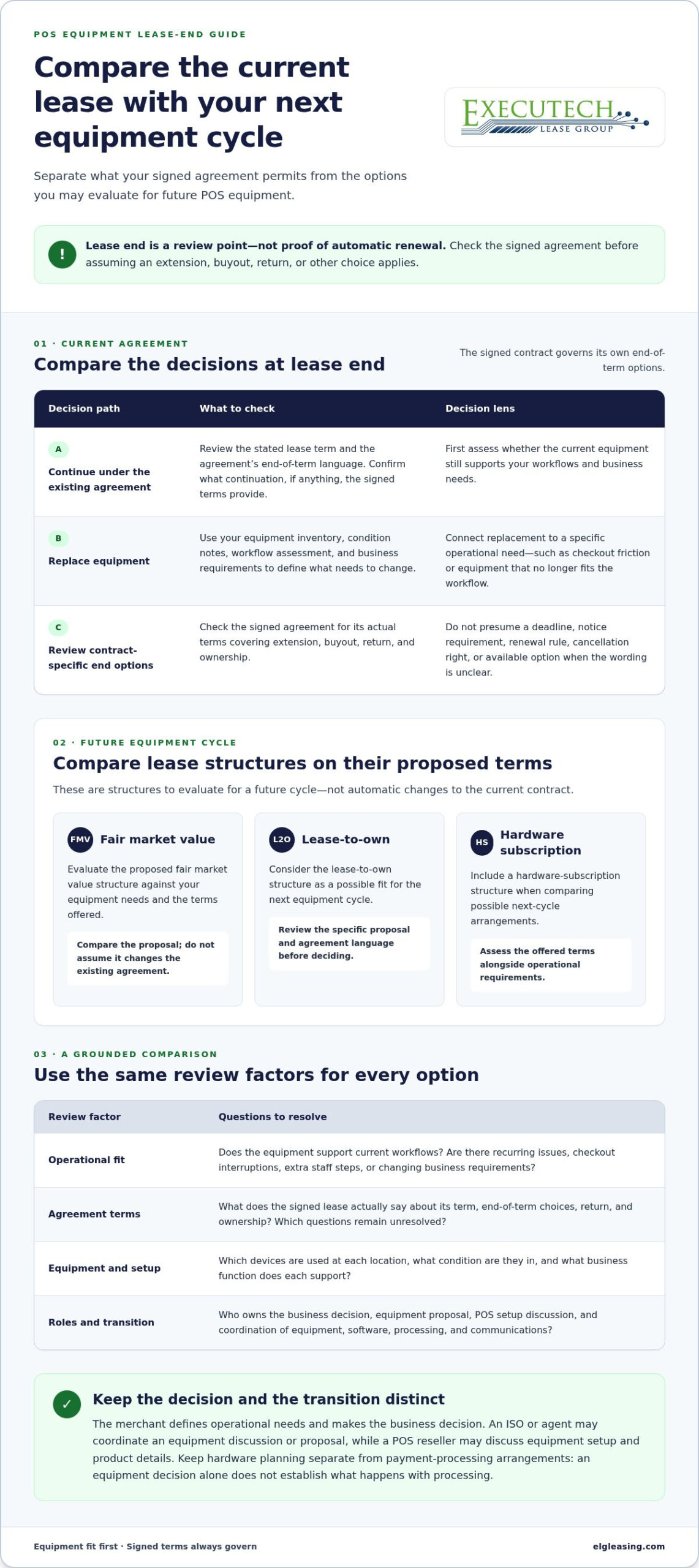
After reviewing the equipment and agreement, separate the choices into two categories: what the current contract allows at the end of its term, and what structures could suit a future equipment cycle. The signed agreement governs its own end-of-term options. A new lease structure is an option to evaluate, not an automatic renewal or a change to the current contract.
| Option | What to review | Key consideration |
|---|---|---|
| Continue under the existing agreement | The agreement’s stated term and applicable end-of-term language | Proceed only according to the terms in that agreement. |
| Replace equipment | Current operational needs and the equipment proposal | Plan the equipment change alongside relevant software and processing arrangements. |
| Evaluate a new lease structure | Term choices, end-of-term option, and obligations | Compare the proposed structure with your business requirements, not an assumed renewal rule. |
Keep contract terms distinct from future options. When comparing POS leasing programs, focus on the terms that matter to your equipment plan. The POS Lease to Own Guide for Merchants and ISOs 2026 also explains the lease-to-own distinction.
How do FMV and lease-to-own structures differ?
ELG offers fair market value (FMV) and lease-to-own equipment lease options with different stated end-of-term buyouts. The FMV option offers terms of 12, 24, 36, 48, or 60 months and ends with about a 10% buyout. The lease-to-own option offers those same term choices and ends with a $1 buyout. The $1 buyout applies only to lease-to-own, not to every lease.
Compare each structure’s term and end option with the equipment you need and the obligations in the proposed agreement. Neither option is an automatic continuation of an existing lease.
When should a hardware subscription enter the comparison?
Include a hardware subscription in the comparison when its terms align with your equipment needs. ELG hardware subscriptions have 12-60 month terms and include a hardware warranty for the subscription term. Compare the stated warranty and term with other options. Don’t assume the subscription includes upgrades or particular cancellation rights.
Use the same criteria across options: operational fit, stated terms, equipment needs, and obligations. This makes trade-offs easier to assess without relying on unsupported savings claims or assumptions about lease-end terms.
Build a Practical Equipment Renewal Decision and Transition Plan
Turn the audit and comparison into a written decision plan. Effective equipment lease renewal strategies make the next steps clear before anyone commits or changes the setup. Align the plan with the existing agreement and the written terms of the selected proposal. Choosing equipment and planning the transition are related but separate tasks: an equipment decision doesn’t assign implementation work or resolve processing arrangements.
Prepare a decision brief for the merchant and vendor
Keep the brief concise and compare each option against the same factors. Include:
- Current setup: Equipment in use, its role, and recurring workflow issues.
- Business requirements: Locations, checkout needs, staff workflows, and functions the next setup must support.
- Existing agreement: The written term and relevant end-of-term language, separated from assumptions.
- Options: Proposed equipment and lease structure, stated terms, end-of-term provisions, and obligations.
- Open questions: Items that need clear answers before the merchant decides.
A consistent format makes trade-offs easier to see. Compare proposals against the same business needs and written terms, rather than relying on a headline feature or informal description. For an overview of equipment structures, review ELG’s leasing programs.
Coordinate the next equipment cycle
Assign an owner to each task before proceeding. The merchant can designate internal leads, while participating agents, vendors, or resellers coordinate the equipment proposal and related communications. Record who will handle equipment decisions, software requirements, processing arrangements, staff updates, and communication with affected parties.
Keep responsibilities clear. The equipment proposal covers the equipment; payment-processing arrangements and processor obligations remain separate. A hardware decision doesn’t establish processing terms or confirm compatibility, funding, delivery, installation, or transition timing.
Close the plan with the selected option, why it fits the business, the written terms reviewed, each person’s assigned tasks, and unresolved questions. Share the record with the merchant and relevant partners so everyone works from the same decision. Vendors and agents interested in working with ELG can submit a vendor-partnership inquiry.
Match the Next POS Equipment Cycle to ELG’s Leasing Programs
Once you’ve identified business requirements and reviewed the current agreement, compare lease structures for a future equipment cycle. ELG is an equipment lease brokerage serving merchants through payment-industry partners, including ISOs, agents, POS dealers, and resellers. Its leasing programs are options to evaluate, not automatic renewals or changes to an existing contract.
Choose the structure that fits the next equipment plan
Match the structure to your priorities, then review its written terms and end-of-term option. The programs differ:
- Fair market value (FMV) lease: Term choices of 12, 24, 36, 48, or 60 months, ending with about a 10% buyout.
- Lease-to-own: Terms from 12 to 60 months, ending with a $1 buyout. This buyout applies only to the lease-to-own option.
- Hardware subscription: Terms from 12 to 60 months, with a hardware warranty for the subscription term.
If an ownership outcome is a priority, compare the lease-to-own program’s written terms with your equipment plan. If you’re evaluating FMV, consider its distinct end option. A hardware subscription may suit your needs when its stated term and warranty align. Don’t assume a subscription includes upgrades or particular cancellation rights, and don’t compare structures using unsupported savings claims.
ELG offers no-money-down equipment leasing. No-money-down describes the down-payment structure, not free equipment; the lease still carries financial obligations. For broader context on POS equipment leasing, read The Comprehensive Guide to POS Equipment Leasing in 2026. Compare each option with your existing agreement and the proposal’s written terms.
Start a focused conversation with ELG
ISOs, independent agents, POS dealers, and resellers considering an equipment-leasing partnership can discuss how a proposal may align with merchant equipment needs. ELG provides credit decisions in 1-2 business hours. That timing refers to the decision only. It doesn’t promise approval, funding timing, equipment delivery, installation, or a particular lease-end or renewal arrangement.
The Apply Now page is for vendor-partnership inquiries, not a merchant financing application. Keep the merchant’s agreement, equipment requirements, and processing arrangements distinct as you plan the next cycle.
Make Your Next POS Equipment Decision With Clarity
Effective equipment lease renewal strategies begin with operational needs, not an assumption that a lease renews automatically. Review equipment performance, read the signed agreement for its end-of-term terms, and compare future options with your business requirements. Assign responsibilities for equipment, software, processing, and communications in the transition plan.
ELG’s FMV and lease-to-own programs have distinct end-of-term buyouts: about 10% for FMV and $1 for lease-to-own. ELG offers no-money-down equipment leasing, which doesn’t mean the equipment is free or remove the lease’s financial obligations. ELG provides credit decisions in 1-2 business hours. That is decision timing only, not a promise of funding or delivery timing.
Independent sales organizations, agents, POS dealers, and resellers considering an equipment-leasing partnership can use the vendor inquiry page to start a focused conversation.
A careful review gives you a clearer basis for planning the next equipment cycle. To discuss a vendor partnership, Discuss becoming an ELG vendor.
Frequently Asked Questions
How early should I start planning an equipment lease renewal?
Start early enough to assess operations, review the signed agreement, compare proposals, and coordinate the next equipment cycle. There isn’t a universal lead time to assume. Use the term and any end-of-term language in your agreement rather than relying on a general notice deadline. Beginning the review before a final decision is needed leaves time to resolve questions and align the merchant and equipment partners.
Can I renew a POS equipment lease instead of replacing the equipment?
You may be able to continue under the existing lease if its written terms provide for that path. A lease end date doesn’t itself mean automatic renewal. Read the signed agreement for applicable end-of-term choices, including any stated continuation, return, or ownership language. If the equipment no longer fits your operations, compare replacement proposals separately and keep any new structure’s terms distinct from the current contract.
What should I compare when evaluating equipment lease renewal strategies?
Compare operational fit and equipment condition alongside the written terms. Review the current agreement’s end-of-term language, then compare each proposal’s term, applicable end option, equipment scope, and obligations. Consider whether the setup supports your workflows and what coordination software or processing arrangements may involve. Use the same factors for every option, and don’t assume a choice saves money without support from the proposal.
How do FMV and lease-to-own equipment leases differ at the end of the term?
ELG’s fair market value (FMV) equipment lease offers terms of 12, 24, 36, 48, or 60 months and ends with about a 10% buyout. ELG’s lease-to-own equipment lease offers terms from 12 to 60 months and ends with a $1 buyout. These are distinct program terms. The $1 buyout applies only to lease-to-own, not to every equipment lease.
Does no-money-down equipment leasing mean the equipment is free?
No. ELG offers no-money-down equipment leasing, but no-money-down doesn’t mean the equipment is free or remove the lease’s financial obligations. It describes the down-payment structure. Review the specific written proposal and agreement to understand the applicable terms. Keep equipment lease obligations separate from payment-processing arrangements. ELG does not process payments, and an equipment lease doesn’t establish the terms of a separate processing arrangement.
How fast does ELG make an equipment lease credit decision?
This refers to the credit decision only, not approval, funding, equipment delivery, or installation timing. A credit decision also doesn’t determine a lease renewal outcome. Treat the decision and equipment transition as separate steps, using the written proposal and assigned partner responsibilities to guide transition planning.

Article by
Robert Ensminger
Robert Ensminger is the founder and CEO of Executech Lease Group (ELG Leasing), which specializes in equipment leasing and financing solutions for the merchant-services, payments, POS, and FinTech industries. With more than 20 years of industry experience, Robert helps independent sales organizations, payment processors, POS providers, and software companies develop practical leasing, subscription, and SaaS-monetization programs. He founded ELG in 2010 and guided the company to recognition on the Inc. 5000. His work focuses on responsive service, transparent program structures, and helping ELG’s partners close more business while creating sustainable revenue.