A lower payment does not always mean a lower total cost. When weighing equipment lease renewal vs buying out, compare renewal payments over the period you expect to use the equipment with the buyout amount and ownership costs. Buying gives you ownership, but also leaves you with the risk that the equipment loses value or becomes outdated.
It is easy to focus on the next payment or the buyout figure alone. A useful comparison covers the same period for each option and accounts for what you will pay, what you will own, and whether the equipment will still meet your needs.
Compare the full costs of renewal and buying out, including renewal charges, buyout terms, ownership expenses, and possible resale value. Tax treatment depends on the agreement’s structure, so do not assume that renewal or a buyout produces a particular tax result. Use the comparison to decide based on the full cost, not just the option that appears cheaper today.
Key Takeaways
- Compare renewal payments and buyout costs over the same time horizon to see which option fits your equipment plans.
- Read the end-of-term terms closely: renewal, return, and purchase options can lead to different costs and ownership outcomes.
- Buying gives you ownership, but also leaves you responsible for the equipment’s eventual resale value and obsolescence risk.
- Tax treatment depends on the lease structure; understand the distinction between operating expenses and ownership deductions with your CPA.
- Use your expected equipment lifespan and ongoing business needs to guide the final decision, not just the next payment.
Comparing lease and purchase costs over the same period
Renewal generally extends equipment use under new terms while the lessor retains ownership. The equipment lease renewal vs buying out decision comes down to total cost, payment timing, and whether you want to own the equipment.
Lease Renewal Costs
Renewal lets you keep using the existing equipment in exchange for rent under an extended agreement. Add those payments to any interim rent and other charges specified in the contract. Renewal spreads costs over the extension but does not transfer ownership. Compare the full extension cost with buying the equipment and using it for the same period, including when payments are due.
Purchase and Buyout Costs
A buyout transfers ownership under the lease’s purchase option. A new cash purchase, by contrast, starts with the equipment’s purchase price. Include the buyout amount, any remaining lease payments, and future ownership costs. The buyout figure alone does not show whether purchasing would cost less; compare costs over the same period of use.
Cash Flow and Upfront Financing
Leasing spreads payments across the contract term, which may require less cash upfront than paying the full purchase price at once. A buyout requires payment of its stated amount, while purchase financing replaces a larger initial outlay with scheduled installments. Compare timing as well as totals: payment schedules affect the cash available for other business needs.
Use the same equipment-use period for every option. For an equipment lease renewal vs buying out comparison, add renewal rent, the buyout amount, and remaining payments where applicable. Then account for expected ownership costs and the equipment’s useful life. Ownership may bring resale proceeds, but equipment can lose value or become outdated. Maintenance is a separate ownership cost.
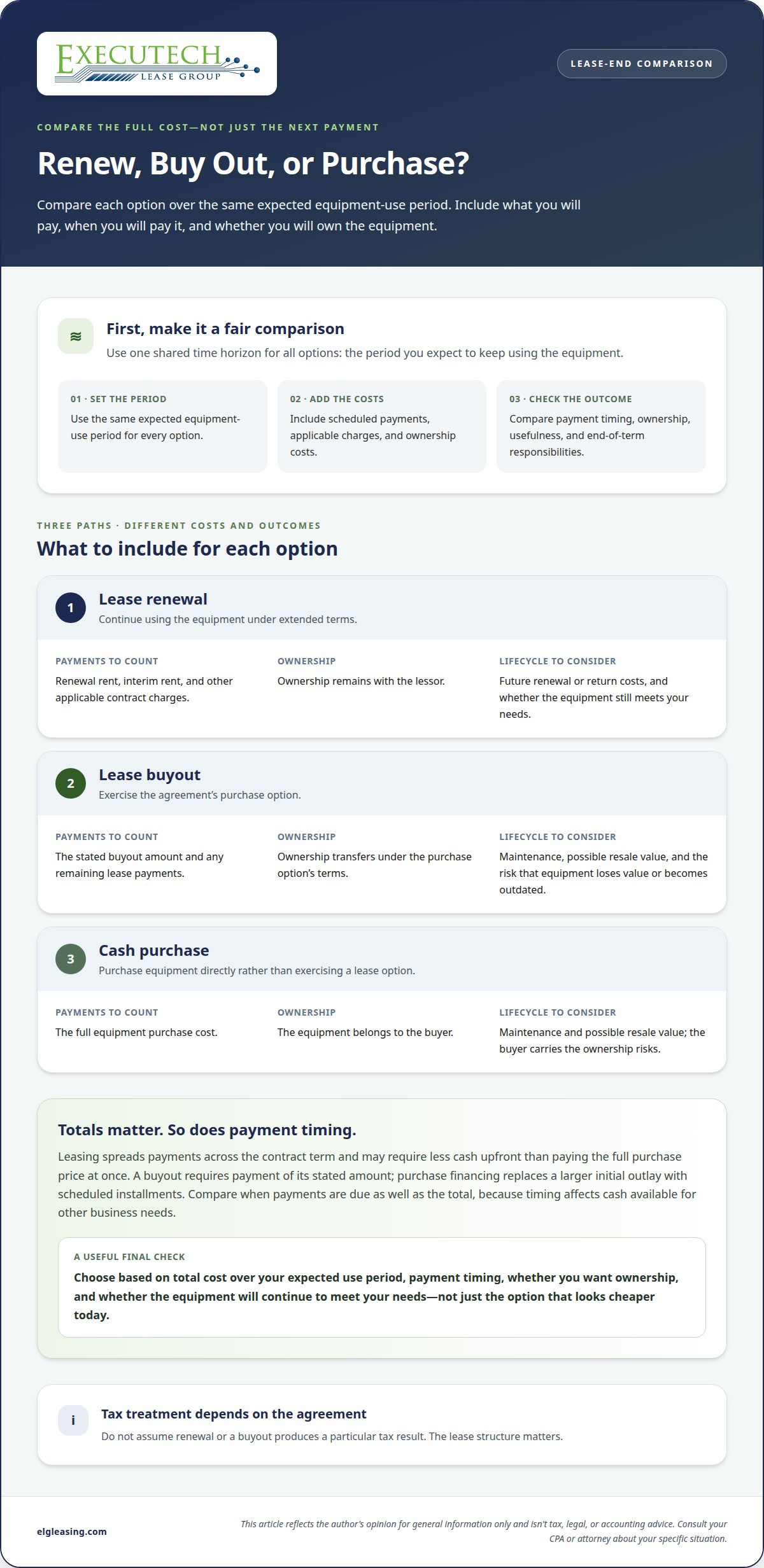
To compare renewal and buyout terms, itemize scheduled payments, interim rent, renewal charges, and the purchase amount. Compare each option over the period you expect to use the equipment. Then consider total cost, payment timing, and end-of-term responsibilities. This shows both how much you will pay and when payments are due.
| Option | Payments to include | Ownership | Lifecycle consideration |
|---|---|---|---|
| Lease renewal | Renewal rent, interim rent, and other applicable contract charges | Remains with lessor | Future renewal or return costs |
| Lease buyout | Buyout amount and remaining payments | Transfers under purchase option | Maintenance and resale value |
| Cash purchase | Full equipment purchase cost | Belongs to buyer | Maintenance and resale value |
Choose the option with the lower total cost over your expected use period, while considering payment timing and whether you want to own the equipment.
Finance leases and end-of-term purchase options
A lease-end decision depends on the contract’s options and the equipment’s usefulness. Renewal extends use, a buyout transfers ownership under the purchase option, and return ends your use of the leased equipment.
An equipment lease buyout means exercising the agreement’s purchase option and paying the stated buyout amount. Once completed under the contract, ownership transfers according to its terms.
How the lease structure affects your choices
A finance lease may place more ownership-like risk on the lessee than an operating-style arrangement. It can function much like an asset purchase financed through debt, so a buyout may suit a business that expects to keep using the equipment. The label alone does not determine what to do. Review the contract’s end-of-term terms.
Some agreements offer a choice among renewal, purchase, or return. Under a fair market value option, the purchase amount is based on the equipment’s value at the end of the lease rather than a fixed amount set when you sign. The examples show why the purchase option matters as much as the payment schedule.
Renew, return, or buy
- Renew: Continue using the same equipment under renewal terms. This can suit a business whose system still meets its operating needs.
- Return: Give the equipment back under the agreement’s return terms. This can make sense when the equipment no longer fits the business or obsolescence makes continued use unattractive.
- Buy: Pay the option amount and take ownership. This can suit a business that wants to retain a working system beyond the lease term.
For example, a business with a reliable payment terminal may prefer renewal if keeping it avoids a disruptive change. If the terminal no longer meets the business’s needs, returning it or arranging replacement equipment may be a better operational fit. Buying can preserve continuity, but the business then owns equipment as it ages.
Before choosing, match each option to the next period of use. Compare renewal payments with the buyout amount and the value of continued use. If returning the equipment, account for the contract’s return requirements and the cost of replacement equipment. This puts obsolescence, continued usefulness, and ownership in the same decision.
If the lease ends and a replacement POS or card terminal is the practical next step, you can start an equipment lease application for a new agreement. Available lease terms span 12 to 60 months, giving businesses different timelines to consider for their next equipment cycle.
Equipment purchase advantages and drawbacks
Buying equipment gives your business ownership and control after the purchase. That can suit a business expecting to use durable equipment for more than five years, especially when it holds its value. Ownership also means the business carries future maintenance costs, obsolescence, and resale risk. Compare those costs with the lease payments you avoid before deciding.
Purchase financing spreads the equipment cost across scheduled payments instead of requiring the full amount upfront. The agreement may include interest, affecting total financing cost and cash flow. A Conditional Sale Contract can make the buyer the owner while the finance company holds a security interest. Compare the financed total, including interest, with leasing over the same period of use.
Tax treatment can affect the comparison, but the contract structure matters. Lease payments under a qualifying FMV lease may be deductible as an operating expense, depending on the lease structure. A lease treated as a purchase for federal tax purposes may instead involve ownership-based deductions. Ask your CPA how the specific agreement applies to your business.
For a purchase, the Internal Revenue Service explains that Section 179 of the Internal Revenue Code allows businesses to deduct the full cost of certain newly acquired assets in the first year. Eligibility and the deduction available depend on current rules and the business’s circumstances. The Internal Revenue Service sets the Section 179 deduction limit at $2,560,000 for the 2026 tax year, with phase-out starting at $4,090,000 of qualifying property placed in service.
The Internal Revenue Service also states that U.S. qualifying assets acquired after January 19, 2025, are eligible for 100% bonus depreciation under the One Big Beautiful Bill Act. These provisions don’t make buying automatically cheaper. A deduction affects taxable income; it doesn’t erase the equipment’s purchase or financing cost. Your CPA can assess how the applicable treatment changes the after-tax comparison.
- Buying can fit: Your business expects long-term use, values ownership, and can manage maintenance and resale.
- Leasing can fit: Your business prioritizes spreading equipment costs and wants to assess renewal or return options at term-end.
- Financing can fit: Your business wants ownership while paying over time, and the agreement’s full cost fits its cash-flow plan.
Compare the same equipment-use period, total payments, ownership costs, and tax treatment. A rental-style lease and a financed purchase may affect expenses differently, so ask your CPA to evaluate the agreement before relying on a deduction.
Who carries resale and obsolescence risk
Buying out leased equipment transfers ownership under the purchase option, along with future exposure to resale risk. You also take responsibility for arranging maintenance. The contract’s structure determines how much risk you already carry during the lease.
Equipment Obsolescence
Obsolescence occurs when equipment becomes less useful as business needs or technology change. A payment terminal may still work but become less suitable if its capabilities no longer match how the business operates. A lease’s end-of-term options provide a decision point. With a buyout, you keep the equipment and bear the risk that its practical or resale value declines.
Resale Value and Return Risks
With ownership, resale value belongs to your business: a later sale may recover some of the cost, or bring in less than expected. Returning leased equipment avoids selling it yourself, but the contract still governs the return. Condition, damage, and return requirements can affect the outcome. Before choosing, identify your return obligations and compare them with the work and uncertainty of reselling older equipment.
Ownership and Maintenance After Buyout
After a completed buyout, your business owns the equipment under the purchase option and decides whether to keep, use, or resell it. That control comes with responsibility: plan for maintenance costs and the possibility of lower resale value. A lease may not remove every ownership-like risk, particularly under a finance lease, which can place substantial ownership risk on the lessee.
Use the equipment’s remaining usefulness to identify which risk matters most. If a payment terminal still supports daily transactions and fits current workflows, keeping it may preserve operational continuity. If changing needs make it outdated, a buyout can leave your business with equipment that has limited resale appeal. Returning it avoids managing resale, while renewal continues use under new terms.
Separate the decision into three practical checks:
- Use: Identify whether the equipment still meets the business’s operating needs.
- Value: Estimate what continued use or resale could contribute, rather than treating book value as cash proceeds.
- Responsibility: Compare ownership and maintenance duties after buyout with the return requirements in the lease.
Tax treatment, including any Section 179 consideration, doesn’t determine resale value or remove obsolescence risk. Keep those questions separate: assess the agreement and tax treatment with a CPA, then weigh the equipment’s remaining utility, maintenance needs, and likely resale appeal. This keeps a possible deduction from obscuring the practical cost of owning a machine that may no longer serve the business well.
Tax deductibility of equipment lease payments
Tax treatment can affect the after-tax comparison between renewing a lease and buying equipment. First identify how the agreement is treated for tax purposes. Then compare potential deductions with total payments, ownership costs, and the equipment’s expected use.
Lease payments and operating expense treatment
FMV lease payments may be deductible as an operating expense, depending on the lease structure. The word “lease” alone does not establish the tax result. A tax adviser will consider the agreement’s terms and how the transaction is classified. Do not assume every payment, renewal charge, or buyout amount receives the same treatment.
For renewal, separate payments for continued equipment use from any purchase option. For a buyout, distinguish the amount paid to acquire ownership from earlier lease payments. A lease treated as a purchase for federal tax purposes may instead qualify for ownership-based deductions, such as depreciation. The classification guides the analysis.
Buying, depreciation, and interest
When a business buys equipment, tax treatment may involve depreciation rather than treating the full purchase as a rental expense. Financing may also add interest, which can receive different treatment from the equipment cost. A financed payment is not necessarily one uniform deduction. Separate principal, interest, and asset-related deductions in the tax analysis.
For example, a business comparing a terminal lease renewal with a financed purchase should model each option separately. The renewal analysis uses the tax treatment of lease payments. The purchase analysis considers ownership, depreciation, and financing interest where applicable. A deduction reduces taxable income; it does not make the equipment or financing free.
Keep tax and accounting views distinct
Tax classification and financial statement accounting answer different questions. Under FASB’s ASC 842, lessees generally record lease assets and liabilities for finance and operating leases, with an exception for lease terms of 12 months or less. That accounting treatment doesn’t, by itself, determine whether payments are deductible for federal tax purposes.
- Identify: Determine whether the agreement is treated as a lease or purchase for tax purposes.
- Separate: Break out lease payments, buyout amounts, equipment cost, and financing interest.
- Compare: Evaluate the tax effect alongside total cash paid and equipment use.
Ask your CPA to assess the specific agreement and your business’s tax position. This helps ensure that a possible deduction does not obscure the full cost of renewing or acquiring the equipment.
This article reflects the author’s opinion for general information only and isn’t tax, legal, or accounting advice. Consult your CPA or attorney about your specific situation.
Executech Lease Group (ELG Leasing): 12-60 Month Credit Card and POS Equipment Leases
Executech Lease Group (ELG) helps merchants access credit card and POS equipment through lease options, including Clover devices. If you are weighing continued use against ownership, compare the equipment’s expected lifespan, the contract’s end-of-term options, and how you want payments structured.
Lease-to-Own Programs may suit businesses aiming to own equipment under the agreement. FMV Lease Options provide a different end-of-term structure for businesses considering renewal, return, or a purchase option. The right fit depends on your equipment plans and the terms you’re evaluating.
Explore ELG’s leasing programs to compare equipment lease structures and discuss your business needs.
Make Your Next Equipment Decision With Confidence
Use the equipment lease renewal vs buying out decision to set a clear priority for your next equipment cycle: flexibility, ownership, or continuity. Then align the contract choice with how long the equipment will serve your operations and how much control you want over its future.
Before committing, bring your expected use period and preferred end-of-term outcome into the discussion. A focused review connects the equipment decision to your operational plans instead of treating the next payment as the only factor. If your requirements change, revisit the comparison based on your updated needs and the equipment’s lifecycle.
Executech Lease Group (ELG Leasing) offers 12-60 Month Credit Card and POS Equipment Leases, Lease-to-Own Programs, and FMV Lease Options. Contact the team to discuss your equipment requirements and explore an option aligned with your plans.
Compare ELG’s lease structures and choose the next step for the equipment your business depends on.
This article reflects the author’s opinion for general information only and isn’t tax, legal, or accounting advice. Consult your CPA or attorney about your specific situation.
Frequently Asked Questions
Does leasing cost more than buying over the long run?
Not necessarily. The lower-cost choice depends on the period of use, contract terms, and ownership costs. A business using a payment terminal briefly may value scheduled lease payments, while one keeping durable equipment longer may prefer ownership. Compare total payments, financing interest, maintenance, and possible resale proceeds over the same period. Tax treatment can also affect the after-tax result, so discuss it separately with your CPA.
What Are the Benefits of Buying Equipment?
Buying gives your business control over how long to keep equipment and whether to sell it later. For example, a business with a stable POS setup may prefer keeping a system that continues to meet its operating needs rather than negotiating another term. Ownership may also make sense when the equipment retains practical value. Weigh that control against maintenance responsibilities, technology changes, and the cash committed to the purchase.
What Are the Downsides of Leasing Equipment?
Leasing may let your business use equipment without gaining ownership, depending on the agreement’s end-of-term option. The contract may also set obligations for renewal, return, or purchase. For example, a business whose needs change may find its equipment no longer fits, even while payments continue under the agreement. Review the end-of-term provisions and total scheduled payments before deciding whether leasing suits your plans.
How to Set Up an Effective Equipment Lease vs Buy Analysis?
Choose a realistic period of equipment use, then compare each option over that same period. For leasing, include scheduled payments, renewal costs, and any purchase amount. For buying, include the purchase or financing cost, interest, maintenance, and likely resale proceeds. Consider payment timing separately from total cost. If tax treatment affects the comparison, ask your CPA to assess the agreement and your business circumstances.
Should You Rent, Lease or Buy?
Choose based on how long you need the equipment and whether ownership matters. Renting may suit a temporary need, leasing can spread use across a contract term, and buying may suit equipment you expect to retain. A short-term event setup differs from a payment system used continuously in a business. Include operational needs, replacement equipment, maintenance, and end-of-term obligations in your decision.
What Questions Should You Ask Before You Decide?
Ask what the agreement requires at the end, how renewal payments are determined, and which purchase option applies. Clarify return conditions, responsibility for damage, and whether interim rent or other charges affect the total. Then consider how long the equipment will remain useful and who bears resale risk. For a tax comparison, ask your CPA how the contract is treated before relying on a deduction.
How is an equipment lease buyout price calculated?
The buyout amount is set by the lease’s purchase option. A fair market value option bases the purchase price on the equipment’s value at the end of the term, while a fixed-price option states the amount in the contract. The same terminal could have different purchase terms under different agreements. Use the written option terms, not an assumed resale value, to estimate the buyout cost.
What are typical equipment lease renewal rates and terms?
There is no universal renewal rate or term for equipment leases. Renewal rent and duration depend on the agreement and the renewal offer. Compare the proposed payments and extension period with the cost of buying or replacing the equipment. For example, an older POS system may not warrant an extension if it no longer supports current operations. The contract governs the available options and obligations.
This article reflects the author’s opinion for general information only and isn’t tax, legal, or accounting advice. Consult your CPA or attorney about your specific situation.

Article by
Robert Ensminger
Robert Ensminger is the founder and CEO of Executech Lease Group (ELG Leasing), which specializes in equipment leasing and financing solutions for the merchant-services, payments, POS, and FinTech industries. With more than 20 years of industry experience, Robert helps ISOs, payment processors, POS providers, and software companies build practical equipment leasing programs. He founded ELG in 2010. His work focuses on responsive service, transparent program structures, subscription and SaaS-monetization programs, and helping ELG’s partners close more business while creating sustainable revenue.