A POS equipment proposal can answer how much the lease payment is and still leave an important question unresolved: who handles each part of the equipment’s working life? The equipment lease, payment-processing agreement, software subscription and service arrangement need to be understood separately.
Before committing to a POS or card terminal lease, build a short record of the costs, responsibilities and contacts behind the proposal. That record gives the merchant and its independent sales organization (ISO) or agent something concrete to review together. It also keeps a question about repairs from being mistaken for a question about financing.
This guide focuses on that practical handoff: what to record, which provider to ask and how to keep the written arrangements accessible after installation.
Start with the equipment and provider map
List the equipment covered by the proposal using its actual description and model information. Include the quantity and any accessories identified in the documents. Ask the equipment provider to resolve missing or conflicting descriptions before treating two documents as a match.
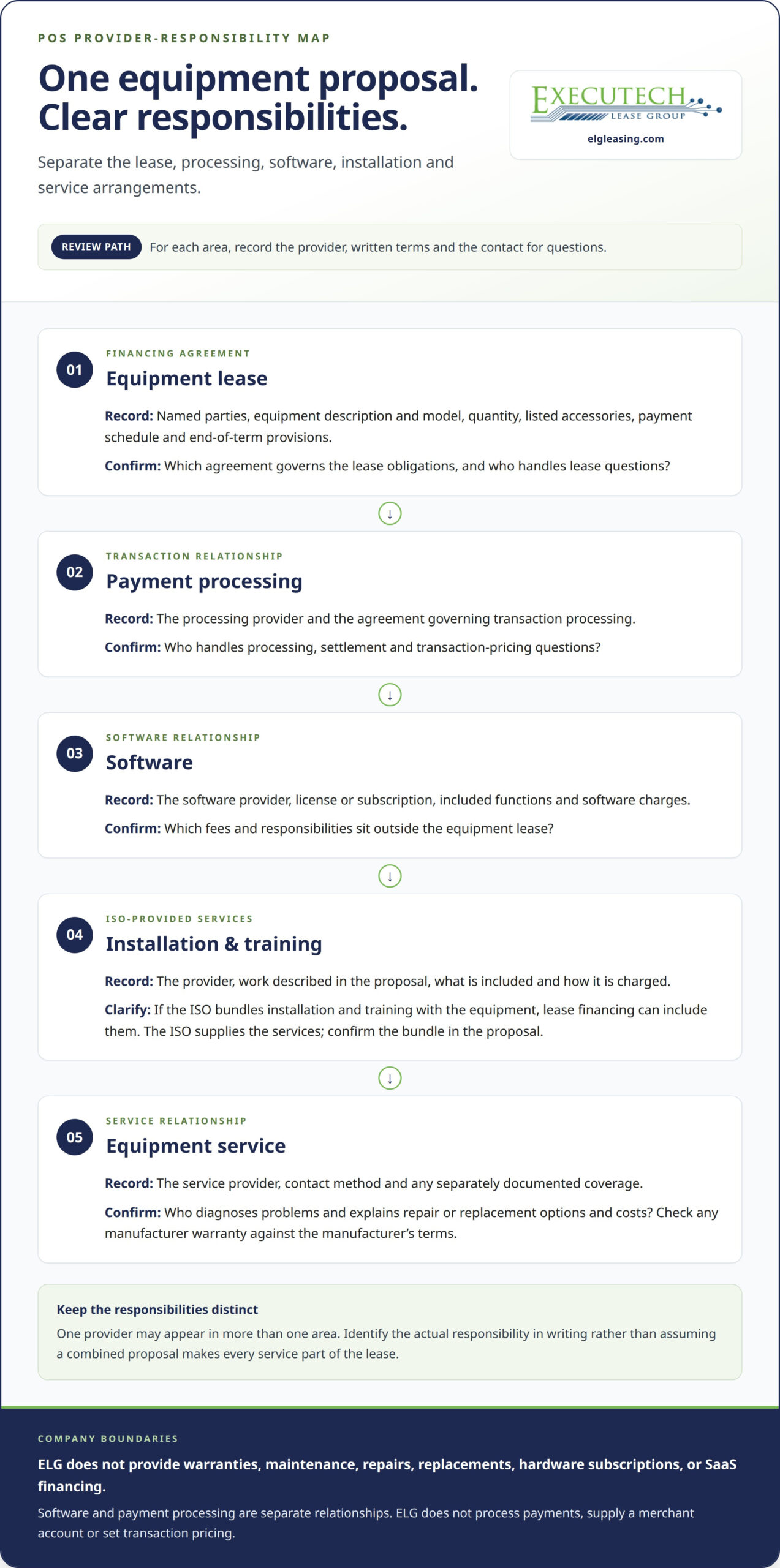
Next, identify the parties responsible for the different arrangements. Executech Lease Group (ELG) is an equipment lease brokerage serving the merchant-services and payments-technology ecosystem. ELG does not process payments, supply a merchant account or set transaction pricing. Its equipment leasing does not establish software licensing, device compatibility or support coverage.
| Arrangement | What to identify in writing | Question to resolve |
|---|---|---|
| Equipment lease | The named parties, equipment description, payment schedule and end-of-term provisions. | Who handles questions about the lease and its obligations? |
| Payment processing | The provider and agreement governing transaction processing. | Who handles processing, settlement and transaction-pricing questions? |
| Software | The provider, license or subscription and included functions. | Which software charges and responsibilities sit outside the equipment lease? |
| Installation and training | The provider and the work described in the proposal. | What is included, who performs it and how is it charged? |
| Equipment service | The service contact and any separately documented coverage. | Who diagnoses problems and explains repair or replacement options and costs? |
One provider can appear in more than one row. The point is to identify the actual responsibility instead of assuming that a single contact or a combined sales presentation makes every service part of the lease.
Reconcile the costs with the written proposal
Use the amounts and dates in the proposed agreements. Avoid filling gaps with an advertised starting payment, an assumed fee or a number from a different transaction. When the proposal and the agreement differ, ask for a written explanation of the difference.
- At the start: Record any amount stated as due and when it is due. ELG offers no-money-down equipment leasing; that description does not mean free equipment, no recurring payments or no other financial obligation.
- During the term: Record the lease payment amount, frequency, number of payments and due dates from the documents. Keep processing, software and separately billed services in their own categories.
- Other stated charges: Identify any taxes, fees or other charges actually described in the documents, the party charging them and how they are determined. Leave an unresolved item as a question instead of treating it as zero.
- At the end: Record the purchase or return provisions for the proposed lease and any amounts or instructions stated for that choice.
A useful review sheet has a source beside each entry: the document name, relevant section and provider contact. This makes a later question easier to resolve without relying on a recollection of the sales conversation.
If an ISO bundles its installation and training with the equipment, ELG lease financing can include those services. The ISO supplies them. Confirm the actual bundle in the proposal rather than treating installation or training as an ELG service or assuming it is included in every transaction.
Separate the end-of-term choice from recurring payments
ELG describes two equipment structures: fair market value (FMV) leases and lease-to-own leases. ELG’s FMV end-of-lease buyout is about 10% of original equipment cost. Its lease-to-own option has a $1 end-of-lease buyout. Those descriptions are not monthly payments or total equipment prices, and the two endings should not be mixed together.
Identify which structure the written proposal uses. Review the actual purchase or return provisions, the contact for end-of-term questions and any stated steps or deadlines. Do not assume that keeping, returning or replacing equipment follows an unwritten process.
ELG’s published equipment term choices are 12, 24, 36, 48 and 60 months. That list is not a promise that every term is available for every transaction. Use the term in the specific proposal when planning the commitment.
Plan the service handoff before equipment is needed
For a merchant, a service plan begins with an answer to a simple question: if this terminal is not working, whom does the team contact first? Record the actual provider, contact method and any documented service scope. A financing contact and a technical-support contact are not automatically the same.
ELG does not provide equipment warranties, maintenance, repairs, replacements, protection plans, hot swaps or equipment support. Any manufacturer warranty must be checked separately against that manufacturer’s terms. Do not treat the lease term as a warranty period or assume that a repair, replacement or service visit is included.
Ask the relevant provider to explain the troubleshooting process, who can authorize work and how the merchant will learn about any charge before agreeing to it. Record only the response supported by the applicable service documents. Do not turn a provider’s informal estimate into a promised response time.
Also ask the equipment, software and processing providers to confirm the proposed configuration. Financing equipment does not establish that a device works with a particular software version, processing arrangement or intended function.
For operational planning, identify how the merchant will handle a service interruption using the options its providers have actually confirmed. Do not assume that downtime suspends lease payments or creates a right to replacement equipment; direct those questions to the written agreement and the appropriate provider.
Keep insurance and business changes on the question list
Read the lease for any insurance obligations it assigns. If a requirement is stated, ask the insurer to explain how the actual policy addresses it and what documentation is needed. The existence of a business policy is not a substitute for that review.
Discuss foreseeable changes before signing: a location closing, the business relocating or equipment no longer being needed. Ask which provisions address those situations and who must be contacted. Do not infer a cancellation right, transfer permission or change to payments from a business plan.
These questions belong alongside the cost review because they concern obligations that remain easy to overlook when attention is focused only on the recurring payment. Ask an attorney to review unresolved legal questions about the proposed agreement. Give the actual documents to a CPA for tax and accounting questions; this guide assigns no deduction or accounting treatment to either lease structure.
Create a handoff record the business can use
Before installation, assemble one accessible record containing the equipment description, agreements, cost review sheet, provider contacts and unresolved questions. Keep the lease, processing, software and service documents identifiable within that record.
At handoff, confirm that the people operating the equipment know where to find the service contact and who handles administrative questions. Record the equipment received and the installation or training actually provided. An item marked complete should describe what occurred, not simply repeat what was proposed.
For an ISO or agent, this is a useful way to explain a proposal without promising services outside its scope. Walk through the provider map with the merchant, resolve conflicting descriptions and make the next contact clear. The result is a documented understanding of the equipment arrangement that the business can refer to after the initial conversation.
Frequently Asked Questions
Does a POS equipment lease include payment processing and software?
Review the specific agreements and their providers separately. ELG does not process payments or supply a merchant account. ELG also does not currently offer hardware subscription programs or SaaS financing. The equipment lease alone does not establish software licensing or processing terms.
Does ELG provide a warranty or repair service?
No. ELG does not provide equipment warranties, maintenance, repairs or replacements. Check any manufacturer warranty separately and identify the actual equipment-service provider and its documented scope.
What should an ISO explain when installation and training are bundled?
Identify the work and the provider in the proposal. ELG lease financing can include an ISO’s installation and training when the ISO bundles them with the equipment; the ISO supplies those services. Confirm what the particular transaction includes.
What belongs in a written cost review?
The actual lease schedule, any other stated charges, the end-of-term provisions and separately documented processing, software or service costs. Give each entry a document reference and a provider contact. Resolve missing figures rather than substituting an estimate presented as a fact.
Discuss your equipment partner process
ISOs and agents bringing POS and card terminal equipment to merchants can discuss an ELG vendor relationship with a clear description of their equipment business and the services they provide. Discuss becoming an ELG vendor.
This article reflects the author’s opinion for general information only and isn’t tax, legal, or accounting advice. Consult your CPA or attorney about your specific situation.

Article by
Robert Ensminger
Robert Ensminger is the founder and CEO of Executech Lease Group (ELG Leasing), which specializes in equipment leasing and financing solutions for the merchant-services, payments, POS, and FinTech industries. Robert helps ISOs, payment processors, POS providers, and software companies build practical equipment leasing programs. He founded ELG in 2010. His work focuses on responsive service, transparent program structures, SaaS-monetization programs, and helping ELG’s partners close more business while creating sustainable revenue.