
A lower monthly payment doesn’t automatically make an equipment deal the lower-cost choice. For merchant services ISOs, equipment leasing programs can provide access to payment hardware without an outright purchase, while the contract structure shapes ownership and end-of-term options. An operating lease generally centers on using the equipment; a capital lease is structured more like financing a purchase.
That distinction matters, but it’s only part of the decision. You also need to understand how equipment finance agreements and $1 purchase agreements work, then compare total costs across the equipment’s useful life.
This guide explains operating and capital leases in practical terms, outlines the commitments an equipment finance agreement can create, and weighs leasing against financing as payment technology ages. You’ll see which factors affect the overall cost, when preserving cash flow may matter more than eventual ownership, and how the right structure depends on how long you plan to use the equipment and what you want to own at the end.
Key Takeaways
- Understand how operating leases, capital leases, and equipment finance agreements differ in ownership and end-of-term obligations.
- Compare leasing with financing by looking beyond periodic payments to total cost and the equipment’s useful life.
- Learn how equipment age and replacement timing can shape the right acquisition approach for your business.
- See how commissions, residuals, and revenue shares may fit into an ISO’s equipment leasing model.
- Explore lease options for payment terminals and POS systems, including lease-to-own and fair market value structures.
Equipment finance agreements and $1 purchase agreements
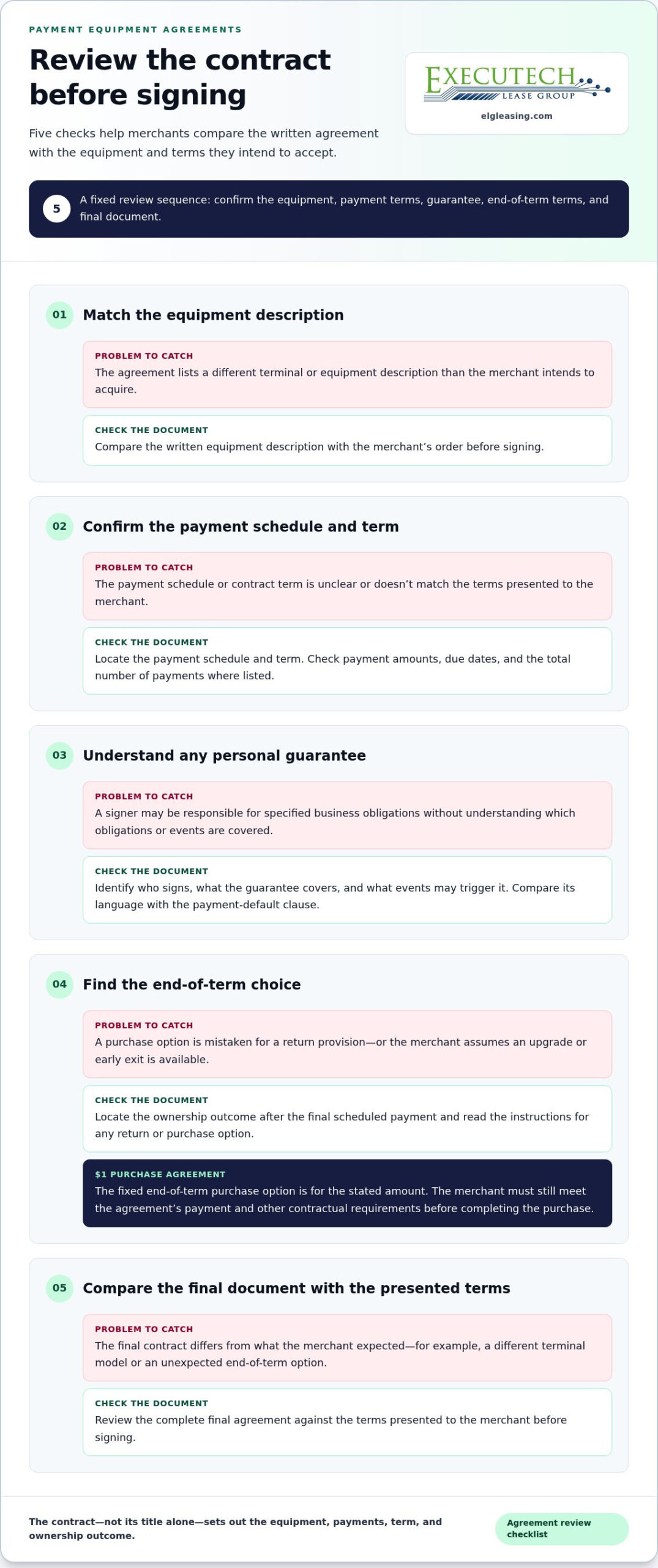
An equipment finance agreement (EFA) sets out how a merchant acquires payment equipment through scheduled payments. The contract should identify the equipment, payment schedule, term, and ownership outcome. For a card terminal, compare the equipment description with what the merchant intends to acquire, then confirm what happens after the final scheduled payment. The contract title alone doesn’t describe every obligation.
A $1 purchase agreement includes a fixed end-of-term purchase option for the stated amount. The merchant must still meet the agreement’s payment and other contractual requirements before completing the purchase. Check whether the $1 option is available at the end of the term, how the merchant exercises it, and whether any other obligations remain. Those details distinguish the option from a return provision.
How do lease terms and consumer protection rules vary by state or for small-business merchants? There isn’t one description that covers every state and merchant situation. Review the agreement’s governing-law and merchant-status clauses, then read its payment, guarantee, default, and dispute provisions rather than assuming consumer-focused terms apply to a business transaction.
Who owns leased payment equipment, and what are the return, upgrade, and buyout rules? The agreement identifies the equipment owner during the term and sets out the available end-of-term choices. It may provide for return or a purchase option, such as the stated $1 option. Use the contract’s instructions to understand the return process and any purchase steps; don’t assume an upgrade or early exit is available.
Personal guarantees deserve separate attention. A guarantee may make an individual responsible for specified business obligations under the agreement. Read who signs, which obligations the guarantee covers, and what events may trigger it. For example, compare the guarantee language with the payment-default clause so the signer understands how those terms relate.
Before signing, review the agreement in a fixed sequence: match the equipment description to the order, check the payment schedule and term, identify any guarantee, and locate the return or purchase provisions. Then compare the final document with the terms presented to the merchant. This review can surface mismatches, such as a different terminal model or an unexpected end-of-term option.
Tax and accounting treatment depends on how the transaction is structured and classified. A contract’s label alone doesn’t establish its treatment. Merchants should have a CPA review the actual agreement and explain how its ownership and payment terms apply to their situation.
Basic leasing terminology
Begin with the parties. The lessor provides equipment for use under a contract, and the lessee uses it and makes the required payments. In a payment-terminal arrangement, the merchant is usually the lessee. The lessor’s name matters because it identifies the party receiving payments and handling notices under the agreement. Check that the company named as lessor matches the party identified in the payment instructions.
The lease term is the period covered by the contract. During that period, lease payments follow the schedule stated in the agreement. Check the payment amount, due dates, and total number of payments. If the contract lists a monthly schedule, compare it with the merchant’s records and note any separate charges described in the same agreement. Clear terms make it easier to track the obligation.
Residual value means the equipment’s anticipated value at the end of the lease. It can affect how a lease is structured, especially when an agreement includes an end-of-term purchase option. Don’t confuse residual value with a stated buyout price. Residual value is an estimate used in structuring the arrangement; a buyout price is a contract term the merchant may need to satisfy.
Fair market value (FMV) describes an end-of-term purchase option based on the equipment’s value at that time, as defined by the agreement. A purchase option gives the lessee a contractual choice to buy equipment under stated conditions. A return provision describes what happens when the merchant finishes using the equipment without purchasing it. Look for the applicable option and its instructions in the contract.
What risks, disclosures, and compliance rules apply to payment terminal leasing in the United States? A generic lease label can’t tell a small-business merchant which protections apply. Read the written agreement’s governing-law, payment, guarantee, default, and dispute clauses to understand the stated terms for that transaction.
For an ISO, distinguish equipment revenue from processing residual income. Compensation for arranging or referring an equipment agreement depends on the ISO’s separate agreement with the leasing company. Review that agreement for how compensation is calculated, when it is paid, and how adjustments affect it. Compare the payment trigger with the timing described in the compensation document.
Use a terminal example to make the vocabulary practical: identify the lessor and lessee, locate the payment schedule, then find the return or purchase language. If you’re ready to explore an application for payment equipment, start an application.
Equipment leasing compared with financing
Leasing gives a merchant the right to use payment equipment under a contract; financing funds a purchase that the merchant repays. The practical difference is what happens at the end: a lease may require a return or offer a purchase option, while financing is generally directed toward ownership. Compare the full agreement, not just the scheduled payment. Equipment leasing programs for merchant services ISOs can help merchants access equipment through a lease structure, but the contract determines the actual obligations.
Useful life can guide the choice. Equipment expected to serve a business for seven to fifteen years or longer may suit financing, because the merchant can use it after paying off the purchase. Technology that may become obsolete within three to five years can be a stronger leasing candidate. A payment terminal’s replacement cycle and compatibility needs matter as much as its initial cost.
Depreciation is another distinction. A business that purchases equipment generally considers the asset’s cost and depreciation in its accounting and tax planning. Lease treatment depends on the contract’s structure. The payment schedule alone doesn’t determine how the transaction is classified, so compare the business’s intended ownership, cash-flow needs, and accounting treatment before choosing.
A useful comparison includes more than the first payment. For a lease, identify total scheduled payments, end-of-term choices, and any return obligations. For financing, include the purchase amount, repayment terms, and the value of keeping the equipment after repayment. A rental arrangement may offer use without ownership, but its contract still determines the total commitment and exit terms.
What are the eligibility requirements for merchants to qualify for equipment leasing? The leasing company evaluates the merchant’s application and proposed equipment transaction, including business and credit information. Approval criteria and required documents depend on the program and agreement.
For an ISO enrolling a merchant, the process starts by identifying the needed terminal or POS system and gathering the merchant’s application details. The ISO submits the request through the program’s process, presents the proposed terms, and ensures the merchant reviews the contract before signing. Keep the equipment description, payment schedule, term, and end-of-term options clear.
For example, a merchant choosing a terminal with a shorter expected technology lifecycle may value a lease’s use-focused structure. A merchant planning to retain equipment for longer may prefer financing and eventual ownership. Neither approach is automatically cheaper: compare the total cost over the period the merchant expects to use the equipment.
ISOs can compare lease programs by presenting the same equipment configuration under each available structure. Review the payment obligation, ownership outcome, and end-of-term commitment side by side. To submit a request for payment equipment, use the equipment leasing application.
Equipment lifecycle and financing decisions
Match the payment structure to how long a merchant expects to use each terminal. Equipment that becomes obsolete within three to five years can suit a use-focused lease, while long-lived equipment may support a purchase decision. For payment technology, consider software compatibility, transaction needs, and how a device fits the merchant’s daily operations. The expected replacement point matters as much as the acquisition date.
Compare total cost of ownership across five to ten years when evaluating a longer-lived asset. Include acquisition or lease payments, expected use, end-of-term choices, and the value of equipment the business will retain. A low initial payment can obscure a larger commitment later. Compare the same period and equipment configuration for each alternative so different assumptions don’t skew the results.
Cash flow analysis adds timing to that comparison. It estimates how much cash a business would need to set aside today for an acquisition’s after-tax costs. A simple example: $50 available today differs from a $50 expense due in one year because cash has a time value. For a merchant, this means weighing immediate capital needs against payments spread across the equipment’s useful life.
Tax treatment can also affect the choice between a lease and a purchase. A true operating lease may treat payments as rent, while a purchase generally involves the equipment’s cost and depreciation. The Internal Revenue Service states that the Section 179 deduction limit for qualifying equipment is $2,560,000 for 2026, with a phase-out threshold of $4,090,000. Eligibility and treatment depend on the transaction and applicable rules. Consult a CPA about the specific structure.
Credit is another practical factor. Financing an outright purchase may depend on the business’s ability to qualify for a loan and manage repayment alongside operating expenses. A lease has its own application and contract requirements. In either case, assess the merchant’s cash flow, planned equipment use, ownership preference, and tolerance for an ongoing payment obligation before selecting a structure.
For an ISO, lifecycle planning begins with the merchant’s operating needs. A terminal that supports current transaction workflows may become a poor fit if the business changes systems or requirements. Map the expected use period, then compare the cost of keeping the equipment with the cost and terms of replacing it at the end of its useful life. Don’t assume an active agreement permits an early change.
Use a consistent decision sequence: estimate the useful life, compare total costs over the same period, identify end-of-term obligations, and review tax treatment with a CPA. This process helps distinguish a capital purchase from a lease designed around equipment use. The better fit depends on how long the merchant expects to rely on the technology and whether retaining ownership is a priority.
How do ISO equipment leasing commissions, residuals, and revenue shares work?
An ISO may earn income by arranging equipment leases, but the compensation structure depends on its agreement with the leasing company. Separate three concepts before evaluating a program: an upfront commission, an ongoing revenue share, and the equipment’s residual value. They describe different payment or valuation mechanisms, not interchangeable forms of income.
A commission is compensation tied to arranging or originating a lease. The agreement should explain what event makes it payable, such as a completed transaction or funded agreement. It should also identify how the commission is calculated, when it is paid, and how cancellations, returned equipment, or merchant defaults affect it. Without those terms, projected income can be difficult to reconcile against actual account activity.
A revenue share allocates a defined portion of eligible lease-related income to the ISO. The contract should state which receipts count, which adjustments may be deducted, and how often the share is calculated and paid. If the agreement bases the share on collected lease payments, for example, unpaid amounts should not be treated as collected income. The calculation must follow the written terms.
Residual can mean two different things in this discussion. Equipment residual value is the expected value of an asset at the lease’s end; it can affect the lease structure. An ISO’s residual income, by contrast, means recurring compensation under its compensation agreement. Confirm which meaning applies before comparing offers or projecting revenue.
Review the compensation document alongside the merchant’s lease contract. The merchant contract defines payment obligations and end-of-term terms. The ISO agreement defines the ISO’s compensation. One document does not automatically establish the other. Check how the agreement handles payment timing, adjustments, reversals, defaults, and account reporting, then compare those clauses with the actual transaction flow.
A practical review can follow a simple sequence:
- Identify whether compensation is upfront, recurring, or both.
- Find the precise definition of eligible lease income.
- Check when a payment becomes earned and payable.
- Review how defaults, reversals, or early account changes affect compensation.
- Match each reported payment to the agreement’s calculation and timing.
For example, an ISO may receive a commission after a lease is completed and a separate revenue share tied to qualifying payments collected later. Those payments may follow different schedules and adjustment rules. Treating them as one projected amount can overstate expected income. Track each source separately in accounting records, and use the contract’s definitions when reviewing statements.
Clear compensation terms help ISOs assess how equipment leasing fits their merchant portfolio. Compare the payment trigger, calculation basis, and adjustment rules before relying on projected recurring income. Lease payments and an ISO’s compensation are governed by separate agreements, so review each agreement’s terms.
[Apply for payment equipment leasing](https://www.elgleasing.com/apply-now/)
Executech Lease Group (ELG Leasing): 12-60 Month Credit Card and POS Equipment Leases
Executech Lease Group (ELG Leasing) helps merchant services providers and ISOs offer merchants payment equipment through 12-60 month credit card and POS equipment leases. When a merchant needs to preserve cash for operations or prefers scheduled payments over an outright purchase, these options provide a structured way to acquire terminals and POS systems.
Lease-to-own programs suit merchants who want an ownership path. FMV lease options suit businesses evaluating use and end-of-term choices. ELG leases POS and card terminal equipment, including Clover devices. The right structure depends on the merchant’s equipment needs, ownership preference, and contract terms. Review the payment schedule and end-of-term obligations with the merchant before choosing an option.
For equipment leasing options for your merchant portfolio, contact Executech Lease Group or visit elgleasing.com.
Build a Clear Equipment Strategy for Your Portfolio
Your next decision is how to make equipment choices consistent across your merchant portfolio. Set a standard review: identify the merchant’s operating needs, expected equipment lifecycle, ownership preference, and tolerance for ongoing payments. Then compare contract terms with those priorities. A repeatable framework helps your team explain trade-offs clearly and manage lease opportunities with fewer surprises.
For equipment leasing programs for merchant services ISOs, the strongest long-term approach connects the merchant’s needs with transparent terms and a compensation model your business can track. Keep the merchant agreement and your ISO compensation agreement distinct, and document how each affects your operation.
Take the next step by sharing your equipment needs with Executech Lease Group. A focused conversation can help you explore how a leasing relationship may fit your portfolio.
[Apply to discuss your equipment leasing needs](https://www.elgleasing.com/apply-now/)
Move forward with a clear process, careful contract review, and an equipment strategy built around your merchants.
This article reflects the author’s opinion for general information only and isn’t tax, legal, or accounting advice. Consult your CPA or attorney about your specific situation.
Frequently Asked Questions
What’s the difference between an operating lease and a capital lease?
An operating lease generally emphasizes the right to use equipment, while a capital lease is structured more like acquiring it through financing. For example, a merchant planning to return a terminal at the end may consider a use-focused lease; a merchant prioritizing ownership may compare a purchase-oriented agreement. The contract’s terms and accounting classification matter more than its label alone. Have a CPA review the accounting treatment for your specific arrangement.
Is equipment leasing tax deductible?
It depends on how the agreement is structured and classified for tax purposes. Payments under a true operating lease may be deductible as rent, while an agreement treated as a purchase can involve depreciation instead. A $1 purchase option doesn’t mean lease payments are fully deductible. For example, two agreements covering similar terminals may receive different tax treatment because their ownership terms differ. Ask a CPA to assess the specific contract.
What equipment leasing programs are available for merchant services ISOs?
Programs can include fair market value (FMV) leases and lease-to-own arrangements for payment equipment. Executech Lease Group (ELG Leasing) offers 12-60 Month Credit Card and POS Equipment Leases, including FMV Lease Options and Lease-to-Own Programs. For an ISO, the practical choice depends on what merchants need and whether they prefer an end-of-term purchase option or another contract-defined outcome. Compare the agreement terms before presenting an option to a merchant.
Which leasing companies partner with merchant services ISOs?
Executech Lease Group (ELG) works with merchant-services providers and ISOs to help merchants acquire payment equipment through leasing. ELG’s role is equipment leasing, separate from payment processing. An ISO evaluating an equipment-leasing relationship can review the available equipment lease structures, merchant application process, and separate compensation agreement. Keep the merchant’s lease terms distinct from any agreement governing the ISO’s compensation or business relationship.
What payment terminal and POS equipment can ISOs lease to merchants?
ISOs can arrange leasing for payment-processing equipment such as credit card terminals and point-of-sale systems. ELG leases POS and card terminal equipment, including Clover devices. A merchant’s choice should reflect the business’s checkout workflow and equipment needs. The lease contract determines which specific equipment is covered, so align its description with what the merchant is acquiring.
What are typical monthly lease rates, terms, and fees for payment processing equipment?
There isn’t one standard monthly rate or fee schedule that applies to every payment-equipment lease. Pricing depends on the equipment, lease structure, and term, and is provided after a quote request. Executech Lease Group offers lease terms from 12 to 60 months. Compare the complete payment schedule and any contract charges, not only the recurring payment, so the merchant understands the full commitment and end-of-term terms.
How do equipment leasing programs compare with equipment financing and free terminal offers?
Financing generally funds a purchase, while a lease provides equipment use under contract terms that define ownership or end-of-term choices. Some processors offer loaner terminals at no additional charge, often as part of attracting processing merchants. Compare the equipment commitment with any related processing agreement, then weigh total payments, ownership, and term. A terminal described as free may still be connected to other contractual obligations.
This article reflects the author’s opinion for general information only and isn’t tax, legal, or accounting advice. Consult your CPA or attorney about your specific situation.
What risks, disclosures, and compliance rules apply to payment terminal leasing in the United States?
Read the agreement’s governing-law, payment, guarantee, default, and dispute clauses to understand its stated terms. The contract label alone does not establish which protections apply.

Article by
Robert Ensminger
Robert Ensminger is the founder and CEO of Executech Lease Group (ELG Leasing), which specializes in equipment leasing and financing solutions for the merchant-services, payments, POS, and FinTech industries. With more than 20 years of industry experience, Robert helps ISOs, payment processors, POS providers, and software companies build practical equipment leasing programs. He founded ELG in 2010. His work focuses on responsive service, transparent program structures, subscription and SaaS-monetization programs, and helping ELG’s partners close more business while creating sustainable revenue.