Owning your point-of-sale hardware is often a liability, not an asset. You already know that payment technology moves faster than your accounting department’s depreciation schedule. By the time you’ve fully paid for a premium system, the hardware is often sluggish or lacks the latest security features. It’s a cycle of high upfront costs and rapid obsolescence that drains your growth capital. A fair market value POS lease solves this by treating hardware as a scalable service rather than a permanent burden.
We understand the frustration of complex financial jargon and systems that feel outdated before they’re out of the box. This guide shows you how to protect your cash flow and secure predictable monthly payments. You’ll learn how to leverage the 2026 Section 179 deduction, which allows for a maximum expensing limit of $2,560,000 for qualifying equipment. We will explore how to automate your hardware refresh every three to five years; this ensures you always have access to the latest tools without the heavy lifting of ownership. It’s time to stop overpaying for depreciating assets and start investing in your business’s momentum.
Key Takeaways
- Stop sinking capital into depreciating hardware. Learn to treat your point-of-sale system as a scalable service rather than a stagnant asset.
- Master the accounting advantages. A fair market value POS lease typically functions as an off-balance sheet operating expense, preserving your financial ratios.
- Choose the right path. We break down the differences between FMV and $1 Buyout programs so you can prioritize either ownership or lower monthly payments.
- Maximize your 2026 tax strategy. Discover how Section 179 allows you to deduct qualifying lease payments to accelerate your ROI.
- Future-proof your operations. See how flexible terms allow for seamless upgrades to premium hardware like Clover Station or Flex every few years.
The Technology Obsolescence Trap: Why Buying POS Hardware is a Legacy Mistake
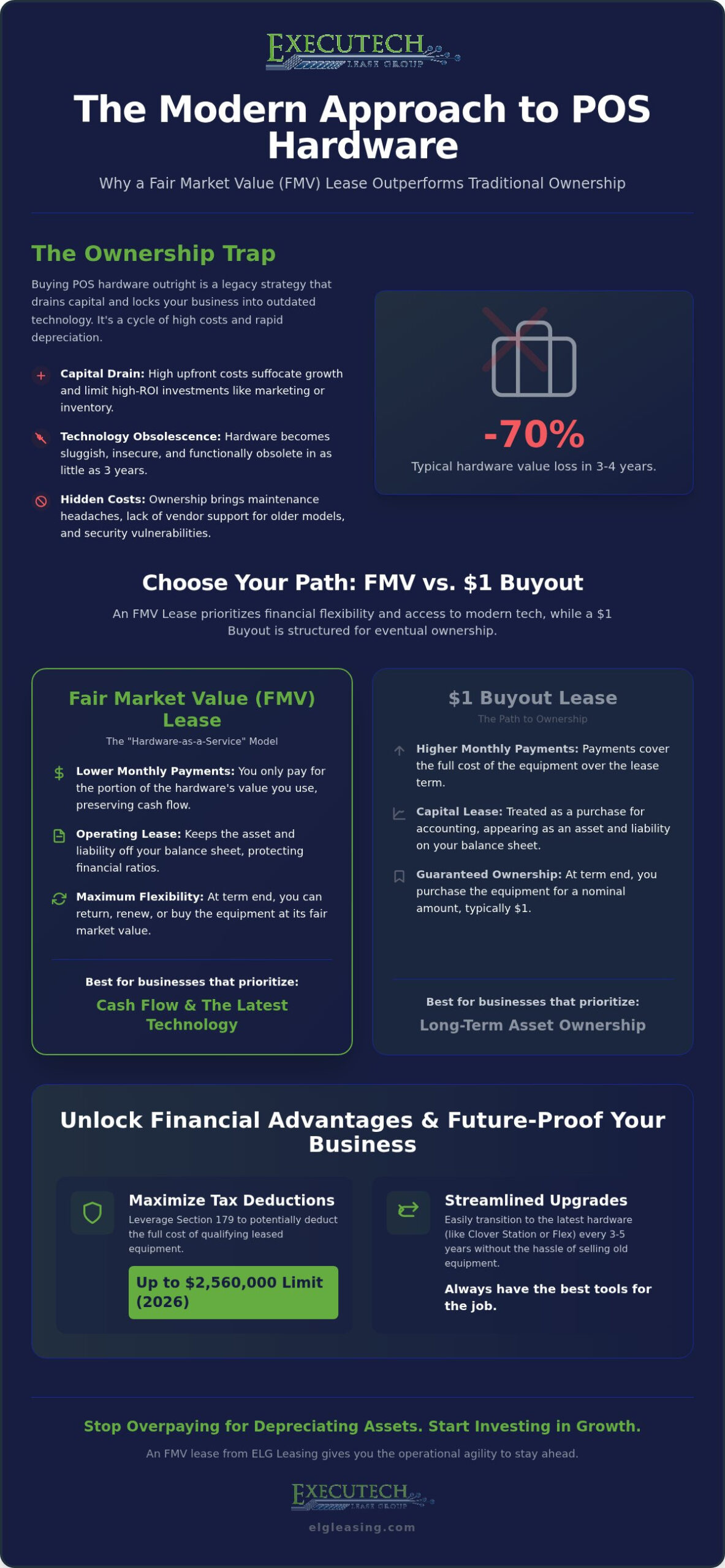
Buying POS hardware outright is a legacy strategy that no longer fits the speed of modern commerce. It assumes technology is static. It isn’t. Payment security standards and cloud software requirements evolve at a breakneck pace. A system purchased today might be functionally obsolete in three years. When you buy, you’re betting that a 2026 solution will still be competitive in 2031. This is a dangerous gamble. A fair market value POS lease eliminates this risk by allowing you to rotate technology before it becomes a liability. Cash is the oxygen of your business. Don’t suffocate your growth by locking liquid capital into depreciating plastic and silicon.
The Hidden Costs of POS Hardware Ownership
Ownership brings maintenance headaches that many vendors fail to mention. As terminals age, manufacturers often stop providing firmware updates or technical support. This leaves you vulnerable to security breaches and software glitches. Legacy hardware also lacks the processing power required to run modern SaaS POS software efficiently. Slow hardware leads to longer checkout lines and frustrated customers. According to recent industry data, over 65% of in-person card transactions in the U.S. are now contactless. If your legacy machine fumbles a “tap to pay” request because of outdated hardware, you lose customer trust and revenue. The opportunity cost is even higher. The thousands of dollars spent upfront on hardware could have been used for high-ROI activities like marketing or inventory expansion.
Why Modern Merchants Treat Hardware as a Utility
Successful merchants have shifted their mindset. They view hardware as a utility rather than a permanent asset. You pay for the value the equipment provides today, not for the right to own a piece of junk five years from now. A fair market value POS lease aligns perfectly with this modern business mindset. From a financial perspective, it functions as an Operating Lease. This keeps the equipment off your balance sheet while providing immediate access to premium tools. This model offers several operational benefits for national US businesses:
- Predictable Budgeting: Fixed monthly payments replace unpredictable repair costs and large capital outlays.
- Streamlined Upgrades: You can transition to the latest Clover Station or Flex terminals without the friction of selling old equipment.
- Operational Agility: You stay ahead of payment trends, such as biometric authentication and advanced data analytics, without additional debt.
This “hardware-as-a-service” approach ensures your checkout experience remains fast and secure. It moves your business away from “old-fashioned” methods and toward a streamlined, tech-forward environment.
Defining the Fair Market Value (FMV) Lease for Modern Payment Systems
A fair market value POS lease is a usage-based financing agreement that prioritizes technology access over ownership. You pay to utilize the hardware for a fixed duration, typically between 12 and 60 months, while the lessor retains the title. This structure allows you to treat the arrangement as an operating lease. This is a critical accounting distinction. It keeps the equipment off your balance sheet and preserves your borrowing power for other operational needs. It is a pragmatic approach to Equipment Leasing Made Simple, designed for merchants who value cash flow over cluttering their books with depreciating assets.
Unlike restrictive traditional loans, we allow you to bundle “soft costs” into your agreement. You can finance your installation fees and cloud-based SaaS POS software subscriptions alongside the physical hardware. This creates a single, streamlined monthly expense. It eliminates the need for multiple vendors and simplifies your accounts payable process. You get the technology you need today without the heavy capital outlay usually required for premium systems.
How FMV Payments are Calculated
Monthly payments for an FMV lease are significantly lower than lease-to-own programs. You aren’t paying for the total cost of the hardware. Instead, you pay only for the value consumed during the lease term. This efficiency is driven by the residual value. Residual value is the estimated worth of the POS system at the end of the lease term. Because the lessor expects the equipment to still have value, they credit that amount against your total payment obligation. This lowers your monthly merchant overhead and accelerates your path to profitability.
The FMV End-of-Lease Options
The true power of this model lies in the flexibility you have when the term expires. You aren’t stuck with a box of outdated terminals. You have three distinct paths:
- Return and Upgrade: Ship back the old hardware and immediately transition to the latest Clover Station or Flex devices. This ensures your business never falls behind the technology curve.
- Purchase: If the equipment still serves your needs, you can buy it at its current fair market value. You pay only what it’s worth today, not the original sticker price.
- Renew: Continue using the system on a month-to-month or fixed-term basis to bridge the gap until your next strategic upgrade.
Deciding which path fits your growth trajectory is the first step toward a more agile business model. For a comprehensive breakdown of buyout structures and renewal strategies, review our guide on POS equipment lease renewal options for merchants. You can also start your application today to see which terms best support your merchant infrastructure.
FMV vs. $1 Buyout: Choosing the Right Path for Your Merchant Infrastructure
Choosing between lease structures is a matter of prioritizing either ownership or cash flow. A $1 Buyout program is essentially a purchase plan spread over time. You pay the full cost of the equipment plus interest. At the end, you own the hardware for a single dollar. Conversely, a fair market value POS lease focuses on the lowest possible monthly overhead. You only pay for the equipment’s useful life. This shift from “owning” to “utilizing” technology reflects a modern understanding of asset management. You wouldn’t buy a subscription to a cloud service with the goal of “owning” the servers. Why treat your POS hardware differently?
For more detail on the alternative path, consult our POS Lease to Own Guide for Merchants and ISOs 2026. High-growth retail and hospitality businesses typically thrive with FMV structures. They need to stay competitive with the latest features. Stable service businesses with minimal tech requirements might prefer the $1 Buyout. However, for most modern merchants, the ability to pivot is more valuable than a pile of old terminals.
When to Choose a Fair Market Value Lease
A fair market value POS lease is the strategic choice for businesses that prioritize liquidity. If you plan to refresh your tech stack every three years, this is your model. It guarantees the lowest monthly payment by factoring in the equipment’s future value. This is also a powerful tool for ISOs. Offering an FMV lease allows you to provide a built-in “hardware upgrade” incentive. It keeps your clients on the latest Clover devices and prevents them from looking for a new processor when their old gear fails.
The Limitations of the $1 Buyout for Tech-Heavy Businesses
Ownership has a dark side in the merchant services industry. By the time you “own” a five-year-old credit card terminal, it’s often a liability. It lacks modern security protocols and biometric capabilities. Older terminals have virtually zero residual value on the secondary market. You’re left with electronic waste rather than an asset. The higher monthly payments required for a $1 Buyout can also strain your short-term cash flow. This limits your ability to invest in marketing or inventory. In a tech-heavy environment, paying a premium to own a depreciating tool is rarely the most efficient use of capital.
Maximizing ROI: Lifecycle Management and Section 179 for FMV Leases
Return on investment for a point of sale system isn’t found in the hardware itself. It’s found in the efficiency of the checkout and the preservation of your capital. A fair market value POS lease is a strategic tool for lifecycle management. It enables a “Tech Refresh” strategy that keeps you ahead of competitors who are stuck with aging terminals. By rotating your hardware every three to five years, you ensure your business always utilizes the latest security features and processing speeds. This proactive approach is one of the core Benefits of ELG Leasing. It turns a depreciating asset into a predictable, high-performance utility.
The financial advantages extend beyond operational speed. FMV leases are typically treated as operating leases. This means they often remain off-balance sheet. This accounting distinction helps you maintain healthy financial ratios, such as a lower debt-to-equity ratio. It preserves your borrowing power for large scale expansions or emergency reserves. You get the technology you need without the heavy debt load that complicates future financing.
2026 Tax Strategies for POS Leasing
Section 179 is a powerful incentive for merchants in 2026. For the 2026 tax year, the maximum amount you can expense under Section 179 is $2,560,000. This deduction only begins to phase out when total equipment purchases exceed $4,090,000. You should consult with a tax professional to maximize these specific deductions for your 2026 filings. In a traditional purchase, you might only deduct interest and gradual depreciation. With a fair market value POS lease, you can often deduct the full amount of your lease payments as an operating expense. Section 179 accelerates the ROI of a Clover terminal lease by allowing you to write off the technology costs in the year the payments are made, significantly reducing your total tax liability.
Strategic Asset Management for ISOs and Agents
ISOs and sales agents can use FMV leases as a primary tool to reduce merchant attrition. Merchant churn often peaks when hardware becomes sluggish or fails. By offering regular upgrades through our Leasing Programs for ISOs, you provide a built-in reason for the merchant to stay. Position the lease as a “service subscription” rather than a debt obligation. This reframing appeals to modern business owners who prefer recurring, predictable expenses over large capital outlays. It transforms you from a vendor into a selective partner focused on their long-term growth.
Strategic FMV Solutions: Why ELG Leasing is the Expert Choice
Acquiring premium payment technology shouldn’t be a cumbersome process. ELG Leasing takes a no-nonsense approach to 12 to 60 month flexible leasing. We prioritize clarity over flowery prose. Our fair market value POS lease programs are designed for merchants who value speed and professional transparency. We understand that in the merchant services industry, your equipment is your lifeline. You need a partner that understands the intersection of finance and cloud technology. We deliver exactly that without the friction of traditional banking methods.
The ELG Advantage: Industry-Specific Expertise
General banks treat POS hardware like office furniture. They don’t understand the rapid depreciation of credit card terminals or the necessity of cloud software updates. Working with a specialized lessor is different. We provide direct B2B transparency. We know the specific value of tools like the Clover Station, Mini, and Flex. Our expertise allows us to offer more aggressive residual values, which lowers your monthly obligation. One of our primary advantages is the ability to bundle Clover hardware with cloud-based SaaS POS software financing. Most lenders shy away from financing software. We embrace it. This bundling creates a seamless, all-in-one monthly expense that streamlines your accounting and accelerates your digital operations.
Streamlining Your Business Operations
Our process is built for efficiency. We move quickly from application to equipment delivery because we know your business can’t wait. We operate with a selective partner mindset. We work with high-standard ISOs and merchants who demand excellence. This exclusivity ensures a secure and reliable ecosystem for all our clients. We don’t claim to be for everyone. We are for the results-driven professional who wants to modernize their checkout without compromising their liquid capital. We provide the powerful tools you need to stay competitive in a tech-forward environment. It’s time to move away from old-fashioned ownership and toward a more agile, flexible business model. You can Apply Now for POS Financing to start your technology refresh today.
Future-Proof Your Merchant Infrastructure with Strategic Leasing
Owning hardware is a legacy mistake that drains your operational oxygen. A fair market value POS lease ensures you aren’t tethered to obsolete terminals while preserving liquid capital for rapid expansion. You stay ahead of competitors with the latest Clover technology and automated software updates. This model transforms a depreciating burden into a powerful, scalable utility. It allows you to focus on customer experience rather than hardware maintenance.
Leveraging the 2026 Section 179 tax deduction alongside flexible 12 to 60 month terms accelerates your path to profitability. We provide a single, streamlined solution for both premium hardware and cloud-based SaaS software subscriptions. Our no-nonsense approach removes the friction from acquiring the tools you need to succeed. It’s time to simplify your financial operations and focus on scaling your business with a partner that understands the modern payment landscape.
Your growth shouldn’t be limited by your equipment’s depreciation schedule. Take the first step toward a more agile and efficient payment environment. We’re ready to help you modernize your merchant infrastructure and secure the technology your business deserves.
Frequently Asked Questions
What happens at the end of a Fair Market Value (FMV) POS lease?
At the end of your term, you have three primary options: return the hardware to upgrade to the latest technology, purchase the equipment at its current fair market value, or renew the lease on a month-to-month basis. Most merchants choose to return their old terminals to access newer Clover devices. This ensures your business stays current with payment security standards and processing speeds without the burden of owning obsolete gear. For a detailed breakdown of each path, see our guide on POS equipment lease renewal options for merchants.
Are FMV lease payments tax-deductible in 2026?
Yes, FMV lease payments are generally fully tax-deductible as an operating expense in the year they are paid. Under Section 179 for the 2026 tax year, businesses can deduct up to $2,560,000 for qualifying equipment. Because a fair market value POS lease is structured as an operating lease, it allows you to accelerate your ROI by writing off the full monthly payment rather than just the interest or depreciation.
Can I upgrade my Clover terminal before the FMV lease term ends?
Upgrades are most seamless at the end of your 12 to 60 month term; however, we specialize in flexible arrangements that support your growth. If your business outgrows its current Clover Station or Flex before the term expires, contact us to discuss a mid-term technology refresh. Our goal is to ensure your payment infrastructure never bottlenecks your revenue. We prioritize your operational efficiency over rigid, old-fashioned contract structures.
What is the difference between an FMV lease and a $1 buyout lease?
The primary difference lies in the monthly payment and the end-of-lease goal. An FMV lease offers the lowest possible monthly payment because you are paying for the equipment’s use, not its full purchase price. A $1 buyout lease has higher payments but guarantees ownership for one dollar at the end. For technology that depreciates rapidly, the FMV model is usually the more pragmatic choice for modern merchants who value cash flow.
Does an FMV lease include POS software and SaaS subscriptions?
Yes, we offer specialized financing that bundles your physical hardware with cloud-based SaaS POS software subscriptions. This creates a single, predictable monthly expense for your entire payment tech stack. Bundling software into your fair market value POS lease streamlines your accounts payable and ensures your hardware and software remain compatible. You get a turnkey solution that includes everything needed to process transactions and manage your digital operations efficiently.
Is an FMV lease considered debt on my business balance sheet?
An FMV lease is typically treated as an operating lease, which often allows it to remain off-balance sheet. This means the lease obligation doesn’t appear as a primary liability, helping you maintain healthy financial ratios like a lower debt-to-equity ratio. This preservation of borrowing power is a significant advantage for businesses planning future expansions or seeking additional lines of credit from traditional lenders. It keeps your financial profile streamlined and professional.
How is the “Fair Market Value” determined at the end of the lease?
The fair market value is the price the equipment would sell for on the open market at the end of your lease term. It is determined by the used market value for that specific model and condition at that time. Since POS technology matures quickly, this value is often significantly lower than the original cost. You only pay what the hardware is worth today, not the premium price it commanded years ago.
Who is responsible for maintenance on an FMV leased POS system?
As the lessee, you are responsible for the physical care and maintenance of the equipment during the lease term. However, because we finance modern cloud-based systems, most software-related issues are handled through remote updates and SaaS support channels. Choosing premium hardware like Clover devices reduces the likelihood of mechanical failure. If a terminal becomes physically obsolete or fails after the warranty, the FMV model simplifies the transition to a replacement.

Article by
Robert Ensminger
Robert Ensminger is the founder and CEO of Executech Lease Group (ELG Leasing), which specializes in equipment leasing and financing solutions for the merchant-services, payments, POS, and FinTech industries. With more than 20 years of industry experience, Robert helps independent sales organizations, payment processors, POS providers, and software companies develop practical leasing, subscription, and SaaS-monetization programs. He founded ELG in 2010 and guided the company to recognition on the Inc. 5000. His work focuses on responsive service, transparent program structures, and helping ELG’s partners close more business while creating sustainable revenue.