
The lower-payment option can leave ownership undecided. Understanding fair market value versus a $1 buyout lease starts with the end-of-term choice: an FMV lease may let you return the equipment, keep leasing it, or buy it at fair market value, depending on the contract. With a $1 buyout lease, you generally pay higher monthly amounts, then purchase the equipment for $1 at the end of the lease term.
Both structures can help a business access equipment, but the right fit depends on whether you prioritize lower payments and flexibility or plan to own and keep the equipment. This comparison explains how payments, ownership, tax treatment, depreciation, and end-of-lease choices differ, so you can weigh the full commitment, not just the monthly amount. You’ll also see which contract details shape the outcome and how to match the lease structure to your equipment plans.
Key Takeaways
- Choose an FMV lease when keeping future equipment options open matters; check the contract for return, continued-use, and purchase terms.
- Compare the full payment structure, not just monthly amounts: a $1 buyout lease generally costs more each month and ends with a $1 purchase option.
- Ownership affects how equipment and lease payments may be treated for accounting and tax purposes; the details depend on the lease structure, so consult your CPA.
- Before signing, identify the end-of-term steps and deadlines that govern returning, buying, or continuing to use the equipment.
- Match the lease to your equipment plans: prioritize flexibility if needs may change, or an ownership path if you expect to keep the equipment.
Fair Market Value or $1 Buyout Lease?
Choose a lease by considering how long you expect to use the equipment, the monthly payments, and what you want to do at the end of the term. If your needs may change, focus on the return and purchase options stated in the agreement.
Fair Market Value Leases
An FMV lease lets a business use equipment for a set lease term, with an end-of-term purchase option based on fair market value. The payment structure accounts for equipment cost, projected depreciation, the term, and estimated value at lease end. Age, condition, supply and demand, and technological change can affect that value. A business with uncertain equipment needs may favor the choice to return or continue leasing, if its agreement allows those options.
$1 Buyout Leases
A $1 buyout lease offers a purchase option for $1 at the end of the term. Payments are generally higher than FMV payments because the arrangement finances the equipment’s full cost. Consider this structure when your business expects to keep using the equipment and wants a fixed purchase amount in the agreement. Compare the scheduled payments and purchase terms with the expected useful role of the equipment in your operations.
Lease Risks and Buyout Rules
State law and the agreement’s wording can affect an equipment lease buyout, so a general comparison cannot determine your legal rights or obligations. Before signing, review the purchase-option language and ask an attorney how the agreement applies to your situation. Also examine the payment schedule, return requirements, renewal terms, and any charges described in the contract. Together, these details define the commitment beyond the monthly payment.
| Option | Payment structure | Purchase choice | Return or continued use | May fit when |
|---|---|---|---|---|
| FMV lease | Based partly on estimated end-of-term value | Purchase at fair market value under the agreement | May be available under the agreement | Equipment needs or timing are uncertain |
| $1 buyout lease | Generally higher monthly payments | Purchase for $1 at the end of the term | Review the agreement’s stated options | You plan to keep using the equipment |
Choose FMV when flexibility at lease end matters more than a fixed purchase amount. Choose a $1 buyout structure when you prioritize a defined purchase option. In either case, base your decision on the full agreement, including payment obligations and the steps required to exercise each end-of-term option.
Monthly payment and ownership tradeoffs
Monthly payments are only one part of the comparison. Review the payment schedule, lease term, and end-of-term buyout before deciding which structure fits your plans.
$1 Buyout Payments and Ownership
A $1 buyout lease generally has higher monthly payments because it finances the equipment’s full cost. The lessee pays throughout the lease term, then can purchase the equipment for $1 at the end. This structure may finance 100% of equipment cost. Compare the total scheduled payments with the cost of owning the asset, rather than judging affordability by one month’s payment alone.
FMV Lease Payments and Terms
FMV lease payments factor in equipment cost, projected depreciation, lease term, and estimated fair market value at the end. Since the lessee isn’t financing the equipment’s full cost, payments are typically lower than lease-to-own payments. Business equipment FMV leases generally run from 12 to 60 months. A shorter term may raise monthly payments because the cost is spread across fewer months.
For example, an FMV payment reflects the expected value remaining in a point-of-sale terminal after its term, not only its original cost. The lessor estimates that residual value based on the equipment and market outlook. Credit profile, equipment type, economic conditions, and market trends can also affect the lease rate factor. These variables explain why two leases for different equipment may have different monthly payments, even with similar terms.
Use this comparison before signing:
- Estimate total payments: Multiply the monthly amount by the number of payments, then include any end-of-term purchase amount stated in the contract.
- Match term to use: If you expect to replace equipment sooner, compare the shorter FMV term’s higher monthly payment against its return options.
- Price ownership: If you expect to keep the equipment, include the $1 purchase option after the scheduled lease payments.
- Review cash flow: Check whether the monthly obligation fits alongside other recurring business expenses throughout the full term.
Don’t treat a lower FMV payment as automatic savings. If you later choose to buy the equipment, its end-of-term fair market value affects the total cost. A $1 buyout has a clearer purchase amount, but generally asks for more each month. Compare both paths over the period you expect to use the equipment, including likely replacement timing and remaining value.
For payment-processing equipment, review the lease application process as a next step after you’ve identified the term and ownership structure that fit your plans.
Tax treatment and depreciation
Tax and accounting outcomes shouldn’t be inferred from “FMV” or “$1 buyout” alone. Compare the actual agreement and your business records with your CPA before deciding how either structure fits your reporting and tax plans.
$1 Buyout Tax Treatment
A $1 buyout agreement makes the purchase option clear, but that detail alone doesn’t determine how to report payments, the equipment, or the end-of-term purchase. Give your CPA the signed agreement, payment schedule, equipment description, and intended business use. Ask which tax and accounting treatment applies, whether depreciation is relevant, and whether Section 179 should be considered for your situation.
Keep the contract and payment records together. If you lease a payment terminal and plan to exercise a purchase option, your CPA can review the payment history alongside the signed agreement and purchase documents. Don’t assume that all lease payments are deductible or that the buyout determines a particular tax outcome.
FMV Lease Tax and Balance-Sheet Treatment
An FMV agreement also needs review in its full contractual context. FMV lease payments may be deductible as an operating expense, but treatment depends on the lease structure and your circumstances. Consult your CPA. For accounting, don’t assume the equipment or lease obligation must be recorded a particular way based only on the FMV label. Have your accounting professional assess the signed terms and applicable reporting requirements.
Bring the agreement, payment schedule, equipment details, and end-of-term option language to that review. If your company prepares financial statements, ask your accounting professional how the lease should be presented and what supporting records to retain. Keep tax questions distinct from accounting presentation.
Use these questions to organize the review:
- Tax treatment: How should payments and any purchase be treated under this agreement?
- Depreciation: Does the business’s tax treatment make depreciation relevant, and what records are needed?
- Section 179: Should this deduction be evaluated for this business and equipment?
- Accounting: How should the lease, equipment, and related obligations be reported?
- Timing: Which periods and records matter for the treatment being considered?
Compare proposed structures before signing, using the same equipment, expected use, and payment information. Ask your CPA to review both options so you can consider their tax and accounting implications without treating a lease label as a conclusion.
This article reflects the author’s opinion for general information only and isn’t tax, legal, or accounting advice. Consult your CPA or attorney about your specific situation.
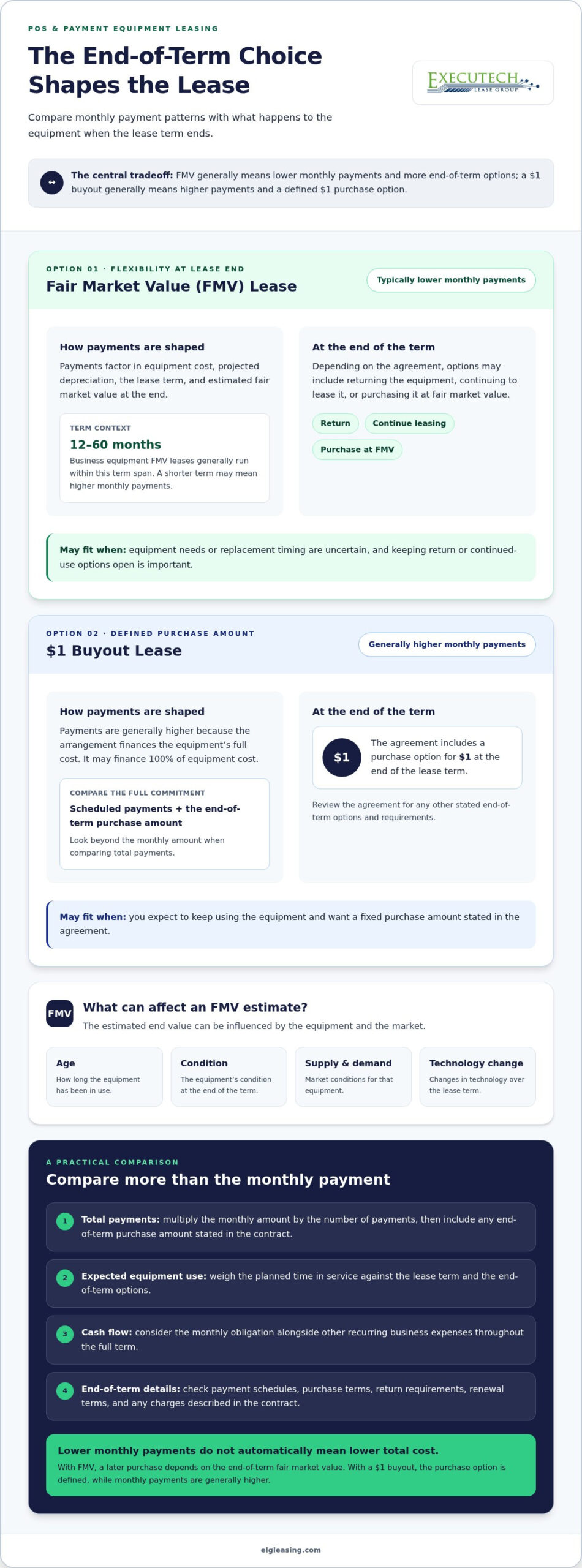
$1 Buyout lease comparison
Compare the total commitment, not one monthly figure. For the same equipment and lease term, calculate scheduled payments and include the end-of-term amount tied to your chosen option.
A $1 buyout agreement generally has higher monthly lease payments than an FMV lease. In return, the agreement provides a path to own the equipment for $1 at the end of the term. An FMV lease may have lower monthly payments because the lessee isn’t financing the equipment’s full cost. If you choose to purchase the equipment at lease end, add its fair market value to the payments already made.
Use a payment terminal as a practical example. A business expects to use the terminal for the full term and wants to retain it afterward. The $1 buyout option makes the purchase amount clear, but the business must account for the generally higher monthly obligation. Another business expects its needs to change and may prefer to return the terminal. An FMV lease can better match that plan, though buying later means accounting for the equipment’s fair market value then.
Build a like-for-like comparison before deciding. Keep the equipment and lease term constant, then compare these components:
- Scheduled payments: Multiply each option’s monthly payment by its number of scheduled payments.
- End-of-term amount: Add the $1 buyout for the purchase option; for an FMV purchase, use the amount determined under that agreement.
- Return plan: If you expect to return the equipment under an FMV lease, include the contract’s return requirements in your decision.
- Expected use: Compare the lease term with how long the business expects to use that equipment before replacing it.
| Comparison point | $1 buyout lease | FMV lease |
|---|---|---|
| Monthly payments | Generally higher | Typically lower |
| Purchase amount at term end | $1 | Fair market value, as set under the agreement |
| Return option | Ownership-focused | May allow a return, depending on terms |
| Best fit | Plan to keep the equipment | Want flexibility at term end |
The lower monthly payment doesn’t automatically make the FMV option less expensive overall. If you buy the equipment, include its end-of-term price; if you return it, compare the payment total and return conditions. The $1 option may suit a business that values ownership and expects continued use. An FMV option may better suit a business prioritizing flexibility. The agreement determines the available choices, so compare its payment schedule and end-of-term terms together.
End-of-lease return, purchase, or upgrade options
As the lease term approaches its end, decide whether you plan to keep the equipment. The agreement sets out the available options and the steps for purchasing, returning, or continuing to use the asset.
A fair market value purchase option gives the lessee the right, but not the obligation, to purchase the equipment at its fair market value when the lease ends. The purchase price isn’t fixed in advance. Equipment age and condition, supply and demand, and technological changes can affect its value. Depending on the agreement, an FMV lease may also allow the business to return the equipment or continue leasing it.
A $1 buyout lease uses a different purchase structure. Its stated purchase option is $1 at the end of the term, subject to the agreement. This can make the purchase amount easier to plan for if your business expects to keep using the equipment. The comparison is less straightforward when considering FMV purchasing, because the end-of-term value is determined later.
| End-of-term option | FMV lease | $1 buyout lease |
|---|---|---|
| Purchase | At fair market value under the agreement | For $1 under the agreement |
| Return | May be available, subject to contract terms | Review the agreement’s stated options |
| Continue using equipment | May be possible under the agreement | Purchase option supports continued ownership |
| Plan an upgrade | Consider new equipment after the term ends | Keep the asset or consider new equipment financing |
Use a simple review before the lease expires. Read the specific schedule, identify its purchase and return options, and note any required actions or conditions. Ask who determines the FMV purchase amount and how the agreement communicates it. For return planning, review the stated instructions and condition requirements. These steps help distinguish a contractual option from an assumption about what happens automatically.
For example, a business with an outdated payment terminal could return it if its FMV agreement permits, then consider replacement equipment after the term ends. A business that still relies on its terminal could compare the FMV purchase amount with the $1 option. Don’t assume every operating lease includes a purchase choice or identical return terms. The written agreement governs.
Choose the path that fits your next equipment plan: return equipment you no longer need, purchase an asset you expect to keep, or plan an end-of-term upgrade through new equipment financing.
Executech Lease Group (ELG Leasing): 12-60 Month Credit Card and POS Equipment Leases
Executech Lease Group (ELG Leasing) helps merchants access credit card terminals and POS equipment through 12-60 month leases. If your decision points toward equipment use with end-of-term flexibility, consider its FMV Lease Options. If you plan to own the equipment, Lease-to-Own Programs may better match that goal. Clover Leasing is also available for businesses seeking Clover equipment.
Start with your equipment plans, then compare the lease structure, term, monthly payments, and end-of-lease terms. That gives you a clearer basis for discussing the option that fits your business, without treating a lower payment as the only measure of value.
Visit elgleasing.com or contact Executech Lease Group to discuss equipment leasing for your business.
Make Your Lease Decision With a Clear Plan
Before choosing, turn your equipment plans into a short decision brief. Note the role the equipment serves, how it fits your operations, and whether retaining it supports your longer-term plans. A practical understanding of fair market value versus a $1 buyout lease helps you frame that choice around business priorities, not just a payment line.
Then review the agreement with the people responsible for finance, operations, and equipment planning. Aligning those perspectives can clarify your next step and help you carry the decision into your budget and operating plan.
With a clear plan in hand, you’re ready to move forward with confidence.
This article reflects the author’s opinion for general information only and isn’t tax, legal, or accounting advice. Consult your CPA or attorney about your specific situation.
Frequently Asked Questions
What does “FMV” stand for?
FMV stands for fair market value. In an equipment lease, it describes the value used when a purchase option is based on the equipment’s value at lease end. It isn’t automatically a preset amount. For example, the value of a payment terminal may reflect its age, condition, demand, and technological relevance when the lease ends. The agreement sets out how the FMV option works.
When Should a Business Choose an FMV Lease?
A business may choose an FMV lease when it expects to use equipment for a defined period and wants options afterward. It can suit a company that expects its needs or technology requirements to change. For example, a merchant planning a payment-system review after a shorter use period may value the option to return the leased equipment. FMV leasing may be preferable when expected use is 36 months or less.
What is fair market value (FMV) lease buyout?
An FMV lease buyout is the purchase option available under some FMV agreements when the term ends. The lessee can choose to purchase the equipment at its fair market value, subject to the contract. The option differs from a fixed-price buyout because the purchase amount isn’t set in advance. Review the agreement’s purchase language to understand how the option applies to your equipment.
What is a $1 buyout lease and how does it work?
A $1 buyout lease is a lease-to-own arrangement with a stated $1 purchase option at the end of its term. The lessee makes the scheduled payments and follows the agreement’s purchase process. Before signing, read the executed documents to see whether the option has conditions, how to exercise it, and what notices are required. A “$1 buyout” label alone doesn’t replace the contract terms.
How is the buyout price determined in an FMV lease?
The FMV buyout price reflects the leased asset’s value at the end of the term, rather than a purchase amount fixed at signing. Equipment age and condition can matter, as can market supply and demand and technological changes. For a payment terminal, newer technology or reduced demand for its model could affect its value. The specific agreement governs the purchase option and valuation process.
How do monthly payments compare between FMV and $1 buyout leases?
Understanding fair market value vs $1 buyout lease costs starts with comparing total scheduled payments, not just the monthly amount. FMV payments are typically lower because the lessee isn’t financing the equipment’s full cost. The lessor accounts for expected residual value when structuring an FMV lease. Include the term and any end-of-term purchase amount in your comparison to evaluate the full commitment.
What happens at the end of an FMV lease: buy, return, or renew?
Depending on the agreement, an FMV lessee may purchase the equipment, return it, or continue using it under a renewal or continued-rental arrangement. The contract controls the available choices and the process for exercising them. For example, a business that no longer needs a terminal may prefer the return path, while a business still using it may consider purchasing or continuing the lease.
What are the advantages and disadvantages of FMV and $1 buyout leases?
Understanding fair market value vs $1 buyout lease options means weighing flexibility against ownership. An FMV lease can offer lower monthly payments and end-of-term choices, but a purchase price is based on fair market value at that time. A $1 buyout lease generally has higher monthly payments but a fixed purchase option. Tax and accounting treatment also depend on contract structure, so ask your CPA to review those details.
This article reflects the author’s opinion for general information only and isn’t tax, legal, or accounting advice. Consult your CPA or attorney about your specific situation.

Article by
Robert Ensminger
Robert Ensminger is the founder and CEO of Executech Lease Group (ELG Leasing), which specializes in equipment leasing and financing solutions for the merchant-services, payments, POS, and FinTech industries. With more than 20 years of industry experience, Robert helps independent sales organizations, payment processors, POS providers, and software companies develop practical leasing, subscription, and SaaS-monetization programs. He founded ELG in 2010 and guided the company to recognition on the Inc. 5000. His work focuses on responsive service, transparent program structures, and helping ELG’s partners close more business while creating sustainable revenue.