
An FMV lease can ease the upfront burden of POS equipment, but the end-of-lease decision matters just as much. For businesses weighing FMV lease benefits for businesses, the practical question is whether the lease structure and equipment plan fit how you expect to use the system. Executech Lease Group (ELG) offers an FMV equipment lease alongside a lease-to-own option, with different end-of-lease buyouts.
No-money-down leasing avoids a down payment, not the recurring lease obligations. Before choosing a structure, compare the equipment you need, the agreement’s terms, and what you want to do at the end of the lease.
This guide explains when an FMV lease may fit, what to weigh before choosing one, and how ELG’s FMV option differs from lease-to-own. ELG’s FMV lease ends with a buyout of about 10% of the original equipment cost, while its lease-to-own option has a $1 buyout. Use those figures as part of a broader comparison, not as a promise of savings or flexibility.
Key Takeaways
- FMV lease benefits for businesses depend on the equipment plan, lease terms, and what you want to do at the end of the term.
- Map your POS equipment needs and intended use before comparing lease structures.
- ELG’s FMV option ends with a buyout of about 10% of the original equipment cost; its lease-to-own option has a $1 buyout.
- Compare the documented lease obligations and end-of-term choices rather than assuming a lease will save money.
- Our goal is to deliver credit decisions in under 2 business hours. That goal applies to the decision, not funding or equipment deployment.
What FMV Lease Benefits Can Matter to a POS-Using Business?
An FMV equipment lease gives a business use of equipment under agreed lease terms. It differs from a $1 buyout lease, where the end-of-term purchase amount is set at $1. The FMV label alone doesn’t tell you the full cost or every end-of-term detail, so review the agreement’s obligations and options.
For a business considering a POS system or credit-card terminal, the potential FMV lease benefits for businesses depend on the equipment required, the contract terms, and what the business wants to do when the lease ends. Avoiding a large upfront equipment purchase may be one consideration, but it doesn’t guarantee improved cash flow or lower overall cost. Lease payments remain obligations, and leasing isn’t automatically cheaper than purchasing.
Start with the operating need. List the POS equipment you expect to use, its role in day-to-day transactions, and how long you expect the setup to fit your plans. Then compare the purchase and lease commitments using the actual terms. ELG’s equipment leasing benefits are best assessed in this practical context, not as guaranteed savings.
How an FMV equipment lease may support business planning
A lease can give a business access to POS equipment without paying the full purchase amount upfront. That may be worth considering when funds also need to cover inventory, staffing, or other operating priorities. It is a planning choice, not a promise that cash flow will improve.
Compare the lease term with your expected equipment use. ELG equipment lease terms are 12, 24, 36, 48, or 60 months. A term that fits your business plan can make it easier to map obligations over time, but the agreement controls the payment schedule and other terms. Also consider what you want to do at the end, and review how the agreement describes the FMV option.
Which businesses may consider FMV leasing?
Merchants evaluating POS systems or credit-card terminals may consider FMV leasing when comparing equipment access with an upfront purchase. The fit depends on the equipment plan and business priorities, including intended use and end-of-term preference.
ISOs, agents, resellers, and POS dealers may also assess leasing as an equipment-access option for merchants. Their planning can include identifying the equipment a merchant needs and explaining the lease structure clearly. In each case, compare the documented obligations with the purchase alternative. The decision should reflect the equipment need and contract details, not a general claim that leasing always saves money.
How ELG’s FMV Equipment Lease Works at the End of the Term
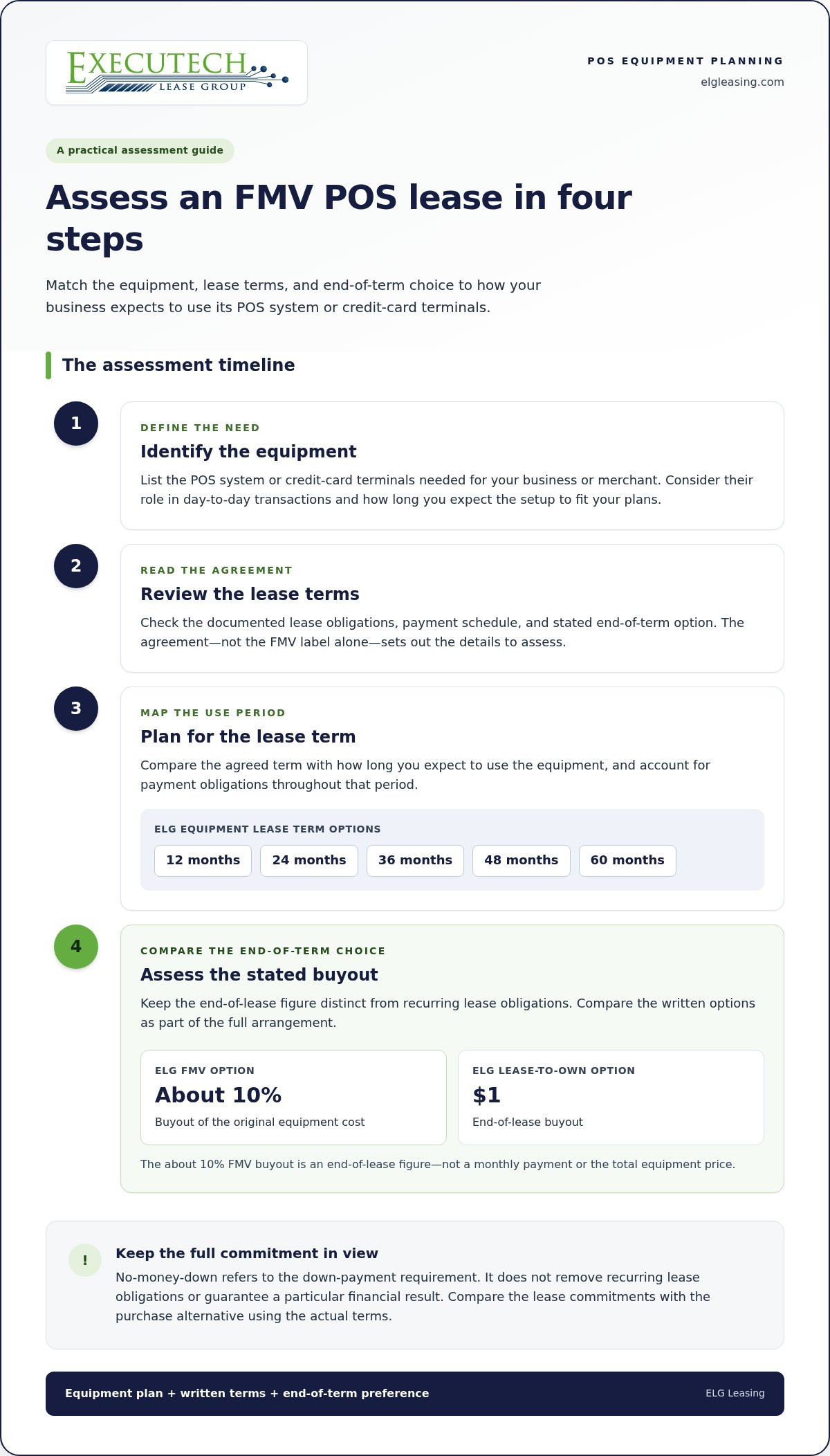
Review the end-of-term details before committing to an FMV lease. ELG’s FMV option has a buyout of about 10% of the original equipment cost. Include that figure in your planning from the start, alongside the recurring obligations. The process for assessing the arrangement is straightforward:
- Identify the equipment. Define the POS system or credit-card terminals needed for your business or merchant.
- Review the lease terms. Read the agreement for the lease obligations and the stated end-of-term option.
- Plan for the term. Consider how the equipment will be used over the agreed lease term, and account for the payment obligations.
- Assess the end-of-term figure. ELG’s FMV equipment lease ends with a buyout of about 10% of the original equipment cost.
That buyout is an end-of-lease figure, not a monthly payment or the total equipment price. Keep it separate from the recurring lease obligations when assessing the full arrangement.
What does ELG’s about 10% FMV buyout mean?
ELG’s FMV option ends with a buyout of about 10% of the original equipment cost. ELG’s lease-to-own option, by contrast, ends with a $1 buyout. That is the key distinction: the FMV option has the about 10% end-of-lease buyout, while the lease-to-own option has the $1 buyout. Neither figure is a substitute for reviewing the recurring obligations during the term.
Compare ELG’s equipment leasing programs by reviewing each structure’s stated terms and how they fit your equipment plans. The agreement’s details should guide the decision.
What no-money-down does, and does not, mean
No-money-down refers to the down-payment requirement. It does not mean the equipment is free, remove recurring lease obligations, or guarantee a particular financial result. Include the ongoing obligations and end-of-term buyout when comparing a lease with purchasing equipment.
Before moving forward, make sure the equipment list, lease term, payment obligations, and end-of-term figure are clear to everyone involved. A credit decision is separate from funding and equipment deployment, and its timing does not establish when either will occur. If you’re evaluating an ELG equipment lease, the vendor, ISO, or MSP inquiry form provides a way to share an inquiry. It is not a financing application or a credit decision. These details help you compare the arrangement with the equipment plan without assuming savings or a particular outcome.
FMV Lease vs. Lease-to-Own: Which Business Goal Fits Each Option?
Both structures can help a business access POS systems or credit-card terminals through a lease. The main difference to weigh is the stated end-of-lease buyout and how it fits your equipment plans. Compare the written obligations and intended use, not an assumed cost advantage.
ELG’s FMV option ends with a buyout of about 10% of the original equipment cost; its lease-to-own option ends with a $1 buyout. These are distinct end-of-lease figures, and the $1 buyout applies only to lease-to-own.
| FMV lease | Lease-to-own |
|---|---|
| End-of-term buyout: About 10% of original equipment cost. | End-of-term buyout: $1. |
| Ownership intent: Consider this structure when access to the equipment is central to the plan and ownership isn’t the only objective. | Ownership intent: Consider this structure when the stated $1 end-of-term buyout aligns with your ownership goal. |
| Planning focus: Assess the equipment’s intended use, lease obligations, and how the buyout fits your end-of-term plans. | Planning focus: Weigh the lease obligations and the $1 buyout against your plans for the equipment after the term. |
When might an FMV lease align with your equipment plans?
An FMV lease may suit a business that wants to evaluate access to POS equipment without making ownership the main goal from the outset. For example, a merchant planning around a particular terminal setup can compare the lease term and obligations with its expected business use, then factor in the stated buyout when considering the end of the term.
This is a planning distinction, not a promise of a future upgrade, trade-in, renewal, or early exit. Keep the decision grounded in the equipment you expect to use and the agreement’s terms. Compare the lease program structures against those priorities.
When might lease-to-own align with ownership goals?
Lease-to-own may align with a business that places importance on its stated end-of-term buyout. ELG’s $1 buyout belongs to this option, not the FMV lease. If retaining the equipment is central to your plan, include that preference in the comparison and review the agreement’s obligations alongside the buyout.
Neither structure is automatically the better choice. List the equipment needed, how you expect to use it, and whether ownership is a priority. Then compare the relevant terms directly. This makes the potential FMV lease benefits for businesses easier to assess against a specific operating plan, without relying on general claims of savings or flexibility.
How to Assess FMV Lease Benefits Against Your Business Needs
A useful comparison starts with the operating plan, not a savings claim. Define the POS equipment you need, how you expect to use it, and which end-of-term outcome matters to your business. Then assess the written lease obligations against those priorities. This keeps the decision focused on your requirements rather than broad claims about leasing.
Questions to answer before choosing an FMV lease
- Which equipment do you plan to use? Identify the POS system or credit-card terminal under consideration and the role it will serve. Be specific about the equipment the lease is meant to cover.
- How does it fit your operating plan? Consider how long you expect to use the equipment under your current plans. A change in business needs may affect how useful a term or end-of-term option feels, but it doesn’t change the agreement’s obligations.
- What outcome do you prefer at the end? Decide whether an FMV structure or a lease-to-own option better reflects your ownership preference. ELG’s FMV option ends with a buyout of about 10% of the original equipment cost; its lease-to-own option ends with a $1 buyout.
- What does the proposed agreement require? Review the payment schedule, lease term, total obligations, and stated end-of-term details. Compare those documented terms with the purchase alternative. Don’t assume leasing will cost less overall.
Use your answers as a decision checkpoint. If access to the equipment is the main priority and ownership isn’t central, weigh the FMV structure against that plan. If the lease-to-own buyout better aligns with your ownership goal, include that in the comparison. A clear written review makes potential FMV lease benefits for businesses specific to your equipment and operating needs.
For broader context on equipment leasing for POS systems and terminals, review ELG’s POS equipment leasing programs. Keep the equipment agreement separate from your arrangement for processing transactions. ELG provides equipment leasing; it doesn’t process payments, provide merchant accounts, or set transaction pricing. The lease terms don’t establish processor compatibility, portability, or the obligations in a separate processor agreement.
If you have tax questions about a lease, discuss them with a tax professional. Don’t base the decision on assumed tax treatment. Focus first on the equipment, documented lease obligations, and end-of-term preference, then seek professional guidance on tax questions.
Explore ELG’s FMV Lease Option and Take the Next Step
A sound next step starts with three points: the POS or credit-card terminal equipment you plan to use, your preferred end-of-term structure, and a clear understanding of the lease obligations. These details help you assess whether ELG’s FMV option fits your business plans without assuming savings or a particular outcome. Keep the decision focused on the equipment and agreement.
Before discussing an option, gather the equipment details and note how the hardware will be used in your operation. Then decide whether you’re comparing an FMV lease with lease-to-own. This puts the end-of-term preference into the conversation from the outset.
What to prepare for a conversation about the FMV option
Prepare a concise outline of the POS system or terminal under consideration and its intended business use. Describe the planned equipment setup and the priorities behind it, such as whether the business is focused on access to equipment or an ownership-oriented structure. Keep questions specific to the agreement, ongoing obligations, end-of-term option, and how the program fits the equipment plan.
Start an inquiry with ELG
ELG’s apply-now page is an inquiry mechanism for vendors, ISOs, and MSPs exploring an ELG relationship. Submitting the form is not a financing application and does not itself produce a credit decision. Keep those steps distinct. Our goal is to deliver credit decisions in under 2 business hours, but that goal does not establish when funding or equipment deployment will occur.
ELG leases payment-processing equipment; it doesn’t process transactions, provide merchant accounts, or set transaction pricing. Any arrangement with a payment processor remains separate from the equipment lease. Equipment warranties come only from the equipment manufacturer. ELG doesn’t provide warranties, repairs, maintenance, or replacements, so keep manufacturer coverage and lease obligations distinct in your planning.
Before moving ahead, organize the equipment details, your preferred end-of-term approach, and any questions about the written obligations. That gives you a clear basis for discussing how an FMV option may fit, without treating potential FMV lease benefits for businesses as a promise of savings or flexibility. The inquiry form is the appropriate starting point for vendors, ISOs, and MSPs exploring an ELG relationship.
Make Your Equipment Plan the Next Step
Turn your evaluation into a clear decision brief. Write down the equipment your operation needs, the role it will serve, and the end-of-term outcome that best matches your plans. Then use the agreement to assess whether the structure works for your business, rather than relying on broad claims about leasing. That practical approach makes the potential FMV lease benefits for businesses easier to evaluate.
A focused inquiry can move the discussion from general options to your equipment plan. For vendors, ISOs, and MSPs, ELG’s inquiry form is a starting point for exploring a relationship, not a financing application. Keep your questions direct and centered on program fit and the lease terms relevant to the equipment.
With a clear plan and the right questions, you can take the next step with greater confidence.
Frequently Asked Questions
What is an FMV lease for business equipment?
An FMV lease lets a business use specified equipment under agreed lease terms. For a merchant, that equipment might be a POS system or credit-card terminal. The contract sets the payment obligations and explains the end-of-term option. Review those details rather than relying on the FMV label alone, especially when comparing leasing with purchasing or a lease-to-own structure.
What are the benefits of an FMV lease for a business?
Potential FMV lease benefits for businesses include accessing POS or terminal equipment without paying the full purchase amount upfront. That may help a business weigh equipment needs alongside other uses for available funds, but it doesn’t guarantee savings or better cash flow. Consider the equipment’s role, lease obligations, and end-of-term preference together. Those trade-offs determine whether the structure fits your business plan.
How does ELG’s FMV buyout differ from its lease-to-own buyout?
ELG’s FMV option ends with a buyout of about 10% of the original equipment cost, while its lease-to-own option ends with a $1 buyout. Each figure applies only to its respective structure. Both are end-of-lease buyouts, not monthly payments or the total equipment price. Compare the applicable figure alongside the agreement’s recurring obligations and your plans for the equipment.
Does ELG require money down?
ELG offers no-money-down equipment leasing. That does not mean the equipment is free or that there are no ongoing lease obligations.
How fast does ELG make a decision?
Our goal is to deliver credit decisions in under 2 business hours. Keep that separate from the funding and equipment-deployment stages.
Does ELG process payments?
No. ELG does not process payments. Its equipment-leasing role is separate from payment processing.
Can an FMV lease guarantee lower equipment costs than buying?
No. An FMV lease can’t guarantee lower overall equipment costs than purchasing. The comparison depends on the lease obligations, the purchase alternative, the equipment’s intended use, and the stated end-of-term option. Review the documented terms side by side rather than assuming leasing saves money. If tax treatment is part of your evaluation, consult a tax professional.
This article reflects the author’s opinion for general information only and isn’t tax, legal, or accounting advice. Consult your CPA or attorney about your specific situation.

Article by
Robert Ensminger
Robert Ensminger is the founder and CEO of Executech Lease Group (ELG Leasing), which specializes in equipment leasing and financing solutions for the merchant-services, payments, POS, and FinTech industries. Robert helps ISOs, payment processors, POS providers, and software companies build practical equipment leasing programs. He founded ELG in 2010. His work focuses on responsive service, transparent program structures, SaaS-monetization programs, and helping ELG’s partners close more business while creating sustainable revenue.