
Generating residual income with POS leasing means combining access to POS equipment with merchant-services relationships that may generate ongoing processing commissions. The recurring income comes from payment-processing activity, not automatically from the equipment lease. Results depend on merchant retention, transaction volume, and the terms of your partner agreement.
That distinction matters. Leasing can help merchants access the equipment they need, while a well-supported merchant portfolio can create recurring revenue over time. But the income isn’t automatic or entirely hands-off: accounts can change, and processing volumes can rise or fall.
This article explains how the revenue model works, shows how to calculate residuals, and outlines how merchant attrition and fee compression can affect earnings. It also explains where POS leasing fits into a broader merchant-services offer, so you can assess the opportunity with realistic expectations.
Key Takeaways
- Recurring merchant-services income generally comes from processing activity, while POS leasing can help merchants access the equipment they need.
- Estimate potential residuals by considering merchant volume, your processing markup, and your share of the revenue.
- Attrition and fee compression can reduce earnings, so portfolio retention and clear partner terms matter.
- Commission structures may include recurring residuals, upfront bonuses, or both; payout terms and clawbacks shape what you actually keep.
- Starting expenses depend on how you build and operate the business, while lease programs can offer merchants 12-60-month equipment terms.
Choosing a passive income stream
Compare revenue streams by what triggers payment, how long it may continue, and what work is needed to maintain it. For a merchant-services agent, that means separating equipment commissions from ongoing processing residuals.
Residuals, Processing Residuals, and Equipment Commissions
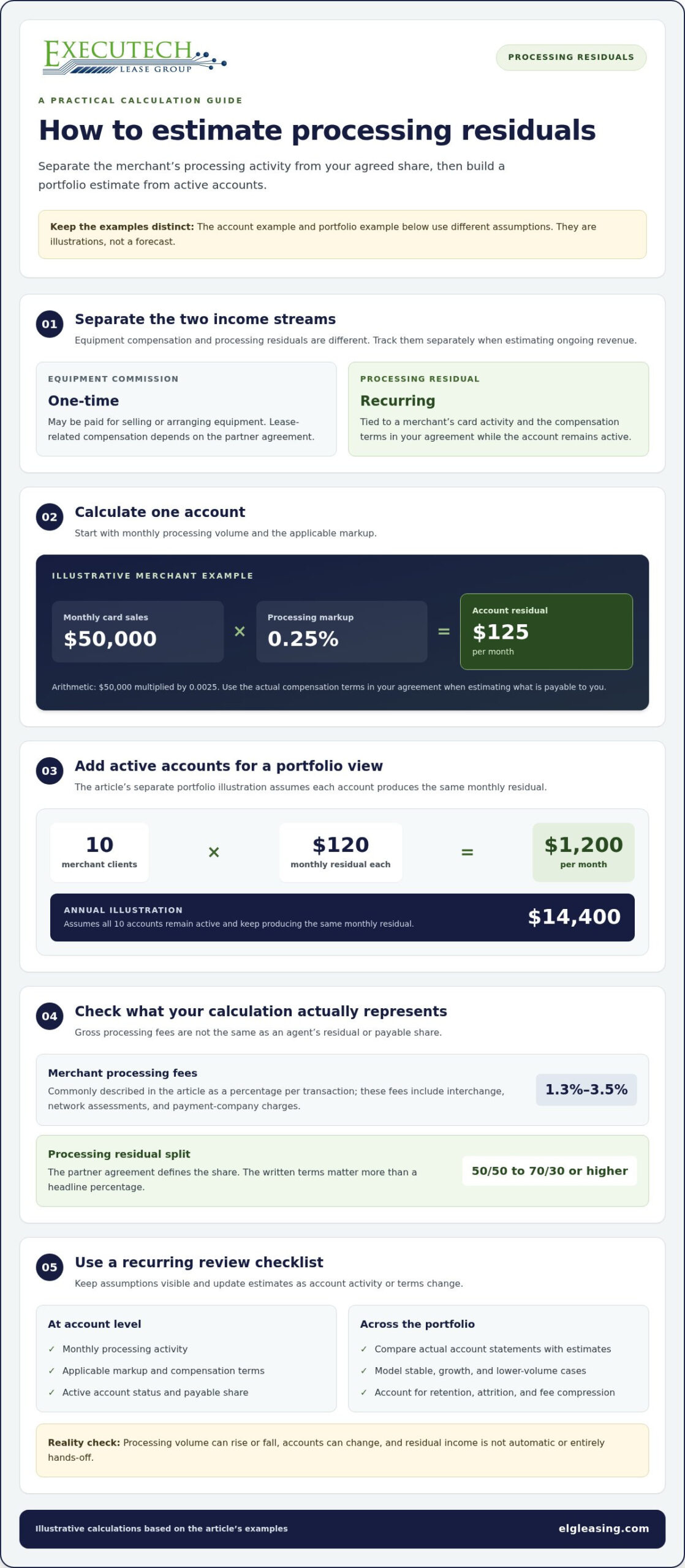
An equipment commission pays for selling or arranging equipment, while processing residuals are recurring commissions tied to a merchant’s card activity. Lease-related compensation depends on the partner agreement, so separate it from processing income when estimating ongoing revenue. For example, an agent may receive a one-time equipment commission and separately earn a share of processing revenue while the merchant account remains active.
Processing fees include costs such as interchange paid to card-issuing banks, network assessments, and payment-company charges. Merchant processing fees are commonly described as 1.3% to 3.5% per transaction, while an agent’s residual is only the portion defined in the partner agreement. That distinction matters: gross processing fees are not the same as your commission.
In the United States, distinguish equipment leasing from payment-processing sales and identify the rules that apply to your business roles and jurisdictions. Before offering agreements, review the lease contract and sales disclosures for each activity against relevant federal and state requirements.
Startup Costs and Ongoing Expenses
Starting as a reseller or independent sales agent involves setting up your business, agreeing on your sales role, and learning the lease and processing programs you represent. Understand the application process, credit decisions, compensation terms, and how residual reports track accounts. These steps shape your operating plan before you start selling.
Upfront and ongoing expenses depend on your operating model. Budget for business setup, prospecting, sales materials, communication tools, and any required partner training. Ongoing work may include maintaining merchant relationships, reviewing account reports, and finding prospects. Keep these operating costs separate from equipment costs financed through a lease.
These examples describe different portfolio stages, not a forecast for a new agent. Results depend on active accounts, merchant processing activity, and your agreed share.
Finding Merchants and Negotiating Agreements
To find merchants, target businesses that need card acceptance or POS equipment, then match the offer to their operating needs. Start with a focused business vertical, such as salons or auto repair, and build a prospect list through consistent outreach. When reviewing existing costs, ask interested merchants for a recent processing statement.
Negotiate by explaining the equipment arrangement separately from processing terms. Clarify the lease term, payment responsibilities, residual split, reporting access, and portfolio ownership in your partner agreement. Payment-processing residual splits may range from 50/50 to 70/30 or higher, so the written terms matter more than a headline percentage.
After reviewing a merchant’s statement, discuss its cost structure and equipment needs in a meeting or phone call. Make the proposal specific: identify the POS equipment, explain the lease arrangement, and show how processing compensation is calculated. Clear terms help you assess whether the opportunity can support ongoing income.
Illustrative residual income calculation
Estimate residual income by separating the merchant’s processing volume from the share assigned to you in your agreement. A credit card transaction may generate processing revenue, but the calculation depends on the applicable markup, partner split, and number of active accounts. Start with account-level assumptions, then model how portfolio changes affect monthly income.
Calculate the account-level residual
Start with one merchant example: monthly card sales of $50,000 and a processing markup of 0.25% produce $125 in residual income for that account. The arithmetic is $50,000 multiplied by 0.0025. This gives you a simple baseline for assessing how transaction volume and the agreed markup affect the account’s contribution.
Then build a portfolio estimate from the account figure. If 10 merchant clients each produce $120 in monthly residuals, the portfolio totals $1,200 per month. Across 12 months, that equals $14,400 annually, assuming all 10 accounts remain active and continue producing the same monthly residual.
- Account volume: Use each merchant’s monthly processing activity.
- Residual rate: Apply the markup or compensation terms in the agreement.
- Portfolio total: Add the account-level amounts for active merchants.
Base each calculation on the actual compensation terms. A processing markup is not automatically your entire payout. If your agreement assigns you only a portion, calculate your share using that split. For example, a portfolio spreadsheet can list each account’s volume, calculated residual, and payable share in separate columns.
Model opportunities without overstating them
Use several scenarios when forecasting. A stable case can hold current accounts and volumes steady; a growth case can add prospective merchants; and a lower-volume case can show the effect of reduced transaction activity. Keep assumptions visible instead of treating a projected monthly figure as income already earned.
Each month, compare actual account statements with your estimates. Flag changes in active status, transaction volume, markup, or partner terms, then update the portfolio total. This makes the model useful for prioritizing sales efforts and identifying accounts that contribute most to ongoing income.
POS leasing can support a merchant offer by helping businesses access payment equipment, while processing activity drives the residual calculation. If equipment access is part of your merchant proposal, you can review the equipment application process as one part of planning that offer.
Risks from attrition and fee compression
A residual portfolio can lose revenue when merchants leave or processing terms change. Attrition removes an account’s contribution; fee compression reduces the revenue generated by an account that remains active. Measure these risks separately, since each can affect the value of future payments in a different way.
How attrition reduces portfolio revenue
Attrition occurs when a merchant closes an account, changes providers, or stops processing through the account tied to your residuals. If a restaurant leaves, for example, its processing activity no longer contributes to your portfolio under that relationship. A partner agreement may also allow an ISO to take back accounts if an agent stops producing, potentially removing future earnings beyond ordinary merchant departures.
Track account status alongside revenue. A merchant can remain listed even as transaction activity drops, so account count alone can overstate portfolio health. Compare active accounts with their processing statements, then investigate sharp changes. Note whether the cause is seasonal activity, a business closure, or a change in payment setup. Each cause calls for a different response.
Make retention work specific. Revisit merchants whose activity declines, ask about changes in their operations, and address service or equipment concerns within your role. Record conversations and agreed follow-ups. Timely attention can help a merchant understand its options and maintain its existing account relationship.
How fee compression affects earnings
Fee compression occurs when competitive pressure or renegotiated terms reduce the markup available to share. A merchant may request lower processing costs, or a provider may adjust pricing. If the account keeps processing but the revenue basis falls, your residual can shrink even when the merchant count stays the same.
Separate transaction volume from the rate used to calculate your share. A stable account, for example, can generate less residual revenue after its pricing terms change. Review partner statements for calculation changes, then compare them with your agreement. This helps identify whether the cause is lower sales, revised pricing, or a changed residual split.
Portfolio concentration creates another risk. If a small group of large merchants supplies much of your revenue, losing one account can have a disproportionate effect. Compare contributions across merchant types and monitor reliance on individual accounts. Consistent prospecting and referrals from current merchants can help create new opportunities instead of relying only on existing revenue.
Use a simple risk review: record account status, processing activity, applicable pricing terms, and your contractual share. Note the cause of each significant change and its effect on portfolio revenue. This provides a clearer basis for earnings projections and marketing priorities than a single headline residual total.
How do POS leasing companies pay commissions and residuals to sales partners?
Sales-partner compensation may combine payment tied to a signed equipment agreement with ongoing commissions from payment processing. These are separate revenue streams. A POS lease supports access to equipment, while processing residuals depend on merchant transaction activity and the partner’s compensation terms.
One-time commissions and recurring residuals
A one-time commission is connected to a sale or account event, such as a newly signed contract, activation, or approval. Recurring processing residuals are calculated from the merchant account’s processing revenue and paid according to the partner agreement. The distinction matters: a sale may generate an initial payment, while ongoing residuals depend on continued account activity.
For illustration, a partner receiving a 0.1% residual on a merchant processing $100,000 in card transactions per month earns $120 in monthly residual income under the stated example. The example shows how a partner’s share relates to processing volume. It does not mean the full processing fee becomes the agent’s commission.
Residual splits also shape the payout. Payment-processing agreements can set splits from 50/50 to 70/30 or higher. Confirm which party receives each side of the split and what revenue base the calculation uses. A percentage without its calculation basis tells you little about the actual payment.
Bonuses, clawbacks, and payout terms
Some partner agreements include bonuses for newly signed contracts, account activation, or approvals. A bonus differs from a residual because it relates to a defined event, not ongoing transaction activity. Some agreements also include a claw-back period. If a merchant decides not to proceed during that period, the partner may have to repay the bonus.
Read payout terms closely. Identify the qualifying event, payment timing, residual calculation, and any claw-back conditions. For example, a contract bonus tied to activation may not be earned if an account never becomes active. Clear definitions help distinguish expected compensation from amounts that depend on later merchant activity.
What to compare in a partner agreement
Review equipment compensation separately from processing residuals. Check whether each payment is one-time or recurring, how the partner split works, and what happens if an account closes or changes status. Clarify whether you retain ownership of your merchant portfolio and how detailed residual reporting will be provided.
Merchant-services agents may continue earning residual commissions while clients remain with them, according to their agreement. That makes account continuity and reporting central to evaluating a program. Compare statements with contract terms, and track signed accounts, activations, and residual payments as distinct measures.
For POS leasing partners, the key question is not simply whether a commission exists. It is how equipment-sale compensation, processing residuals, and bonus conditions fit together in the written agreement.
What upfront costs and ongoing expenses are involved in starting a POS leasing business?
Startup expenses depend on whether you act as a sales agent, build a reseller operation, or finance equipment yourself. Each model has different cash-flow demands. An agent may focus spending on business setup and merchant acquisition, while a business that owns equipment also needs capital for inventory and asset management. Define your role before estimating the resources required.
Separate expenses into launch and operating costs. Launch costs may include business registration, contract review, sales materials, and training on the programs you represent. Ongoing expenses may include prospecting, travel to merchant meetings, customer relationship tools, communications, and bookkeeping. A field-based sales operation, for example, may budget travel differently from one focused on phone outreach.
Build a cost plan around the work you will actually perform:
- Business setup: Account for registration, professional advice, and basic financial records.
- Merchant acquisition: Plan for outreach materials, prospecting tools, and meetings with business owners.
- Equipment exposure: Determine whether your role requires purchasing devices or whether a leasing partner funds the equipment.
- Account administration: Allow time and resources for applications, contract records, commission tracking, and residual reviews.
- Cash-flow reserves: Consider the gap between paying operating expenses and receiving commissions or residual payments.
Equipment financing changes the capital question. If a leasing partner finances payment-processing equipment, a sales agent may not need to purchase each device before presenting a lease option. If you instead acquire equipment for leasing, account for its purchase, storage, deployment, and asset tracking. The agreement determines which party handles each responsibility, so map those duties before committing capital.
Ongoing expenses may also grow with the portfolio. More merchants can mean more applications, records, statement reviews, and follow-up. For example, an agent serving merchants across several business verticals may need a structured system to track account status and commission statements. Include that administrative workload in your operating plan, even when it does not involve hardware purchases.
Use a break-even worksheet before launch. List each expected expense, note whether it recurs, and compare it with the timing and conditions of partner payments. Keep equipment costs separate from sales-operation costs. This helps show how long your available cash can support prospecting while accounts develop.
For a merchant seeking leased POS equipment, start an equipment application
Executech Lease Group (ELG Leasing): 12-60 Month Credit Card and POS Equipment Leases
Executech Lease Group (ELG Leasing) helps merchant services providers, ISOs, and payment processors offer merchants access to payment-processing equipment through 12-60-month leases. Options include lease-to-own programs, FMV lease options, and Clover Leasing.
Consider equipment leasing when a merchant needs a POS system or credit card terminal and equipment access is part of your sales proposal. Leasing can support your merchant relationship, but processing residuals depend on processing activity and your separate partner agreement.
To explore equipment leasing for your merchant portfolio, visit elgleasing.com.
Turn Your Revenue Model Into a Practical Next Step
Before adding equipment leasing to your sales approach, decide what role it should play in your merchant relationships. For teams generating residual income with POS leasing, the next step is to align the equipment conversation with a clear plan for merchant acquisition, account retention, and ongoing portfolio management. That keeps the model grounded in how you serve merchants.
Consider which merchant needs you can address consistently, how you will explain lease terms, and how you will track each relationship. A focused approach helps you evaluate the opportunity as a business model, not just another line in a sales pitch. Keep equipment financing distinct from payment-processing revenue as you build your plan.
If equipment leasing fits your merchant strategy, explore the available options and consider how they could support your next conversation. Start with a clear business case, then take the next step at your own pace.
Build deliberately, keep expectations grounded, and give your merchant relationships room to grow.
Frequently Asked Questions
How does POS terminal leasing generate residual income?
POS leasing can help a merchant obtain equipment, but recurring commissions generally come from a separate payment-processing agreement. For agents generating residual income with POS leasing, distinguish lease-sale compensation from processing residuals. The latter is calculated under partner terms based on eligible merchant activity. If a merchant leases a terminal but processes transactions elsewhere, the equipment lease alone does not generate that processing commission.
What are typical POS leasing prices, contract terms, and monthly fees in the United States?
There’s no single standard U.S. monthly payment for POS equipment leasing. Pricing depends on the equipment and lease structure, and a specific quote follows a quote request. Compare the scheduled payments, contract length, and end-of-term option rather than judging by a monthly figure alone. The agreement should also make clear which equipment is included and whether any bundled services form part of the arrangement.
How much residual income can a POS leasing agent earn per merchant account?
There is no fixed residual amount per merchant account. Calculate each account using its eligible processing revenue and the partner’s agreed share, then account for changes in transaction activity or compensation terms. Two merchants in the same portfolio, for example, may contribute different amounts because their sales volumes differ. Keep account-level calculations separate to see which relationships contribute to monthly revenue.
What risks can reduce or eliminate POS leasing residual income, such as merchant churn or chargebacks?
Merchant churn can eliminate residual income from an account when the merchant leaves or stops processing through that relationship. Lower transaction volume or changed contract terms can also reduce payouts. Chargebacks affect transaction records, but any effect on an agent’s residual depends on the partner agreement. Track account activity and reconcile payout statements against the written terms to distinguish volume changes from contractual adjustments.
This article reflects the author’s opinion for general information only and isn’t tax, legal, or accounting advice. Consult your CPA or attorney about your specific situation.

Article by
Robert Ensminger
Robert Ensminger is the founder and CEO of Executech Lease Group (ELG Leasing), which specializes in equipment leasing and financing solutions for the merchant-services, payments, POS, and FinTech industries. With more than 20 years of industry experience, Robert helps ISOs, payment processors, POS providers, and software companies build practical equipment leasing programs. He founded ELG in 2010. His work focuses on responsive service, transparent program structures, subscription and SaaS-monetization programs, and helping ELG’s partners close more business while creating sustainable revenue.