
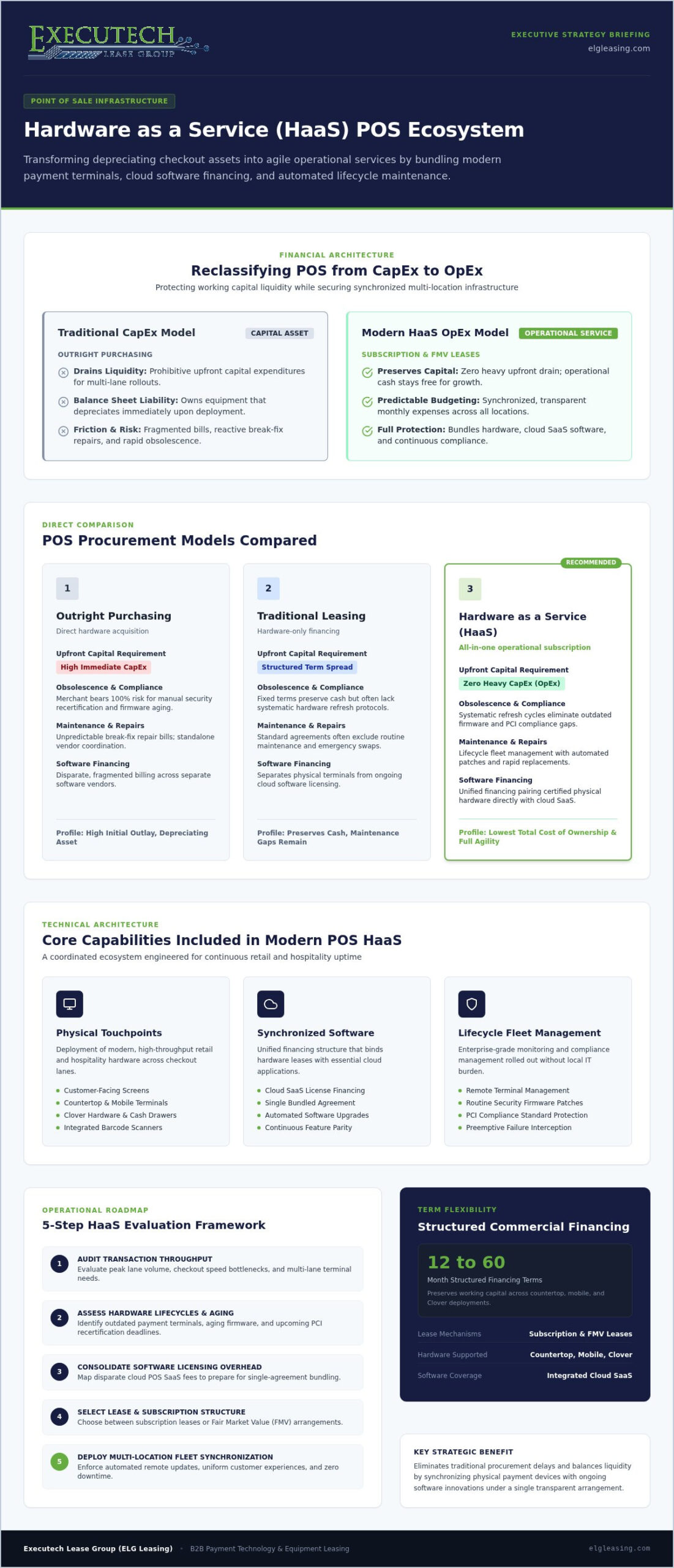
Treating payment terminals as capital assets is quietly draining your working capital. Between prohibitive upfront expenses for multi-lane rollouts and rapid hardware obsolescence, purchasing checkout equipment locks cash into depreciating tools that quickly fall behind compliance standards. You already know the administrative friction. Juggling fragmented bills across software providers, terminal vendors, and support technicians wastes valuable time and complicates monthly cash flow. Shifting to a hardware as a service POS model changes that dynamic immediately, transforming static hardware from a sunk cost into an agile operational asset.
Modernizing your checkout infrastructure shouldn’t require depleting cash reserves or managing disparate vendor contracts. In this guide, you’ll learn how Hardware as a Service (HaaS) POS eliminates heavy upfront capital costs while delivering modern terminal technology, automated software upgrades, and predictable operational expenses. We’ll examine the exact mechanics of subscription leases, Fair Market Value (FMV) options, and integrated cloud software financing so you can secure a streamlined payment ecosystem through a single transparent arrangement.
Key Takeaways
- Understand how hardware as a service POS eliminates prohibitive capital expenditures by bundling terminals, cloud software, and maintenance into a single operational expense.
- Compare the financial mechanics of subscription leases, FMV leases, and direct purchases to pinpoint the lowest total cost of ownership.
- Discover how combining physical payment devices with cloud SaaS software financing protects your checkout flow from rapid obsolescence.
- Use a five-step evaluation framework to audit transaction throughput, terminal lifecycles, and software overhead across all business locations.
- Identify how structured 12 to 60-month financing terms preserve commercial working capital while delivering modern countertop, mobile, and Clover hardware.
What Is Hardware as a Service POS and How Does It Work?
Most checkout management systems fail because merchants confuse asset ownership with operational utility. When you buy retail checkout gear outright, you own an asset that begins depreciating the moment it leaves the warehouse. In contrast, hardware as a service POS combines physical devices, cloud software access, and maintenance into a structured subscription agreement. Instead of purchasing standalone registers, merchants deploy complete checkout ecosystems as an ongoing operational service. Modern commerce moves quickly; legacy ownership ties your store to rigid systems.
To see how upgrading checkout technology impacts everyday store operations, watch this overview of modern retail hardware:
Deploying checkout infrastructure this way bypasses traditional procurement delays. Rather than managing complex IT seat allocations or settling for reactive break-fix repair programs, merchants leverage specialized subscription programs to streamline terminal operations. A standard Point of Sale (POS) footprint requires regular security revisions. By enforcing systematic refresh schedules, the HaaS model eliminates outdated firmware, prevents PCI compliance gaps, and stops hardware failures before they interrupt customer checkouts.
The Shift from CapEx to OpEx in Point of Sale
Sinking tens of thousands of dollars into checkout lanes makes little financial sense. Reclassifying point of sale procurement from capital expenditure (CapEx) to operating expenditure (OpEx) protects liquidity. You maintain operational cash flow for inventory expansion, marketing, and staffing. Rather than absorbing unpredictable maintenance charges or steep upfront deployment costs, your multi-location footprint operates under predictable, synchronized monthly expenses that stabilize annual budgets.
Core Capabilities Included in Modern POS HaaS
A true hardware as a service POS agreement delivers a coordinated ecosystem engineered for continuous retail uptime. Typical deployments integrate several vital layers:
- Physical Touchpoints: Customer-facing screens, countertop terminals, cash drawers, and barcode scanners configured for fast lane throughput.
- Synchronized Software: Unified financing that pairs physical terminals directly with cloud software licenses.
- Lifecycle Fleet Management: Automated remote terminal management, routine compliance patches, and security firmware updates rolled out across all devices without local IT intervention.
POS HaaS vs. Traditional Leasing vs. Buying: A Direct Comparison
Selecting checkout equipment requires balancing upfront liquidity against recurring operational costs. Purchasing hardware directly seems simple on paper, but it forces your business to assume full balance-sheet depreciation, manual terminal recertification, and unexpected repair expenses. As Hardware as a Service (HaaS) frameworks gain adoption across modern retail environments, merchants are moving away from outright ownership. Instead, they leverage flexible financing to match terminal lifecycles with continuous payment innovations.
Understanding how each acquisition path affects your operation clarifies which model suits your current growth phase:
- Outright Purchasing: Requires high immediate capital expenditure. The merchant carries total responsibility for device obsolescence, broken hardware swaps, and manual security patches.
- Traditional Commercial Leasing: Spreads hardware costs over structured terms. While it preserves upfront cash, standard contracts often separate physical equipment from ongoing software updates, leaving maintenance gaps.
- Hardware as a Service POS: Combines certified payment devices, cloud software financing, and active maintenance into a single operational agreement, ensuring regular terminal refreshes.
Financial Flexibility: Cash Flow, Taxes, and Ownership
Capital management separates thriving retail operations from stagnant ones. Buying terminals locks substantial liquidity into depreciating tools. That capital could otherwise finance inventory expansion or marketing. Structured lease agreements allow businesses to treat monthly payments as deductible operational expenses or leverage Section 179 depreciation rules depending on contract structure. When you own legacy gear outright, upgrading to support new biometric or mobile payment methods requires another massive cash outlay. An agile operating lease avoids this trap entirely.
Lifecycle Management and Equipment Upgrades
Disposing of legacy terminals is an administrative nightmare. Merchants must securely sanitize encrypted data, scrap outdated components, and pay out of pocket to purchase compliant replacements. Modern lease structures solve this cycle cleanly. Choosing a Fair Market Value (FMV) agreement lets you return or upgrade your devices at the end of your term without disposal friction. For a broader breakdown of contract terms, explore our guide on POS equipment leasing to compare your options.
Ready to modernize your terminal infrastructure without balance-sheet strain? Take a moment to explore our flexible financing options tailored to your checkout workflow.
Key Components of an Effective POS Hardware Subscription Agreement
Fragmented vendor relationships create unnecessary operational risk. When a touchscreen fails or a card reader rejects contactless payments, merchants often get caught in finger-pointing between software developers, device distributors, and field technicians. An enterprise-grade hardware as a service POS contract eliminates this operational friction. By consolidating physical terminals, ongoing licensing, and equipment lifecycle management into a single transparent schedule, you establish unified accountability across your entire checkout infrastructure.
Industry leaders recognize this shift toward consolidation. According to Clover, adopting a subscription model for payment terminals allows operators to preserve capital while systematically accessing modern payment technology. A complete agreement must clearly address terminal certifications, software provisioning, and end-of-term parameters to prevent surprise expenses.
Bundling Terminal Hardware with Cloud SaaS POS Software
Managing disparate invoices for cloud software seats, add-on modules, and physical countertop terminals drains back-office productivity. Forward-thinking operators consolidate these costs into unified subscription leases. Rather than writing separate checks to an independent software vendor (ISV) and an equipment distributor, you bundle them together. You can review how integrated structures work through cloud-based POS financing, aligning your ongoing application fees, real-time inventory tools, and lane devices into one predictable payment schedule.
Device Specialization: Countertop, Mobile, and Smart Terminals
Every checkout environment demands purpose-built equipment. A quick-service cafe needs durable customer-facing displays, while a multi-floor retailer requires portable handheld units for line busting. Structuring an agile hardware as a service POS strategy allows you to deploy the exact form factors your floor plan requires:
- Smart Countertop Stations: High-throughput dual-screen configurations designed for rapid order entry, cash drawer connectivity, and barcode integration.
- Mobile and Handheld Terminals: Lightweight devices featuring integrated payment readers and cellular failover for tableside ordering or curbside checkout.
- Integrated Smart Terminals: Comprehensive ecosystems like those featured in our guide to Clover terminal leasing, offering custom business management apps alongside native EMV chip and NFC processing.
Every deployed unit must maintain rigorous security standards. Your agreement must specify point-to-point encryption (P2PE), physical tamper detection, and verified PCI compliance to safeguard cardholder data across every lane.
Evaluating POS Hardware as a Service for Your Business Model
Every commercial checkout environment presents unique demands. Determining whether to transition to a hardware as a service POS structure requires auditing how your terminals perform under daily transaction pressure. While some enterprise providers claim subscription financing only makes sense for national chains with thousands of seats, growing retailers and multi-lane merchants gain immediate advantages from operational agility. Structured evaluation protects your profit margins from unnecessary equipment expenses.
Use this five-step framework to audit your current checkout infrastructure:
- Terminal Age and Failure Rates: Identify devices older than three years that struggle with contactless response times or require frequent manual reboots.
- Peak Transaction Velocity: Calculate hourly customer volume to verify whether fixed countertop units or mobile devices prevent checkout bottlenecks.
- Software Licensing Overhead: Map every recurring fee paid for inventory management, software seats, and third-party integrations across all locations.
- Term Alignment: Select custom financing terms between 12 and 60 months that mirror your store’s natural hardware depreciation cycles.
- Growth and Upgrades: Ensure your agreement includes flexible provisions for adding lanes or swapping equipment mid-term as payment standards evolve.
Assessing Transaction Velocity and Hardware Wear
Checkout hardware takes a beating in fast-paced retail and hospitality spaces. High daily transaction counts wear down touchscreens, internal printer mechanisms, and card reader slots far faster than standard corporate office IT equipment. When an aging stationary terminal freezes during lunch rush or holiday retail peaks, lost sales and customer frustration compound quickly. Migrating to a flexible hardware as a service POS framework ensures proactive unit replacement before mechanical wear disrupts daily revenue.
Choosing Between FMV Leases, Subscription Leases, and Lease-to-Own
Selecting the right financing vehicle depends on whether your organization values asset ownership or continuous technology turnover. Reviewing our POS lease to own guide helps clarify these distinct financial paths. A standard lease-to-own structure fits businesses operating stable, low-complexity checkout stations where long-term ownership equity makes operational sense. Conversely, a Fair Market Value (FMV) or subscription lease suits high-growth merchants who prioritize regular hardware refreshes to support new customer payment preferences without disposing of obsolete assets.
Implementing Your POS Equipment Strategy with ELG Leasing
Executing an agile hardware strategy requires a specialized financing partner who understands payment operations. Traditional commercial banks rarely understand point of sale depreciation cycles, while broad IT leasing firms force merchants into rigid corporate workstation models. ELG Leasing serves as the dedicated financial engine that facilitates modern terminal deployments without balance sheet disruption. By delivering flexible 12 to 60-month agreement structures, merchants access cutting-edge checkout hardware and cloud software through predictable, transparent arrangements.
Whether you need countertop terminals, mobile payment units, or versatile Clover devices, our nationwide programs eliminate the friction of legacy procurement. We do not provide direct payment processing or short-term daily rentals. We specialize strictly in commercial equipment and software financing, ensuring our interests remain completely aligned with your operational success.
Tailored Financing Programs for Merchants and ISOs Nationwide
Independent Sales Organizations (ISOs), sales agents, and merchant service providers require adaptable financing tools to close larger merchant accounts. Providing a complete checkout package without demanding high upfront equipment capital expands merchant adoption and protects retention. Through specialized ELG Leasing programs, sales partners can bundle physical terminal equipment with cloud SaaS POS applications into a unified monthly structure, serving everything from single-terminal specialty boutiques to rapidly expanding multi-lane retail chains.
Streamlined Approval and Onboarding Process
Speed to deployment is critical when opening new locations or upgrading non-compliant hardware fleets. Long sales cycles, bureaucratic underwriting, and complex paperwork stall commercial momentum. ELG Leasing operates an efficient, document-light onboarding process engineered to approve applications quickly and keep your installation dates on schedule.
Our operational framework follows a transparent progression:
- Direct Digital Submission: Simple online application intake that captures your hardware preferences, software licensing needs, and requested terms.
- Rapid Underwriting: Swift commercial review that assesses business profiles without unnecessary delays or cumbersome audits.
- Unified Contract Execution: Fast digital document delivery via e-signature, coordinating equipment distribution immediately.
Review every operational stage on our detailed ELG Leasing process flow page to understand how quickly your store can deploy modern checkout infrastructure.
Modernize Your Checkout Infrastructure with Financial Agility
Treating payment hardware as a heavy capital investment restricts cash flow and slows down store modernization. Migrating to an agile hardware as a service POS framework lets you eliminate upfront capital drains, bundle cloud software seats into predictable monthly operational expenses, and maintain continuous PCI compliance. Pairing modern countertop terminals or mobile Clover devices with structured 12 to 60-month financing protects working capital, ensuring your business stays equipped with the latest checkout tools without balance-sheet strain.
Take control of your checkout operations today and build a resilient payment setup designed to scale alongside your business.
Frequently Asked Questions
What is the main difference between Hardware as a Service POS and traditional leasing?
A hardware as a service POS agreement bundles physical terminals, cloud POS software financing, and routine system upgrades into a single recurring monthly cost. Traditional commercial equipment leasing focuses strictly on financing the physical machinery, often leaving maintenance, software subscriptions, and terminal recertifications to be managed under separate vendor agreements.
Can cloud POS software fees be bundled into a POS equipment lease?
Yes, specialized subscription leases can finance both physical terminals and cloud SaaS POS software licenses simultaneously. This arrangement consolidates your core application fees, add-on features, and terminal costs into one predictable billing structure, eliminating the hassle of juggling multiple provider payments each month.
What happens to the POS hardware at the end of the agreement term?
End-of-term options depend directly on whether you choose a Fair Market Value (FMV) lease, a subscription agreement, or a lease-to-own structure. With an FMV or subscription lease, you can return the gear to upgrade to new payment technology or renew the contract. Lease-to-own programs allow you to retain full ownership of the devices once the agreed terms conclude.
Is Hardware as a Service cost-effective for small businesses and single-terminal shops?
Yes, single-location shops benefit significantly by preserving working capital instead of paying heavy upfront costs for registers, printers, and scanners. A structured hardware as a service POS plan spreads expenses over 12 to 60 months. This gives independent merchants immediate access to modern payment terminals without straining commercial cash reserves.
Can I upgrade my POS payment terminals before my agreement term expires?
Early terminal upgrades are supported through structured mid-term trade-in options and contract amendments. If consumer payment standards change or your checkout requires higher processing speeds, your financing agreement can often be restructured to roll remaining balances into newer equipment models, keeping your checkout lanes competitive.
Who is responsible for hardware replacements if a payment terminal malfunctions?
Hardware support terms depend on the specific program agreement established at signing. Subscription models generally coordinate replacement units, warranty swaps, and technical provisioning through your provider channel. This process minimizes checkout lane downtime and avoids the costly surprise repair invoices typical of outright equipment ownership.
Does POS equipment leasing require switching payment processing providers?
No, leasing equipment through an independent financing specialist does not lock you into a specific credit card processor. ELG Leasing focuses entirely on flexible hardware and software financing structures. We do not provide direct payment processing, giving you the operational freedom to pair your leased terminals with whichever merchant processor best fits your business.
Article by
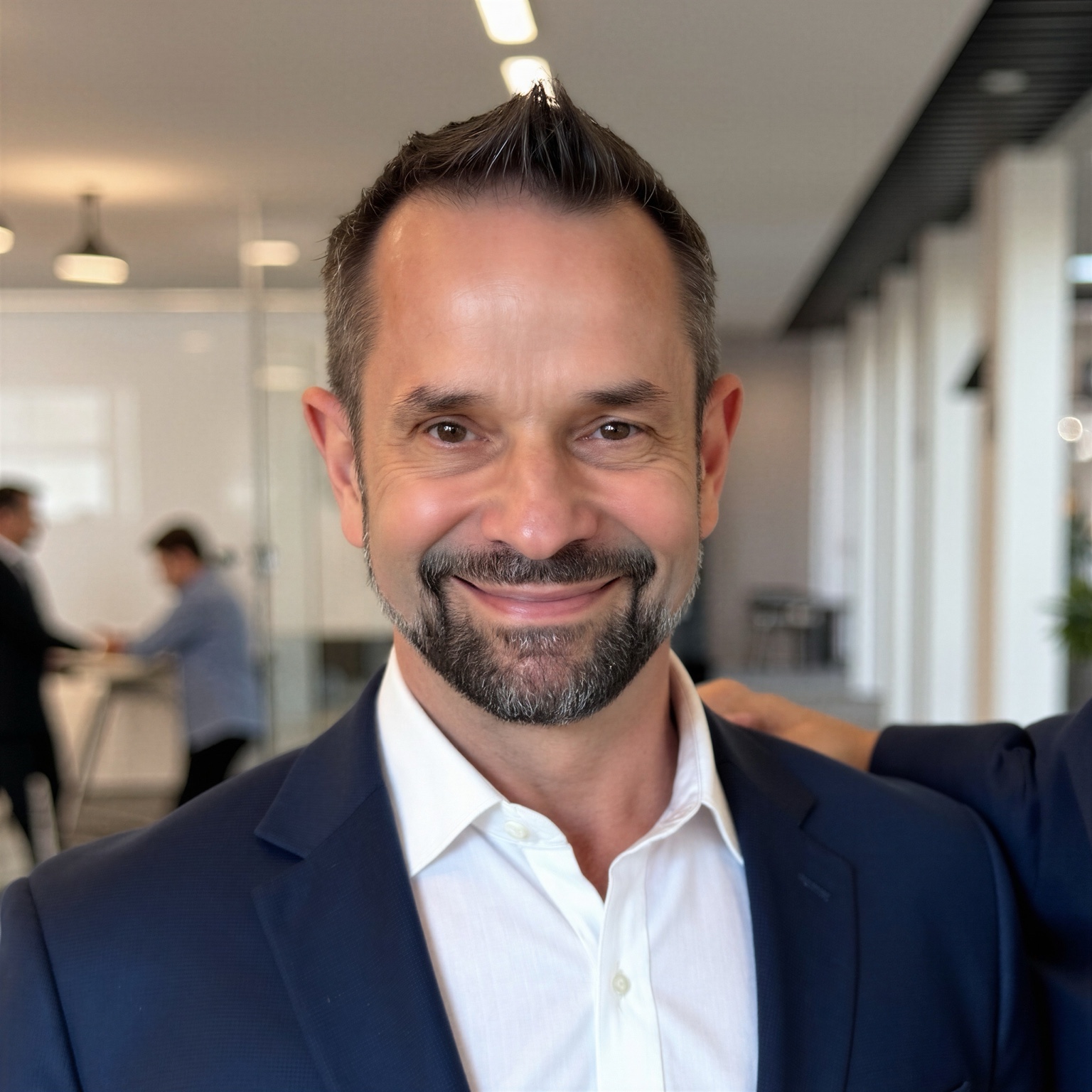
Robert Ensminger
Robert Ensminger is the founder and CEO of Executech Lease Group (ELG Leasing), which specializes in equipment leasing and financing solutions for the merchant-services, payments, POS, and FinTech industries. With more than 20 years of industry experience, Robert helps independent sales organizations, payment processors, POS providers, and software companies develop practical leasing, subscription, and SaaS-monetization programs. He founded ELG in 2010 and guided the company to recognition on the Inc. 5000. His work focuses on responsive service, transparent program structures, and helping ELG’s partners close more business while creating sustainable revenue.