
POS leasing combines sales and equipment financing, not just a hardware pitch. To learn how to become a POS leasing agent, build knowledge of merchant services, payment terminals, and lease structures, then look for a role with a provider or sales organization in the industry. The path also depends on what you mean by “sponsoring broker,” a term more commonly associated with real estate.
Look beyond the job title. The work may involve qualifying merchants, explaining equipment lease options, handling paperwork, and understanding how equipment costs affect a deal. A broker relationship may matter in some roles, but it is not automatically a requirement for arranging POS equipment leases.
This guide covers the skills and work conditions to consider, the leasing duties an agent may handle, and how equipment costs fit into the business. It also explains what to clarify about broker sponsorship so you can identify a suitable route and get a realistic picture of the role.
Key Takeaways
- Separate POS equipment leasing from property leasing before pursuing a sponsoring broker; the roles can involve different duties and requirements.
- Identify the sales experience, product knowledge, and merchant-services training that fit the POS agent role you want.
- Understand how merchant qualification, lease paperwork, and processing-account setup can shape your day-to-day responsibilities.
- Review how compensation is structured, including whether earnings depend on salary, commission, or both.
- Build your knowledge of lease options and hardware pricing so you can explain terms clearly to merchants.
Business eligibility and qualification requirements
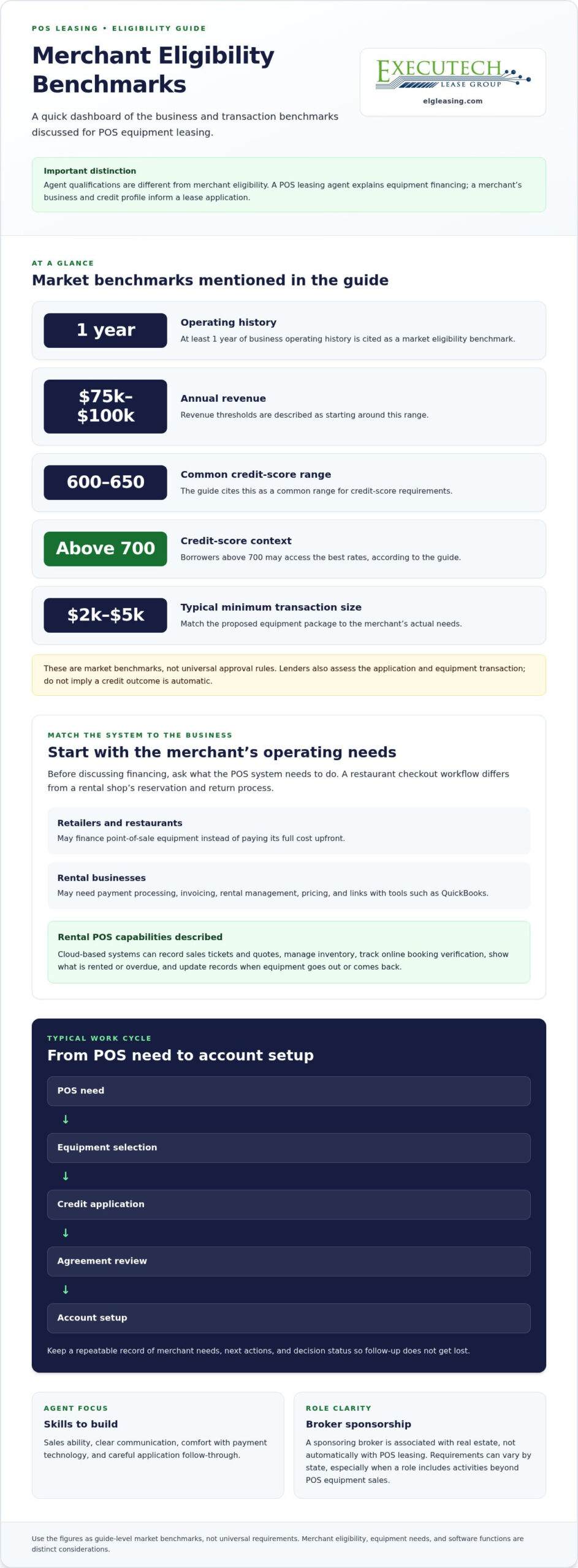
Requirements and opportunities can vary by state, particularly when a role includes activities beyond POS equipment sales. A sponsoring broker is associated with real estate, not automatically with POS leasing. Distinguishing between the two fields is a useful first step in learning how to become a POS leasing agent.
- Separate agent qualifications from merchant eligibility. A POS leasing agent explains equipment financing; the merchant’s business and credit profile inform a lease application. Focus on sales ability, clear communication, and comfort with payment technology. A prospective customer’s credit criteria are not universal hiring requirements. For example, a retail sales role may emphasize merchant conversations, while an account-focused position may require careful application follow-through. This distinction helps you identify the skills to build as you learn how to become a POS leasing agent.
- Learn which businesses use POS financing. Retailers and restaurants may finance point-of-sale equipment instead of paying its full cost upfront. Rental businesses also use POS systems to manage inventory and transactions. Their needs may include payment processing, invoicing, rental management, pricing, and links with tools such as QuickBooks. Before discussing financing, ask what the merchant needs the system to do. A restaurant’s checkout workflow differs from a rental shop’s reservation and return process.
- Understand the merchant’s business and credit profile. Market eligibility benchmarks for POS equipment leasing include at least 1 year of operating history and annual revenue thresholds starting around $75,000 to $100,000. Common credit-score requirements fall between 600 and 650; borrowers above 700 may access the best rates. These are market benchmarks, not universal approval rules. Lenders also assess the application and equipment transaction. Typical minimum transaction sizes are $2,000 to $5,000, so match the proposed equipment package to the merchant’s actual needs.
- Connect rental POS capabilities to operational needs. Cloud-based systems can record sales tickets and quotes, manage inventory, and track online booking verification. Rental inventory tools may show what is rented or overdue and update records when equipment goes out or comes back. A rental business accepting online reservations can use its system to coordinate preparation. Ask owners how they track availability, then connect relevant capabilities to a specific task, such as preparing a reserved item.
As you prepare for the role, learn to distinguish merchant eligibility, equipment requirements, and software functions. This helps you explain the application process without confusing POS leasing with property leasing or promising a credit outcome.
Career outlook and work conditions
- Assess the role’s sales structure before accepting. POS leasing jobs can differ in how they assign prospects, manage accounts, and compensate completed business. Review the job description for territory expectations, lead sources, travel, and whether you’ll prospect independently or work with existing merchant relationships. A role based on visiting retailers has different daily demands from one focused on scheduled calls. Ask how managers measure activity and completed lease agreements so you can assess the work against your strengths.
- Map the full work cycle. A merchant conversation may start with a POS need, then move through equipment selection, a credit application, agreement review, and account setup. Tracking each stage helps keep promising conversations from getting lost after follow-up. Use a repeatable system to record the merchant’s needs, next action, and decision status. After discussing a restaurant’s checkout setup, for example, record the agreed next step and when you’ll reconnect.
- Prepare for changing workloads. Prospecting and follow-up demands can shift throughout the sales cycle. A new contact may need a product explanation, while a merchant reviewing lease terms may need precise answers about the agreement. Organize your day around outreach, application updates, and scheduled conversations. During busy periods, keep notes current and prioritize time-sensitive questions without implying that credit decisions or lease approvals are automatic.
- Evaluate the career path by transferable skills. POS leasing work can develop skills in consultative sales, payment technology, customer communication, and application tracking. Depending on the employer’s structure and your results, these skills may support future roles in merchant services or account management. Compare positions by training, management access, territory, and the balance between prospecting and account follow-through. Look for clear expectations around agreements and customer handoffs, not broad promises about career growth.
For a role that includes helping merchants submit equipment applications, understanding the merchant equipment leasing application process can make the paperwork easier to explain. Keep your expectations grounded in the specific job’s responsibilities, sales process, and compensation terms.
Rental POS systems can track employee hours and create work schedules. When discussing equipment with a merchant, be ready to explain these functions alongside the checkout needs that prompted the conversation. Ask whether the role includes workforce features in product discussions and what training is provided to present them accurately. Clear expectations help you understand whether the job focuses on arranging equipment leases or also involves explaining relevant system capabilities.
Questions about these features can help you learn what matters to a prospective customer. Record the merchant’s needs and agreed next steps for follow-up. Keep explanations tied to stated requirements, and avoid promising outcomes beyond the system functions described.
Leasing agent duties
- Learn the rules for the transaction and location. Legal, disclosure, and consumer-protection requirements can vary by state and deal structure. Identify whether the customer is a business, follow the applicable agreement process, and use the disclosures supplied for that transaction. Don’t present a general sales explanation as legal advice. For a retail merchant, explain the commercial purpose and key terms clearly before requesting a signature.
- Qualify the equipment need before discussing terms. Ask what the merchant wants to finance, how the POS system will be used, and which equipment belongs in the proposal. A small shop may need a different setup from a restaurant with several checkout stations. Keep the proposed package aligned with the owner’s stated requirements so optional equipment or services aren’t confused with items included in the lease.
- Explain the available program and agreement plainly. Compare relevant lease programs by term, payment structure, end-of-term options, and covered equipment. Explain unfamiliar terms before asking the owner to proceed. Don’t describe a lease as a purchase unless the agreement says so. A clear explanation helps the merchant compare the proposal with the business’s budget and operating plans.
- Submit complete paperwork and track each step. Sales steps typically include recording the equipment selection, completing the credit application, presenting the lease agreement, and arranging processing-account setup. Contract processing and processing-account setup should follow the applicable workflow. Track missing fields and follow-up actions, then provide copies of completed documents through the approved process. Never fill gaps by guessing on the merchant’s behalf.
- Protect the merchant from misleading sales practices. Watch for pressure to sign immediately, unexplained charges, altered terms, or requests to sign blank documents. Compare the final agreement with the proposal, including equipment, payment obligations, and end-of-term language. Don’t promise approval, a particular rate, or savings. Keep the pitch accurate and correct mistakes before documents move forward.
- Keep the account handoff organized. Confirm that the signed contract, equipment details, and processing-account information match. For example, if a merchant selects one terminal but the agreement lists another, pause and resolve the mismatch through the authorized workflow. Record the correction and communicate the next step. Accurate tracking reduces avoidable confusion for the merchant and the teams handling fulfillment.
In short, arranging a POS equipment lease means matching equipment to the business, explaining the agreement, completing accurate paperwork, and coordinating the required account setup. Watch for pressure tactics, blank forms, and differences between the proposal and signed terms.
How to get certified to sell POS and leasing services?
- Confirm what the role requires. Before enrolling in a course, distinguish POS product training from leasing and sales preparation. Review the job description for any named credentials or required employer training. A role selling payment terminals may emphasize hardware features, while a leasing-focused position may prioritize explaining agreement terms. List required skills, preferred qualifications, and topics you still need to learn. This gives your plan for becoming a POS leasing agent a practical starting point.
- Build practical POS system knowledge. Learn how a point-of-sale system supports checkout, payment acceptance, and daily workflows. Compare a basic retail checkout with a restaurant’s order-taking needs. Practice explaining the system in plain language and how the equipment fits the merchant’s stated use. Focus on the business need, not a feature list. Clear explanations help owners judge whether the proposed setup suits their operation.
- Study lease structures and agreement language. Learn how a lease differs from an outright equipment purchase. Review how term, payment schedule, ownership, and end-of-term provisions appear in sample agreements. Practice explaining which equipment is covered, what the merchant pays, and what happens when the term ends. Don’t paraphrase a clause you don’t understand. Record questions for your trainer and use approved explanations with merchants.
- Train on the application workflow. Practice each stage, from gathering equipment details to completing an application and tracking its status. Use a fictional merchant profile to spot missing fields, inconsistent business information, or equipment that doesn’t match the proposal. Learn which team handles each handoff and how to record follow-up. Accurate paperwork is part of the job, not an administrative detail to leave until after the sale.
- Rehearse ethical sales conversations. Role-play a meeting with a retail owner who needs checkout equipment and has questions about lease obligations. Explain the terms without promising approval, a specific rate, or savings. Practice answering “Can I own it at the end?” by referring to the agreement’s actual option. Ask a trainer to review your explanation for accuracy, clarity, and pressure-free language before speaking with merchants.
Use a simple training record to track product lessons, agreement reviews, application practice, and role-play feedback. Note which lease terms you can explain confidently and which need a trainer’s review. If you’re deciding how to become a POS leasing agent, a certificate can document course completion when an employer requires one. Practical competence comes from accurately explaining equipment, agreements, and workflow.
What are typical POS leasing agent commissions, salaries, and earnings?
- Separate POS compensation from property-leasing salary data. Salary figures for real-estate leasing agents don’t establish typical pay for POS equipment sales. Earnings in a POS role depend on the employer’s compensation plan, sales responsibilities, and whether the position includes a base salary. Confirm the job category and pay structure first. A merchant-services sales position may combine prospecting with lease applications, while another role may focus on assigned accounts.
- Ask how commissions are triggered. A commission plan should define what earns payment, such as a completed sale or funded lease. It should also explain how the employer handles cancellations, incomplete applications, and equipment-package changes. Ask for a written example using a hypothetical transaction. This helps clarify whether earnings depend on signed paperwork, funding, or another stated milestone.
- Compare salary, commission, and combined plans. A salary is a fixed wage under the employer’s terms; commission varies with qualifying sales. A combined plan may include both, but the written agreement should explain each component. Compare eligibility rules, payment timing, and how the plan treats assigned accounts. Don’t estimate annual income from a top-performer example alone. Use the actual plan terms and your expected sales activity.
- Identify the factors that affect variable earnings. Commission may depend on the employer’s formula, eligible equipment, completed lease volume, and the agent’s role in the transaction. An agent who sources a merchant, for example, may receive different credit under a plan from one who processes an assigned application. Review how split sales, repeat business, and incomplete deals are treated. Clarify the definitions before comparing job offers.
- Evaluate the role’s day-to-day demands alongside pay. Earnings potential isn’t the only measure of a POS leasing job. Compare prospecting expectations, lead assignment, training, travel, sales targets, and administrative work. Ask how managers track completed agreements and review performance. A clear plan should tie compensation to defined duties, not vague promises about future earnings. Keep a copy of the offer and written compensation terms for comparison.
Executech Lease Group (ELG Leasing): 12-60 Month Credit Card and POS Equipment Leases
Executech Lease Group (ELG Leasing) helps merchant-services providers and their merchants access payment-processing equipment through lease options. If your role involves helping a merchant finance POS hardware or card terminals, its 12-60-month equipment leases may fit the next step after qualifying the business and identifying its equipment needs.
Available structures include lease-to-own and fair market value (FMV) lease options. Executech Lease Group (ELG) leases POS and card-terminal equipment, including Clover devices. Its role is equipment leasing, not direct payment processing. Match the option to the merchant’s equipment needs and explain the agreement clearly.
If you’re ready to discuss equipment leasing for a merchant, contact Executech Lease Group.
Take the next step toward a POS leasing career
To decide how to become a POS leasing agent, connect your sales strengths with the day-to-day work. Consider whether you enjoy explaining technology, handling detailed paperwork, and building merchant relationships. Then look for roles with clearly defined expectations, training, and compensation terms.
If you work with merchants who need payment equipment, understanding how lease applications move from discussion to submission can help you support the process. Explore the leasing programs and consider where your skills fit.
Build your knowledge one conversation at a time, then explore the next step with Executech Lease Group (ELG).
This article reflects the author’s opinion for general information only and isn’t tax, legal, or accounting advice. Consult your CPA or attorney about your specific situation.
Frequently Asked Questions
What Is a Leasing Agent?
A leasing agent helps a customer arrange use of equipment or property under an agreement. The work depends on the asset: a property leasing agent handles real estate rentals, while a POS leasing agent focuses on payment equipment financing. For example, a POS agent may help a retailer understand equipment options and move an application through the leasing process. The title alone doesn’t identify the industry or duties.
What does a POS leasing agent do?
A POS leasing agent connects a business’s equipment needs with a lease option and guides the transaction. This can involve learning how a merchant handles checkout, discussing suitable terminals or POS hardware, explaining the agreement, and coordinating application details. An agent might help a shop owner distinguish a countertop terminal from a broader point-of-sale setup. Explain terms accurately and don’t promise approval or specific outcomes.
What qualifications or licenses are required to become a POS leasing agent in the United States?
Requirements depend on the employer and the work involved. POS equipment sales and property leasing are different activities, and a sponsoring broker is associated with real-estate licensees, not automatically with POS equipment sales. Employers may value sales ability, payment-technology knowledge, and careful document handling. Before accepting a role, clarify its duties and training expectations, especially if it includes activities beyond discussing equipment and lease applications.
How can I find POS leasing companies hiring agents or independent sales representatives?
Search for roles using terms such as POS equipment sales, merchant services agent, and payment technology sales. Review employer career pages and job listings, then compare employee and independent representative positions. Check each posting for lead-generation duties, territory expectations, compensation structure, training, and whether the role handles equipment leasing or payment processing. Prepare a concise resume highlighting relevant sales experience and examples of explaining technical products to business customers.
How do I find and qualify businesses that need POS systems?
Start with businesses where checkout, order handling, or rental transactions are central to daily operations. Ask owners how they accept payments, track sales, and manage their equipment. A retailer with separate checkout devices may have different needs from a rental business managing reservations and returns. Before discussing a lease application, record the owner’s workflow, equipment priorities, decision process, and desired next step.

Article by
Robert Ensminger
Robert Ensminger is the founder and CEO of Executech Lease Group (ELG Leasing), which specializes in equipment leasing and financing solutions for the merchant-services, payments, POS, and FinTech industries. With more than 20 years of industry experience, Robert helps ISOs, payment processors, POS providers, and software companies build practical equipment leasing programs. He founded ELG in 2010. His work focuses on responsive service, transparent program structures, subscription and SaaS-monetization programs, and helping ELG’s partners close more business while creating sustainable revenue.