
A manageable monthly payment can still hide a costly commitment. To understand how to negotiate POS equipment lease terms, look beyond the monthly amount and focus on your obligations across the full term, including what happens at the end. A payment that fits today may not tell you whether the structure suits your business as equipment needs or operations change.
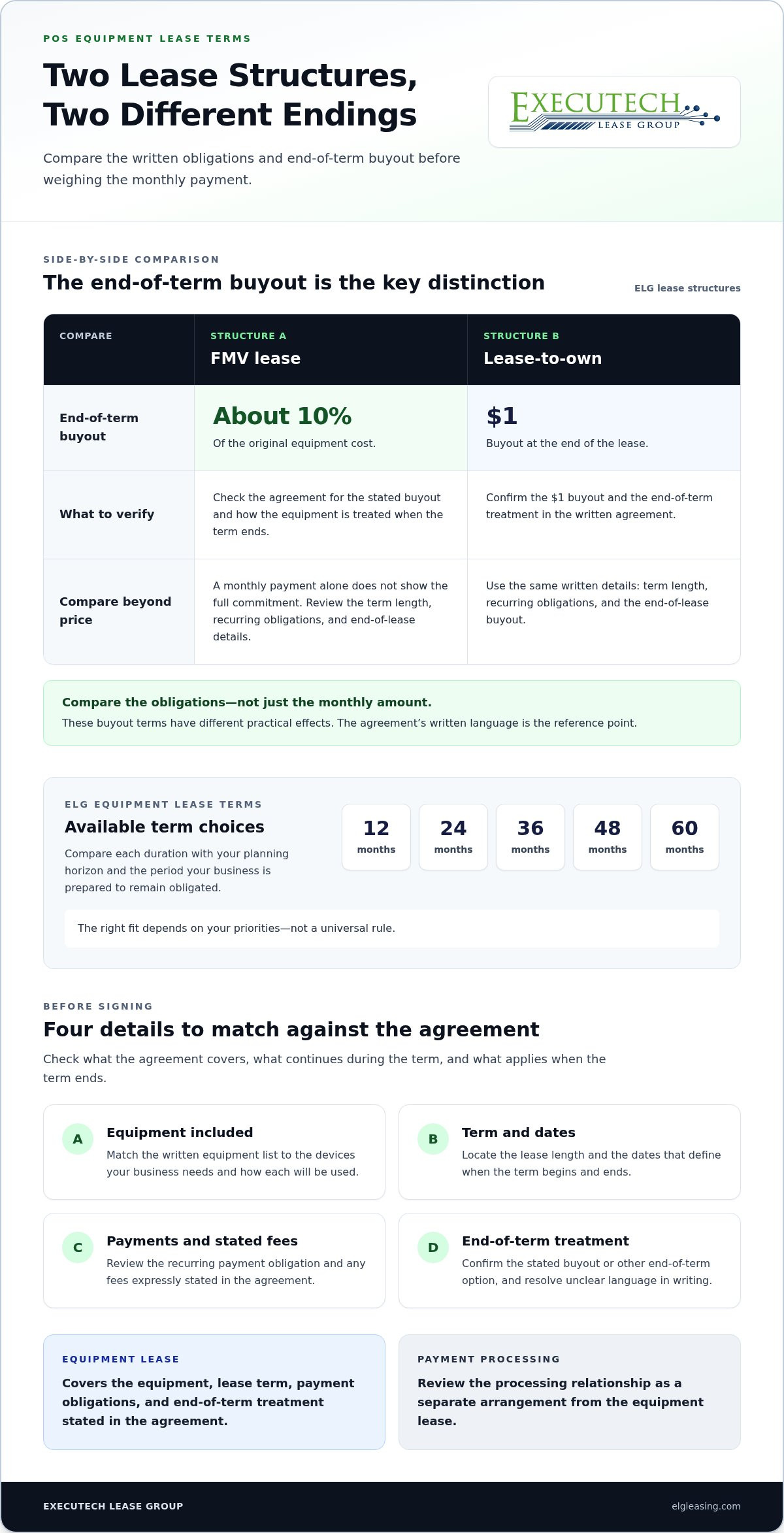
It’s reasonable to compare the payment first. But a fair comparison also needs clear, written details about the lease structure and end-of-term choices. For example, Executech Lease Group (ELG Leasing) offers FMV leases that end with a buyout of about 10% of the original equipment cost, and lease-to-own leases that end with a $1 buyout. Those terms have different practical effects, so don’t judge them by the payment alone.
This guide shows you how to prepare for a negotiation, compare lease structures, and clarify the terms that shape your commitment. You’ll learn which questions to ask about payments, duration, end-of-term obligations, and how the agreement fits your equipment plans, so you can approach the discussion with focused questions and realistic expectations.
Key Takeaways
- Prepare for how to negotiate POS equipment lease terms by listing the equipment you need, setting priorities, and recording questions before discussions begin.
- Compare lease structures using written details about term length, recurring obligations, and end-of-term options, not just the monthly payment.
- Match the equipment scope to your business operations, and avoid assuming every POS setup is compatible with your requirements.
- Review payment obligations, stated fees, and contract dates. Keep equipment lease terms separate from your payment processor’s agreement and obligations.
- ELG offers no-money-down equipment leasing, but lease payments and other written obligations still apply.
What POS Equipment Lease Negotiation Should Clarify Before You Sign
Negotiation isn’t only about asking for a different payment. It’s the process of clarifying, in writing, what equipment the agreement covers, what obligations continue during the term, and what options or responsibilities apply when the term ends. A useful definition: POS lease negotiation is the review and clarification of documented equipment, payment, term, and end-of-lease obligations before you sign.
A monthly payment is one part of the commitment, not a complete summary. The agreement may also specify how long payments continue, which equipment is included, and how the lease treats the equipment at the end. A payment that appears manageable on its own can’t tell you whether the term or end-of-lease treatment aligns with your plans.
Keep the equipment lease separate from payment processing. A POS system brings together hardware and software used to support sales activity. Leasing equipment does not itself establish a merchant account, set transaction pricing, or define the terms of your processing relationship. Review those as separate arrangements.
Which POS lease terms affect your business obligations?
Start with the clauses that describe what you’re agreeing to. Check the written agreement for:
- The equipment included, described clearly enough to compare with the proposed setup.
- The lease length and the dates that define when the term begins and ends.
- The recurring payment obligation and any fees expressly stated in the agreement.
- The treatment of the equipment at the end of the term, including any stated buyout or other option.
Use the signed document as your reference point. A verbal explanation can help you understand a term, but it doesn’t replace written language. If a description, payment obligation, or end-of-term option seems inconsistent with what you were told, resolve the difference before signing. Equipment warranties come from the equipment manufacturer, not Executech Lease Group (ELG Leasing); don’t treat a lease as warranty coverage.
What should you settle before discussing terms?
Prepare a short written brief so the discussion stays focused. List the equipment the proposed agreement is intended to cover and describe how your business will use it. Consider the locations, checkout workflow, and operational needs that shape the equipment scope. Don’t assume every device or setup is compatible with your existing systems; base the scope on the specific requirements you need the proposed equipment to meet.
Then rank your priorities. Decide whether term length, predictable recurring obligations, or your preference about ownership at the end matters most. You may need to weigh these against one another. Write down open questions about any clause you don’t understand, and distinguish confirmed agreement language from assumptions or informal explanations. That preparation gives you a clearer basis for how to negotiate POS equipment lease terms: discuss the obligations and options that affect your operations, not just the payment figure.
How to Prepare for a POS Equipment Lease Negotiation
Preparation turns a broad discussion into a focused review of the equipment and obligations your business actually needs. Before discussing terms, gather the operational details, decide what matters most, and compare those priorities with the agreement in writing. This gives you a practical framework for how to negotiate POS equipment lease terms without assuming that a particular payment or change to the offer is guaranteed.
- Inventory the equipment. List each POS system, credit-card terminal, and other payment-processing device the proposed agreement is intended to cover. Note where each will be used and what role it serves in your checkout workflow. Describe the requirements clearly, but don’t assume that equipment will work with every existing system or setup.
- Define your priorities. Decide how term length, predictable recurring obligations, and ownership preference rank for your business. These priorities may compete. For example, a shorter commitment means less time obligated under the agreement, while a longer term keeps the business committed for a longer period.
- Review the written terms. Compare the equipment list with your inventory. Locate the term length, recurring payment language, any fees stated in the agreement, and the end-of-term treatment. ELG’s leasing program structures provide context for understanding the equipment lease options available through ELG.
- Record open questions. Write down any amount, date, responsibility, or clause that remains unclear. Keep the question specific, such as, “Which equipment does this payment cover?” or “What does this agreement require at the end of the term?” Then request the explanation in writing so you can compare it with the agreement itself.
How do you define the equipment and term you need?
Match the equipment scope to actual business use, not a generic package. If a proposed agreement lists multiple devices, check that each item has a defined role in your operations. ELG’s equipment lease term choices are 12, 24, 36, 48, and 60 months. Compare each available duration with your planning horizon and the period your business is prepared to remain obligated. The right fit depends on your priorities, not a universal rule.
How do you turn priorities into clear questions?
Translate each priority into a request for specific written information. Ask for a breakdown of recurring obligations and any fees stated in the agreement. Ask which end-of-term option applies and what the contract says that option means. ELG’s equipment lease structures include FMV and lease-to-own options, so identify the structure attached to the proposed terms rather than relying on a label alone.
Bring your equipment inventory and questions into the discussion as a working checklist. If you want to begin a POS equipment leasing conversation, ELG’s vendor inquiry page is the place to submit an inquiry, not a financing application or credit-decision submission.
How to Compare POS Lease Terms and End-of-Lease Options
A useful comparison puts each offer’s duration, recurring obligations, and end-of-lease treatment in view at the same time. Don’t compare a payment figure from one structure with an end-of-term figure from another and assume they describe equivalent commitments. Read each proposal as a complete set of written obligations.
Executech Lease Group (ELG Leasing) offers FMV and lease-to-own equipment lease structures. The figures below describe their confirmed end-of-lease buyouts. They don’t replace the specific payment schedule or other terms stated in an agreement.
| Comparison point | FMV equipment lease | Lease-to-own equipment lease |
|---|---|---|
| Term length | Use the duration stated in the written offer. | Use the duration stated in the written offer. |
| Recurring obligations | Review the recurring payment terms and any fees stated in the agreement. | Review the recurring payment terms and any fees stated in the agreement. |
| Confirmed end-of-lease figure | Buyout of about 10% of original equipment cost. | $1 buyout at the end of the lease. |
ELG’s FMV equipment lease ends with a buyout of about 10% of original equipment cost, while its lease-to-own equipment lease ends with a $1 buyout. Keep each figure attached to its own structure. Neither figure tells you the recurring payment or explains every other obligation in the contract.
What should you compare in an FMV equipment lease?
For an FMV lease, identify the stated buyout and understand that the confirmed figure is about 10% of original equipment cost. Then review the rest of the agreement for the term, payment obligations, and all other end-of-lease details. Don’t assume renewal rules, return conditions, notice deadlines, or a calculation method that the written terms don’t specify. If a detail matters to your decision, seek written clarification before signing.
How does lease-to-own differ from an FMV lease?
The confirmed distinction is the end-of-lease buyout: ELG’s lease-to-own equipment lease ends with a $1 buyout, while the FMV lease has the buyout described above. Compare the structures against your ownership preference and the obligations documented for the specific offer. Avoid treating either figure as proof of lower overall cost or a particular payment level.
ELG’s POS lease structure information can provide context as you review these options. For a practical comparison, place the written term, recurring obligations, and applicable buyout side by side. That makes it easier to see what each structure commits your business to, and gives you focused questions for how to negotiate POS equipment lease terms.
What to Ask About POS Lease Payments, Responsibilities, and Contract Language
Before signing, turn unclear terms into direct questions and compare the answers with the written agreement. Focus on what the lease requires, when each obligation applies, and which relationship governs it. This is a practical way to approach how to negotiate POS equipment lease terms without assuming that a discussion will change the offer.
How can you clarify recurring payments and other stated obligations?
Ask for a written explanation of the payment schedule and any other amounts the agreement requires. No-money-down describes the amount due upfront; it does not remove recurring lease obligations or mean the agreement has no fees. Use the document to confirm the applicable amounts and dates, rather than relying on an informal estimate.
- How often are recurring payments due, and what dates does the agreement use?
- Which amounts are required under the written agreement, and what does each listed fee relate to?
- What date does the lease term begin, and what date does it end?
- Does the equipment list match the items the agreement covers?
- Which end-of-term option applies, and where is it described in the contract?
Compare the answers with the actual clauses. If a term is described differently in a conversation than in the document, ask for the written language to be clarified before signing. Don’t infer that an unlisted fee, payment schedule, or option applies. The goal is to understand the agreement as written, not to rely on assumptions.
Which responsibilities belong to the lease versus other relationships?
An equipment lease covers equipment obligations; payment processing, merchant accounts, and transaction pricing belong to separate relationships. Don’t assume a POS equipment lease sets processing terms or controls processor obligations. ELG does not provide equipment warranties, maintenance, repairs, or replacements. Any equipment warranty comes only from the manufacturer, so keep warranty information distinct from lease language.
For clarity, identify which agreement governs each question. Direct questions about equipment, term, recurring lease obligations, and end-of-term treatment to the lease document. Review processing fees, merchant account terms, and transaction pricing under the separate processing relationship. ELG’s lease inquiry and review process provides context for the inquiry-to-review path, while the written agreement remains the reference for its terms.
If contract language is difficult to interpret, consider having a qualified legal professional review it. For questions about tax treatment, consult a tax professional. Neither step requires assuming a particular tax result or legal outcome.
Keep a record of your questions and the written answers alongside the agreement. That simple discipline helps you see whether the payment dates, term dates, stated fees, equipment scope, and assigned responsibilities fit together. Resolve the points that affect your decision before signing, and make sure the final document reflects the terms you intend to accept.
How to Move Forward with a POS Equipment Lease Discussion
Move from comparison to a clear written review. Gather the equipment details, identify the lease structure that fits your priorities, and resolve any open questions about the proposed terms before signing. The point isn’t to chase a particular payment. It’s to understand what the agreement commits your business to and decide whether those obligations align with its operations.
What information should you have ready for a lease conversation?
Bring a concise summary of the payment-technology equipment under consideration and how your business plans to use it. Include the proposed term, recurring payment details, and end-of-term language. Keep processor-service questions separate: equipment leasing and payment processing involve distinct agreements and obligations.
- Equipment scope: List the POS systems or credit-card terminals being considered and the business use each will support.
- Proposed terms: Note the lease duration, payment schedule, and any fees stated in the written agreement.
- End-of-term language: Identify the stated option and any related obligations described in the agreement.
- Open questions: Record unclear wording or differences between the document and explanations you’ve received.
Review each item against the proposed agreement. If a term remains unclear, ask for a written explanation and compare it with the contract language. That gives you a more focused discussion and a useful record of what you understood before making a decision.
How can you start the right conversation with ELG?
Executech Lease Group (ELG Leasing) offers no-money-down equipment leasing. That means no money down, not no recurring payments or no ongoing lease obligations. For a conversation about POS equipment leasing, merchant-services providers and ISOs can use ELG’s vendor inquiry form. It’s an inquiry, not a financing application or credit-decision submission.
Submitting an inquiry doesn’t guarantee approval, funding, delivery, or installation. Keep the next step straightforward: share the equipment and business-use information relevant to the discussion, then review any proposed terms in writing. The inquiry is a starting point for a conversation, not a substitute for understanding the agreement.
A disciplined process helps you move forward with realistic expectations: organize equipment needs, compare the available structures, review the written obligations, and resolve questions that matter to your business. That’s the practical foundation for how to negotiate POS equipment lease terms. Make your decision based on the full agreement, not on one attractive feature in isolation.
Make Your Next Lease Discussion Count
Before moving ahead, turn the discussion into a decision record your team can use. Note who will review the agreement, which operational needs the equipment must support, and what questions still need clear written answers. That creates a useful checkpoint between considering an offer and committing to it.
Learning how to negotiate POS equipment lease terms is ultimately about making a deliberate decision with the information in front of you. Give the agreement a final read with the people responsible for payments and day-to-day operations. Check that everyone understands the obligations and that unresolved points have been addressed in writing. If the agreement’s wording remains unclear, seek appropriate professional guidance before signing.
A focused conversation can help you move forward with greater clarity. Take the next step when your questions are ready, and keep your business needs at the center of the decision.
Frequently Asked Questions
What POS equipment lease terms can you negotiate?
You can raise questions about the equipment scope, lease length, recurring obligations, and end-of-term language before signing. That’s the practical starting point for how to negotiate POS equipment lease terms, but a discussion doesn’t mean a specific clause can be changed. Program options and individual agreement terms may differ. Compare the written offer with your business needs, request clarification on unclear wording, and rely on the final written agreement for the obligations you accept.
Can you negotiate the length of a POS equipment lease?
Lease length is an important comparison point, but don’t assume it can be changed in every agreement. ELG equipment lease term choices are 12, 24, 36, 48, and 60 months. Compare the duration in an offer with how long you expect to use the equipment and the period your business is prepared to remain obligated. Before signing, confirm the exact term and its dates in the written agreement.
What is the difference between an FMV POS lease and lease-to-own?
ELG’s FMV equipment lease ends with a buyout of about 10% of original equipment cost, while its lease-to-own equipment lease ends with a $1 buyout. Both are end-of-lease figures, not monthly payments or total equipment prices. To compare the structures, consider your ownership preference and review the specific agreement’s payment obligations and other written terms. Don’t assume additional return, renewal, or cancellation conditions.
Does no-money-down mean a POS equipment lease has no payments?
No. No-money-down refers only to the upfront payment requirement. It doesn’t mean the equipment is free, recurring payments stop, or the agreement has no financial obligations or fees. Before signing, read the written payment schedule and identify every obligation the agreement states. If a payment amount, timing, or listed fee is unclear, request clarification in writing and compare the explanation with the contract.
Does ELG provide a warranty or repairs for leased POS equipment?
No. ELG doesn’t provide equipment warranties, maintenance, repairs, or replacements. Any warranty comes only from the equipment manufacturer. Keep the lease agreement separate from the manufacturer’s warranty terms, and review the manufacturer’s documentation to understand its coverage. A POS equipment lease through ELG doesn’t include a protection plan, repair or replacement coverage, or a promise of uninterrupted service.
Does ELG process payments or provide merchant accounts?
No. ELG’s role is equipment leasing, separate from payment processing. ELG doesn’t process payments, supply merchant accounts, set transaction pricing, or control processor obligations. Treat the equipment lease and your payment-processing relationship as distinct arrangements, each with its own written terms. Questions about transaction fees or merchant-account services belong to the processing relationship, not the POS equipment lease negotiation.
How quickly does ELG make a credit decision?
Our goal is to deliver credit decisions in under 2 business hours. This describes a goal for the credit-decision stage only. It doesn’t promise approval or determine when funding, equipment delivery, or installation will occur. Keep those steps separate when planning your equipment needs, and don’t treat a decision-time goal as a delivery or deployment schedule.

Article by
Robert Ensminger
Robert Ensminger is the founder and CEO of Executech Lease Group (ELG Leasing), which specializes in equipment leasing and financing solutions for the merchant-services, payments, POS, and FinTech industries. With more than 20 years of industry experience, Robert helps independent sales organizations, payment processors, POS providers, and software companies develop practical leasing, subscription, and SaaS-monetization programs. He founded ELG in 2010 and guided the company to recognition on the Inc. 5000. His work focuses on responsive service, transparent program structures, and helping ELG’s partners close more business while creating sustainable revenue.