Equipment leasing can make a merchant’s hardware decision easier, but it isn’t payment processing. Leasing solutions for payment facilitators work best as a distinct part of the merchant offer: they can give merchants an alternative to a large upfront equipment purchase while keeping hardware terms separate from processing services and obligations.
That separation matters. Merchants need a clear explanation of what they’re leasing, what recurring payments they’re agreeing to, and what happens when the lease ends. FMV and lease-to-own programs aren’t interchangeable: one has an end-of-term structure that differs from the other, so presenting the options accurately helps set expectations from the start.
This guide explains where leasing fits in a payment facilitator’s merchant offering, how FMV, lease-to-own, and hardware-subscription structures differ, and what to assess in a vendor partnership. You’ll also see how to keep the equipment arrangement distinct from processing, so your offer stays practical, transparent, and easier to explain.
Key Takeaways
- Use Leasing solutions for payment facilitators to make equipment access part of a merchant offer while keeping the arrangement clearly defined.
- Match the lease structure to the merchant’s needs: FMV, lease-to-own, and hardware subscriptions have different terms and end points.
- Keep equipment needs, lease terms, merchant-account setup, and processing responsibilities distinct in your workflow and communications.
- Build a practical partnership plan around roles, equipment scope, and how your team will explain the proposal to merchants.
- Executech Lease Group offers POS and card-terminal leasing options, including FMV, lease-to-own, and hardware subscriptions; it does not process payments.
Why leasing solutions matter to payment facilitators building merchant offers
A payment facilitator, or PayFac, helps businesses access payment acceptance as part of a broader merchant-services relationship. The precise role can vary across the payments ecosystem, but the equipment question remains distinct: how does a merchant obtain the POS system or card terminal they need?
Equipment leasing addresses that acquisition question. Processing concerns accepting and handling the merchant’s payments. Keeping those conversations separate helps you describe each part of an offer accurately, without implying that equipment leasing provides payment processing or determines the merchant’s processing arrangements.
Where equipment leasing fits in a payment-facilitator offer
Leasing can be an optional equipment-financing path alongside a merchant technology proposal. A merchant comparing POS options may want to consider how the hardware is acquired as well as what it can do. A lease structure gives the equipment conversation its own terms to evaluate, rather than folding hardware acquisition into an explanation of payment services.
Keep the proposal clear: identify the equipment need, explain the lease arrangement separately, and describe payment acceptance through the appropriate processing relationship. Leasing may give a merchant an alternative to a large upfront equipment purchase, but it still involves recurring payments and a financial obligation. For more context on equipment leasing, see The Comprehensive Guide to POS Equipment Leasing in 2026. You can also review the available equipment leasing programs.
This separation supports cleaner conversations across teams. The person discussing terminal or POS equipment can explain its lease structure, while the processing relationship remains governed by its own terms and responsibilities. Neither conversation should imply that the lease controls processor obligations or that a particular device works with every processing setup.
Which payments-industry partners may find the model relevant
Leasing may be relevant to PayFacs, independent sales organizations (ISOs), agents, and POS resellers that include equipment in their merchant conversations. Their roles differ. One partner may focus on payment services, another on merchant relationships, and another on technology or equipment. Their offers can differ, too. Leasing is an option to consider where it fits, not a requirement for every partner or merchant.
For a US-wide business relationship, start by mapping the actual offer: who presents the equipment, who explains the lease terms, and which party handles the processing relationship. Make the handoff explicit. A merchant should be able to distinguish an equipment proposal from payment-processing terms without having to infer where one ends and the other begins.
That practical distinction is the value of Leasing solutions for payment facilitators. They can add a separate way to discuss POS and terminal acquisition, while leaving each partner’s role visible and the merchant’s choices easier to understand.
How payment-facilitator equipment leasing fits the merchant technology workflow
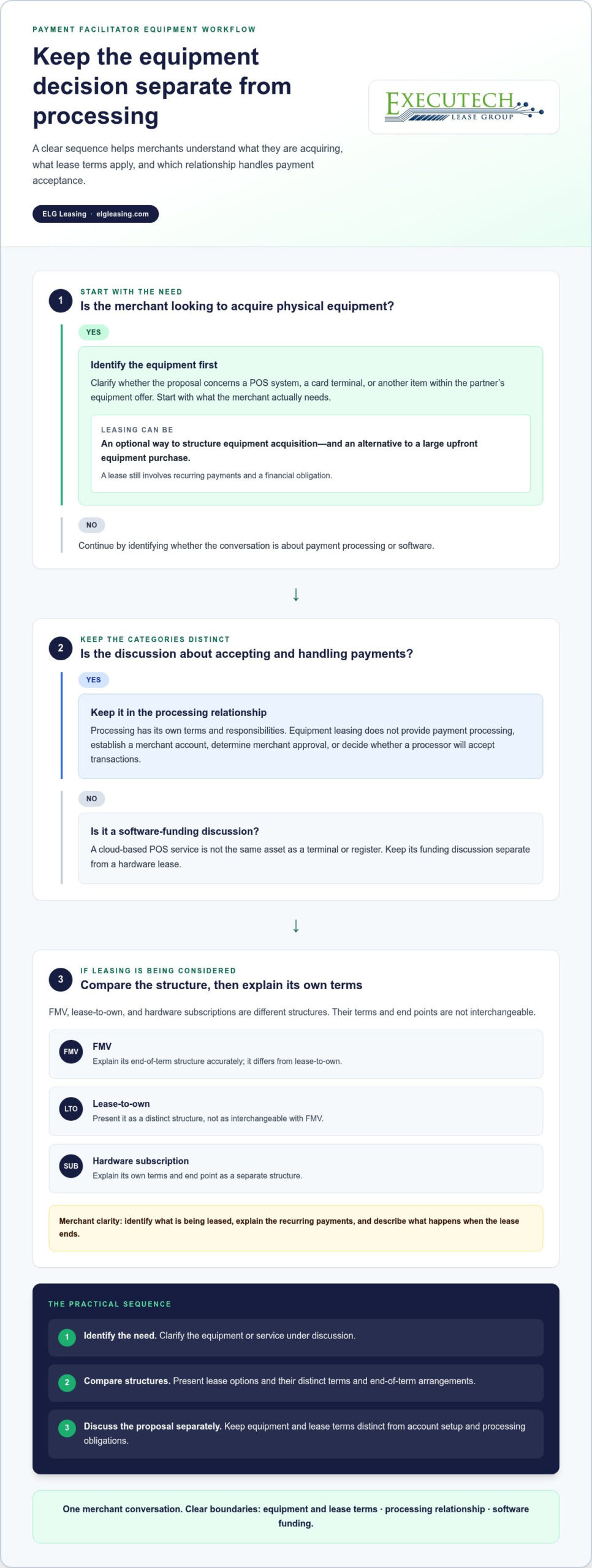
A leasing discussion works best as a clear sequence, not as an extra term buried in a processing pitch. First, identify the merchant’s equipment need. Next, compare the available lease structures. Then, present the equipment proposal with its own terms and responsibilities. This keeps the conversation practical and gives the merchant a distinct choice to consider.
For example, a merchant planning to take payments in person may need a point-of-sale (POS) system or a card terminal. A partner’s broader technology portfolio may also include ATMs, but that doesn’t mean an ATM belongs in every equipment proposal. Start with the equipment the merchant actually needs and the role it will play in the business.
From equipment need to a leasing discussion
Once the equipment category is clear, explain leasing as one way to structure its acquisition. The merchant can then consider the proposal and the lease terms as a separate decision from the payment-processing relationship. A lease decision doesn’t determine merchant approval, establish a merchant account, or decide whether a processor will accept transactions.
Keep the steps visible:
- Identify the need. Clarify whether the discussion concerns a POS system, card terminal, or another item within the partner’s equipment offer.
- Compare structures. Present the available lease options accurately, including their distinct terms and lease-end arrangements.
- Discuss the proposal. Explain the equipment and lease separately from account setup and processing obligations.
This workflow gives each party a defined conversation. For background on the payment facilitator model, Understanding the Payment Facilitator Model offers context on how the model relates to payment services. The equipment proposal remains a separate part of the merchant’s technology discussion.
Keep hardware, processing, and software funding distinct
Physical equipment leasing concerns hardware, such as POS systems and card terminals. Processing concerns payment acceptance and its related obligations. Software is another category: a cloud-based POS service is not the same asset as a terminal or register, so its funding discussion should stay separate from a hardware lease.
Where relevant, cloud-based POS financing can be discussed as a distinct software topic, without presenting it as completed funding or assigning it terms that haven’t been stated. The same discipline applies to merchant-account setup: keep it within the appropriate processing relationship rather than implying an equipment lease determines its outcome.
These distinctions make Leasing solutions for payment facilitators easier to operationalize across merchant conversations. If you’re mapping out an equipment-leasing partnership, you can start a vendor partnership inquiry. It’s a partnership discussion, not a financing application or credit decision.
FMV, lease-to-own, and subscription leasing: compare the structures
The structure matters as much as the equipment category. A payment facilitator or other partner should be able to explain the term and end-of-term amount plainly, without presenting different options as equivalent. The comparison below summarizes the stated terms. It doesn’t add assumptions about total cost, renewal, cancellation, or tax treatment.
| Structure | Confirmed term choices | Stated lease-end amount |
|---|---|---|
| FMV lease | 12, 24, 36, 48, or 60 months | About a 10% buyout |
| Lease-to-own | 12-60 months | $1 buyout |
| Hardware subscription | 12-60 months | No buyout amount stated |
These are distinct program structures, not interchangeable labels. Leasing solutions for payment facilitators are easier to present when merchants can see which details are defined and which should not be assumed.
How the FMV and lease-to-own options differ
An FMV lease offers terms of 12, 24, 36, 48, or 60 months and an approximate 10% buyout. That figure should be shared as stated, without adding a calculation base or formula. Lease-to-own offers terms from 12 to 60 months and a $1 buyout. The $1 amount applies only to lease-to-own, not FMV or subscription leasing.
For a merchant conversation, state the term options and buyout for each program side by side. Don’t imply an FMV lease has the same end point as lease-to-own, or that a buyout amount describes the total cost of a lease. The FMV and lease-to-own program details provide the relevant program information for this comparison.
When to consider a hardware subscription
A hardware subscription has a different stated feature: it runs for 12-60 months and includes a hardware warranty for the subscription term. That gives partners a concise way to describe the option while avoiding assumptions about ownership or a buyout at the end. Don’t imply free upgrades, cancellation rights, or a particular service turnaround.
In practice, match the explanation to the merchant’s question. If they’re comparing lease-end amounts, distinguish FMV from lease-to-own. If they’re considering a subscription, explain its term range and warranty period. Keep the stated terms visible in the proposal so the merchant can compare structures without confusing a warranty with ownership or payment processing.
How payment facilitators can operationalize a leasing partnership
A leasing partnership needs more than a program overview. It needs a defined handoff, a clear equipment scope, and merchant-facing language that keeps each responsibility visible. Set those basics before adding leasing to a proposal or sales workflow. That makes it easier for your team to explain the offer consistently without promising a particular approval, delivery date, or merchant result.
Set clear boundaries between partner responsibilities
Start by documenting who handles each part of the relationship. The facilitator’s processing role stays separate from Executech Lease Group (ELG Leasing), which handles the equipment-leasing role. ELG doesn’t provide merchant accounts, process payments, or control processor obligations. Use the equipment-leasing process flow as a reference for structuring the partner discussion and mapping where equipment leasing fits.
A practical partnership checklist can include:
- Roles: Identify who presents the equipment proposal, explains lease terms, and manages the processing relationship.
- Equipment scope: Define which equipment categories the partnership will discuss, such as POS systems or card terminals, and how each is described.
- Proposal handoff: Decide how the merchant moves from an equipment conversation to the relevant leasing discussion, without implying the lease sets up an account or processing service.
- Team guidance: Give staff consistent language for describing the lease and directing processing questions to the appropriate relationship.
ELG provides credit decisions in 1-2 business hours. That timing refers to the credit decision only. It doesn’t establish funding, equipment delivery, or installation timing, and it isn’t a promise of approval. Keep those distinctions clear in partner materials and conversations.
Build a clear merchant-facing explanation
Make the proposal easy to follow. Name the equipment category, identify the lease structure, and state the applicable term and lease-end details in plain commercial language. Don’t assume a device works with every processor, or suggest that a lease decision guarantees merchant approval or payment acceptance. The facilitator and ELG have distinct roles, and the explanation should reflect that.
Before rollout, review the merchant-facing explanation with the people who will use it. Check that it distinguishes hardware from processing, uses lease terms accurately, and avoids implied outcomes. A concise explanation might say that the proposal covers leasing a specified POS system, while processing arrangements are addressed separately through the merchant’s processing relationship. Keep written materials consistent with that distinction.
For payment facilitators, Leasing solutions for payment facilitators become easier to operationalize when the partnership defines scope, roles, and communication before merchants see a proposal. ELG’s Apply Now page is a vendor inquiry for discussing a partnership, not a financing application or credit decision.
Why Executech Lease Group fits payment facilitators seeking equipment leasing
Executech Lease Group (ELG Leasing) is an equipment lease brokerage serving the merchant-services and payments-technology ecosystem. For payment facilitators building a merchant offer, the fit is straightforward: ELG focuses on equipment leasing, while the facilitator’s processing relationship remains separate. That distinction gives partners a defined place to discuss POS and card-terminal equipment without presenting ELG as a processor or merchant-account provider.
A potential vendor relationship works best when both sides have a clear picture of the equipment conversation. Consider which equipment categories your merchant offer covers, who will introduce the leasing option, and how your team will describe the separation between hardware terms and payment processing. These are practical starting points for a partnership discussion, not claims about a particular merchant outcome.
What ELG brings to an equipment-leasing discussion
ELG’s equipment focus includes POS systems and card terminals. Its program options include FMV leases, lease-to-own programs, and hardware subscriptions. Each structure has its own terms, so a partner can keep the discussion specific to the option being presented rather than treating every lease as the same arrangement.
That focus is distinct from processing. ELG doesn’t process payments, supply merchant accounts, or set the obligations a merchant has with a processor. A vendor relationship can therefore be organized around the equipment proposal and leasing discussion, while the payment facilitator and its processing partners continue to handle their respective payment-service roles.
For your team, the practical value is clarity. The leasing partner discussion can focus on equipment categories, program structure, and how information will be shared with merchants. It doesn’t need to blur into account setup or processing decisions. Keep compatibility claims specific to the equipment and arrangement being discussed; don’t imply that every device works with every processor.
The next step for a prospective vendor
Payment facilitators, ISOs, agents, and POS resellers can use an initial conversation to outline the relationship they want to explore. Bring a concise view of your business model, the equipment categories relevant to your merchant conversations, and how your team currently separates equipment proposals from processing services. That gives the partnership discussion a practical focus.
ELG’s Apply Now page is the starting point for a vendor inquiry. It opens a discussion about a potential vendor relationship. It isn’t a financing application and doesn’t itself produce a credit decision. This distinction matters: a partnership conversation concerns how organizations may work together, while a merchant credit decision belongs to a separate process.
For partners considering Leasing solutions for payment facilitators, the next step is to define the equipment scope and partnership goals, then open a vendor discussion with ELG. Keep the inquiry focused on your organization’s role, merchant offer, and equipment-leasing needs.
Make the next move toward a defined partnership
The next step is to turn the leasing concept into a practical vendor conversation. Consider where equipment leasing could fit in your merchant offer, who would explain the equipment terms, and how your team will keep that discussion distinct from processing. Clear roles give both organizations a stronger starting point.
ELG’s no-money-down equipment leasing can be part of that discussion. No money down doesn’t mean the equipment is free; the lease still carries recurring payments and a financial obligation. Keep the program details clear, including the distinct end-of-term buyout amounts for FMV and lease-to-own.
For payment facilitators exploring Leasing solutions for payment facilitators, a vendor inquiry is a practical way to discuss whether a partnership fits your merchant technology offer. It starts a conversation, not a financing application or credit decision.
A clear conversation can help you shape an equipment offer with confidence and keep every partner’s role straightforward.
Frequently Asked Questions
Does ELG require money down?
No. ELG offers no-money-down equipment leasing, which means a down payment isn’t required under that offering. It doesn’t mean the equipment is free or remove the lease’s financial obligation. A merchant evaluating a POS or terminal proposal should still review the recurring payments and all applicable obligations in the agreement. For your team, the practical distinction is simple: explain the down-payment structure separately from the full lease commitment.
How fast does ELG make a credit decision?
ELG provides credit decisions in 1-2 business hours. This refers only to the equipment credit decision, not a guarantee of approval. It also doesn’t establish when funding, equipment delivery, or installation will occur. If you’re coordinating a merchant proposal, describe the decision timing as one step in the leasing process, then keep any later steps separate. That helps prevent a decision estimate from being mistaken for a delivery schedule.
Does ELG process payments?
No. ELG doesn’t process payments. Its role is equipment lease brokerage for the merchant-services and payments-technology ecosystem. For example, a merchant may discuss leasing a terminal through an equipment proposal while addressing payment acceptance and any merchant-account arrangements through a separate processing relationship. Keep the distinction explicit in partner materials: equipment leasing concerns acquiring hardware, while the processor handles its own payment services and related obligations.
Does an ELG equipment credit decision approve a merchant for payment processing?
No. An equipment credit decision and a processor’s merchant decision are separate. ELG’s decision relates to its equipment-leasing process; it doesn’t approve a merchant account, establish processing, or determine a processor’s obligations. If a merchant asks whether one decision settles both questions, explain that each relationship has its own process. This keeps your equipment proposal accurate and avoids implying that either decision guarantees the other.
Is ELG’s Apply Now page a financing application?
No. The Apply Now page is for discussing a vendor relationship with ELG. It isn’t a merchant financing application, and submitting an inquiry doesn’t produce an equipment credit decision. For a payment facilitator or other vendor partner, use the page to start a business discussion about a potential relationship, rather than presenting it to merchants as a step in their equipment application. That keeps the purpose of the form clear.
Can an independent software vendor discuss SaaS funding with ELG now?
Yes. ELG is actively staging independent software vendors (ISVs) for its SaaS funding program, and ISVs may engage now to discuss the opportunity. This is an invitation to start a conversation, not a statement that funding has been completed or is available for disbursement. Keep this discussion separate from hardware leasing: equipment lease terms don’t define SaaS program economics. ISVs can discuss their SaaS business with ELG.

Article by
Robert Ensminger
Robert Ensminger is the founder and CEO of Executech Lease Group (ELG Leasing), which specializes in equipment leasing and financing solutions for the merchant-services, payments, POS, and FinTech industries. With more than 20 years of industry experience, Robert helps independent sales organizations, payment processors, POS providers, and software companies develop practical leasing, subscription, and SaaS-monetization programs. He founded ELG in 2010 and guided the company to recognition on the Inc. 5000. His work focuses on responsive service, transparent program structures, and helping ELG’s partners close more business while creating sustainable revenue.