
What if the way you acquire payment equipment matters as much as the equipment itself? Preserving working capital with leasing may reduce the cash needed at the outset compared with an outright purchase, leaving more cash available for payroll, inventory, and other operating needs. It doesn’t erase the cost. Lease payments and end-of-term obligations still matter.
If you’re weighing a purchase against a lease, consider both your immediate cash needs and the full commitment. The right comparison depends on your cash flow, the equipment you need, and how long you expect to use it.
This article explains how working capital supports daily operations and how to compare buying with leasing using your own cash-flow assumptions. You’ll also learn which payment terms and end-of-term choices deserve close review, including the difference between an FMV lease and a lease-to-own option. Executech Lease Group (ELG) offers equipment leases for payment technology such as POS systems and card terminals. The goal is to assess whether leasing fits your business, not to assume it’s always the better choice.
Key Takeaways
- Preserving working capital with leasing starts with identifying the resources your business needs for near-term operating expenses.
- Map equipment costs against regular cash needs before comparing an outright purchase with recurring lease payments.
- Review the full lease commitment, including payment terms, ownership, and end-of-term options.
- Assess whether a POS system, card terminal, or ATM serves a defined business need before choosing how to acquire it.
- ELG offers payment-equipment leasing, separate from payment processing. Review the equipment lease and processor obligations as distinct commitments.
What preserving working capital means for payment-equipment decisions
Working capital is the short-term financial capacity a business can use to keep daily operations moving. It is commonly understood as current assets, such as cash and resources expected to become cash soon, minus current liabilities, the payments and obligations due in the near term. Looking at both sides helps you assess the funds available to meet short-term business needs.
Preserving working capital with leasing means considering whether a lease could reduce the cash needed at the outset of an equipment decision. That does not guarantee stronger liquidity or a better financial outcome. The useful question is whether the timing and amount of lease obligations fit your operating plan.
How working capital supports everyday operations
Cash availability matters because business receipts and expenses don’t always arrive at the same time. You may need to pay suppliers, meet payroll, or cover routine bills before customer payments come in. Reviewing those timing gaps can help you identify which funds need to remain available and what commitments the business can reasonably take on.
Consider these cash movements together. An equipment decision can affect the funds available for other planned expenses, so assess it as part of your broader operating plan rather than in isolation.
Why payment equipment belongs in the capital conversation
A POS system, credit-card terminal, or ATM may serve an important payment function, but acquiring one still creates a financial commitment. An outright purchase directs cash toward the equipment at the time of purchase. A lease instead creates scheduled payments and contractual obligations. The two structures affect cash commitments differently, but neither is inherently the better financial choice for every business.
Start with the operational requirement. What payment function needs equipment, and what does the business need the equipment to do? Then consider how acquiring it fits alongside other planned commitments. This ties the decision to both the business purpose and the cash impact.
For example, if a terminal purchase would coincide with other scheduled expenses, consider how that timing affects the funds available for those needs. With a lease, compare recurring payments against the same operating plan. Use your own circumstances to assess both options, rather than assuming one will deliver savings or improve cash flow.
Working capital isn’t simply cash sitting unused. It represents short-term capacity to manage normal business needs as money comes in and goes out. Keep that role in view when deciding how to acquire payment equipment, and assess the choice alongside the obligations your business expects to meet.
How leasing payment equipment can change upfront cash demands
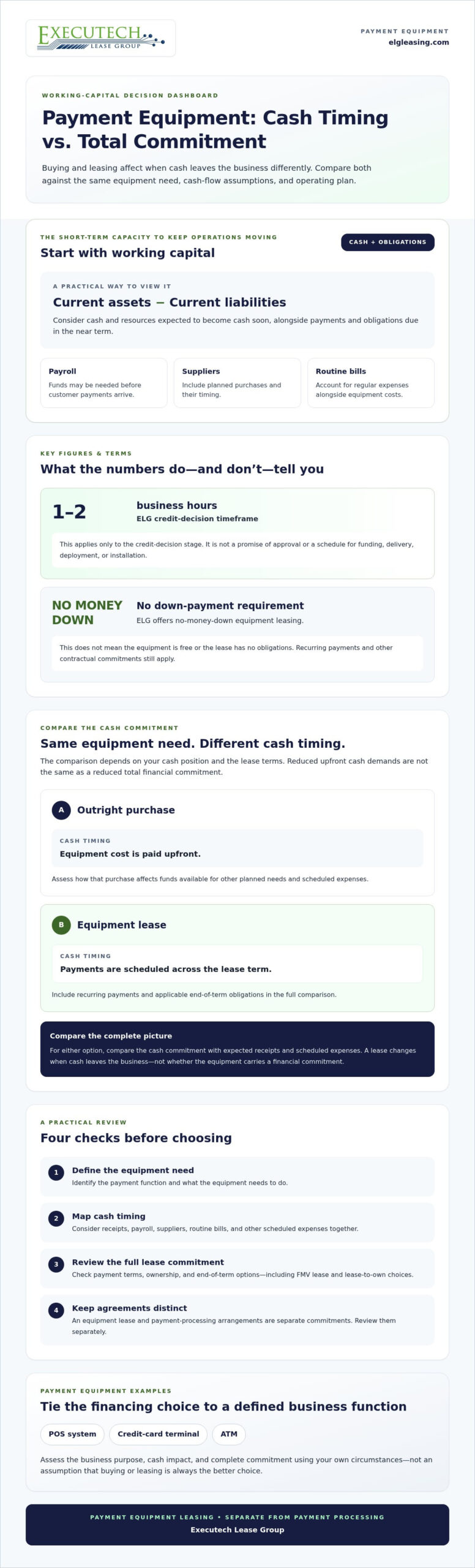
Buying payment equipment typically means paying for it upfront, while leasing schedules payments across the lease term. That changes when cash leaves the business, not whether the equipment carries a financial commitment. The difference may matter if a large purchase would coincide with other near-term expenses, but the effect depends on your cash position and the lease terms.
Reduced upfront cash demands are not the same as a reduced total financial commitment. To assess whether leasing fits, compare the cash you would retain at the outset with the recurring payments and other obligations you would take on. Preserving working capital with leasing is a possibility to evaluate against your business’s actual cash needs, not a guaranteed improvement.
What no-money-down equipment leasing does and does not mean
ELG offers no-money-down equipment leasing. No money down means there’s no down-payment requirement. It doesn’t mean the equipment is free or that the lease has no obligations. Recurring lease payments and other contractual commitments still apply. Include scheduled payments in your cash plan alongside existing operating expenses before deciding whether the arrangement fits.
A practical comparison starts with the same equipment need and planning period. For an outright purchase, identify the upfront cash requirement and how it affects funds available for other needs. For a lease, map payments across the term and include the applicable end-of-term obligation. Compare each commitment with expected receipts and scheduled expenses. This gives you a clearer view of cash timing without assuming the lease costs less overall.
Also separate the equipment decision from the business’s payment-processing arrangements. Leasing payment equipment concerns the equipment commitment; it does not determine processing terms or obligations. Review those commitments separately so your cash plan reflects each agreement.
The timing of a credit decision
Our goal is to deliver credit decisions in under 2 business hours. This goal applies only to the credit-decision stage. It is not a promise of approval or a schedule for funding, equipment delivery, deployment, or installation. Treat each stage separately when planning operations, and don’t build an equipment timeline around the credit-decision timeframe alone.
Before proceeding, test the proposed lease against more than one cash-flow scenario. For example, consider how scheduled payments would fit if customer receipts arrived later than expected, or if routine expenses clustered near a payment date. These are planning questions, not predictions. They can help you assess how recurring obligations fit alongside the business’s other commitments.
If a payment-equipment lease is part of your plan, you can submit an equipment leasing inquiry and evaluate the terms in light of your cash timing. The inquiry is a starting point for a conversation, not a financing application. Keep the decision grounded in the full commitment, not just the amount due at the start.
Buying versus leasing payment equipment: compare the full commitment
A purchase and a lease can provide the same payment equipment while creating different cash and ownership commitments. Compare the full arrangement, not just the amount due at the start. Assess cash timing and total obligations together. Preserving working capital with leasing may be relevant to your decision, but it doesn’t establish that leasing costs less or suits every business.
Use the equipment you actually need, such as a POS system or card terminal, and assess each option over the period you expect to use it. The table offers a framework, not a price comparison. Fill it with your own cash-flow assumptions and the specific terms under consideration.
| Consideration | Upfront purchase | Equipment lease |
|---|---|---|
| Cash timing | Cash goes toward the purchase at the outset. | Payments recur over the lease term, according to the contract. |
| Operating cash to assess | Consider how the initial outlay aligns with upcoming expenses and expected receipts. | Consider each scheduled payment alongside other commitments throughout the term. |
| Ownership | You acquire the equipment through the purchase. | Ownership and any end-of-term option depend on the lease structure. |
| End-of-term consideration | No lease-end decision applies; consider the equipment’s continued role in the business. | Review the contract’s stated end-of-term terms and any applicable buyout obligation. |
Compare the cash-flow timing, not just the first payment
Start by identifying when the equipment is needed and when cash is expected to come in. Then compare the purchase outlay with the lease’s recurring payments across its full term. Include other contractual obligations and assess how each schedule fits alongside normal operating expenses. This business-specific comparison avoids assuming that a smaller initial cash demand means lower overall cost or better cash flow.
Ownership is another part of the decision. An outright purchase gives you the equipment, while a lease’s ownership outcome depends on its structure and end-of-term terms. Consider how long you expect to use the equipment and what you want to happen when the lease ends. Those priorities can affect which structure makes sense, even when the initial cash timing appears attractive.
Understand the equipment lease end-of-term choices
ELG’s FMV equipment lease ends with about a 10% buyout. Its lease-to-own equipment lease ends with a $1 buyout. These figures apply to different lease options, and neither is a monthly payment. Include the applicable end-of-term amount alongside recurring payments when comparing the full commitment.
Before choosing, write down the purchase outlay or lease payments, the obligations across the full term, the ownership outcome, and the end-of-term consideration. Use the same equipment need and planning assumptions for both options. That keeps the comparison focused on your business’s priorities rather than a broad claim that buying or leasing is always superior.
A practical framework for assessing a payment-equipment lease
A clear review connects the equipment to a real business need, then tests the lease against your cash plan and operating expectations. Use the steps below in order. They help you assess the full commitment without assuming that leasing will improve cash flow or suit every situation.
- Identify the equipment need. Define the function a POS system, card terminal, or ATM must serve. Consider what business task it supports and why you need it now. A defined requirement makes it easier to compare the equipment commitment with its role in your operations.
- Map cash timing. Set out expected receipts, routine operating expenses, and the dates lease payments would be due. Consider realistic variations in timing, such as receipts arriving later than expected. This is a planning exercise, not a prediction of future results.
- Compare lease terms. Review the payment schedule, duration, and contractual commitments together. ELG equipment lease terms are available in 12, 24, 36, 48, and 60 months. Consider which term aligns with your equipment need and cash-planning horizon.
- Review end-of-term options. Identify the applicable buyout option and its stated amount, then include it in your assessment of the commitment. Don’t treat recurring payments as the only cost or obligation to consider.
Match the equipment and term to the business need
Keep the review focused on payment-processing equipment, such as POS systems, credit-card terminals, and ATMs. Consider whether the equipment supports a defined business requirement and whether the lease term aligns with the period you expect that requirement to remain relevant. A longer or shorter term changes the schedule of obligations, so evaluate it alongside your operating plans rather than choosing by term alone.
Next, check whether the proposed payment schedule can fit alongside ordinary commitments under more than one reasonable scenario. For example, consider a period when receipts come in later or expenses fall due close together. The point isn’t to predict a shortfall. It’s to understand how the contractual payments interact with your cash plan and whether you can account for them.
Review the contract questions that affect the decision
Read the agreement for the payment schedule, lease term, total contractual commitments, and applicable end-of-term buyout. ELG’s equipment leasing programs outline its lease structures. For a broader purchase-versus-lease perspective on POS systems, explore the related POS equipment articles. Keep tax questions separate from the cash-flow comparison and consult a tax professional about your circumstances.
Before deciding, make sure the equipment need, cash timing, term, and end-of-term obligation appear in the same review. That’s the practical test for preserving working capital with leasing: assess whether the scheduled commitments fit your business plan, not just whether the initial cash demand feels manageable.
Explore ELG equipment leasing as a working-capital option
Executech Lease Group (ELG) is a U.S. equipment lease brokerage focused on merchant-services and payments technology. Its role is to arrange equipment leasing for payment equipment. ELG does not process payments or control your obligations under a separate agreement with a payment processor. Keep those commitments distinct as you assess how equipment payments fit your business’s cash plan.
Leasing is one option to evaluate, not a guarantee of improved liquidity or a better financial outcome. The practical question is whether the equipment supports a defined business need and whether the lease’s full payment schedule and end-of-term terms fit your plans. That’s the basis for assessing preserving working capital with leasing without treating the initial cash demand as the whole decision.
What ELG’s equipment lease options include
ELG’s equipment focus includes POS systems, credit-card terminals, and ATMs. Its options include no-money-down equipment leasing, an FMV equipment lease, and a lease-to-own equipment lease. No money down means no down-payment requirement; recurring payments and contractual obligations still apply. The FMV equipment lease ends with a buyout of about 10% of original equipment cost. The lease-to-own equipment lease ends with a $1 buyout. These are distinct lease structures, not a recommendation that one will suit every business.
Compare the options against your equipment requirement, expected use, planned cash commitments, and preferred end-of-term outcome. A POS system and an ATM may support different operating needs, so begin with the purpose of the equipment rather than assuming the same structure fits every purchase. Review the agreement’s terms to understand the commitment you would be taking on.
Take the next step with clear expectations
If you want to understand the sequence of the equipment leasing process, ELG’s leasing process overview provides a useful starting point. For broader context on payment equipment and POS leasing, explore ELG’s POS equipment leasing articles. Keep the key distinctions in view: an equipment lease concerns the equipment, while payment processing and related processor obligations remain separate.
Vendors, ISOs, and MSPs can use the inquiry form to start a conversation about equipment leasing. Submitting an inquiry does not promise approval, funding, delivery, or installation. The form is for inquiries, not a financing application or credit decision.
Make your next equipment decision with clarity
Turn your cash-flow review into a practical decision record. Note the business requirement, the cash commitments you need to protect, and the equipment obligations you’re prepared to take on. This gives your team a shared basis for discussing whether a lease belongs in the plan, rather than treating upfront liquidity as the only measure of fit.
Preserving working capital with leasing is a question to assess against your operating priorities, not a result to assume. A clear view of the equipment need and the full commitment can help you prepare for the next conversation.
Vendors considering an ELG equipment-leasing relationship can submit an inquiry to start the discussion. The form is an inquiry, not a promise of approval or a particular outcome.
A thoughtful next step starts with clear expectations. You’re well positioned to make one.
Frequently Asked Questions
Does leasing payment equipment always preserve working capital?
No. A lease may change when cash leaves your business, but it doesn’t guarantee improved cash flow or preserve liquidity in every situation. Compare scheduled lease payments with an outright purchase using the same equipment need and expected operating receipts. Preserving working capital with leasing depends on your cash timing, the full contract commitment, and how the equipment fits your operations. Assess those factors together before deciding.
Does ELG require money down?
ELG offers no-money-down equipment leasing. That does not mean the equipment is free or that there are no ongoing lease obligations. Recurring lease payments remain part of the commitment. Set the payment dates beside regular business expenses and expected receipts, then consider whether those obligations fit your cash plan throughout the term.
How fast does ELG make a decision?
Our goal is to deliver credit decisions in under 2 business hours. Keep that separate from the funding and equipment-deployment stages. This goal applies only to the credit-decision stage, not to approval, equipment delivery, or installation. If you need equipment by a particular operational date, don’t treat the decision timeframe as a delivery schedule. Account for the other steps separately when planning.
How do ELG’s FMV and lease-to-own buyouts differ?
ELG’s FMV option ends with about a 10% buyout. Its lease-to-own option ends with a $1 buyout. Those are end-of-lease figures, not monthly payments or total equipment prices. As you compare agreements, identify which option applies and include its end-of-term obligation in your review of the full commitment.
Does ELG process payments for merchants?
No. ELG does not process payments. Its equipment-leasing role is separate from payment processing. ELG doesn’t supply merchant accounts, set transaction pricing, or control a processor’s terms. If you’re assessing a POS system or card terminal lease, consider the equipment agreement separately from your payment-processing relationship. This distinction helps keep the responsibilities and commitments of each arrangement clear in your business planning.
Does an equipment lease always cost less than buying?
No. Leasing isn’t automatically cheaper than purchasing. The comparison depends on the specific equipment, lease terms, purchase alternative, and your business circumstances. Look beyond the amount due at the start: account for recurring payments and any applicable end-of-term obligation, then compare them with the purchase commitment. Use your own business assumptions rather than relying on a general promise of savings or lower overall cost.
Does ELG provide equipment warranties or repairs?
No. ELG doesn’t provide equipment warranties, maintenance, repairs, or replacements. Any equipment warranty comes only from the equipment manufacturer. Don’t assume a lease includes service coverage, replacement equipment, or uninterrupted operation. Keep equipment-related warranty and service responsibilities distinct from the financial terms of the lease, and review the manufacturer’s warranty information for details about its coverage.

Article by
Robert Ensminger
Robert Ensminger is the founder and CEO of Executech Lease Group (ELG Leasing), which specializes in equipment leasing and financing solutions for the merchant-services, payments, POS, and FinTech industries. Robert helps ISOs, payment processors, POS providers, and software companies build practical equipment leasing programs. He founded ELG in 2010. His work focuses on responsive service, transparent program structures, SaaS-monetization programs, and helping ELG’s partners close more business while creating sustainable revenue.