
What if the right restaurant POS lease depends less on the monthly payment and more on what you want to happen when the term ends? Equipment purchases can compete with other operating priorities, and lease terminology can make the final obligation hard to compare. Leasing solutions for restaurant POS systems should start with the equipment your operation needs and your plans for ownership, not a generic promise of savings.
Executech Lease Group (ELG) brokers equipment leases for POS systems and card terminals. Its role is separate from payment processing: a POS equipment lease doesn’t establish your merchant account or set your processing terms. That distinction matters when you’re evaluating the full setup.
This guide compares fair market value (FMV) and lease-to-own structures, explains what to look for at the end of each term, and outlines practical details to organize before discussing a lease. Your equipment needs and ownership plans can shape the comparison. A clear view of the terms helps you assess the commitment on its own merits, without relying on broad savings claims.
Key Takeaways
- Start with your service workflow and the POS equipment it requires before comparing lease terms.
- Leasing solutions for restaurant POS systems cover equipment obligations, not your separate payment-processing relationship.
- Compare FMV and lease-to-own based on your plans at term end; their buyout structures differ.
- No money down means no down-payment requirement, not an absence of recurring lease obligations.
- Organize your equipment needs and decide whether ownership matters before discussing lease options.
Why restaurant POS equipment leasing starts with the way your business operates
Start with the service, not the lease. Where orders are entered and payments are accepted helps determine what POS equipment your restaurant needs. A counter-service operation may center activity at a fixed ordering and payment point. In table service, staff may take orders and accept payment at different points in the dining area. Define your workflow before comparing Leasing solutions for restaurant POS systems.
Leasing is one way to obtain specified equipment. It doesn’t guarantee savings, and the lease shouldn’t determine what your operation needs. Identify the equipment and its role first, then compare lease terms against your priorities.
Which restaurant workflows should shape a POS equipment decision?
Map a normal service period from order entry through payment acceptance. Note where staff handle each step and who uses the POS system or credit-card terminal. A counter-service restaurant may center ordering and payment at its counter. A table-service restaurant may need staff to handle those tasks across tables and at a payment point. These are examples of operating patterns, not prescribed equipment bundles.
Use your workflow notes to describe the actual need: where staff enter orders, where they accept payment, and how those tasks fit the service format. This gives you a practical basis for discussing equipment without assuming one setup fits every restaurant.
What should a restaurant define before comparing lease solutions?
Prepare a short equipment brief focused on your current operation. Separate firm requirements from expectations or assumptions.
- Equipment and purpose: List each POS system or credit-card terminal you intend to obtain and the task it will support.
- Users: Identify the staff roles that will use the equipment and where they’ll use it during service.
- Service pattern: Describe how orders are entered and payments accepted during a typical shift, including differences between counter and table service.
- Processing relationship: Record your current payment-processing arrangement. Equipment leasing and payment processing are separate considerations; a lease doesn’t set your processing terms.
- Priorities and assumptions: Separate must-have equipment needs from expectations about future upgrades, maintenance, or support. Don’t assume those services are part of an equipment lease.
With this brief in hand, you can compare equipment and lease structures against defined needs rather than broad claims about affordability. It also gives you a practical starting point for weighing obligations and end-of-term choices.
How restaurant POS equipment leasing works, and what the agreement covers
A POS equipment lease is a financing arrangement for specified business equipment, such as a POS system or credit-card terminal. The agreement sets the terms for that equipment and the restaurant’s payment obligations. It provides a way to obtain equipment through recurring lease payments rather than paying the full purchase price upfront. That structure doesn’t make leasing automatically less costly or better suited to every restaurant.
No money down refers only to the down-payment requirement. It doesn’t mean the equipment is free or that recurring payments and other obligations disappear. Include those commitments in your operating plans before choosing a structure. Leasing solutions for restaurant POS systems should be assessed as equipment agreements, not as a shortcut around the cost of operating the equipment.
What is included in an equipment lease discussion?
Begin with the specific equipment you intend to obtain and the role it serves in your restaurant. Then review the proposed lease structure and agreement. The document, not an assumption about how leases usually work, defines the obligations and terms for your arrangement.
- Equipment: Identify the POS system or credit-card terminal covered by the agreement and its intended business use.
- Lease terms: Review the stated term, recurring payment obligations, and end-of-term provisions in the agreement.
- Separate responsibilities: Keep equipment leasing distinct from installation, payment processing, maintenance, and technical support. Don’t assume those services are part of the lease.
Equipment warranty coverage comes only from the equipment manufacturer. ELG doesn’t provide warranties, maintenance, repairs, or replacements. Keep that distinction clear as you review what the equipment agreement does and doesn’t cover.
Why should restaurants separate leasing from payment processing?
An equipment lease and a processor relationship serve different purposes. The lease concerns specified equipment and its payment terms. The processor relationship concerns payment acceptance, the merchant account, and its own pricing arrangements. ELG is an equipment lease brokerage. It doesn’t process payments, set processing prices, or control a processor’s obligations.
Equipment leasing covers the POS hardware agreement; payment processing is a separate relationship that governs how your restaurant accepts payments. Keeping those arrangements distinct helps you avoid treating an equipment lease as a merchant account or assuming it changes your processing terms.
Vendors and ISOs exploring equipment leasing for restaurant POS systems can use ELG’s vendor inquiry form. The form is an inquiry mechanism, not a merchant financing application.
FMV vs. lease-to-own: compare restaurant POS lease-end choices
The key difference between an FMV equipment lease and a lease-to-own structure is the confirmed buyout at the end of the lease. Compare that figure with your plans for the POS equipment after the term. Do you expect to retain it, or is keeping it not central to your decision? Your answer helps frame the comparison, but the agreement governs the applicable terms.
For Leasing solutions for restaurant POS systems, keep the lease-end amount separate from recurring payments and the equipment’s price. Neither buyout figure is a monthly payment or the total equipment price.
| Structure | Confirmed lease-end buyout | Ownership-intent consideration |
|---|---|---|
| FMV equipment lease | About 10% of original equipment cost | Compare this lease-end figure with whether you expect to retain the equipment. |
| Lease-to-own equipment lease | $1 | Consider this structure if a defined ownership-oriented lease-end option aligns with your plans. |
When might a restaurant compare an FMV equipment lease?
An FMV equipment lease ends with a buyout of about 10% of original equipment cost. Treat that as the confirmed lease-end figure, not as a calculation formula or a statement about the equipment’s market value. Consider whether you expect to retain the POS equipment and how that intent fits the agreement’s end-of-term amount. If keeping the equipment isn’t a priority, weigh that figure against the other lease terms rather than assuming it settles the choice.
When might lease-to-own align with an ownership plan?
ELG’s lease-to-own equipment lease ends with a $1 buyout. That is a lease-end figure, not the total equipment price or a recurring payment. It may be relevant if your plan centers on the lease-end ownership option, but don’t treat the figure alone as a promise of an outcome beyond the option stated for the lease. Review the agreement’s terms as a whole.
Use a like-for-like comparison. Keep the equipment and lease duration consistent where possible, then review the recurring obligation and stated buyout together. Avoid choosing based on the smallest isolated number: the $1 and about-10% figures apply at the end of their respective lease structures, not throughout the term. A clear view of your ownership intent makes the distinction easier to evaluate.
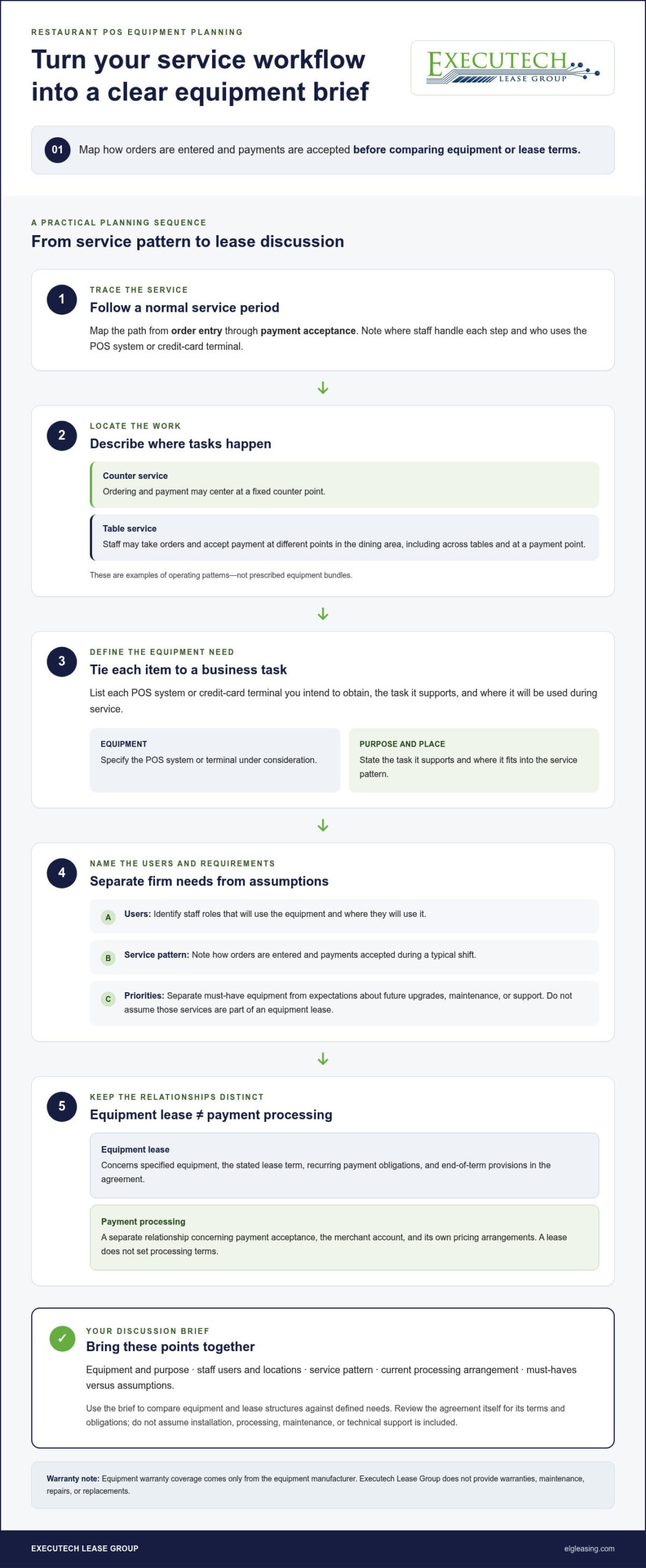
A restaurant POS leasing checklist for choosing equipment and terms
A useful comparison starts with a clear record of how the restaurant operates and what the equipment needs to do. Use this checklist to turn that picture into specific details for evaluating Leasing solutions for restaurant POS systems. Keep equipment requirements, lease obligations, payment processing, and manufacturer warranty questions in separate categories.
- Map the service workflow. Note where staff enter orders and accept payments during a typical service period. Record meaningful differences between shifts or service formats.
- List the equipment and its purpose. Identify each POS system or credit-card terminal you intend to obtain, where it will be used, and the task it supports. Describe what you need rather than assuming a bundle or configuration.
- Identify users and locations. Record which staff roles will use each item and where it will be used. This makes the equipment request specific and easier to compare.
- Separate processing details. Keep notes about your current payment-processing relationship apart from equipment lease terms. The lease and processor arrangement serve different purposes.
- Set your planning horizon. Compare the available equipment lease terms of 12, 24, 36, 48, or 60 months with your equipment planning horizon. None is a universal fit; assess the stated obligations in light of your plans.
- Decide your lease-end intent. Before comparing FMV and lease-to-own, decide whether retaining the equipment is a priority. Then evaluate each option’s stated end-of-term structure against that intent.
- Keep coverage questions distinct. Manufacturer warranty coverage comes from the equipment manufacturer. List warranty questions separately from lease terms, and don’t assume maintenance, repairs, or technical support are included in an equipment lease.
What makes the comparison more useful?
Use the same equipment list and business assumptions for each option you review. Compare recurring obligations and lease-end provisions as written, not just one appealing figure or a broad savings claim. If a proposed term doesn’t align with your planning horizon, note the mismatch and consider what it means for your decision. For more context about equipment structures, explore ELG’s POS equipment leasing programs.
How should you handle tax questions?
Keep tax treatment outside the lease comparison unless you’re reviewing it with a qualified tax professional. Don’t assume a particular tax result from the structure alone. Your professional can assess your circumstances, while your equipment comparison stays focused on the stated lease obligations, term, and lease-end option.
How Executech Lease Group (ELG Leasing) supports restaurant POS equipment leasing
ELG is a U.S. equipment lease brokerage focused on payment technology. For restaurant POS needs, its equipment leasing includes POS systems and credit-card terminals, with FMV and lease-to-own structures to compare. Its role is specific: equipment leasing, not managing every part of a restaurant’s payment setup.
That separation matters for merchants and industry partners alike. An equipment lease doesn’t establish a merchant account, process transactions, set processing prices, or change a processor’s obligations. The payment-processing relationship remains separate. Leasing solutions for restaurant POS systems are easier to assess when equipment, processing, and service responsibilities stay clearly defined.
What role does ELG play in a restaurant POS equipment lease?
ELG’s role centers on the equipment lease and its terms. It doesn’t provide installation, maintenance, repairs, replacements, or technical support. Equipment warranties come only from the manufacturer, so keep warranty questions separate from ELG’s leasing role.
Industry partners can also explore ELG’s article, “POS Leasing for Independent Sales Agents.” It relates to the partner side of equipment leasing and offers perspective for merchant-services providers and POS resellers.
What is a practical next step for an industry partner?
Before beginning a business conversation, organize the equipment scope and restaurant use case. Identify the POS systems or credit-card terminals involved, their intended roles, and whether your lease-end preference is FMV or lease-to-own. This gives the discussion a practical starting point without assuming one structure suits every restaurant.
Vendors, ISOs, and POS resellers can use ELG’s Become a Vendor form to inquire about equipment leasing. It’s a vendor or ISO inquiry mechanism, not a merchant financing application or a submission for a credit decision.
Turn your POS equipment plan into a clear next step
Turn your restaurant’s equipment needs into a concise plan: what equipment you’re considering, how it will be used, and what you want the lease arrangement to support. That gives the next conversation a practical starting point. Keep the equipment decision distinct from payment processing, and bring tax questions to your tax professional.
For vendors, ISOs, and POS resellers, Leasing solutions for restaurant POS systems are easier to discuss when the equipment scope and business context are clear. Our goal is to deliver credit decisions in under 2 business hours. That goal applies only to the decision stage and doesn’t promise approval or determine later steps.
A focused inquiry is a useful way to move from general planning to a specific equipment-leasing discussion. Use ELG’s vendor inquiry form to start that conversation.
Frequently Asked Questions
Does ELG require money down?
ELG offers no-money-down equipment leasing. That does not mean the equipment is free or that there are no ongoing lease obligations.
How fast does ELG make a decision?
Our goal is to deliver credit decisions in under 2 business hours. Keep that separate from the funding and equipment-deployment stages.
Does ELG process payments for restaurant customers?
No. ELG does not process payments. Its equipment-leasing role is separate from payment processing. Questions about transaction pricing and account terms belong to the restaurant’s separate processing relationship.
Who provides the warranty for leased restaurant POS equipment?
Warranty coverage comes only from the equipment manufacturer. Review the manufacturer’s documentation for details about the specific equipment. ELG doesn’t provide warranties, maintenance, repairs, or replacements.
Can leasing restaurant POS equipment always cost less than buying?
No. The cost comparison depends on the equipment and the specific proposed terms. Compare the lease’s recurring obligations and end-of-term provisions with the purchase alternative and its ownership considerations. Consider the restaurant’s intended use for the equipment and how long it expects to rely on it. A general savings claim can’t replace a side-by-side review of the actual arrangements.
Can ELG advise on tax deductions for a restaurant POS lease?
Consult a qualified tax professional about your restaurant’s circumstances. Don’t infer a tax result from an equipment lease structure or its end-of-term option. Bring the proposed agreement and relevant business details to your tax professional, and keep that advice distinct from comparing equipment requirements, payment obligations, and lease terms.
Can a restaurant include POS software in an equipment lease?
Don’t assume POS software is part of a hardware equipment lease. ELG invites independent software vendors to discuss its SaaS funding program and program fit, but that invitation doesn’t establish funding availability or mean restaurant software is included in an equipment lease. If you’re planning Leasing solutions for restaurant POS systems, list software and hardware needs separately so each can be considered under the relevant arrangement.
This article reflects the author’s opinion for general information only and isn’t tax, legal, or accounting advice. Consult your CPA or attorney about your specific situation.

Article by
Robert Ensminger
Robert Ensminger is the founder and CEO of Executech Lease Group (ELG Leasing), which specializes in equipment leasing and financing solutions for the merchant-services, payments, POS, and FinTech industries. Robert helps ISOs, payment processors, POS providers, and software companies build practical equipment leasing programs. He founded ELG in 2010. His work focuses on responsive service, transparent program structures, SaaS-monetization programs, and helping ELG’s partners close more business while creating sustainable revenue.