Your POS hardware is depreciating the moment you unbox it. In 2026, buying technology is often a bet against the very innovation your business needs to survive. You recognize the drain that high upfront costs for systems like Clover place on your liquid capital. The choice between leasing vs buying POS equipment is no longer just about a price tag. It is a strategic decision between fixed ownership and operational agility. We prioritize clarity over fluff. If you want to maximize your cash flow, you need a strategy that keeps pace with the digital economy.
We agree that financial transparency is the only way to build a sustainable operation. This article provides a direct comparison to help you choose between capital ownership and the flexibility of SaaS-based leasing. You will gain a clear understanding of how to access the latest technology without the fear of obsolescence. We also break down the 2026 Section 179 tax implications, including the $2,560,000 deduction limit. We will examine FMV options and lease-to-own programs to ensure your equipment serves your bottom line. It’s time to streamline your path to a smarter payment infrastructure.
Key Takeaways
- Protect your cash flow by evaluating the strategic trade-offs of leasing vs buying POS equipment.
- Understand why financing SaaS software is now a requirement for businesses using cloud-based data hubs.
- Contrast Fair Market Value (FMV) leases with lease-to-own programs to balance tech refreshes and long-term equity.
- Use a direct 5-step framework to assess your liquid capital and hardware replacement cycles accurately.
- Streamline your acquisition of premium Clover devices with flexible terms that match your growth trajectory.
The POS Acquisition Dilemma: Capital Outlay vs. Operational Agility
The modern market has moved past simple cash drawers. To understand what is a POS system in 2026, you must view it as a central data hub. It manages inventory, employee performance, and customer loyalty in real-time. This shift creates a fundamental conflict: do you own the asset or access the utility? The decision between leasing vs buying POS equipment directly dictates your operational agility. Ownership brings the burden of maintenance and hardware aging. Access allows for rapid scaling. Your growth trajectory depends on making the right call now.
Current data shows that 73% of restaurant operators cite technology investment as a top priority this year. However, investing doesn’t always mean purchasing. Buying locks you into a specific hardware generation. Leasing allows you to pivot. Your choice impacts your balance sheet, your tax strategy, and your ability to respond to market shifts. We prioritize efficiency. We want you to understand the real cost of ownership before you commit your capital.
The High Cost of Upfront Ownership
Buying equipment requires significant liquid capital. This upfront CapEx investment often siphons funds away from marketing or hiring. You pay for the entire lifecycle of the device on day one. If the technology becomes obsolete in 24 months, you are stuck with the hardware. Many businesses find their expansion projects stalled because cash is locked in depreciating assets. Ownership also means managing your own software updates and security patches. It is a heavy administrative load for a fast-moving business. You are essentially betting that today’s hardware will remain competitive for years. In a digital economy, that is a risky wager.
The Leasing Alternative: Preserving Cash Flow
Leasing transforms a massive capital hurdle into a predictable monthly OpEx. This approach preserves your working capital for revenue-generating activities. It streamlines the process of getting premium hardware like a Clover Station into your storefront without a massive hit to your bank account. You gain the psychological relief of fixed costs. There are no surprise repair bills or sudden upgrade requirements. You simply pay for the performance of the system. This model matches the SaaS-driven landscape of 2026. It ensures your business remains tech-forward. You get the latest features without the financial strain of total ownership. It’s about moving fast and staying lean.
Financial Breakdown: Buying vs. Leasing POS Hardware and Software
Cash is the lifeblood of your operation. When comparing leasing vs buying POS equipment, the calculation extends beyond the initial sticker price. A 36-month or 60-month term reveals the true total cost of ownership (TCO). Buying requires immediate full payment, which can strain your liquidity. Leasing spreads that cost, allowing you to use the equipment’s revenue to pay for the asset itself. This approach mirrors the recurring revenue models that define modern business. It ensures your technology pays for itself as you scale. We prioritize your ability to maintain a lean, efficient balance sheet.
Tax Implications and Section 179
The tax code rewards those who invest in their infrastructure. For 2026, the Section 179 deduction limit is $2,560,000. This allows you to deduct the full cost of qualifying equipment in the year you place it in service. It applies to both purchased and leased hardware. If you buy, you deduct the purchase price immediately. If you lease, you can often deduct the full value of the equipment upfront or deduct the monthly payments as an operating expense. This flexibility is a powerful tool for managing your tax liability. Always consult with a tax professional to ensure you maximize these benefits before the phase-out threshold of $4,090,000. We don’t just provide equipment; we provide a path to financial efficiency.
Financing the “Soft Costs” of SaaS
Modern POS systems are useless without software. Most providers force you to pay for hardware upfront while charging software fees monthly. We do things differently. Financing cloud-based SaaS POS software is a strategic move to preserve your monthly margins. By including software in your lease package, you simplify your accounting. You get a single, predictable monthly payment for both your hardware and your digital tools. This consolidated approach removes the friction of managing multiple vendors. It allows you to access premium POS leasing solutions that cover the entire technology stack, not just the physical terminal. Subscription leases ensure your software stays updated without sudden cost spikes.
Strategic leasing accelerates technology adoption by removing the capital barriers that prevent small businesses from accessing enterprise-grade tools.
Strategic Lease Structures: FMV vs. Lease-to-Own Programs
Choosing between leasing vs buying POS equipment is the first step. The second is selecting a structure that matches your long-term asset management goals. Not all leases are created equal. Some prioritize the lowest possible monthly cost. Others focus on eventual ownership. We provide the transparency you need to navigate these options without the confusion of hidden fees. Your decision should align with how often you intend to refresh your technology stack.
Fair Market Value (FMV) for Tech-Heavy Businesses
FMV leases are the ultimate path for businesses that demand a high technology refresh cycle. These agreements typically offer the lowest monthly payments. You are essentially paying for the use of the equipment rather than the equipment itself. At the end of your 12 to 60-month term, you can return the hardware and upgrade to the newest Clover Mini or Flex devices. This prevents tech stagnation. It is ideal for retail and restaurant environments where 73% of operators now prioritize technology investment to stay competitive. You maintain operational agility without being anchored to aging processors.
Lease-to-Own: The Path to Ownership
Lease-to-own programs are designed for businesses with stable, long-term hardware requirements. These structures often feature a $1 buyout at the end of the term. While monthly payments may be slightly higher than an FMV lease, you are building equity in your hardware. Once the term concludes, you own the asset outright. This is a pragmatic choice for established businesses that don’t require biennial hardware updates. It provides a clear end-point for your financial obligation while securing your infrastructure.
| Feature | FMV Lease Option | Lease-to-Own ($1 Buyout) |
|---|---|---|
| Monthly Payment | Lowest available | Standard fixed rate |
| End of Term | Return, upgrade, or purchase | Full ownership for $1 |
| Best For | Rapid tech refresh cycles | Long-term hardware stability |
Subscription Leases: The Modern Approach
Subscription leases represent the next evolution in payment technology. This model bundles your 12 to 60-month hardware lease with your cloud-based SaaS POS software. It mirrors the way you already consume digital services. You get a single, predictable line item on your balance sheet. This structure streamlines your operations by consolidating your technology costs into one manageable payment. It eliminates the friction of managing separate hardware and software vendors. We focus on results. This approach ensures you always have access to premium tools without the administrative burden of traditional ownership models.
The 5-Step Decision Framework for POS Acquisition
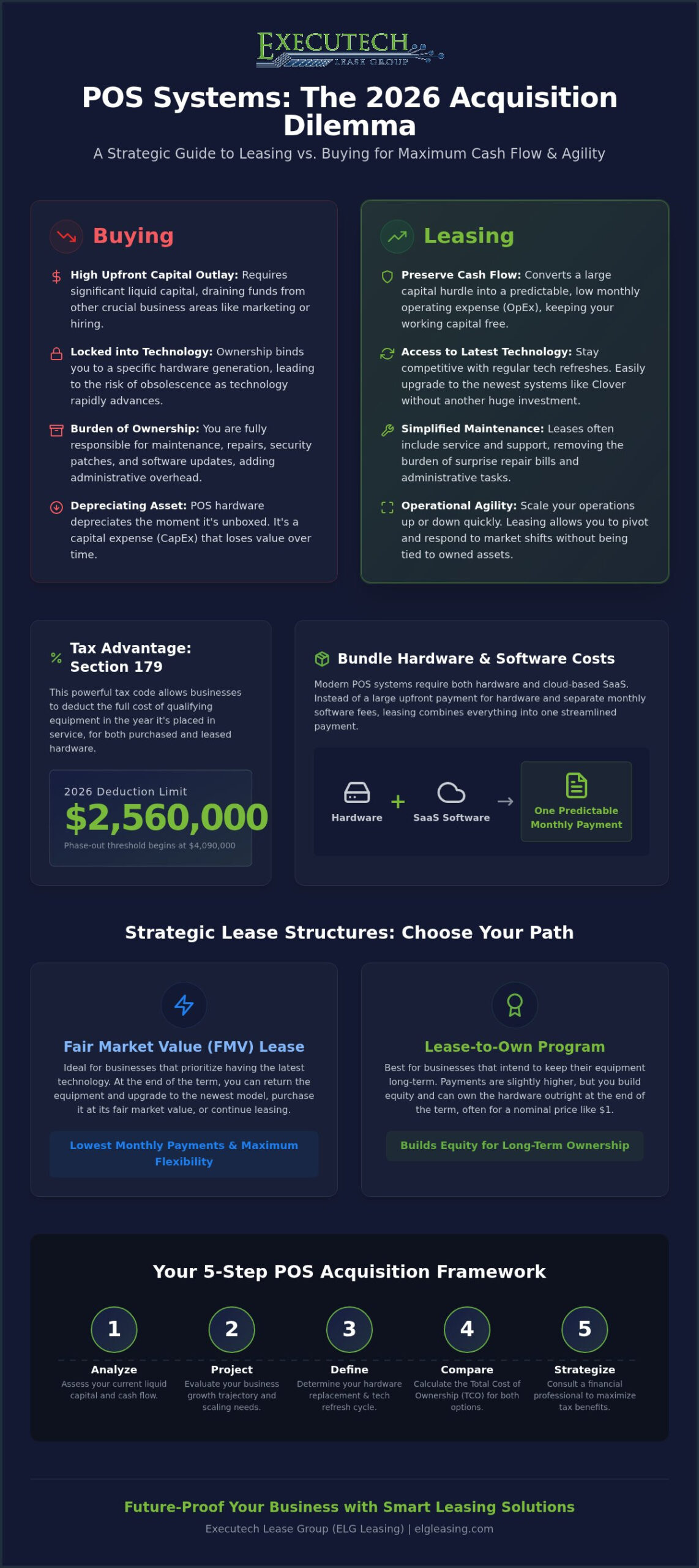
Making the right choice between leasing vs buying POS equipment requires a logical framework. You need a strategy that prioritizes your balance sheet while maintaining your competitive edge. We don’t believe in one-size-fits-all answers. Instead, we offer a disciplined approach to asset management. Follow these five steps to determine the best path for your specific operation.
- Step 1: Evaluate Liquid Capital. Analyze your current cash flow requirements. Determine if tying up significant capital in depreciating hardware serves your expansion goals or if that cash is better spent on marketing and inventory.
- Step 2: Determine Your Refresh Cycle. Assess how long you expect your hardware to remain competitive. If you demand the latest features every 24 to 36 months, a lease is the only logical choice to avoid tech stagnation.
- Step 3: Analyze Tax Position. Review your 2026 tax strategy. Consider how Section 179 deductions can offset your equipment costs. A lease can often provide the same immediate tax relief as a purchase without the upfront cash hit.
- Step 4: Assess Software Bundling. Identify your SaaS requirements. Determine if your budget benefits from consolidating hardware and cloud-based software into a single, predictable monthly payment.
- Step 5: Review Processor Flexibility. Protect your independence. Ensure your equipment acquisition doesn’t lock you into a specific payment processor with unfavorable rates.
Assessing Your Technology Lifecycle
Payment standards move faster than hardware. We’ve seen the shift from basic magstripe to EMV and NFC. Now, biometrics and AI-driven ordering are becoming the standard. If you buy your hardware, you are responsible for its inevitable decline. Hardware failure outside of a manufacturer’s warranty can lead to unexpected downtime. Leasing provides a supported lifecycle. It ensures you have functioning, modern equipment without the burden of maintenance. Efficiency is the goal. Don’t let your “pride of ownership” become a technical anchor that prevents you from adopting newer, faster payment methods.
Evaluating Vendor and Processor Independence
Processors often use “free” equipment as bait. It’s a trap. These bundles usually come with higher processing rates and restrictive long-term contracts. By choosing a third-party partner like ELG Leasing, you maintain your leverage. You separate your equipment financing from your payment processing. This independence allows you to switch processors if rates climb, all while keeping your premium hardware. We value transparency. Our lease terms are professional and direct. You deserve a partner that empowers your business rather than one that seeks to control it. To secure your operational freedom, you can access our flexible POS leasing programs today.
Future-Proofing Your Business with ELG Leasing Solutions
Success in 2026 requires more than just a functional register. It requires a tech-forward infrastructure that evolves with your market. Choosing between leasing vs buying POS equipment is a choice between stagnation and momentum. We provide the momentum. Our solutions allow you to access premium Clover devices and sophisticated cloud-based software without the heavy upfront price tag. We prioritize your cash flow. We offer flexible 12 to 60-month terms tailored to your specific revenue patterns. This isn’t just about hardware. It’s about a comprehensive financial strategy that includes your SaaS POS software in one streamlined package.
We understand that modern businesses are data-driven. A system that can’t handle digital operations is a liability. By financing both your hardware and your software subscriptions, you ensure your business stays at the cutting edge. You can learn more about our specific Clover terminal leasing options to see how we help you scale. We focus on results. We get you what you need with minimal friction.
The ELG Advantage for ISOs and Sales Agents
We aren’t just for business owners. We are a selective partner for ISOs and sales agents who demand high standards for their clients. We empower merchant service providers to offer better technology. This helps agents maximize their residuals and close more deals. Our approach is professional and no-nonsense. We handle the complex financial arrangements so you can focus on building your portfolio. We act as a disciplined gatekeeper. We protect our ecosystem by working with partners who value quality and transparency. If you want to accelerate your growth, you need a partner that understands the intersection of finance and technology.
Getting Started with a Transparent Lease
Simplicity is our recurring linguistic anchor. We’ve removed the perceived difficulty of the broader leasing industry. The Executech Lease Group application process is direct. It’s designed for speed. Once approved, you can expect a transparent 12–60 month journey with no hidden fees or impenetrable legalese. We don’t claim to be for everyone. We work with businesses that value efficiency and professional clarity. Your technology shouldn’t be a burden. It should be a powerful tool for growth. Take the next step in your financial strategy. Apply for your POS equipment lease today and secure the operational agility your business deserves.
Secure Your Operational Agility for 2026
The decision regarding leasing vs buying POS equipment defines your ability to adapt in a fast-moving market. You’ve evaluated the financial frameworks and the strategic benefits of preserving liquid capital. Now, you must choose a path that prioritizes momentum over static ownership. Efficiency is the goal. We agree that simplicity is the ultimate business advantage. By consolidating your hardware and software into a single, manageable plan, you eliminate the friction of traditional procurement.
We offer 12–60 month flexible terms and specialized Clover financing designed for rapid growth. Our SaaS and software lease options ensure your digital tools are always current and your balance sheet remains lean. Streamline your tech acquisition with ELG Leasing to protect your capital and accelerate your operations. Your business deserves a foundation built for the next decade of digital commerce. Let’s build it together.
Frequently Asked Questions
Is it cheaper to buy or lease a POS system?
Buying has a lower total dollar cost over five years. However, leasing is often more cost-effective when you factor in the time value of money and opportunity costs. By choosing a lease, you avoid the heavy upfront hit to your working capital. This allows you to reinvest that cash into inventory or marketing. When evaluating leasing vs buying POS equipment, consider your growth trajectory rather than just the final price tag.
Can I lease a Clover terminal without a long-term processor contract?
You can lease a Clover terminal through a third-party partner like ELG Leasing to maintain your processor independence. Some processors offer “free” hardware that locks you into high rates and restrictive contracts. Our specialized Clover financing separates your equipment from your processing. This gives you the leverage to switch providers if their service or rates no longer meet your standards. It’s about maintaining control over your technology and your residuals.
What happens at the end of a POS equipment lease?
Your options depend on the lease structure you selected at the start. If you have a Fair Market Value (FMV) lease, you can return the equipment, upgrade to the latest technology, or purchase it at its current market price. If you chose a lease-to-own program, you typically own the hardware outright after a final $1 buyout. We prioritize transparency, so your end-of-term path is clearly defined before you sign.
Does POS equipment leasing qualify for Section 179 tax deductions?
POS equipment leasing absolutely qualifies for Section 179 tax deductions. For the 2026 tax year, the deduction limit is $2,560,000. This allows you to deduct the full value of the leased equipment from your gross income in the first year it’s placed in service. It’s a powerful tool for reducing your tax liability while preserving your cash flow. Always consult with a qualified tax professional to maximize these 2026 benefits.
Can I lease POS software as well as hardware?
You can lease both hardware and cloud-based SaaS POS software through our streamlined financing programs. We recognize that modern payment technology is a combination of physical terminals and digital tools. Bundling these costs into a single monthly payment simplifies your accounting and protects your margins. This subscription-based approach ensures you have access to the full technology stack without managing multiple vendors or facing unpredictable software price spikes.
What is the typical length of a merchant hardware lease?
The typical length of a merchant hardware lease ranges from 12 to 60 months. We offer flexible terms to ensure the financing aligns with your specific revenue cycles and technology needs. A 36-month term is a common choice for businesses that want to refresh their hardware frequently. Longer 60-month terms provide the lowest monthly payments for established businesses with stable infrastructure requirements. We help you choose the duration that fits your goals.
Are there early termination penalties in a POS lease?
Most professional lease agreements are non-cancelable contracts that require the full payment of the remaining term if terminated early. We value professional transparency and clearly outline these obligations in our agreements. Some businesses can negotiate a buyout or a technology refresh if their needs change. It’s vital to review your contract carefully before signing. We focus on providing predictable financial arrangements that eliminate surprises for our partners and their clients.
Can I upgrade my equipment before the lease term ends?
Upgrading your equipment before the term ends is a common strategic move in leasing vs buying POS equipment discussions. Fair Market Value (FMV) leases are specifically designed to facilitate these technology refresh cycles. We can often restructure your agreement to include the latest Clover hardware or updated SaaS software. This ensures your business never falls behind the curve of digital innovation. We make the transition to newer technology feel organized and predictable.

Article by
Robert Ensminger
Robert Ensminger is the founder and CEO of Executech Lease Group (ELG Leasing), which specializes in equipment leasing and financing solutions for the merchant-services, payments, POS, and FinTech industries. With more than 20 years of industry experience, Robert helps independent sales organizations, payment processors, POS providers, and software companies develop practical leasing, subscription, and SaaS-monetization programs. He founded ELG in 2010 and guided the company to recognition on the Inc. 5000. His work focuses on responsive service, transparent program structures, and helping ELG’s partners close more business while creating sustainable revenue.