
A fixed payment does not tell you how easily you can leave a POS equipment agreement. Subscription based equipment leasing lets a business use equipment for recurring payments, while the contract sets the term, ownership, purchase options, and what happens if you end the arrangement early. The label alone does not tell you whether you can buy, exchange, or return the equipment.
It is easy to focus on the monthly payment and assume a subscription works like a cancel-anytime service. With equipment, the agreement’s end date and termination terms matter just as much. This article explains how subscription models compare with traditional leases and equipment loans, and what to review before signing. You’ll see how purchase and upgrade terms can differ, what substitution clauses mean, and how an early exit may affect your remaining obligations. The goal is a clear comparison, so you can match the contract structure to how long you expect to use the POS equipment.
Key Takeaways
- Compare a POS equipment lease with financing by looking at ownership, payment structure, and what happens at the end of the agreement.
- Understand how subscription, operating, and lease-to-own arrangements differ before choosing a term or payment structure.
- Review the purchase option carefully, including its price and when you can exercise it.
- Check whether the contract allows equipment substitution, and understand that upgrade terms may apply at the end of the lease rather than during it.
- Read early-termination terms for any remaining payment obligations and the process for ending the agreement.
What Is Equipment Leasing?
Equipment leasing lets a business use a POS system or card terminal in exchange for agreed payments. The agreement sets the lease term, ownership rights, and options at the end of that term.
Leasing Compared With Financing
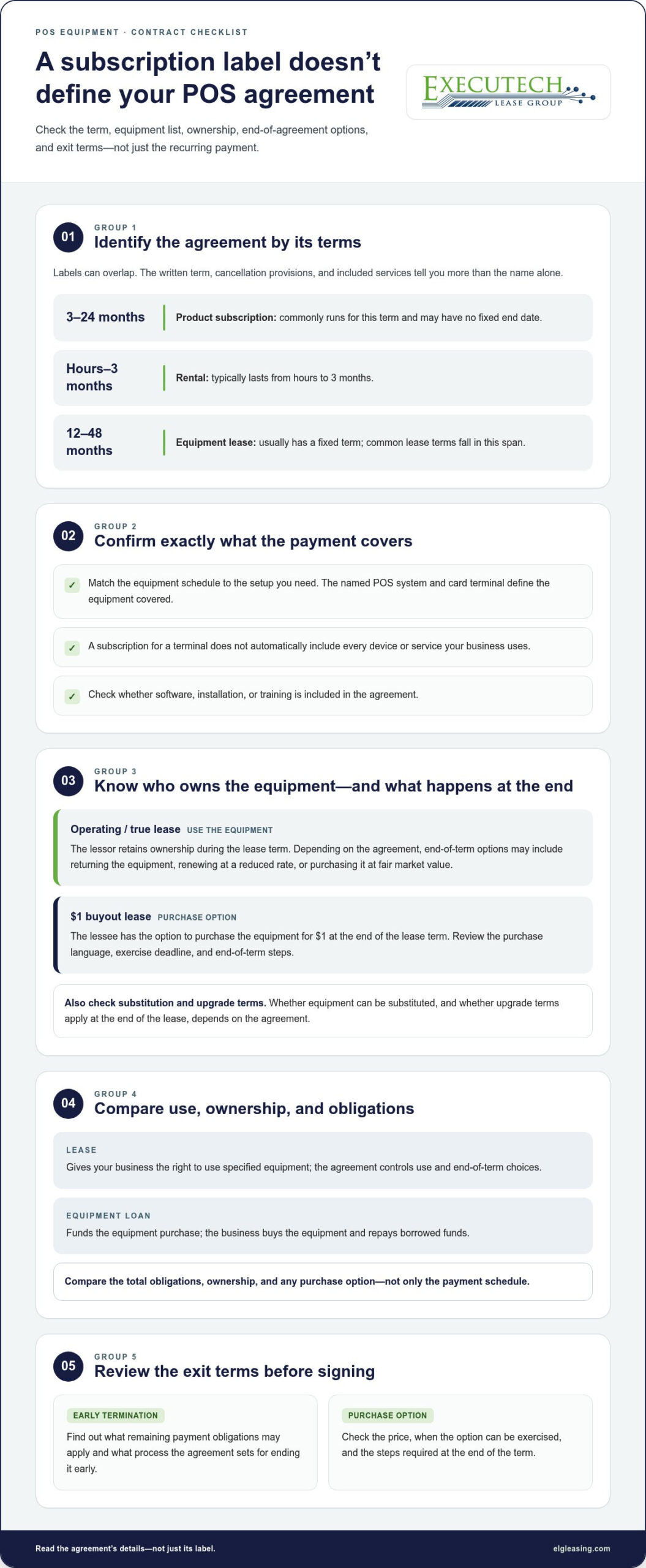
An equipment lease gives your business the right to use specified equipment, while an equipment loan funds its purchase. That difference matters when deciding whether owning the POS system or preserving capital better fits your plans. With a lease, the agreement controls use and end-of-term choices. With a loan, the business buys the equipment and repays borrowed funds. Compare total obligations, ownership, and any purchase option, not just the payment schedule.
Capital and Finance Lease Structures
A capital, or finance, lease can have tax implications that differ from other lease structures. It can allow the lessee to claim depreciation deductions or, if eligible, a Section 179 deduction. The lessee is usually responsible for maintenance and insurance. These terms matter if you intend to keep the POS equipment and accept owner-like responsibilities. Read the agreement’s end-of-term purchase language before choosing this structure.
Tax and Accounting Treatment
Lease and loan tax treatment depends on the agreement’s structure. FMV lease payments may be deductible as an operating expense, while a capital lease may allow depreciation deductions and, if eligible, a Section 179 deduction. Consult a CPA about your circumstances. For U.S. operating leases longer than 12 months, ASC 842 places a lease liability on the balance sheet and records payments as a single operating expense. A lease may shift equipment costs from a capital expense to an operating expense, but that treatment depends on the lease structure.
Equipment Financing Application Process
A financing application typically moves through defined stages. First, identify the POS equipment and purchase amount you want financed. Next, provide the lender with its application and requested business information. The lender reviews the application and evaluates the proposed financing terms. If approved, review the repayment schedule, obligations, and equipment details before accepting. This sequence helps distinguish a loan to buy a terminal from a lease to use one.
Direct Equipment Lending and Financing
Direct equipment lending provides funds for a business to purchase equipment, with repayment owed to the lender. Intermediate-term debt may lend up to 80% of the equipment’s appraised value, depending on the financing structure. That appraisal-based approach differs from a lease, where payment terms relate to using the equipment rather than borrowing to own it. For a POS system, compare who holds title, how payments are calculated, and whether an upgrade means a new purchase or a new agreement.
This article reflects the author’s opinion for general information only and isn’t tax, legal, or accounting advice. Consult your CPA or attorney about your specific situation.
What Types of Equipment Leases Are Available?
For POS use, subscription leasing can cover payment-processing equipment, including card terminals and point-of-sale systems. The contract defines the equipment, payment schedule, term, ownership, and end-of-agreement options.
Operating and True Lease Structures
An operating, or true, lease lets a business use equipment while the lessor retains ownership throughout the lease term. That distinction matters if you want access to a POS system without treating the agreement as a purchase. At the end, the contract may allow you to return the equipment, renew at a reduced rate, or purchase it at fair market value. The available options depend on the agreement.
Subscription, Rental, and Lease Definitions
A product subscription commonly runs for 3–24 months and may have no fixed end date; a rental typically lasts from hours to 3 months; and a lease usually has a fixed term. Product subscriptions commonly bundle services, while rental and lease agreements focus on equipment use and payment obligations. Those labels can overlap, so the contract’s term, cancellation provisions, and included services matter more than its name.
Equipment leases commonly have fixed terms of 12–48 months. Payment amounts depend on equipment value, interest rates, competition among lessors, credit and obsolescence risk, and which party receives tax benefits. The term also shapes the payment schedule and how long the business remains responsible for the equipment. Compare the full agreement, not a monthly figure alone.
Equipment Available Through Subscription Leasing
In the United States, subscription leasing for POS operations can cover payment-processing equipment such as credit card terminals and point-of-sale systems. The equipment named in the agreement defines the scope of the arrangement. A subscription for a terminal does not automatically include every device or service the business uses.
Before signing, match the equipment list to the setup you need. For example, if the contract names a POS system and a card terminal, those are the assets covered. Separate devices, software, installation, or training depend on what the agreement includes. A clear equipment schedule helps you understand what each payment covers.
A $1 buyout lease gives the lessee the option to purchase the equipment for $1 at the end of the lease term. That differs from an operating lease, where the lessor retains ownership during the term and the contract may offer return, renewal, or fair-market-value purchase options. Review the purchase language, exercise deadline, and end-of-term steps before choosing.
Payment and responsibility terms also vary. An agreement may assign the lessee insurance, maintenance, repair, shipping, or end-of-term handling costs. Product subscriptions may bundle services, but those services should be listed in the contract rather than assumed. If you’re assessing POS equipment financing options, review the equipment application process alongside the agreement’s term and ownership provisions.
Equipment leasing compared with equipment loans
In the United States, POS equipment subscriptions are offered through equipment lessors, payment-technology vendors, and providers that bundle equipment access with recurring services. The operator’s contract defines which equipment is covered, how long access lasts, and what happens when the agreement ends.
An equipment loan funds a purchase, so the business acquires the POS equipment and repays the lender under a schedule. A lease gives the business use of specified equipment under a lessor’s agreement. For term loans, repayment schedules can reach 7 years at banks and 10 years at finance companies. Compare those obligations with the lease term and end-of-term choices. Ownership, rather than the payment frequency, is the central difference.
An operating lease can suit a business that values access over ownership. The lessor retains ownership throughout the lease period, and the agreement may allow a return, renewal, or purchase at the end. Loan payments support a purchase instead. For example, a business replacing a POS system as its needs change may weigh lease-end options against owning equipment it plans to keep using. Flexibility depends on contract terms, not the word “lease.”
A subscription may resemble a lease because both can provide equipment for recurring payments. The distinction is often in the agreement’s duration and included services. Product subscriptions commonly run for 3–24 months and may have no fixed end date. Fixed-term equipment leases commonly run for 12–48 months. Subscriptions may bundle maintenance, repair, or support, while a lease can assign those responsibilities to the lessee. Read the service list alongside the equipment schedule.
Choosing an equipment leasing company starts with matching the agreement to your POS needs. Compare the named equipment, payment schedule, lease term, ownership, maintenance duties, and end-of-term options. Then examine how the contract handles insurance, shipping, and equipment return. A subscription with bundled services may suit a business seeking a defined package; a fixed-term lease may suit one planning around a set usage period. A loan is the ownership route. Compare the full obligation over the contract’s life, not just one payment.
Ask how the agreement addresses equipment that becomes outdated. A lease may remain tied to the named asset through its term, while an end-of-term purchase option may let the business keep it. A new agreement can finance replacement equipment after the existing term. Review these provisions before signing, especially when POS technology may change before your planned ownership timeline.
In the United States, POS equipment subscriptions are offered by equipment lessors, payment-technology vendors, and providers that bundle equipment access with recurring services.
Purchase, upgrade, and substitution options
A POS equipment lease may end with a return, renewal, or purchase, depending on its terms. The contract should make the equipment, end date, and financial obligations clear.
Purchase Options and Stipulated Loss Value
A purchase option sets whether you can buy the leased equipment, at what price, and when you can exercise that right. A stipulated loss value formula calculates the amount owed if equipment is damaged, lost, or stolen. These terms matter because a purchase obligation and a casualty loss have different financial outcomes. Review the stated option price, exercise deadline, and loss calculation separately.
Buyout structures differ. A $1 buyout lease gives the lessee the option to purchase the equipment for $1 at the end of the lease term. A 10 percent option lease gives the lessee the option to buy for 10 percent of the equipment’s original value when the term ends. By contrast, a 10 percent purchase-upon-termination lease requires the lessee to buy for 10 percent of original cost at termination. An optional purchase and a required purchase are not the same obligation.
Ownership Intent and Buyout Choices
Your ownership plans should guide the buyout you consider. If you plan to keep a POS terminal after the lease term, a purchase option spells out how ownership can transfer. If you expect to return the equipment, examine the return and end-of-term duties instead. The choice affects whether the contract ends with a purchase expense, equipment return, or renewal.
Texas law treats a lease with a $1 or other nominal buyout as a sale with a security interest rather than a true lease. That distinction can matter when you compare contract structures and ownership expectations. A nominal purchase option therefore does not function like a typical end-of-term fair-market-value choice. Review the agreement’s terminology and purchase clause in context.
Read equipment substitution and upgrade language carefully. Do not assume a lease lets you change the named POS system during its active term. Check which equipment the contract identifies and what happens at the end. If the system is outdated then, a new lease may finance replacement equipment. That separates a future replacement decision from the current contract’s obligations.
Before signing, compare the agreement’s key end-of-term provisions:
- Whether a purchase is optional or required.
- The purchase price and deadline for exercising the option.
- Return, renewal, and equipment condition obligations.
- The stipulated loss value formula for a casualty loss.
These clauses define the expense and ownership outcome. A clear contract lets you compare a buyout with returning the equipment or arranging a new lease after the term ends.
Early termination requirements
Ending a POS equipment agreement before its scheduled end date is different from reaching the end of its term. The contract determines whether early termination is permitted and what financial or return obligations apply. A recurring monthly payment does not, by itself, mean you can cancel at any time.
Start with the termination clause. Identify whether it gives you a right to end the agreement early or describes obligations if the equipment arrangement ends prematurely. Those are not the same. If the contract does not provide an early-exit right, do not assume that returning a terminal ends your payment responsibility. The written agreement controls.
Next, find the method for calculating any amount due. The contract may state how remaining payments, a purchase option, or other amounts affect the total. For example, a POS system agreement could require a calculation tied to the unpaid term. Use the contract’s formula and the account’s payment history to understand the amount. Do not treat the monthly payment alone as the full termination cost.
Separate an early exit from an equipment return. The agreement may describe return shipping, insurance, equipment condition, or dismantling costs at the end of the lease. Those end-of-term details do not automatically create a right to terminate early. A card terminal returned before the scheduled end date may still leave financial obligations under the contract.
Review these provisions together before signing:
- Termination right: Does the agreement permit early termination, or only state its consequences?
- Calculation: What contract formula determines any amount due after early termination?
- Notice: Does the agreement set a required notice method or deadline?
- Equipment: Where must the POS equipment go, and who handles shipping and insurance?
- Purchase option: Does termination affect a purchase option or create a separate purchase obligation?
Consider a business that expects to relocate before a fixed lease term ends. Before signing, it should compare the relocation timeline with the contract’s end date and termination language. If the agreement requires continued payments after equipment return, that obligation could affect cash flow even when the POS system is no longer in use. A subscription may have different end provisions, so compare its actual contract rather than relying on the subscription label.
Keep a copy of the signed agreement and any written termination notice. If an early exit becomes relevant, follow the stated process, retain delivery records, and compare the final account statement with the contract’s calculation. These steps make it easier to identify which obligations remain and whether the equipment return was completed as required.
Executech Lease Group (ELG Leasing): 12–60 Month Credit Card and POS Equipment Leases
Executech Lease Group (ELG Leasing) helps merchants access credit card terminals and POS systems through 12–60-month equipment leases. If your decision depends on whether you plan to own the equipment or use it for a defined term, compare its Lease-to-Own Programs with FMV Lease Options. Clover Leasing is also available for businesses considering Clover equipment.
The right structure depends on your ownership plans and the agreement’s end-of-term provisions. Review the payment schedule, purchase option, and equipment obligations together before choosing. This makes it easier to match the lease type to your POS requirements.
Contact Executech Lease Group to discuss POS equipment leasing for your business.
Make the Contract Fit Your Next Business Decision
Before committing, map the equipment agreement to a realistic operating plan: how long the POS setup should remain useful, which responsibilities your team can handle, and what change might prompt a different arrangement. Then compare those assumptions with the contract’s payment duties, end date, and exit language. This makes subscription based equipment leasing a decision you can assess against your business needs, not just a label.
Give particular attention to what your business needs when the agreement ends. A clear plan for keeping, returning, or replacing equipment helps you avoid choosing based only on a convenient payment structure. If your requirements may change, focus on the contract’s actual terms rather than assuming it includes an early exit or equipment exchange.
Executech Lease Group can help you consider POS equipment lease structures in light of the equipment and ownership approach you’re weighing. Bring your priorities into the discussion so the next step starts with practical requirements, not assumptions.
A well-matched agreement gives you a clearer basis for planning. Move forward with confidence in the questions you’re asking.
Frequently Asked Questions
What is a lease?
A lease gives a business the right to use named equipment in exchange for payments. For a POS setup, the contract identifies the terminal or system, payment schedule, lease term, responsibilities, and end-of-term options. Ownership may remain with the lessor, or the agreement may include a purchase option. Read the equipment description and end-of-term clauses together to understand what the arrangement covers.
What is the difference between renting and leasing?
Rentals usually cover short-term equipment use, while leases typically set a longer, fixed period. Equipment rentals can last from hours to three months; equipment leases commonly have fixed terms of 12–48 months. For example, a business needing a terminal for a brief event might consider a rental structure, while a merchant planning ongoing POS use may compare longer-term agreements. The contract determines payment and return obligations.
Do rental and subscription businesses need credit checks?
Some rental and subscription providers use credit checks, particularly for high-value equipment, to assess payment risk and reduce fraud. A check may form one part of an application review, alongside business details and the equipment requested. Requirements differ by provider and agreement. Before applying, understand whether the review concerns the business, an owner, or both, and how the provider uses the information in its decision.
What are the main categories of equipment leases?
Common categories include operating or true leases, finance or capital leases, fair-market-value options, and lease-to-own structures. The categories differ in ownership treatment, end-of-term choices, and which party carries responsibilities. For instance, an operating lease may offer a return or purchase choice, while lease-to-own terms focus on eventual ownership. Compare the agreement’s actual clauses, since labels alone do not establish obligations or purchase rights.
What is subscription-based equipment leasing and how does it work?
Subscription-based equipment leasing provides access to specified equipment through recurring payments under a subscription agreement. The contract states what equipment is included, the payment schedule, service components, and how the arrangement ends or renews. Some subscriptions bundle services, while others focus on equipment access. For a POS setup, identify whether the agreement covers only a terminal or also names other hardware, software, or services.
How much does equipment leasing by subscription cost, including fees and deposits?
Subscription lease costs depend on the equipment, contract duration, payment structure, and any included services. Fees and deposits depend on the provider’s agreement, so do not assume that a recurring payment covers every charge or that a deposit is always required. Compare the full payment schedule and listed charges before accepting. For a POS system, make sure the quote matches the equipment and services named in the contract.
How do subscription-based equipment leasing plans compare with traditional leases and equipment financing?
A subscription often combines recurring equipment access with services, while a traditional lease centers on using specified equipment under agreed terms. Equipment financing funds a purchase, so the business repays borrowed funds and acquires the equipment. A retailer choosing a POS system can compare who owns the hardware, which services the payment includes, and what happens when the agreement ends. Those distinctions matter more than the product label.
What are the typical contract terms, renewal rules, and cancellation policies?
Equipment lease terms commonly run 12–48 months, while product subscriptions commonly run 3–24 months; rental periods can range from hours to three months. Renewal and cancellation rules depend on the written agreement. Look for the end date, renewal procedure, required notice, early-termination language, and equipment-return instructions. A contract’s recurring payment schedule does not, by itself, establish a right to cancel or renew automatically.
This article reflects the author’s opinion for general information only and isn’t tax, legal, or accounting advice. Consult your CPA or attorney about your specific situation.

Article by
Robert Ensminger
Robert Ensminger is the founder and CEO of Executech Lease Group (ELG Leasing), which specializes in equipment leasing and financing solutions for the merchant-services, payments, POS, and FinTech industries. With more than 20 years of industry experience, Robert helps ISOs, payment processors, POS providers, and software companies build practical equipment leasing programs. He founded ELG in 2010. His work focuses on responsive service, transparent program structures, subscription and SaaS-monetization programs, and helping ELG’s partners close more business while creating sustainable revenue.