
The smallest monthly payment can become the costliest POS choice if it leaves key expenses outside the quote. A low monthly payment POS offer may cover equipment, software, or only part of the setup, so the headline figure doesn’t tell you what you’ll actually pay.
It makes sense to look for a manageable payment when an upfront equipment purchase could strain cash flow. Leasing can reduce the initial outlay, but it still creates a recurring financial commitment. And “free software” doesn’t necessarily include hardware or payment processing.
This guide shows you how to compare proposals using consistent cost categories, separate software payments from equipment payments, and understand the commitment and end-of-term options behind a lease. You’ll also see how equipment leasing differs from payment processing and how to assess whether an FMV lease, lease-to-own program, or another structure fits your cash-flow plan. The goal is to judge the full scope of the offer, not just its monthly figure.
Key Takeaways
- Break each POS proposal into software, equipment, processing, and other listed charges so you can compare the same categories.
- A low monthly payment POS offer should identify the equipment and services it covers, not just the recurring amount.
- ELG offers no-money-down equipment leasing. No down payment is required, but the lease still creates a payment commitment for the equipment.
- Review the lease term and end-of-term option alongside the monthly payment before deciding whether the structure fits your cash-flow plan.
- Understand how an equipment lease brokerage such as Executech Lease Group (ELG) works with merchant-services providers, including independent sales organizations (ISOs) and agents.
What Does a Low Monthly Payment POS System Actually Include?
A recurring payment only makes sense in context. A low monthly payment POS offer may refer to software access, leased equipment, or another specific product or service. It doesn’t automatically represent the cost of running the full checkout setup. Before comparing monthly figures, identify what each one pays for and which expenses are billed separately.
POS affordability depends on what recurring payments cover. A smaller figure can reflect a narrower set of products or services, a different contract term, or a payment that excludes important parts of your setup. Compare the scope and commitment, not just the amount displayed.
POS software, equipment, and processing are different cost categories
Point of sale (POS) describes the system used to complete sales and manage related business functions. A POS system can include software and physical equipment, but those components aren’t interchangeable. Software provides access to the platform and its features. Equipment means the physical devices used at checkout, such as terminals or other hardware named in a proposal.
Keep transaction charges separate, too. Processing charges relate to payments customers make; an equipment lease covers hardware. Executech Lease Group (ELG) provides equipment leasing, not payment processing or merchant accounts. A lease payment doesn’t replace processing charges, and software access doesn’t establish that equipment is included.
- Software: Recurring charges, if any, for access to the POS platform and its features.
- Equipment: A purchase or recurring lease payment for the hardware identified in a proposal.
- Processing: Charges associated with handling transactions, separate from an equipment lease.
- Other listed items: Review each additional line item and note whether it recurs or applies under specific terms.
A plan described as “free software” only speaks to the software offer. It doesn’t establish that the terminal or other hardware is free, or that transaction processing is included at no charge. Treat each category separately. A POS equipment lease concerns hardware payment obligations, not the software plan or processing arrangement.
Why a small monthly figure needs context
Read the proposal as a commitment, not a headline. Identify the equipment or services covered by the recurring payment, then locate the term, payment frequency, and end-of-term option. If those details are difficult to find, the monthly figure alone isn’t enough to compare the proposal fairly.
- Match the payment to its scope. Confirm which devices, software access, or other listed items it covers.
- Identify the schedule and term. Note how often payments are due and how long the commitment runs.
- Read the end-of-term language. Find the option stated for when the term concludes.
A lower monthly amount doesn’t prove a lower total commitment. The payment may cover equipment only, with software and processing costs listed elsewhere, or it may run for a different term. Put each proposal’s categories side by side before deciding what the monthly payment means for your business.
How POS Equipment Leasing Shapes a Monthly Payment
Leasing turns the cost of specified POS hardware into a recurring commitment rather than a single upfront purchase. The proposed payment depends on the equipment covered, the lease term, and the program structure. A terminal-only package and a broader setup represent different equipment commitments, so start with the itemized scope.
No-money-down describes the initial payment requirement, not the total cost. ELG offers no-money-down equipment leasing, meaning there’s no down payment at the start. The equipment isn’t free, and the lease still creates a recurring payment obligation. Keep the equipment lease separate from any software subscription and transaction-processing arrangement.
What to identify in an equipment payment proposal
Read the equipment schedule and payment terms together. Identify each device covered, the lease term, payment frequency, and stated end-of-term option. Then distinguish the equipment payment from charges for software access or transaction processing. This makes it easier to compare proposals with different equipment packages or program structures without treating them as equivalent.
- Equipment: The hardware included in the lease.
- Term: How long the recurring equipment commitment lasts.
- Separate arrangements: Software subscriptions and payment processing, if applicable.
- End option: What the proposal specifies when the lease term concludes.
For a closer look at equipment lease arrangements, review this POS equipment leasing guide. Compare the proposal’s specific equipment and terms against the options that matter to your business.
How ELG lease structures differ
Program structure affects the commitment and the end-of-term option. ELG’s fair market value (FMV) lease offers terms of 12, 24, 36, 48, or 60 months and ends with about a 10% buyout. Lease-to-own terms run from 12 to 60 months and end with a $1 buyout. These are distinct options: the $1 buyout applies to lease-to-own, not FMV.
Compare the stated term and end option alongside the recurring payment. A payment figure by itself doesn’t show how long the obligation lasts or how the arrangement concludes. Keep the equipment package, payment schedule, program structure, and end option visible in the same comparison.
If you’re organizing the details for an equipment leasing inquiry, ELG’s Apply Now page is a route for vendor inquiries. A low monthly payment POS proposal is easier to assess when its equipment and commitment are clearly identified.
Free POS Software vs. a Low Monthly Equipment Payment
These options address different business needs. Software determines which digital tools your team can use, while an equipment purchase or lease determines how you acquire physical devices. The better fit depends on the features your operation needs, how you prefer to acquire hardware, and how the equipment arrangement fits your plans.
Use this table to compare the basic structure of each option. Then review the actual proposal, since features, terms, and ownership arrangements can vary.
| Option | What it covers | Recurring obligation | Equipment ownership implications |
|---|---|---|---|
| Free POS software | Access to the tools and features included in the software tier | The tier may not require a recurring software payment | Doesn’t itself determine how hardware is acquired or who owns it |
| Purchased hardware | POS devices acquired through a purchase | No equipment lease obligation | The business purchases the equipment |
| Leased hardware | Equipment identified in a lease arrangement | Recurring payments follow the stated lease terms | The program’s terms determine the applicable end-of-term option |
What “free POS” may, and may not, mean
A free software tier is a software-plan choice. Its practical value depends on whether its features support your day-to-day workflow, including the sales tasks and reporting functions your business relies on. Software providers may present free access and hardware options separately, or pair a free tier with a path to paid features.
Compare the functions your team needs and the equipment arrangement as separate decisions. A software tier that suits a simple workflow may not meet the needs of a business with different operational requirements. Check which features are included in the specific tier and whether the hardware you need is listed separately.
When a recurring equipment payment merits comparison
Consider your cash-flow plan and equipment strategy together. If retaining more cash for operating needs is a priority, compare a recurring hardware arrangement with an upfront purchase. The tradeoff is a continuing payment schedule, so assess whether the proposed term aligns with how long you expect to use the equipment and how you plan to handle changes to your setup.
Compare the equipment included, lease term, and end-of-term option across proposals. Also consider whether the hardware configuration suits your checkout workflow and whether the software plan offers the features your team needs. Leasing and free software aren’t competing answers to the same question. One concerns the acquisition and use of equipment; the other concerns access to software tools. Choose based on the combined fit with your operations, cash-flow priorities, and equipment plans, rather than assuming either option is universally cheaper.
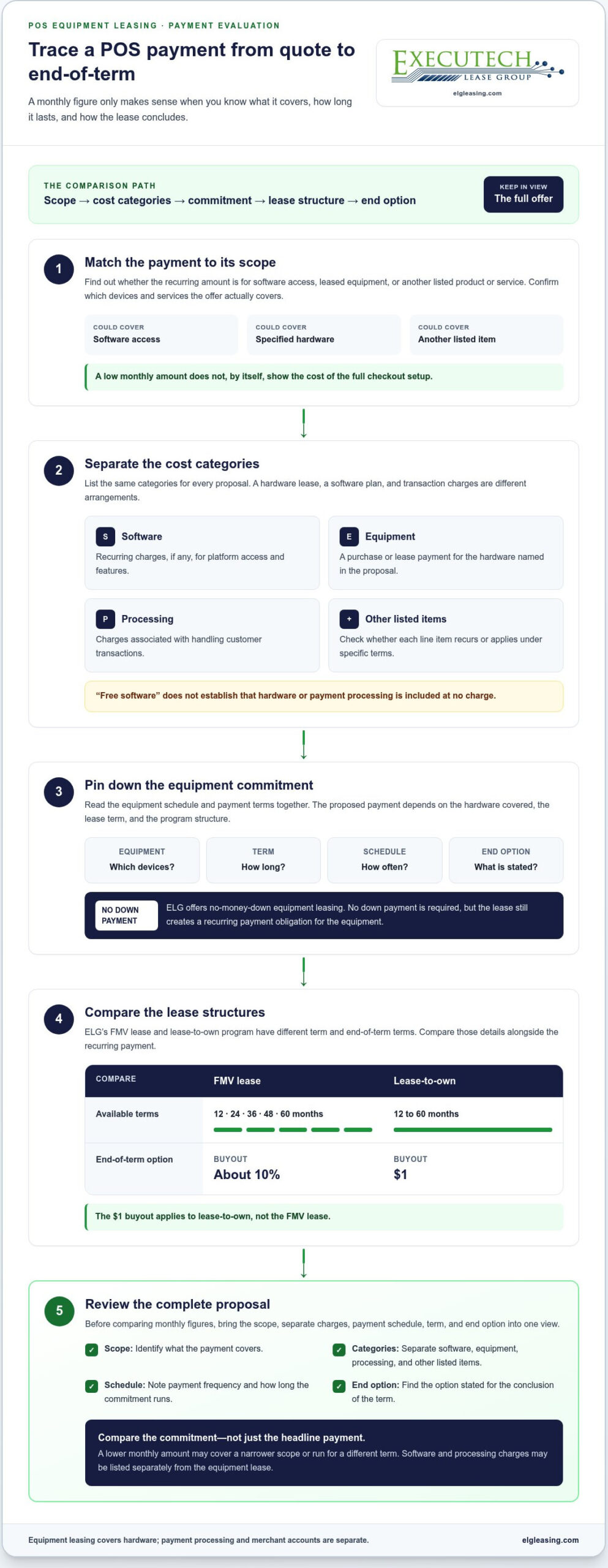
How to Evaluate a Low Monthly POS Proposal
A proposal is easier to assess when every commitment is visible in one place. Don’t start by ranking monthly figures. First map each payment to the equipment or service it covers, then record the term and end-of-term option. This makes it easier to compare the scope of each offer and spot details that may otherwise be spread across separate documents.
A practical sequence for comparing proposals
Use the same review sequence for each proposal. Record what the payment covers and how the commitment works, using the proposal’s own wording. This gives you a consistent basis for comparison without guessing at rates, fees, or costs that aren’t stated.
- Identify the equipment. Record each device or item explicitly included in the equipment proposal.
- Separate the services. Note whether software access, payment processing, or another service appears in a separate arrangement.
- Record the commitment. Write down the recurring payment, how often it is due, and the lease term exactly as stated.
- Capture the end option. Note the specific option that applies to that program. Don’t assume terms from one proposal apply to another.
- Compare scope and obligations. Review what each proposal covers and how long it commits your business, not just the monthly figure.
For context on different program structures, review ELG’s leasing programs alongside the options named in an equipment proposal.
Questions the proposal should answer clearly
A clear proposal should make the equipment, payment, term, and applicable end option easy to locate. It should also distinguish the equipment lease from software and transaction-processing arrangements. Use these questions to check that the key details are explicit:
- Which equipment does the recurring payment cover?
- What lease term and payment frequency does the proposal state?
- Which end-of-term option applies to this specific program?
- Which software or payment-processing arrangements sit outside the equipment lease?
If a proposal groups unlike items under one monthly amount, separate them in your comparison notes. List hardware payments apart from software access and processing charges rather than treating them as one interchangeable POS cost. If two offers cover different equipment or services, account for that difference before comparing them.
A low monthly payment POS proposal should make its scope and obligations understandable before you judge whether it fits your business. Review each item consistently, then weigh the complete commitment against your operating plan.
How ELG Supports POS Equipment Leasing Decisions
ELG is a U.S. equipment lease brokerage serving the payments-technology ecosystem. It works with merchant-services providers, agents, POS resellers, and vendor partners that support merchants evaluating equipment proposals. This partner model gives businesses a way to consider equipment lease options through the relationships already involved in their POS planning.
For merchants, the proposal is the practical point of comparison: identify the equipment and program terms, then review how they fit the business’s plans. For industry partners, the question is whether equipment leasing can complement the solutions they bring to their merchant customers.
ELG’s role in a POS equipment leasing arrangement
ELG’s equipment focus includes POS systems and credit-card terminals. Its brokerage role connects this equipment with leasing programs, while the merchant’s existing partners remain part of the broader technology and services relationship. Keeping those roles distinct helps merchants understand where an equipment proposal fits within their overall POS setup.
ELG provides credit decisions in 1-2 business hours. This refers to decision timing only. It doesn’t establish approval, funding, delivery, or installation timing. Merchants and partners can use the proposal details to understand the equipment commitment and coordinate it with their own planning.
A next step for vendors and payment-services partners
ISOs, agents, POS resellers, and vendor partners can discuss an ELG relationship if equipment leasing could complement their merchant-services offerings. Start with the types of equipment needs that arise in your merchant relationships and consider how a leasing resource could fit into your workflow.
Independent sales agents exploring this partner approach can consider how POS leasing fits into their merchant conversations. The Apply Now page provides an inquiry route for vendors and payment-services partners interested in discussing a relationship with ELG. It is a vendor inquiry, not a financing application or a way to generate a credit decision.
For vendors and payment-services partners interested in a relationship with ELG:
Build a POS Equipment Plan That Fits Your Next Move
Use your next equipment review to set a decision standard your team can apply again. Identify the checkout capabilities your business needs, decide how much room your operating plan allows for recurring commitments, and consider how future equipment changes could affect the setup. A low monthly payment POS arrangement is useful only if its structure supports the way your business operates, not just the way a proposal presents the payment.
For merchant-services providers, agents, resellers, and vendors, equipment leasing can also become part of a broader partner offering. A clear conversation about the merchants you serve and the equipment needs you encounter can help you assess whether an ELG relationship fits your business.
Make your next equipment decision with a clear view of the commitment and a plan built for what comes next.
Frequently Asked Questions
Does no-money-down POS leasing mean the equipment is free?
No. ELG offers no-money-down equipment leasing, which means no down payment is required at the start of the equipment lease. The lease still creates a financial obligation. Before accepting a proposal, match the recurring payment to the listed equipment and review how long payments continue. This distinguishes a lower upfront cash requirement from the cost and commitment of acquiring the hardware over the lease term.
Does a POS equipment lease include payment processing?
No. An equipment lease covers the hardware specified in its agreement; payment processing is a separate service for handling customer transactions. A business may have one arrangement for its terminal and another with a payment processor. Keep those obligations distinct when reviewing monthly statements or planning operating expenses, because the equipment lease doesn’t replace or define the terms of a processing arrangement.
How quickly does ELG provide a credit decision?
ELG provides credit decisions in 1-2 business hours. That timeframe refers to the decision only, not approval, funding, equipment delivery, or installation. If you’re coordinating a new POS setup, treat the decision as one part of the process and plan separately for other steps involved. The decision timing doesn’t establish when those steps will happen.
What is the difference between an FMV lease and lease-to-own?
ELG’s FMV lease offers terms of 12, 24, 36, 48, or 60 months and ends with about a 10% buyout. Its lease-to-own option has terms from 12 to 60 months and ends with a $1 buyout. These end options apply to their respective programs. Compare the term and applicable end option in the specific proposal rather than assuming one program’s terms apply to the other.
Can a free POS software plan still involve equipment payments?
Yes. A free software tier may cover access to the POS platform while the business obtains hardware separately through a purchase or lease. A business could use a software plan with no recurring software charge and still make recurring equipment payments under a hardware lease. This distinction is central to assessing a low monthly payment POS proposal: software pricing alone doesn’t describe the hardware arrangement.
Does ELG provide a merchant account with a POS equipment lease?
No. ELG provides equipment leasing and doesn’t supply merchant accounts or process payments. A merchant account and associated processing services are arranged separately from the hardware lease. Keep those roles clear when organizing a POS setup: ELG’s lease addresses the equipment commitment, while account and processing terms belong to the relevant service arrangement.
Can an ISV discuss SaaS funding with ELG now?
Yes. An independent software vendor (ISV) can engage with ELG now about its SaaS funding program. ELG is actively staging ISVs for the program, and interested software companies can begin a discussion about their business and potential partnership.

Article by
Robert Ensminger
Robert Ensminger is the founder and CEO of Executech Lease Group (ELG Leasing), which specializes in equipment leasing and financing solutions for the merchant-services, payments, POS, and FinTech industries. With more than 20 years of industry experience, Robert helps independent sales organizations, payment processors, POS providers, and software companies develop practical leasing, subscription, and SaaS-monetization programs. He founded ELG in 2010 and guided the company to recognition on the Inc. 5000. His work focuses on responsive service, transparent program structures, and helping ELG’s partners close more business while creating sustainable revenue.