What if “managed” describes the payment arrangement, not the software support you expect? Managed software leasing for POS can bring together financing, software access, and ongoing services, but those are separate commitments. The label alone won’t tell you what’s included.
To compare offers, identify who provides the software, who handles administration or support, and what happens when the agreement ends. Financing software doesn’t automatically mean someone manages it. For example, a payment schedule may cover eligible software costs while the software provider remains responsible for account access and technical support.
This 2026 buyer’s guide explains how to compare software financing with software management, assess program structures against your deployment needs, and identify terms to confirm before applying or presenting a program to merchants. You’ll also learn what to check when coordinating software financing with POS equipment or payment services, including whether they can be combined and which terms apply. Executech Lease Group provides financing for cloud-based SaaS POS software alongside POS and payment equipment leasing. Start by checking exactly what the agreement covers.
Key Takeaways
- Managed software leasing for POS can refer to different arrangements. Check the agreement to distinguish software access and financing from administration, updates, and support.
- Compare FMV, lease-to-own, and subscription-based options by their contract-specific payment terms, rights, and end-of-term obligations.
- Use a side-by-side comparison to identify who handles software access, support, updates, and POS hardware.
- Before applying, define deployment needs, map responsibilities, review terms, and confirm program eligibility.
- Explore whether ELG’s cloud-based SaaS POS software financing and equipment leasing fit your needs, then confirm eligible costs, combined-program options, and applicable terms.
What Managed Software Leasing for POS Should Actually Include
Managed software leasing for POS can involve three distinct things: financing, which sets out how eligible costs are paid; software access, which gives a business permission to use a POS platform; and software management, which may cover operational tasks such as setup or support. One agreement may address some or all of them. The word “managed” alone doesn’t establish the scope.
“Managed POS software leasing is a payment arrangement for POS software that may also define who handles related services, with the written agreement setting the actual scope.” Treat this as a practical description, not a standard legal category. Before signing, list each service you expect and identify the party responsible for it. Confirm those responsibilities in writing.
How POS software leasing differs from software management
Financing structures payments. It doesn’t automatically include account administration, technical support, or troubleshooting. Access to cloud-based software also isn’t the same as owning the software. A SaaS arrangement generally concerns access to a hosted service, and the software terms should explain the access rights and conditions.
Ask who sets up the account, creates and manages user access, handles updates, and troubleshoots problems. The software provider, a payment-industry partner, your own staff, or another party may handle these tasks. Don’t assume the financing provider does them. If support is important to your operation, confirm how to contact the responsible provider and what the agreement says about that support.
Which POS software and equipment might be involved?
A POS setup can include software and devices used to complete transactions. A proposal might cover cloud POS software, payment terminals, or other POS equipment, but the combination varies. Check each item against the agreement rather than relying on a package name.
Separate software charges from hardware costs in the proposal. Check whether software access, equipment, implementation, support, and updates are listed as distinct items, and note who provides each one. A package doesn’t necessarily include integrations, training, or service. If a provider says an item is included, ask where that appears in the written terms.
- Software access: Which platform, users, or locations are covered?
- Equipment: Are payment terminals or other POS devices part of the arrangement?
- Implementation: Who handles setup, if anyone?
- Support and updates: Who provides them, and what does the agreement specify?
- Payments: Which charges relate to software, and which relate to equipment?
Executech Lease Group provides financing for cloud-based SaaS POS software as well as POS and payment equipment leasing. That financing doesn’t, by itself, confirm that software administration, implementation, maintenance, or support is included. Review the applicable SaaS software program details and confirm eligible costs and terms for the specific arrangement.
How POS Software Leasing Programs and Payment Structures Work
Program names suggest a general payment structure, not a complete set of terms. The agreement determines what’s financed, what you can use, how payments are scheduled, and what choices or obligations apply at the end. Assess managed software leasing for POS by those written details, not by the label alone.
Scheduled payments can make expenses easier to plan for, but they don’t guarantee savings, approval, or a particular total cost. Compare the full payment schedule and contract obligations with your deployment plan. Executech Lease Group offers equipment lease terms of 12-60 months; don’t assume those terms apply to software financing. Confirm software program eligibility and available terms separately.
What to compare across FMV, lease-to-own, and subscription options
Executech Lease Group offers FMV, lease-to-own, and subscription-based options. These are distinct program categories, and the name alone doesn’t establish the rights or end-of-term choices in a specific agreement. Compare the details side by side:
- Payment structure: How are payments scheduled, and which software or equipment items do they cover?
- Use rights: What software access or equipment use does the agreement provide, and for how long?
- End-of-term choices: For an FMV or lease-to-own option, what choices or obligations are written into the contract?
- Renewal conditions: Does the agreement describe renewal, continuation, or notice requirements?
Don’t assume an FMV or lease-to-own structure applies to every software program. Ask whether software access continues if you change hardware or payment services, and whether separate provider terms affect access. For an overview of cloud-based SaaS POS financing programs, review the program information, then confirm eligible costs, contract type, and terms for your proposal.
How to assess software and equipment in one deployment
A single POS deployment may involve the merchant, software provider, payment provider, and financing partner. Each can have a different role. Clarify who supplies software access, who provides terminals or other equipment, who bills each item, and who handles service responsibilities. A coordinated deployment doesn’t necessarily mean one agreement or one bill.
Before presenting or accepting an offer, confirm whether software and POS hardware require separate agreements or can be coordinated. Get eligible items, term, billing schedule, and end-of-term process in writing. To review the next step, see the application information, then verify the applicable program details before proceeding.
Managed POS Software Leasing vs. Separate Financing: What to Compare
Financing POS software doesn’t prove that software management is included. A payment agreement can cover eligible costs while the software provider or another party handles account access, support, and updates. Compare responsibilities alongside payment terms. A software-focused agreement and separate software and equipment arrangements can each suit a deployment, depending on how their terms fit together.
Use this comparison to see what the proposal confirms and what still needs an answer:
| Item | Software-focused agreement | Separate arrangements |
|---|---|---|
| Software access | Check which software costs or access rights are covered. | Confirm the software provider’s separate access terms. |
| Payment arrangement | Verify the eligible costs included in the scheduled payment. | Review each agreement’s payment schedule and billing party. |
| Support | Identify whether support is included and who provides it. | Confirm the software provider’s support terms separately. |
| Updates | Check whether updates are addressed and who is responsible. | Verify update responsibilities in the software terms. |
| Hardware | Confirm whether POS equipment is included or excluded. | Review equipment terms separately from software terms. |
Neither structure is automatically better. A software-focused arrangement may group specified eligible costs, while separate agreements can make each provider’s role easier to identify. In either case, check that the documents align on billing, responsibilities, and what happens if one part of the deployment changes.
What does the monthly payment cover?
Match every proposed payment to the items it covers. Ask whether it applies to software access, equipment, or only specified eligible costs. Check the proposal for taxes, setup charges, integrations, and additional service fees instead of assuming they’re included. For broader context on cloud software financing, consult the article’s Cloud-Based POS Financing guide.
Who handles access, support, updates, and contract changes?
Record which provider administers accounts and user permissions. Confirm support channels, update responsibilities, renewal terms, and cancellation conditions. Ask what happens to software access if you replace hardware or change payment providers. Managed software leasing for POS should make these responsibilities clear rather than leave them to assumption.
Before signing, confirm in writing what the payment covers, who provides access and support, how updates and changes are handled, and what renewal or cancellation terms apply.
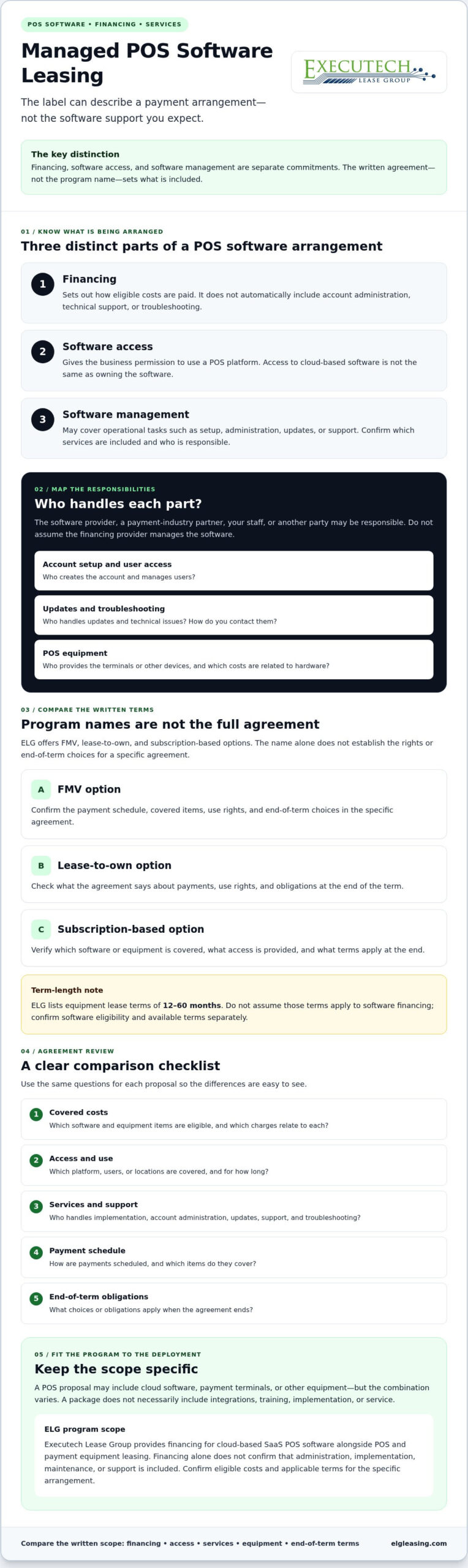
A POS Software Leasing Checklist for Merchants and Payment Partners
Work through these checks in order. They clarify what the deployment needs, who is responsible for each task, and whether the proposed program fits before anyone applies or presents terms. Managed software leasing for POS is easier to assess when software, equipment, and support roles are clear from the start.
- Define deployment needs. List the POS capabilities, users, locations, and payment workflows the business requires. Identify whether the plan involves cloud software, terminals, or other POS equipment.
- Map responsibilities. Name the software provider, payment provider, equipment supplier, and financing partner. Confirm who handles software access, setup, support, updates, and billing.
- Compare the terms. Review covered costs, payment schedules, agreement length, renewal conditions, and end-of-term options. Keep software and equipment terms distinct if they appear in separate agreements.
- Verify eligibility and process. Ask which merchant profiles and software costs may qualify, what information an application requires, and what steps follow submission. Confirm details for the specific program.
- Apply or present the offer. Proceed once the scope, responsibilities, and terms are clear enough to explain accurately. Use the POS leasing application process to understand the general process, then verify requirements that apply to the particular program.
Questions merchants should resolve before choosing a program
Start with the operating plan. Which POS capabilities are essential? How many users and locations need access? Which payment workflows must the system support? Identify the software provider and confirm its subscription, access, and support terms directly. Then check whether the payment schedule and end-of-term conditions fit the expected use of the system. If software and equipment have different agreements, review each one separately.
Questions ISOs and payment processors should ask
Before discussing an offer with a merchant, confirm which customer profiles and software costs fit the available program. Establish who explains financing terms and who answers questions about software access or technical support. Verify application documents, decision steps, and partner responsibilities rather than implying approval or service coverage. Also consider how the program fits your sales workflow and merchant support model. Clear handoffs help keep financing questions separate from software and payment-service questions.
For ELG programs, confirm eligibility and terms for the specific software arrangement. Cloud-based SaaS POS software financing and equipment leasing are available offerings, but the program details determine what may be included.
When ELG’s POS Software Leasing Programs May Fit, and How to Apply
Executech Lease Group works with merchants through merchant services providers, ISOs, and payment processors. Its programs may be worth exploring if you’re considering financing for cloud-based SaaS POS software, a subscription-based structure, or POS and payment equipment leasing. Managed software leasing for POS shouldn’t be taken to mean ELG administers software or provides technical support. Confirm what the financing covers and who handles software operations.
ELG offers FMV and lease-to-own options, as well as subscription-based programs. These are program categories, not a promise that every structure applies to every software or equipment need. Review the subscription-based leasing programs and verify eligibility, terms, and included costs for the specific proposal. If you need direct payment processing, discuss that service with an appropriate provider. ELG doesn’t sell payment processing services.
How to assess fit with ELG’s financing programs
First, identify the need: cloud software financing, a subscription structure, POS equipment, or a potential combination. Ask ELG which costs and contract types may qualify, what terms apply, and whether software and equipment can be coordinated. Confirm the agreement’s scope in writing. Financing arrangements don’t establish who supplies software, manages accounts, or provides support.
What to have ready before applying
Prepare your business and provider details, software information, equipment needs, and the program structure you want to discuss. Be ready to describe the deployment and distinguish software costs from equipment requirements. Then use ELG’s application process to confirm what information is required and what steps follow. Requirements can depend on the program, so verify them rather than assuming.
Keep expectations precise. Applying doesn’t guarantee approval, program availability, or specific terms. Confirm those details for your circumstances before making commitments or presenting a program to a merchant. Payment-industry partners should also clarify their role in explaining financing and direct software or technical questions to the responsible provider.
Choose a POS Program With Clear Terms
Managed software leasing for POS is easier to evaluate when you separate the payment structure from software access and ongoing management. Confirm who provides the software, what costs the agreement covers, and who handles support, updates, and account administration. Then compare payment and end-of-term terms with your deployment needs.
Executech Lease Group finances cloud-based SaaS POS software and serves merchants through merchant services providers, ISOs, and payment processors. Its confirmed program options include FMV, lease-to-own, and subscription-based arrangements. Eligibility, applicable terms, and included costs need to be confirmed for the specific application. Financing does not, by itself, establish that software management services are included.
Before moving ahead, gather your software and equipment details, clarify provider responsibilities, and review the written terms. A well-defined proposal gives you a stronger basis for deciding whether the program fits your business or merchant workflow.
To discuss a POS software financing program, review the application information and confirm the requirements for your proposed arrangement.
Frequently Asked Questions
What is managed software leasing for POS?
Managed software leasing for POS is a financing or payment arrangement for POS software that may also specify related services, but “managed” alone doesn’t define what’s included. Software access, financing, and administration are separate considerations. Check the written agreement for covered costs, who provides access, and who handles setup, updates, or support. Executech Lease Group finances cloud-based SaaS POS software; that financing doesn’t itself confirm software management services.
Does POS software leasing include support and software updates?
Not automatically. Support and updates are included only if the applicable agreement or software terms say so. Before signing, identify the software provider and ask who handles account access, updates, troubleshooting, and technical support. Confirm how to request help and whether any related service has separate terms or charges. A financing agreement may cover eligible software costs without making the financing provider responsible for administering or supporting the software.
Can you lease POS software without leasing the hardware?
Possibly, but availability depends on the program and the software costs that qualify. A software-focused arrangement may be separate from POS equipment leasing, but don’t assume a particular provider offers every configuration. Ask whether the software can be financed on its own, what costs are eligible, and whether a hardware change affects access. ELG finances cloud-based SaaS POS software and offers POS equipment leasing; confirm the specific program terms.
What should a POS software leasing agreement include?
Look for a clear description of covered software costs, access rights, payment schedule, contract term, billing responsibilities, and any included equipment. The agreement or related software terms should also clarify who handles setup, account administration, support, and updates. Review renewal, cancellation, and end-of-term conditions, plus any charges identified in the proposal. If different providers supply the software, equipment, or financing, confirm each party’s role in writing.
Is a POS software lease the same as a SaaS subscription?
No. A SaaS subscription generally describes access to cloud-based software under the software provider’s subscription terms. A software lease or financing program describes how eligible costs are paid. These arrangements may relate to the same POS deployment, but they aren’t interchangeable terms. Read both sets of documents to understand software access, payment obligations, renewal conditions, and responsibilities. Confirm whether the financing arrangement covers subscription costs and what happens if the subscription changes.
Can POS software and equipment be financed together?
Some programs may coordinate software and equipment, but don’t assume they can be combined in one agreement or payment. Confirm which software and hardware costs qualify, whether separate agreements apply, who bills each item, and whether the terms align. Executech Lease Group offers financing for cloud-based SaaS POS software alongside POS and payment equipment leasing. Ask ELG whether your specific software and equipment needs can be coordinated and what terms apply.
How do I apply for POS software leasing through ELG?
Start through a merchant services provider, ISO, or payment processor, the channels through which ELG serves merchants. Prepare your business and provider details, software information, equipment needs, and preferred program structure. Then apply to discuss a POS software financing program and confirm required information and next steps. Eligibility, approval, available programs, included costs, and terms depend on the specific application and require confirmation.

Article by
Robert Ensminger
Robert Ensminger is the founder and CEO of Executech Lease Group (ELG Leasing), which specializes in equipment leasing and financing solutions for the merchant-services, payments, POS, and FinTech industries. With more than 20 years of industry experience, Robert helps independent sales organizations, payment processors, POS providers, and software companies develop practical leasing, subscription, and SaaS-monetization programs. He founded ELG in 2010 and guided the company to recognition on the Inc. 5000. His work focuses on responsive service, transparent program structures, and helping ELG’s partners close more business while creating sustainable revenue.